Meet the new Bond…

… same as old Bond.

I have to admit this up front: I’m not a big fan of James Bond or the series of films he features in. I liked Casino Royale a lot, but even apparent series classic Goldeneye didn’t do anything for me, and while I could tolerate the Sean Connery films I wouldn’t want to sit through Roger Moore’s panto-style movies ever again.

Skyfall is both a call-back to old-school Bond and a deconstruction of the films and the character. In terms of both form and theme, it’s the most ambitious film in the series. At the end, as the credits were rolling, I was exhilarated and excited – yet I’m not sure I’m looking forward to what the Broccoli Gang will come up with next. For, see, Skyfall ends at a point where we could very easily segue into Dr No. Craig’s Bond at the film’s close is Connery’s original Bond, for all intents and purposes, complete with a male M and trusty Moneypenny.

Regardless of this, I come to praise Bond, not to bury him. After a boring, confused Quantum of Solace that barely works as a companion piece to Casino Royale – and that even then doesn’t add much to its predecessor – Sam Mendes has a much better handle on… well, everything. I haven’t yet seen a Mark Foster film that has convinced me the man deserves the praise he’s received, and he was most definitely the wrong man for Bond. Mendes hasn’t really done any action films, the closest being Road to Perdition, but he knows how to stage scenes effectively – and he knows how to pick his collaborators, with Roger Deakins turning in the most gorgeous film in the series yet. His aesthetic sensibilities complement Mendes’ directorial eye well, especially in a fight silhouetted against Blade Runner-esque Shanghai facades and in the Macao scenes. (Also, is it just me or is Mendes more overtly theatrical, though effectively so, in this than in any of his previous films?)

Skyfall

There’s more to like about Skyfall: the phantasmagoric-to-the-point-of-becoming-apocalyptic intro sequence (I didn’t like Adele’s song all that much until I saw it matched to the intro visuals), Craig’s co-stars (let me single out Javier Bardem who succeeds at being camp and chilling, gentle and deranged), a smart, witty script that doesn’t shy away from pathos when it is called for. It’s the first Bond film I’ve seen at the cinema that I wanted to see again as soon as the credits rolled, and it’s the second that has made me emotionally invested. Yet there remains that niggling feeling that Skyfall succeeds all too well at making everything that’s interesting about it superfluous for the next film in the franchise. Bond mentions at some point during the film that his hobby is resurrection – let’s hope that what this film has resurrected isn’t one of the undead, a revenant of the Bonds of old and nothing more.

P.S.: Ben Whishaw’s Q, while not much more substantial than a cameo, was much appreciated, as were Naomie Harris, Ralph Fiennes and Albert Finney.
Christmas Variety Pack – of one!

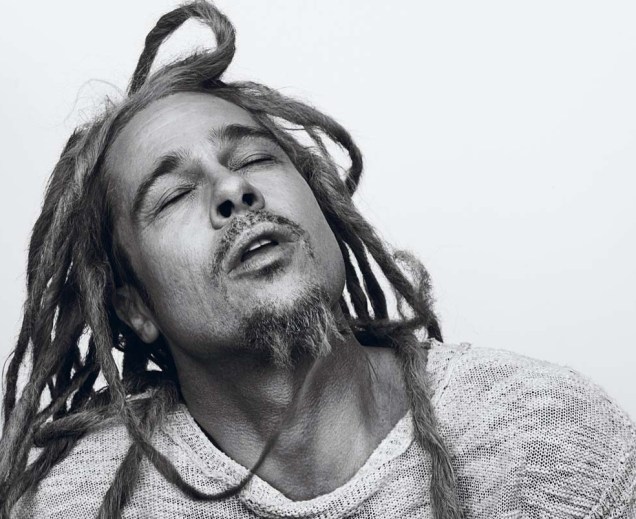
I’ve managed to catch a few films at the cinema in the last few weeks and I wanted to get them off my plate before a big steaming turkey landed on said plate… or something to that effect. Possibly something less ewwy. However, since WordPress just played a naughty pre-Christmas trick on me, gobbling up what I’d written for the second and third item, here’s a shorter variety pack, featuring the silliest picture of Brad Pitt in a long, long time.

Killing Them Softly

For anyone who’s forgotten one of the zillion times I’ve mentioned it, Andrew Dominik’s The Assassination of Jesse James by the Coward Robert Ford may just be my favourite film of the last ten years. I was accordingly excited when I heard that its director and star were getting back together for a darkly comic gangster flick, and the trailer looked intriguing – as well as pushing several of my movie- and TV-loving buttons. James “Tony Soprano” Gandolfini? Richard “Late Nate” Jenkins? Henry Motherfucking Hill himself, Ray Liotta? Count me in!

Talk about killing a film, not softly, but with unrealistic expectations. I loved The Assassination… for its sure-handed direction and for Pitt’s performance (although it’s Casey Affleck and Sam Rockwell who were the biggest revelations), but also for its elegiac tone, its hauntingly beautiful images, the writing largely taken from the original novel. Killing Them Softly may have been directed by the same man and shares the star of Dominik’s earlier film, but it is entirely different in tone and setting. It’s grimy, and it rarely evokes any emotions for its characters other than sarcastic pity. They’re a largely pathetic gang of losers, and Pitt’s pragmatic blue-collar hitman is the best of a sorry bunch. Which is exactly what the script requires and what Dominik goes for, and he’s very effective at this – but I wasn’t exactly engaged by all of this. Several Sopranos alumni turning up didn’t exactly help, replacing one set of expectations (something that would pull me in as much, and in similar ways, as The Assassination… had) with another (will this ever crawl out of the shadows of The Sopranos?).

Maybe someone should tell him that Bob Marley was black?

Is Killing Them Softly a good film? I didn’t mind watching it, even while my expectations deflated like a sad seaside toy punctured by an urchin. Does it do anything special or new? Not particularly. There’s a sustained political subtext, a commentary on today’s America that, at least in my opinion, doesn’t work and comes across as fairly facile. There is a beautifully tense robbery scene, and the mis-en-scène is generally interesting – but damned if I know what, if anything, Killing Them Softly adds up to. Perhaps that’s the jaded, cynical point.

And that’s it for now. Tune in soon for my thoughts on Argo and Skyfall – and in the meantime, happy holidays, one and all!

Just don’t mention Auntie’s MPD!

In its many years of service, the Beeb has done some terrific drama. The Singing Detective, Edge of Darkness, Pride and Prejudice, or, going back to the ’70s, I, Claudius. Its recent output has been all over the place, but I enjoyed last year’s Page Eight and The Hour (in spite of some flaws).

The second season of The Hour finished a couple of days ago. The series kept some of its problems, mainly the uneven quality of the writing, with some scenes very effective and others rushing headlong into hamfisted melodrama, clumsy exposition or silly cliché. Nevertheless, it was a definite improvement on the first series – exciting, engaging, and every scene with Peter Capaldi and Anna Chancellor a revelation. Come Awards season, if Auntie doesn’t pat itself on the shoulder for putting those two on a sound stage together and letting them show what they’re capable of, I hope that Malcolm Tucker unleashes hell on the people responsible.

One of these you don't want to be stuck in an elevator with...

So, that’s BBC at its… well, perhaps not best, but definitely good. If this is the standard of British television drama, I think Britain could do a whole lot worse.

Cue Hunted.

It’s easy to see what they were going for: an entertaining, fast-paced yet moody spy thriller set in a world of shifting allegiances and moral ambiguities. What they got was one of the most half-baked, clichéd TV shows I’ve seen in a long while. Laughably bad writing – the premise should have been a warning, with the main character, Sam Hunter, becoming (dun dun DUN!) the hunted! The aesthetics were all early 2000s gone HD, but the plot and characterisation were on par with your average ’80s series, except this didn’t even have the giddy sense of fun that some of those shows had.

And this may reveal me as sorely lacking in testosterone, but I’d rather watch Peter Capaldi go OCD on his desk for an hour (pun only semi-intended) than Melissa George trying to infuse her undercooked character with personality by bringing out her most potent duck-faced pout ever. I’ve seen George do much better work with stronger material, but her Sam Hunter is insipid, as are most of the characters, whether they’re played by veteran actors or not. Someone should have told the makers of Hunted that conflicted doesn’t equal dour, dour doesn’t equal glum, and glum doesn’t equal moodily bored.

In the end it’s a race: what does the series in? The one-dimensional characters? The charmless acting? The glossy yet drab visuals? The writing that’s either done by idiots, for idiots or both? The final episode that provides less resolution than an episode of Eastenders? Or the BBC, deciding that Frank Spotnitz would have a better chance taking his pet project somewhere else?

Just pucker up your lips, 'cause this blows...

Love in the unconditional

Michael Haneke is what I would call the anti-Spielberg. He is a director who consistently avoids even a trace of sentimentalism or pathos. Based on the Haneke films I’ve seen, his goal is primarily to make people think – and when he wants to make them feel, he never dictates the specific feelings they should experience. Haneke’s work has been described as cool, distant, even clinical.

Amour

His most recent film Amour, winner of the Cannes Palme d’Or, doesn’t exactly break with this tradition; the film maker’s style, both in terms of his direction and his writing, is still very much in evidence. Nevertheless, I’ve found Amour one of the most affecting, profoundly emotional films, definitely of the year and possibly of the century so far. It is brutal and raw as much as it is tender and loving, and it is perhaps one of the best cinematic examinations of what it is like to watch a loved one die.

The immediate praise must certainly go to his duo of actors, Jean-Louis Trintignant and Emmanuelle Riva, both of whom don’t show a trace of obvious acting: they simply are the characters on screen. It is impossible to say which one is more impressive; while Trintignant captures the anguish, frustration and fear of a husband who can only be there for his dying wife but not help her (except in one way, ultimately), Riva is uncannily convincing as the wife who, after first one stroke and then another, slowly crumbles away and fades into the darkness like a latterday Eurydice. They occasionally share the screen with other characters, primarily the high-strung daughter played by Isabelle Huppert, but the film is entirely theirs.

Amour

For me, it was impossible to watch the film and not be reminded of my mother’s death three years ago. I’ve talked to others who found it brought back the death of their loved ones: parents, grandparents. Yet while Amour captures something that seems universal about death and bereavement, at least in our culture and society, it is at the same time entirely specific to these characters. It does not go for vague, and essentially rather cheapening, generalisations along the lines of “Aren’t we all…” and “Don’t we all…”. And differently from some of Haneke’s earlier works, it never feels didactic or cruel. Its unflinching eye on the process of dying is hard to take at times, but it’s this commitment to the act of bearing witness that is finally tender and beautiful.