The Limits of Detection

This blog entry is partly a reply to Emily Nussbaum’s article Cool Story, Bro. The Shallow Deep Talk on True Detective, which appeared in the New Yorker on March 3, 2014. That artice can be found here: http://nyr.kr/1eosEyD
truedetective_010914_1600

I would really, really like to see a series that takes stuff from the film noir genre – the lies, the sex, the crimes, the shadows – and then casts two female detectives in the lead roles. It could be written and directed by women so we are spared the male gaze. That would be a new thing. If it already exists, then I don’t know about it. Maybe the second season of True Detective will bring us something like that. Jessica Chastain’s name is attached to the project, and I personally could see Michelle Forbes as the other lead.

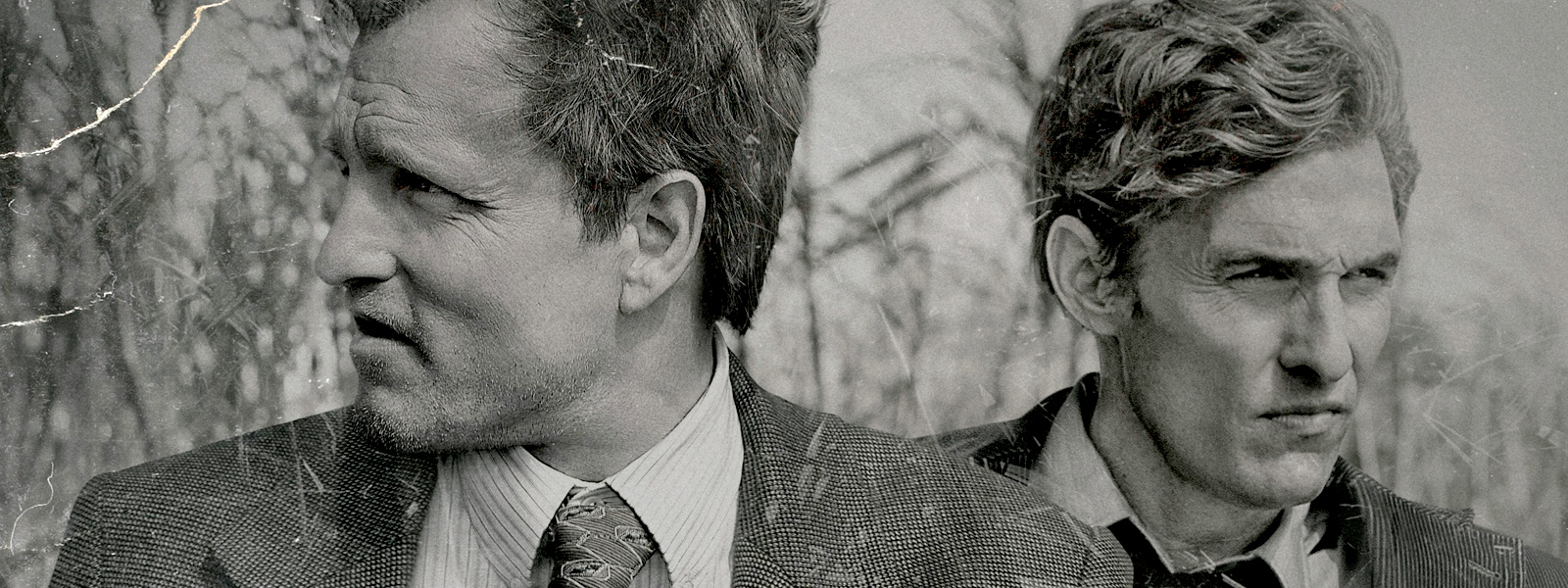
Meanwhile, we have the first season of True Detective to watch. To me, TD is not a police procedural or a whodunit, but a character study of Marty Hart (Woody Harrelson) and Rust Cohle (Matthew MacConaughey), two guys who might cross the street or the state line to avoid each other in everyday life. It took me half the series to see that it is not about the Yellow King or Carcosa, but about their relationship. If anyone keeps watching it as a whodunit, prepare for disappointment: the last episode is by far the weakest one. I restarted the series and watched all of it as the study of two very different guys. And while it won’t ever pass the Bechdel test, it worked very well. It’s certainly flawed , but there are only a couple of other series I liked better these last few months.
images

I disagree with Nussbaum’s label of the series as macho nonsense. Marty Hart has a strong tendency to rule over his family and often tells women what’s what. While that is certainly macho, he is also a horrible liar and a pathetic adulterer. He is weak, but instead of accepting his weakness, he pleads with his wife for more credibility, and as soon as he has it, he delves into that self-styled schizophrenia that lets him believe that if he lets off steam with some anonymous pussy, he can be much more caring and loving at home. For Marty, sublimation won’t work for much longer. His wife sees through him every time. To be clear: It’s the character that has macho tendencies, not the series.

Rust Cohle, on the other hand, is nowhere near a macho. He uses work as self-harm, and may be very close to do some real harm to himself. There is that nihilistic stuff he mutters forth, and these monologues are actually the highlight of the series for me. Unlike Marty, he does not have any defense mechanism. He knows exactly what is wrong with him, but he cannot climb out of his black hole, and so he blames the whole world. Those monologues are sometimes wafer-thin, but they often need to be. Can there be any grand-standing, any redeeming speech from a guy who could jump from a bridge at any moment? Rust doesn’t have to make sense because he doesn’t have to make sense to himself, either. It is to his credit that sometimes, he really does make sense, which renders his existence that much worse. With that guy, the wiring shows. As with Marty, life does not go on for much longer like this.

Rusty can come across as an arrogant asshole by the time Gilbough and Papania come around asking questions. That could be interpreted as macho, but to me, it is all self-protection. Rust the nihilist is still in there somewhere, preserved in a barrel of cheap beer.

reggieledoux

Yes, the victims in True Detective are all female. But they all die off-screen, and there is very little violence going on in real time. Compare that to The Fall, and then tell me that the latter series does not make you cringe for all the stuff done to women. (I can’t shake the impression that Helen Mirren referred to The Fall when she criticised the fact that most victims in film and TV these days are girls and women.) The Fall shows you women alive and well, then being assaulted, bound, gagged, raped, dying, dead, and disposed of. Repeatedly. And all is made well by that one phone call between that brilliant female police detective and the male killer in the very last minute of the last episode? Does Nussbaum really think that this is any consolation for those people in the audience who cannot take the immediate violence of the episodes before that last scene?

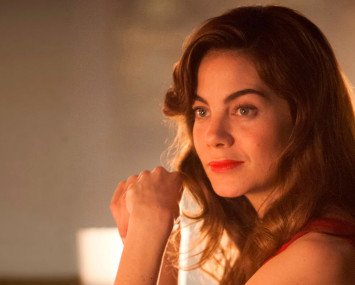
The women of True Detective are not paper-thin. It is true, however, that the most prominent woman, Maggie Hart (Michelle Monaghan) could be much better written, and given more of an active role to play. What I don’t get is that Nussbaum can say that the betrayal of Maggie sleeping with Rust has no weight. Rust is thrown off balance, while Maggie sees it as the mistake it is, but not entirely. There is something new about her afterwards, something empowering. Maybe it is not so much the sex, but the fact that she has slept with him, not him with her.
Michelle-Monaghan-True-Detective-Portable-355x285

The other women are far from thin, too. Marty’s fling Lisa (Alexandra Daddario) could bring down his marriage and his job with just two anonymous phone calls. For a long time, I thought that something like that has happened to Marty in the missing years. Lisa has legal training, so she is one of the best educated characters in the show. And those memorable scenes with Tess Harper? Ann Dowd? Come on. While the men are still trying to figure out stuff, the women already seem to know something.

What I don’t get is that Nussbaum can describe a series initially as stylish and complex and let some sort of reluctant admiration shine through, and then makes a U-turn and uses the rest of the article for telling us how it’s full of macho nonsense and that it’s really the female asses and the nice bouncy racks telling the real story. The whole season contains maybe four or five nude scenes, and brief ones at that. That may not even be average. So what is it going to be – deplorable macho nonsense or likeable lady parts? You can’t have both.
Arthouse oinks

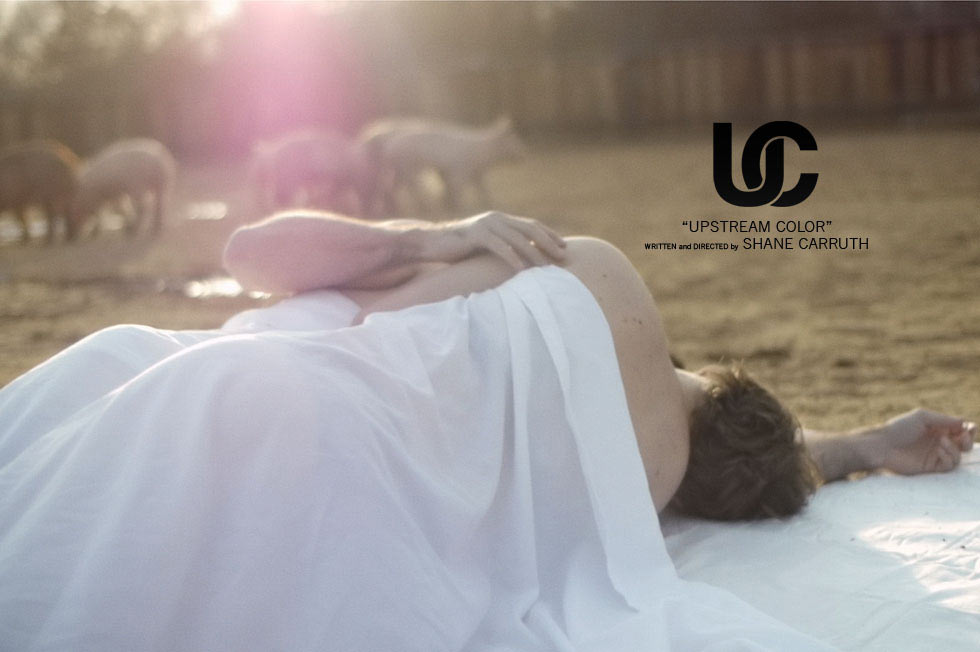
I was expecting to like Upstream Color. I like cerebral sci-fi with an emotional core, I like elliptic storytelling and filmmaking, I love the film’s look and atmosphere.

Yet I came away from the film, Shane Carruth’s follow-up to his headscratcher Primer, feeling sort of aggravated. I didn’t hate Upstream Color, but seeing how critics loved it I couldn’t help feeling underwhelmed. Carruth is a skilled craftsman, he appears to have his very own vision of what he wants to do with the medium, and that’s something I respect. However, I don’t think that Upstream Color is as smart – or as affecting – as it sets out to be, and that’s because to my mind the pieces don’t really fit together very well.

uc_2

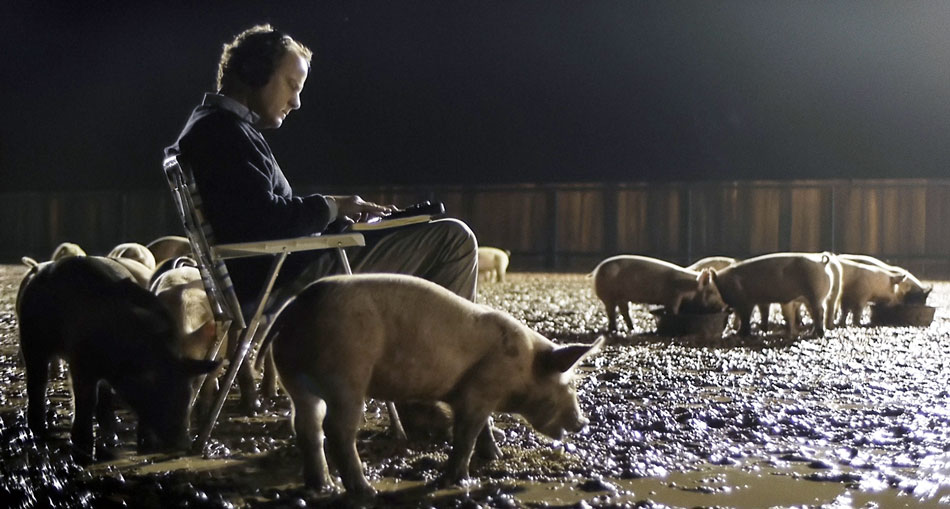
The story is weird and complicated to follow but not as complex as it might appear at first: there are these grubs that seem to allow for some sort of mental synchronisation between people. An identity thief uses these grubs to steal people’s identities and brainwash them into transferring their entire wealth to him, after which he leaves them unaware of what exactly has happened. Meanwhile, another man (called the Sampler in the film’s credits) finds the people who have been grubbed thus, extracts the parasites from the Thief’s victims and puts them in pigs, which allows them to mentally tune into the people the grubs originally came from, seeing, hearing and feeling what they are experiencing. So far, so huh. One of the Thief’s victims, a woman called Kris, loses her job and emotional stability after having been abducted and ruined by his machinations. A man named Jeff (played by Carruth himself) finds himself attracted to Kris and starts pursuing her romantically; it turns out that he’s also been grubbed and that the two of them are somehow in sync, to the extent that they cannot keep their thoughts and memories separate.

There is more that happens, involving porcine pregnancies, blue flowers and Inception-style murder, but the bulk of the film is about Kris and Jeff’s relationship. The sci-fi angle could skew this in intriguing ways, but my main problem with Upstream Color is this: the two stories (grubs, identity theft and telepathy vs. relationships, blurring boundaries and questions of identity) don’t end up working well with each other. Some ideas are either underdeveloped or appear arbitrary: why can the Thief use the grubs to program his victims, in effect hypnotising them like a cheesy silent movie villain? Yes, we see identities blur and thoughts and feelings wander from one being to the next, but that’s because the grub link has been established. The Thief’s powers seem something entirely different. Similarly, the film pulls a plot element out of thin air: Kris is suddenly revealed to be unable to have children, which her doctors attribute to cancer, though which may be due to the worms – whichever it is, the film doesn’t care to make this particularly coherent.

Upstream Color

As viewers, we’re asked to fill in many blanks. That’s fine, but filling in the blanks should add to a better understanding or stronger engagement in the film. Instead, here it feels like busywork: plugging the gaps in a story that, at least in the form it takes on screen, is underdeveloped. Individual elements are interesting, but they pull the film into different directions, and other parts of Upstream Color seem too designed to come across as meaningful – when, to my mind, meaning isn’t something that should be signalled and symbols rarely work best when they’re overtly insisted on.

The script has potential, and Carruth is a highly skilled filmmaker. In this case, though, it feels like he was too much in love with his ideas. The Sampler and his farm of telepathic pigs could be intriguing, but it distracts from the rest of the story. When Kris ends up enacting revenge against him, although the person who ruined her life was the Thief, it doesn’t resonate, it doesn’t read as dramatic irony: instead, it comes across as, again, arbitrary. Given a rewrite, Upstream Color could have been a film I like or even love – instead, I can’t help but see it as too much of a disappointing mess.

And, for a film that makes it harder for the viewer to follow than is justified by what it seems to be aiming at, it’s probably par for the course that there are no subtitle options whatsoever. I guess that deep meaning is most effectively conveyed by unsubtitled actors mumbling and muttering their dialogues.

Mother knows best, but not everything

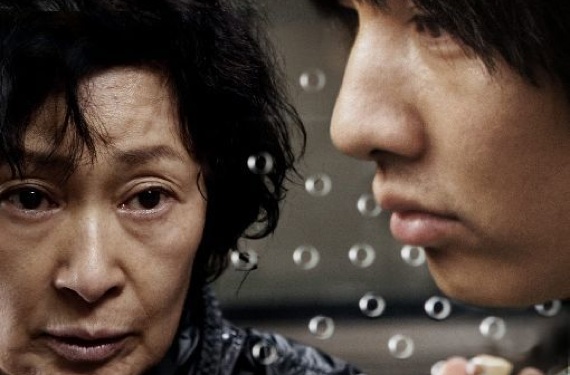
Joon-ho Bong’s Mother is a twofer. It’s inconsistent in tone and theme and wants to rush through a lot of plot in a short time. It contains scenes that are unclear and lead nowhere even on a second viewing. It seems to tell two stories at once, but never really manages to convince its audience that they should be in the same film.mother

The crucial story driving the plot is a murder whodunit. There is a teenage son who drinks half the night and then staggers back home at night. Suddenly there’s a young girl walking in front of him. He calls out to her, but she disappears into a dark, empty house. The son can’t figure out if she was really there and has all but forgotten about her in the morning. Then she turns up dead on the flat roof of the house she disappeared in. He is a suspect because, well, he’s been seen with the victim near the house.

The other story is his mother who is determined to do everything in her power to prove that her son is innocent. It doesn’t help that the boy is naïve, bordering on mental deficiency. Why else would he grin like a fool while he demonstrates to the police how he carried the girl up onto the roof? But I digress – it’s the mother who plays the biggest part in the film. She raises money for a lawyer who turns out to be useless. On a hunch, she goes to get evidence at the house of her son’s best friend, whom she considers bad company, and to her own surprise really finds a golf club with a blood smear on it. It’s bad luck that the friend comes home with his girlfriend, and so the mother hides behind the curtains, golf club in hand, while the couple is budy shagging. That scene is close to comedy, while the girl’s murder (which happens off-screen) is a scary bit of atmospheric horror.

best00madeo

There is a beautiful scene where the mother walks through a field of tall pale grass and then does a little dance. It’s a throwaway scene, and I am not sure what it means, but it pays homage to the actress, to Hie-ya Kim, who is said to be one of the most famous stage actresses in South Korea.

I think the scenes with the zealous mother work well, but are uneven – they venture from pathos to horror to farce and back. She is not an avenging angel, but cares for her only child because she is convinced that he is innocent. As a character study, the movie is admirable. The whodunit is less successful because there seem to be two or even three ways the crime could have been committed. I am not at all against open endings, but three possibilities seem a bit much for a movie that is plot-heavy and contains a fair number of red herrings.

All fun and games, until someone loses his head

I understand that the following might get me defenestrated, decapitated, poisoned, disembowelled and/or otherwise treated harshly – but I think that Game of Thrones is overrated. Don’t get me wrong: it’s a great series with a cast that well night perfect, characters that are engaging, production values that are amazing, complex storylines that are riveting and setpieces that are stunning. It’s head (not Ned’s, obviously) and shoulders above a lot of TV. Nevertheless, on a list of favourite series it wouldn’t make it into my Top 5: I’d take The Sopranos, Deadwood, Six Feet Under, Breaking Bad and The Wire over it any day, to name just a few.

Thing is, for all its strengths the series is pretty much entirely about itself. It has little to say about our world. I’m not denying the series all relevance, but for all the cruelty and political intrigue of the world it depicts it is still escapism. Does it need to be anything more? Most emphatically not – but it makes the superlative praise the series gets ring somewhat hollow.

Hmm... My shoelaces are untied.

My impression is that because the series is brutal, because it kills our darlings, people implicitly see it as something more than escapist entertainment. “This is what the world is really like – cruel, amoral and swift to kick you in the privates, steal your silver and stab you in the spleen!” Except I doubt that most of its fans live in a world in any real sense that is like Westeros. Does Game of Thrones have anything much to say about power, responsibility, pragmatism and honour in a world of shifting alliances and uncertain motives? It probably does, although not all that much beyond what makes an intriguing story. Then again, it doesn’t need to – but its fans sometimes behave as if the series is completely new and does things that haven’t been tried before.

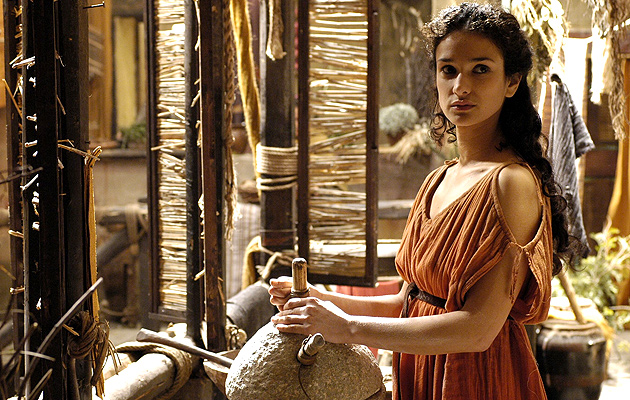
What puzzles me most is how Game of Thrones is almost universally hailed, yet HBO’s earlier series Rome barely made it to the end of season 2. In so many ways, Rome is an amazingly close precursor to the sprawling Westerosiad. Sex and violence? Check. Political intrigue? Check. Exotic locales? Check. Moral ambiguity? Check. Ciarán Hinds, Indira Varma, Tobias Menzies? Check, check and check again. (We’re still waiting for Ray Stevenson to make it to Westeros and for Kevin McKidd to be saved from his Seattle day job by a crazed, bomb-wielding, suicidal plane crash-cum-zombie apocalypse.) In terms of format, tone, characters, visual identity and, obviously, Nipple Count (and no, that’s not a character on the X-rated Sesame Street spin-off), the two series are very similar. Certainly, there are no ice zombies and dragons in Rome, but is that what makes Game of Thrones a success whereas the earlier series floundered? When people praise the series’ complexity, its characters and the world it evokes, are they actually saying that dragons, ice wights and boobs are cool? Or was the world not yet ready for a series of this kind when Rome was first aired?

Two.

There’s something about about the way the internet has embraced Game of Thrones that recalls self-perpetuating feedback loops. People don’t just get excited about the latest episode, they get excited about the latest round of YouTube videos depicting fan reactions. Watch total strangers scream at their TVs as Prince Fringfrang of House Shmoodle gets his arms torn clean off! Controversial scenes? Check out the clickbait: Why women like The Walking Dead better than Game of Thrones! (Not a joke, that one…). There’s something performative to the fan hype, as if people think they’ll become more interesting if they’ve got a video of themselves shrieking at Ned Stark’s decapitation or if they’ve got a blog post about what people on the internet say about-

Okay, gotcha. I’m feeding on, and into, the hype machine as much as everyone else. And who am I to tell the internet that it’s overrating its latest darling, especially if I then go and wax gastronomical about Hannibal after posting my own clickbait? So, to close this meandering post: if any fans of Game of Thrones are still reading this, I’m not telling you to stop enjoying the show or talk about it. But if you get bored waiting nine months for season 5, do check out Rome, especially season 1. You might enjoy it. And you won’t have to worry about book readers spoiling next episode… just pesky historians. Just don’t enter “does caesar” into the Google search window, lest the auto-complete function ruins it for you.

All the world’s a sound stage

Holy Motors is not a film for those looking for a strong storyline or for conventional entertainment. It’s not a film for the artistically squeamish or for those with no time to give to experimental cinema that is unconcerned with pleasing its audience and often downright absurd. It is one of the more exhilarating cinematic experiences I’ve seen in the last year or so – although it is definitely not for everyone.

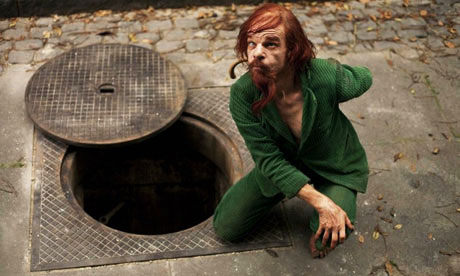
A plot summary is relatively easy to give yet beside the point to some extent, because the film’s effect mostly lies in how it does what it does. A man named Monsieur Oscar is driven from one mysterious engagement to another – nine, all in all – by his elderly female chauffeur. In the spacious back of the stretch limousine he puts on make-up and one costume after another, slipping into wildly different roles: an old, possibly Romanian beggar woman, a motion-capture actor in an altogether too fetishistic rubber suit, an anarchic sewer-dwelling troll-like creature, a scarred killer – as well as his lowlife mobster victim – but also a middle-aged father driving his daughter home and an old man dying in his bed. Even when he goes home at night, his home is another fiction entirely different from the home he left in the morning, his family (in a disconcertingly funny revelation) made up of chimpanzees. Everything is a part, it’s fictions all the way down. Is there a real Monsieur Oscar beneath the masks, the make-up and the (for the most part ostensively stylised) scenes he plays? Does he even know himself? (The ambiguity of that question was unintended, but it is quite fitting.)

Holy Motors

It’s not only the protagonist’s ontological state that is questioned; only one scene makes explicit that the person Monsieur Oscar interacts with is also an actor (possibly with her own stretch limo and chauffeur, unless these are reserved for the more seasoned actors), but the strangeness of the different scenes and the reactions of the people whose lives cross with his at least make us wonder whether most if not all the people in the universe of Holy Motors are simply moving from one acting engagement to the next. Now you’re a photo model. Now you’re a receptionist. Now you’re a lover. Now you’re a mourner. Now you’re dead (your gravestone linking to your personal website in one of the film’s offbeat jokes).

The film has been interpreted as being about cinema, although its director Leos Carax has denied this interpretation. More likely, at least to my mind, it is about how our lives are made up of roles and how in many of them we have precious little agency of our own. We put on our costumes, our masks, and we act what we think is required of the part. Not particularly new or original, I grant – but then, as I mentioned earlier, Holy Motors works largely because of its verve and energy, the conviction with which it and its main star Denis Lavant throw themselves into the different episodes. An art house film this is, obviously, but not the po-faced or even the self-consciously, needily quirky kind of film that sometimes feels as generic and by-the-numbers as the latest Bayfest or Snyderama. Holy Motors‘ energy is more anarchic, at times downright punk, though it is not in your face in every single scene.

In one sequence, the film indeed aims for something more poignant. Its themes of alienation and loss of identity (if indeed there ever was an identity to lose) may already hint as such poignancy, but it comes to the fore when Monsieur Oscar comes upon another stretch limo, finding in its back a former lover called Eva, played by Kylie Minogue. The two, having half an hour between engagements, talk about the twenty years they have to catch up on, and Eva sings a sad song about the people they once were before she sends Monsieur Oscar away. As he exits the building where they talked, he sees that Eva apparently has committed suicide by throwing herself off the roof. The sequence and especially Minogue’s song is superficially affecting, but it suffers from the films ontological twists and turns: we’ve seen the protagonist get stabbed and (apparently) bleed out, yet character death only meant that it was time for the next role. Why shouldn’t Eva get up, brush off the dust and hop into her limo the moment we’re not watching any more? What makes one death more real than another – and if death isn’t real for these actors, what is the point of the sequence and its underlying sadness? Holy Motors seems to come down heavily on the side of nothing being real, everything being an act, but then it can’t really have its cake and eat it.

Except it could. On stage more often than on the screen, I’ve seen performances that held the brittle balance between emotional authenticity and obvious artifice, where a character’s death mattered even while you are fully aware of the actor living and breathing. We are capable of buying into a fiction with our hearts and minds while knowing it’s a fiction. Holy Motors could have done this, and as a result the Kylie Minogue sequence would have gained a resonance that is hinted at but finally remains out of the film’s reach. However, as a result the film might have lost some of its anarchic energy: part of what makes it work is that it doesn’t take itself all that seriously, that it revels in its own ridiculousness. As it is, Monsieur Oscar’s meeting with Eva is something of an irritating foreign body in the film: it is streaked with sadness, yet Holy Motors would seem to render this sadness a non sequitur. (In fact, other than the actors’ words, we have little evidence that this is not another one of Monsieur Oscar’s engagements, although one that adds an even more pronounced metafictional turn of the screw.)

Regardless of this, which others seeing the film might respond to altogether differently , Holy Motors is well worth checking out. It is inventive, evocative, often funny (if you like your humour absurd), and it may just have the most rousing entr’acte in all of cinema. And that’s not even mentioning the gratuitously grotesque prosthetic hard-on, which is a more believable special effect than anything encountered in Sharknado.

Love, loss and Lauren Bacall

The beginning of Jonathan Glazer’s Birth is odd. There is a voice-over from a man, probably a scientific lecturer, who says he doesn’t believe in reincarnation. Then he goes for a run through Central Park during dusk. It’s winter. He stops, falls down, and dies. Then there’s a baby being born.

kidmanBirth

Ten years later, his widow Anna (Nicole Kidman) has an engagement party, because she finally said yes to Joseph (Danny Houston). They live next to Central Park, in a very expensive apartment. There is Anna’s mother, played by Lauren Bacall, and Anna’s pregnant sister Laura and her husband Bob (Alison Elliot and Arliss Howard). There are family friends, among them Clara and Clifford (Anne Heche and Peter Stormare).

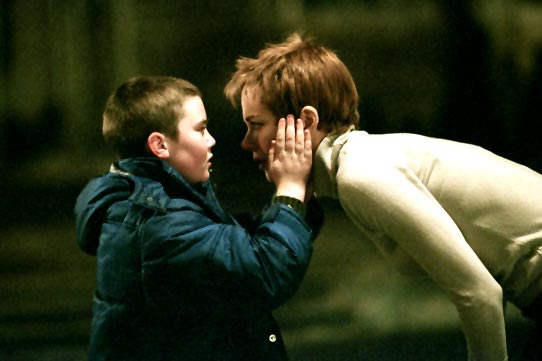
And then there is that boy, played by Cameron Bright. He’s not cute, but there is an earnestness about him. He first follows Clara into the park and then turns up at the party, claiming that he is Anna’s dead husband Sean, and that he doesn’t want her to marry Joseph.

The party treats him as a joke, and Anna wants to send him away, but finds that she cannot bring herself to do that. The boy is adamant, unflinching, and although Anna tells him not to lie, she cannot forget his words, and the way he looks at her. Then he faints, and she sees it. There is a scene at the opera where the camera looks at Kidman’s face for several minutes, without interruption. I’m not sure about what happens to Anna, but some kind of realization seems to take place.

2004_birth_013

It doesn’t matter that part of Anna is convinced that Sean’s story is bogus. It only matters that what that boy tells her fills her longing to see Sean again. That the person making that impossible dream come true is a ten-year old is a small obstacle towards happiness that seemed out of reach for good.

The thing is that the boy is really called Sean. His parents tell him to stop hassling that nice lady. He tells his mother that he is no longer her stupid son. There is no telling what the heck is going on here. The movie treats the boy as a boy, and takes him seriously. The adults don’t panic, but try to cope with an impossible situation as best they can. Anna’s brother-in-law Bob questions the boy. Sean gives surprisingly intimate answers, and he knows stuff only Anna’s husband would know. He isn’t scary or spooky or a threat – he just insists that Anna is his wife. There are no guns, no blood, and no madness tucked away in a corner of someone’s mind.

cameron-bright

The movie consists of muted colors, lots of black and brown and grey. It tries very hard to feel black and white. The apartment and Nicole Kidman’s hairstyle bring to mind Rosemary’s Baby. Birth is a horror film, too, but it is scary because it treats its theme seriously. In movies, when we ask ourselves what the hell is going on, the explanation at the end is almost always a disappointment. The better the build-up, the bigger the jerk we get when the third act plants us firmly back on the solid ground of reality. The explanation is either too much, or not enough. Not here. There is a reason for all this, and it contains some sort of emotional logic.

Apparently, Jonathan Glazer is unable to make a boring film. He did Sexy Beast in 2000, then this one in 2004, and Under the Skin last year. He is the director of many TV ads and music videos. Everything he does is different from anything else. Watch his Levi’s ad featuring Nicholas Duvauchelle, using that famous Sarabande by Händel.

Anna desperately looks for ways to convince herself that this is not her dead husband. People tell her so, but to no avail. She is afraid that she might fall in love again. She cannot win: if the boy is her dead husband, she is still attached to him. If he isn’t, then how crushing can it be to lose your husband twice?

You died, rinse, repeat

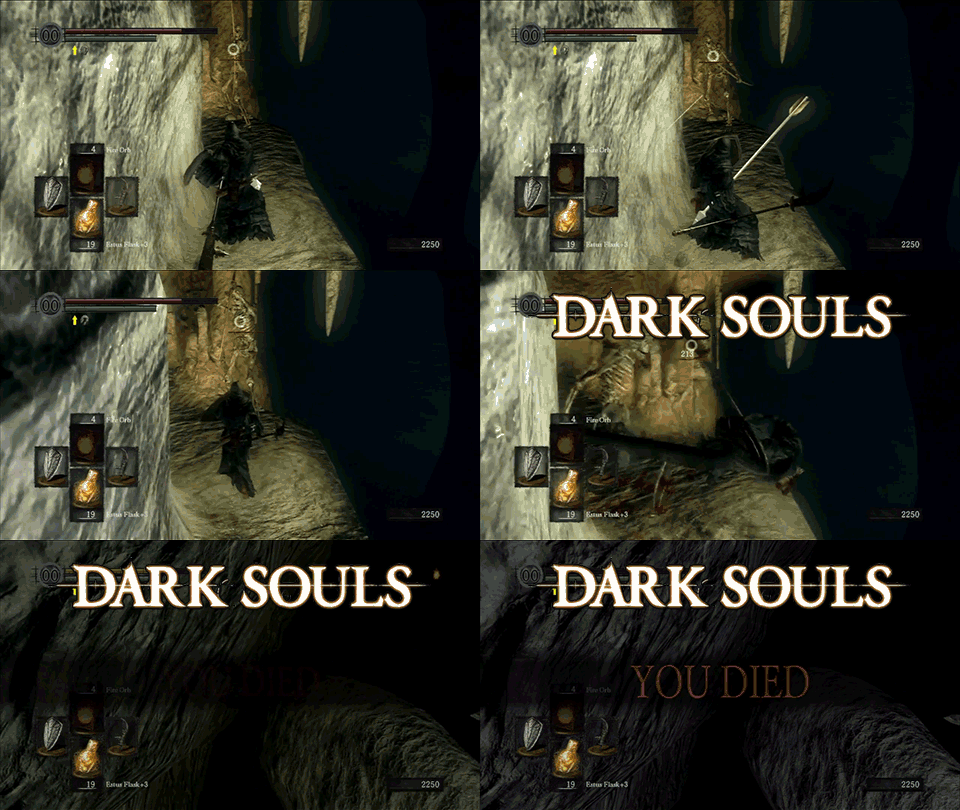
I admit: even though I’m pretty self-assured, not least when it comes to my media consumption, I still feel faintly embarrassed about telling people that I play games. It’s not even my age;  I don’t mind being a gamer at the age of 38 (soon to be 39). It’s not entirely the subject matter either; there are many games that are embarrassing, juvenile rubbish in terms of their aesthetics and writing. No, I think what it is most of all is how gaming can reduce me to one of the dumber monkeys in a Skinner Box: it’ll have me doing the same thing over and over and over with little immediate reward. Take my current addiction, Dark Souls 2, a game so proud of its own difficulty that its central hub area has a monument to all the player deaths the game has garnered worldwide.

At present, the monument lists over 100 million deaths. Let’s be clear about what this means: people playing Dark Souls 2, like me, have been doing minor variations of the same thing over and over again, and dying again and again. Ideally they progress a bit in between deaths, but if they’re anything like me they’ll die dozens of times in the same situation, doing pretty much the same thing and trying to figure out how to change it up so they can die a split-second later, hit an enemy for just a bit more damage, and slowly but surely inch their way to getting through that bit alive – only to die again (and again and again, clap clap) two rooms further on.

What is it that makes such an exercise in repetition and masochism engaging and even entertaining? Obviously there are the moments when you actually make it, when a combination of learning, skill, strategy and sheer luck lets you whittle that enemy’s hit points down to zero, when you dive under an enemy mage’s spell and stick him with the pointy end, when you turn a corner and find a momentary sanctuary there – but most of the time you’re busy pulling that lever and wondering why you’re not getting that piece of cheese or the fish biscuit you were hoping for. You’re a rat in a maze. A beautifully rendered, darkly romantic, imaginative maze, but even that beauty is lost as you’re getting skewered, flash-fried and/or magic missiled for the nth time.

There have been articles about the inherent pointlessness of Dark Souls and similar games, and as much as gamers tend to dislike critical looks at their hobby, I do think it’s a valid question: what are we getting out of the endless rinse-and-repeat cycle? At what point have we succumbed to the gamers’ version of Stockholm Syndrome and we keep pulling that lever not because we expect a fish biscuit but because we’ve come to like it?

Now excuse me, I’ve got a lever to pull. And to be stabbed in the back by an Undead Knight while doing it, most likely.

You died. Again. Wimp.