One of the things that video games can do magnificently is create worlds. These posts are an occasional exploration of games that I love because of where they take me.
What do you think of when you think of your teenage years? Do you think of hormones and crushes, of defying your parents and going to parties you shouldn’t have gone to? Do you think of crushing insecurity and emotions that could go from elation to depression within seconds, based on how someone did or didn’t look at you?
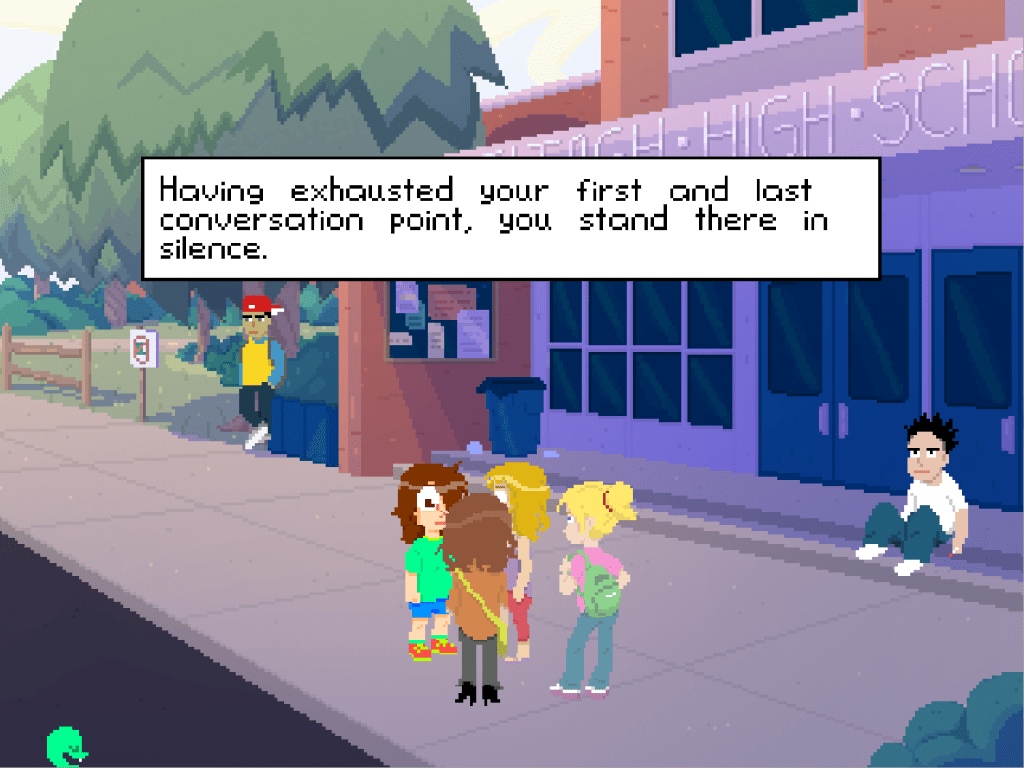
Quite honestly, when I think of my teenage years, the thing that perhaps comes to mind most is this: chunky square pixels.
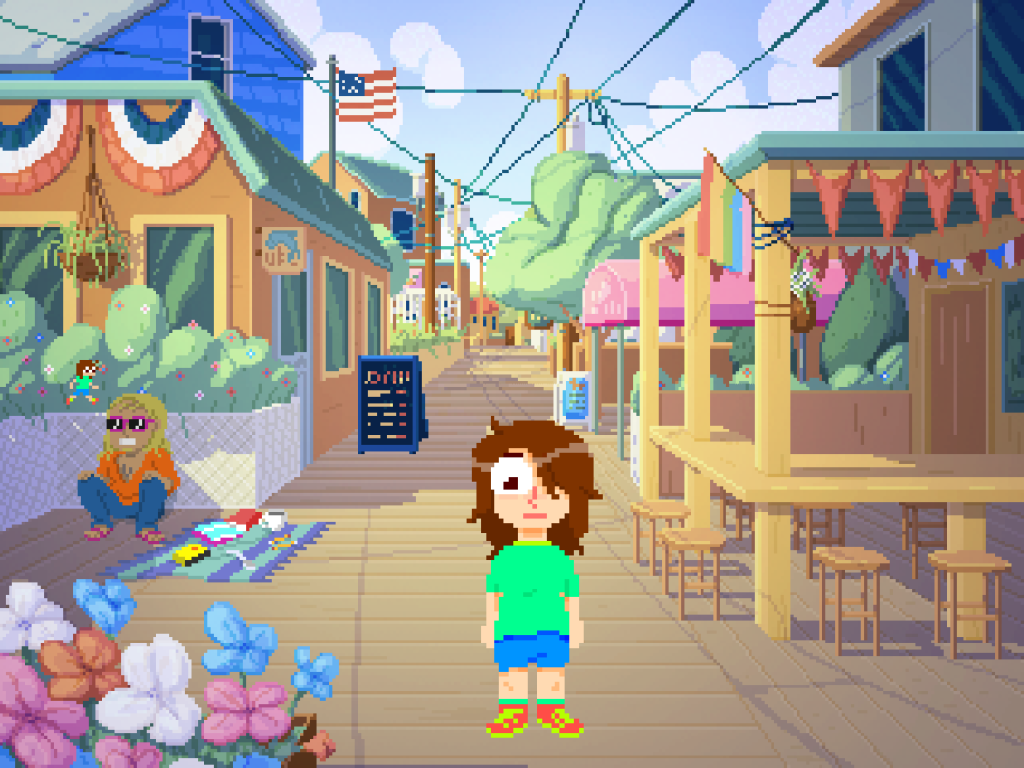
Perfect Tides is a point-and-click adventure game developed by Three Bees, a studio run by the cartoonist Meredith Gran. It’s about Mara Whitefish, a girl just a bit shy of her 16th birthday. She lives with her mother and father on the island of Perfect Tides. The family is not doing great financially, but more than that, they are still in mourning over Mara’s father who died not too long ago.
The writing in Perfect Tides is pitch-perfect, evoking Mara’s adolescent anxieties with nuance and sensitivity. Whitefish doesn’t ignore the ways in which adolescents can be ridiculous in how they think they’re the only ones facing these issues when, really, everyone does, but neither does she make Mara into a cliché. She is a typical teenager, but she is also very much, very specifically herself. Her struggles are universal, at times even trite, but they are also Mara’s and Mara’s only.
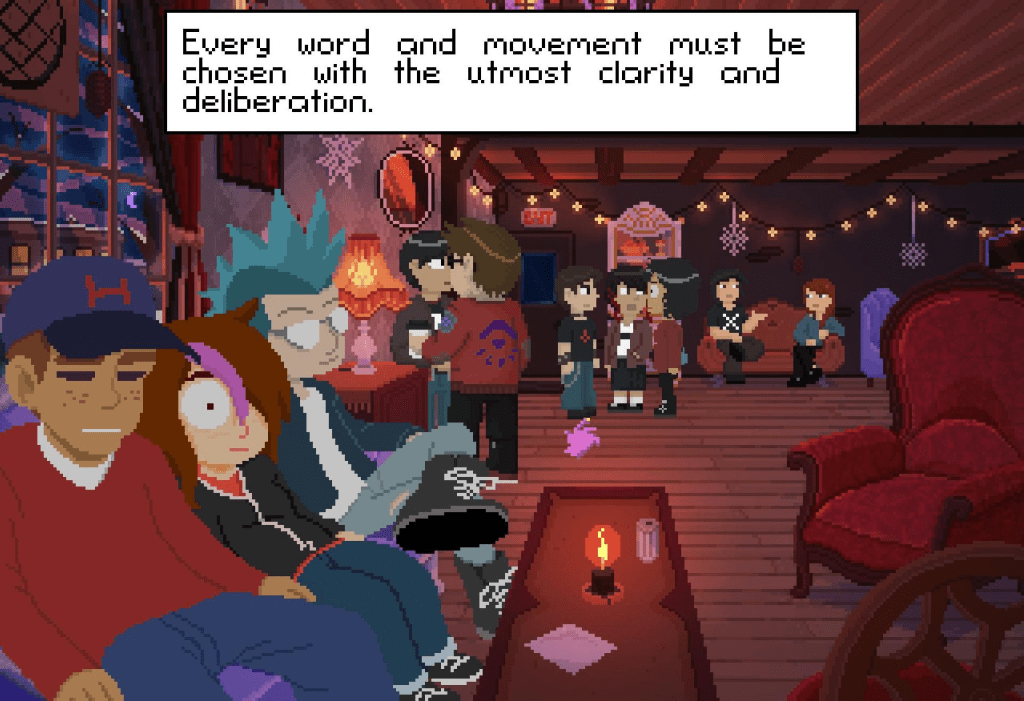
And yet, for me it wasn’t Mara and her relatability that pulled me in. To be honest, at first it was due to Mara that I bounced off Perfect Tides to some extent. The thing is: sometimes I feel that I was the most hermit-like teenager alive. Sure, I had crushes and desires, I was insecure – but on the whole, my adolescence didn’t have the extreme peaks and valleys. I was unhappy a lot of the time until the age of 15 or 16 and then I was mostly… okay, I guess. I think I missed most of the teenage drama. Not that I think this made me superior or more mature or anything: it’s simply that I guess I was a teenager in moderation – which seems to be exactly what so many stories about adolescence are not about. My mother once told me that she thought I was born as an old man and that I aged backwards, so perhaps I’ll enter adolescence… any… day… now.
I did eventually find myself engaging with Perfect Tides on an emotional level – through the weirdest gateway: its aesthetic, controls and game mechanisms. As a teenager, I didn’t much go to parties, and I was definitely not successful in romantic terms – but I spent many, many, many hours playing computer games, a hobby that started when we got a Commodore 64 when I was eight years old. Fast-forward half a dozen years and I mainly played games on Amiga and later on MS-DOS PCs. I especially liked games that told stories – and many of my favourite games were point-and-click adventure games. You know the kind: click on USE, pick an object from your inventory, then USE that object on another object in the environment. USE MASKING TAPE ON HOLE IN SHED DOOR, and when the cat tries to go through the hole, its fur gets stuck on the tape. GET CAT HAIR. USE CAT HAIR ON PACKET OF SYRUP. Et voilà: you’ve got yourself a fake moustache. (This is a real, much-ridiculed puzzle from Gabriel Knight 3, which I never played, but it’s a good illustration of the moon logic of some of these adventure games.)
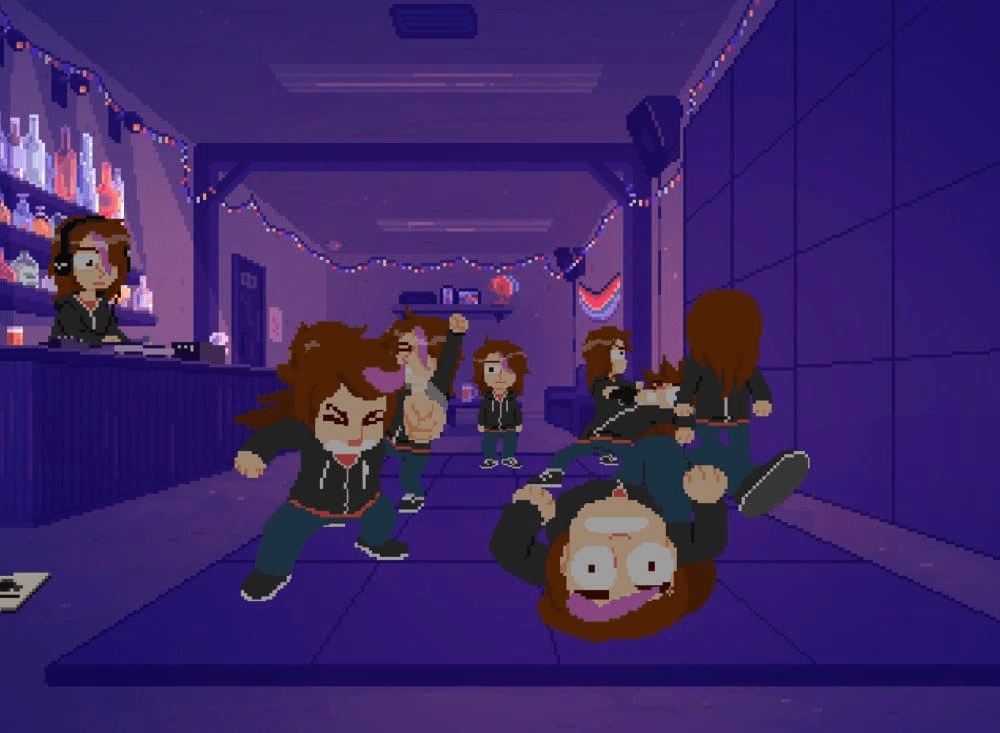
While Perfect Tides is never really about puzzles, and certainly not about the kind of classic computer game puzzles that can feel like trials imposed by a capricious, mad god, it has the look and feel of a point-and-click adventure from this era. It has the chunky pixels, the reduced colour palette, and an indie comic-book style that reflects Gran’s drawing style, but it also has a vibe that is similar to the games I played in my teens and early 20s. It also controls like those games (for veterans of video games, Perfect Tides has a user interface that is closer to that of Sierra’s adventures than to LucasArts’ classics – and the UI is even used for some sly jokes).
And, weirdly, where I didn’t immediately feel all that much kinship with Mara, it was the way Perfect Tides looks (and sounds), and the way it controls, that took me back to that time and that age. It is likely that Gran went for the lo-fi graphics and old-school game genre in part because they are easier to implement for a small, independent studio than other styles and genres – but Perfect Tides plays enough with the specific experience of using computers in the late 1990s, the look of IRC chats and the sound of a dial-up modem connecting to the internet, that its visual identity is surely down to much more than just what is feasible to a small indie team.
Most likely, there is an element of nostalgia to my reaction to Perfect Tides, but the story it tells is never about how the past was better. It tells a bittersweet tale about the personal hell that being 15 can be, using signifiers of a very specific past to tell this story. And, for me, it was the trappings of classic point-and-click adventures and the vibe evoked by the way Perfect Tides looks and sounds that gave me a gateway into Mara’s life – and that eased me into relating to the sides of her that were familiar while recognising and appreciating the ways in which her experience was different to my own – yet still very recognisable. I didn’t need to have been a teenager, let alone a teenage girl, in the year 2000 for this. It was enough for me to recognise those big, square pixels, the way characters are animated, the tinny yet surprisingly rich soundtrack, the icons letting me walk places, talk to people (if I dared), touch and grab things. Perfect Tides gave me a way in by presenting me with the user interface, and user experience, of my own adolescence.
P.S.: Perfect Tides: Station to Station, a sequel that returns to Mara’s life two years later, came out in 2026. I am very much looking forward to playing it, as much for the old-school vibe as for Mara herself.