“Someone must have slandered Joseph K., for one morning, without having done anything truly wrong, he was arrested.”
Back when I went to school, it was clear that, at some point, we would be reading something by Franz Kafka – and, at the time at least, chances were it’d either be The Metamorphosis (published in 1915), in which a man wakes up to find himself changed into an enormous insect, or The Trial (published in 1925), that foundational work of paranoid fiction. If I remember correctly, we ended up reading both, though from the time I mostly remember the 1915 novella, perhaps also because of that memorable MTV short from the channel’s “Feed Your Head” series. But while The Metamorphosis still has that deliciously fantastic angle of a man turning into a bug (admittedly, at my current age I find that premise less fantastic than I did as a teen), arguably it’s The Trial that feels the most universal – and its footprints can be found across culture and cinema.
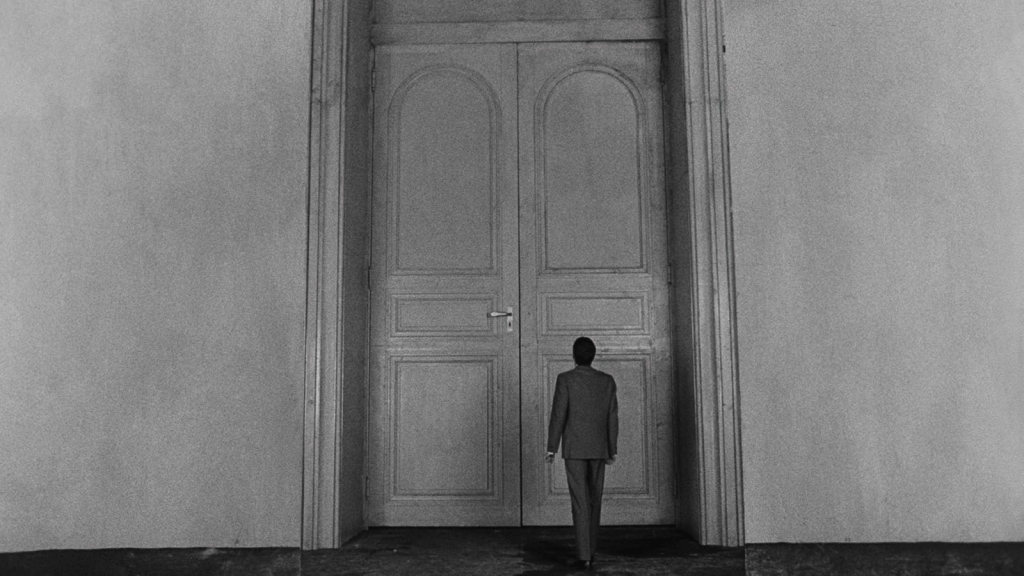
The Trial is perhaps Kafka’s most frequently adapted work: it can be found on the stage, on radio, in the form of graphic novels – and, obviously, as film. There is a 1993 adaptation, based on a screenplay by Harold Pinter and starring Kyle MacLachlan, that apparently wasn’t very good and that has mostly been forgotten – and then there is Orson Welles’ strange, neurotic film that came out in 1962. Welles’ The Trial is a strange beast: it is extremely faithful to Kafka’s novel in many ways, but it has a feel that is very much its own thing – not least because of its lead.
Welles got Anthony Perkins, who two years earlier had played that iconic mommy’s boy Norman Bates in Alfred Hitchcock’s Psycho, to play Josef K., the powerless protagonist of Kafka’s story about a man who is accused of some unstated crime and who undertakes a futile fight against an inscrutable and antagonistic legal system. Perkins is an odd choice that some might see as inspired, others as missing the point altogether: considering the role that made him famous, can any audience aware of Psycho watch the instantly recognisable actor and not think that he’s a wrong ‘un to begin with? This is matched by the nervous energy that Perkins exudes pretty much from the very first scene: this is a man that practically sweats some sort of guilt.
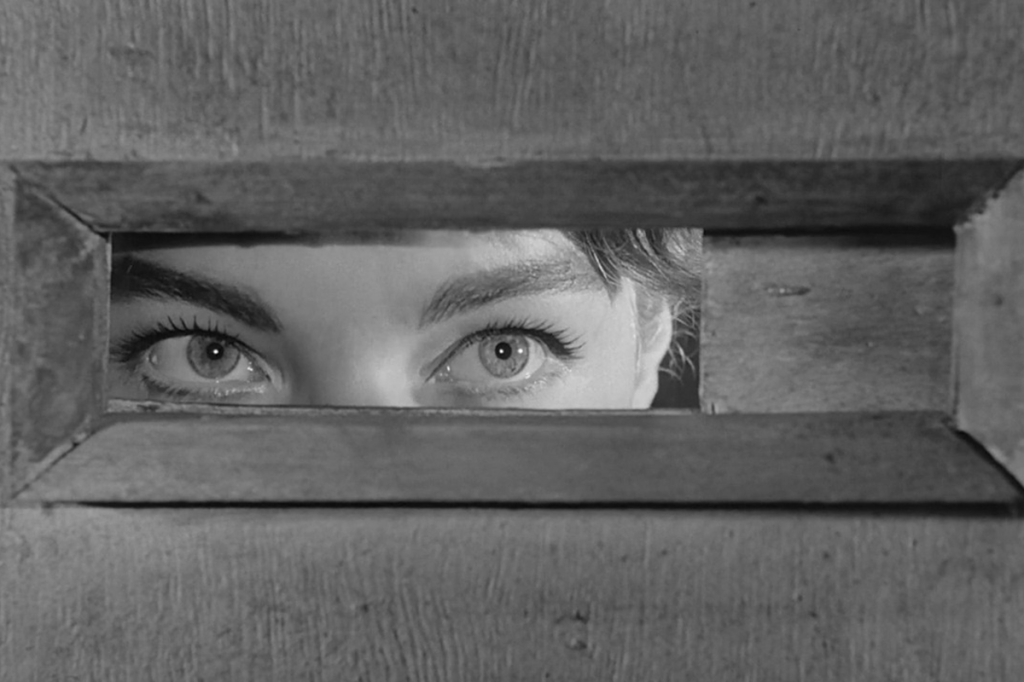
I have to admit that it is in no small part Anthony Perkins and his performance in The Trial that irritated me and kept me at arm’s length – but it is also difficult to say whether my teenage reading of Kafka had solidified into something that, more than thirty years later, no longer resembles the original text all that much. I remembered Josef K. as an everyman, a cypher, someone onto whom the reader could project themselves, and their own vague yet persistent feelings of guilt (which, as a teenager, I could certainly identify with). There is something altogether more specific to Perkins: his neurotic anxiety has the energy and rhythms, if not necessarily the humour, of an early Woody Allen character, combined with that particular Norman Bates vibe. When I read The Trial, I understood why this man would seek out legal representation; watching Welles’ film, my first thought was: this man doesn’t need a lawyer, he needs a shrink.
As I was struggling with the casting of Perkins and his performance (which may well have been played up by director Welles), I also found that The Trial made me think as much of cinema as of Kafka’s literature – and in some ways, my viewing of the film suffered from me coming to it so late. In terms of its visual language, Welles’ film feels tremendously familiar: it is shot and edited in the style of dreams, but less so dreams as we dream them than dreams as film depicts them. In its high-contrast black and white, The Trial resembles a feature-length episode of The Twilight Zone, which its story bears out. The corridors with their stark shadows, the close-ups of wide-open eyes, the Dutch angles: this is what we’ve come to expect dreams to look like. I expect that Welles himself was inspired by cinematic surrealists, but he certainly was an inspiration to other filmmakers himself – and, judging from the familiarity of the images in the film, The Trial served as much as an inspiration as his other, better-known films. It comes as no surprise that cinematographer Edmond Richard, who also collaborated with Welles on Chimes at Midnight, would later work with surrealist Luis Buñuel on three of his films: The Discreet Charm of the Bourgeoisie, The Phantom of Liberty and That Obscure Object of Desire: there is a sense that his cinematography became something of a de facto standard of what absurdism looks like on screen.
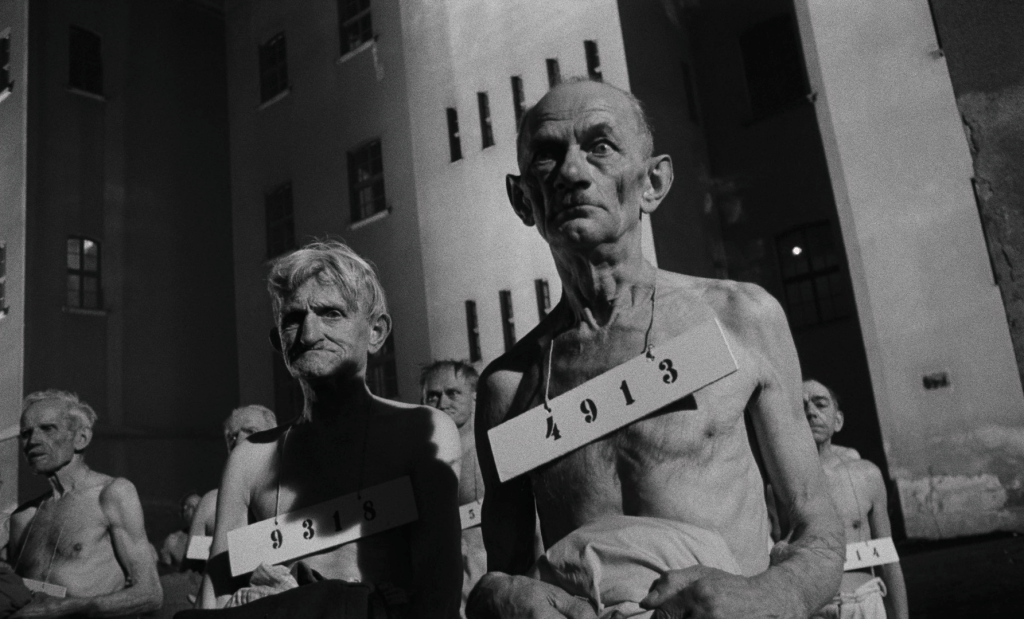
Verdict: For the first half of The Trial, I wasn’t on board with Welles’ adaptation. While plotwise, the film is remarkably close to Kafka’s novel, its very particular intensity, which is feverish almost to the point of becoming cartoonish, combined with Anthony Perkins’ high-energy neuroticism was at odds with how I read the original novel.
Over time, however, I came to realise that what what bothered me more than Perkins’ particular energy was the over-familiarity of what I was seeing. So many of the surrealist techniques Welles applies have since been used in so many films and TV series: the Dutch angles, the acting style, the whole vibe of Josef K.’s nightmare, we’ve seen these again and again, so that by now they can feel quite clichéd and hamfisted, when in 1962 they probably felt fresh, or at least fresher. In some ways, Welles’ film does come across like a feature-length Kafka-flavoured episode of The Twilight Zone, and (for me at least) the novel’s sense of dread gives way to a more superficial kind of pulp-surrealism.
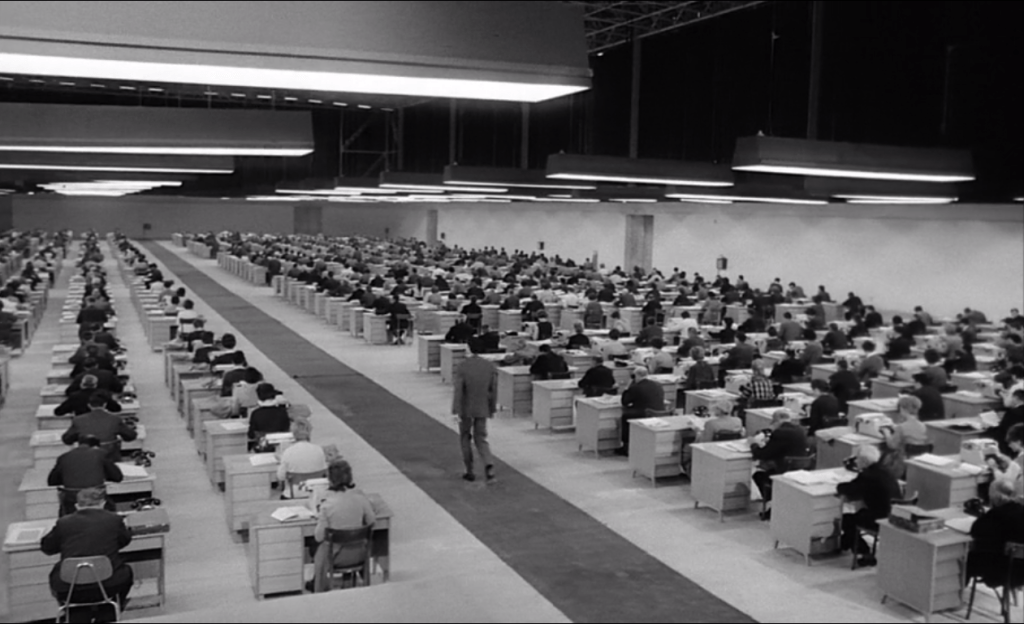
Once I eased into this, though, I found myself enjoying Welles’ adaptation more for being its own thing. Where it works best for me is when it moves away from dialogue and focuses on its images. There’s something overly literal for me to how Welles adapts Kafka’s language (which also sits somewhat at odds with the film’s utter 1960s-ness), but you could certainly frame this film and hang it on a wall, and in such a format I think it’d be better at evoking the dread that I associate with Kafka. And as a cinematic forerunner of films such as Terry Gilliam’s Brazil, the film was clearly tremendously influential – though, ironically, I find Brazil more effectively Kafkaesque than Welles’ The Trial, perhaps in part because it is not a literal adaptation of Kafka’s writings but clearly riffs on it, as well as on George Orwell’s Nineteen Eighty-Four, through a Pythonesque lens.
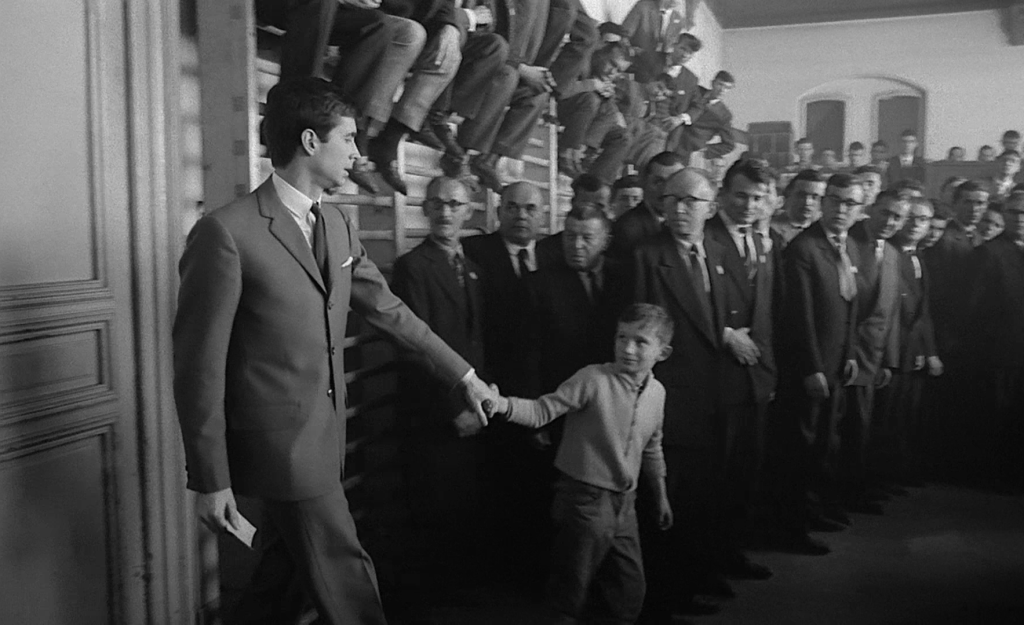
Then again, there are moments where Welles departs from Kafka’s story, and for me these are hit-and-miss. I’m not sure how well Welles’ much more shownman-like tendencies as a filmmaker work with Kafka’s style – though I am by no means an expert. Kafka is a tricky one in that many people’s ideas, including my own, are perhaps shaped as much by pastiche and cliché as by the real thing. It is easy to have an idea of what is Kafkaesque without having read a single story by Kafka – or, as in my case, having read the most famous stories several decades ago. I don’t think Welles’ ending, which adapts Kafka’s almost literally until it takes a very peculiar turn in its final minute, feels very true to Kafka – but for all I know, an expert on the writer might consider Welles’ The Trial a more faithful adaptation in all the ways that count than so many films and series that are labelled as Kafkaesque, even though they bear little more than a surface resemblance.
Though, once again, picking stills for this post and looking at the images in isolation, I find myself becoming more fond of The Trial, an effect that I’ve observed with quite a few of the films in the Criterion Collection that I didn’t particularly enjoy while watching them. As a visual work of art, The Trial is rich and fascinating, even if it has proven so influential that, coming at it late, some parts of Welles’ film can feel clichéd in their aesthetic. It is hard to fault the film for being effective at establishing a template for what dreams can look like on screen. If anything, perhaps The Trial is too effective at giving itself a dream-like feel: again, this is my recollection of mostly having read Kafka a long time ago, but where I remember the stories feeling very dream-like to begin with, for me they were finally at their most potent when the dream begins to feel all too real and familiar. While The Trial often excels in its images, these images may be too intent on signalling: this is a dream. The greatest dread in Kafka’s stories lies in the moment when we begin to recognise just how Kafkaesque reality can be.

