Welcome to One Best Picture After Another – where I attempt to watch all the winners of the Academy Award for Best Picture, starting at the very beginning. And attempt to answer two simple questions – is the film still actually any good? And why did it win?
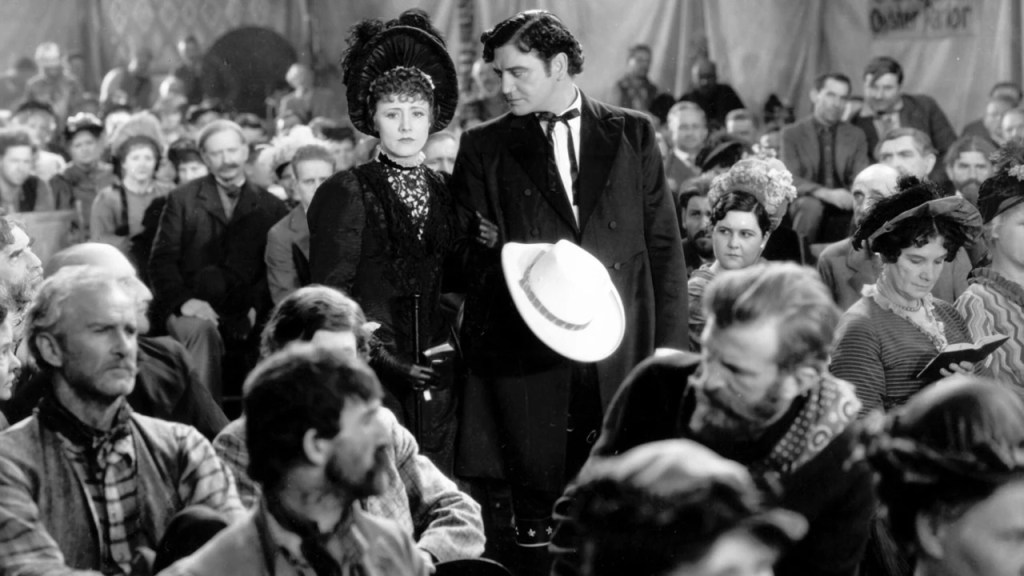
2/10
The past is a foreign country, they make films differently there. Both critically acclaimed and a box office hit back in 1931, Cimarron‘s appeal seems genuinely mystifying to me today. A Western saga set in Oklahoma that manages to be both clunky, messy and boring, despite having gun fights, family drama and a court case about sex work.
The first thing to probably get out the way is the extent to which this film contains racism that makes it a difficult watch at times. Eugene Jackson’s Isiah is an astonishing crass stereotype, portrayed as a grovelling idiot for comic effect. Native Americans get a couple of paternalistic expressions of sympathy, a patronising aside that fails to undo all the other references to savagery and a truly galling final image. Of course, none of this was likely to damage its chances of winning an Academy Award, but it is something worth being ready for if you want to watch the film.
When you do watch it, though, it’s striking just how little actual engaging drama there is here. Stuff just seems to happen, devoid of much real peril. And yet all the ingredients are here that should be able to make things exciting. There’s good old Western gunfights to be had – as both a threatening killer lurks in town, and later a gang of outlaws attempt a bank raid. Yet when the guns are drawn, it’s all something of a damp squib. The white good guys are never in any danger.
There’s also a subplot involving Dixie Lee, a fallen woman who the lead character (and family man) Yancey Cravat seems fond of. There’s potential here for drama over the reasons for this, and given that this is before the days of censorship, you would think that this could be openly explored. This subplot leads directly into a court case where you would expect the sort of tension and combative dialogue in these scenes. Instead, any potential drama dissipates as it is all quickly resolved when Yancey Cravat delivers some cringingly bad lines that immediately win over the whole jury, and the rest of the court starts cheering.
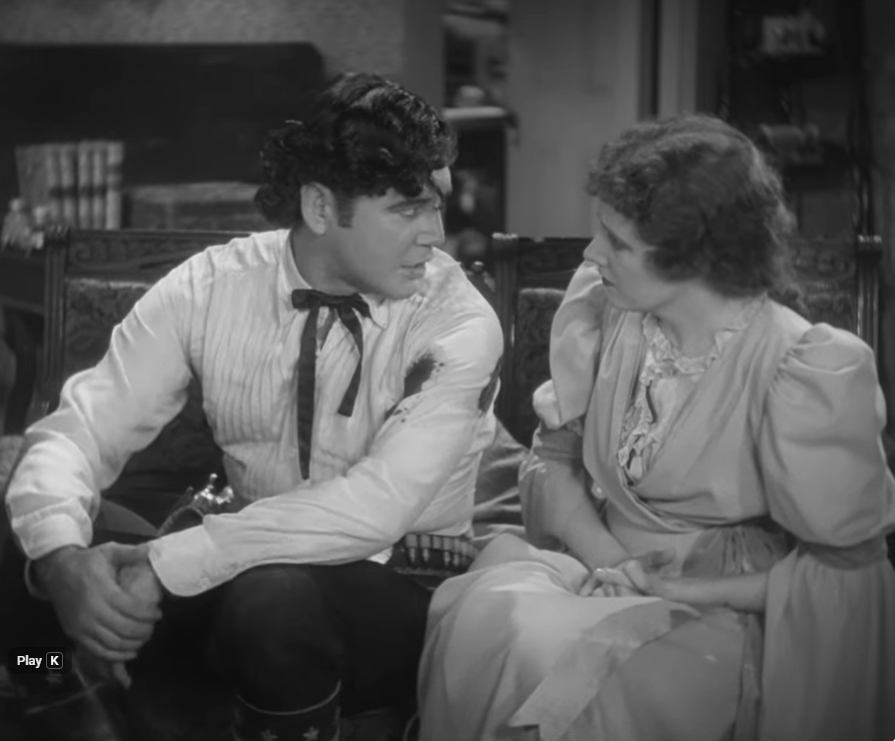
Throughout the film, Richard Dix’s performance as Yancey Cravat is also a genuine oddity. There’s a stilted manner to it that is hard to ever take seriously, a problem made worse by some of the clunky dialogue he’s made to deliver. And by deliver, I mean Declare Theatrically, which seems to be his only setting.
Again, there is potential here, exploring the role of the traditional patriarch figure who turns out to be someone who cannot settle in a family home, but at no point do I get an inkling as to why that’s the case. Or even why I should care. Dix’s shortcomings are further highlighted by having to act opposite Irene Dunne for much of the film. Her performance is one of the highlights, although to be fair, she is one of the few characters in the film with anything to work with. All too often, however, her character development is characterised by her simply changing without any explanation as to why her character has evolved.
Another frustration I had with the film is that there are ideas in here that have aged well, but they seem glossed over. Yancey Cravat’s son falls in love with a Native American woman and is shown, at the end of the film, married to her with children. The film doesn’t really bother with minor, trivial details like showing us them actually falling in love, but it does show their mother accepting this relationship. It does this by having her angrily hostile to it in one scene and then seemingly being fine with it the next time we see her. That a happy interracial couple exists in this film at all is a plus, but I appreciate it’s barely part of the film. At the same time, the film repeatedly has the lead express sympathy for the plight of Native Americans, before heading off to participate in another land grab. The film doesn’t really ever get around to challenging or exploring this hypocrisy – which probably reflects a lot of how the audience watching at the time felt: a bit bad at some of what happened, but nowhere near enough to stop doing it.
A much more impressive highlight of the film is its opening: presenting the Oklahoma Land Grab of 1889. There’s a fabulous sense of scale in these scenes – shot on location, capturing the vast landscape being grabbed. Hundreds of settlers – in wagons – race across the screen in epic shots that still look impressive. And if it still has the power to look good today, it was probably truly breathtaking when it came out. But after the opening high point, the film never comes close to that excitement. And when you compare it to the previous year’s winner All Quiet On The Western Front, this is completely in its shadow in every respect, like the industry leapt a decade backwards.
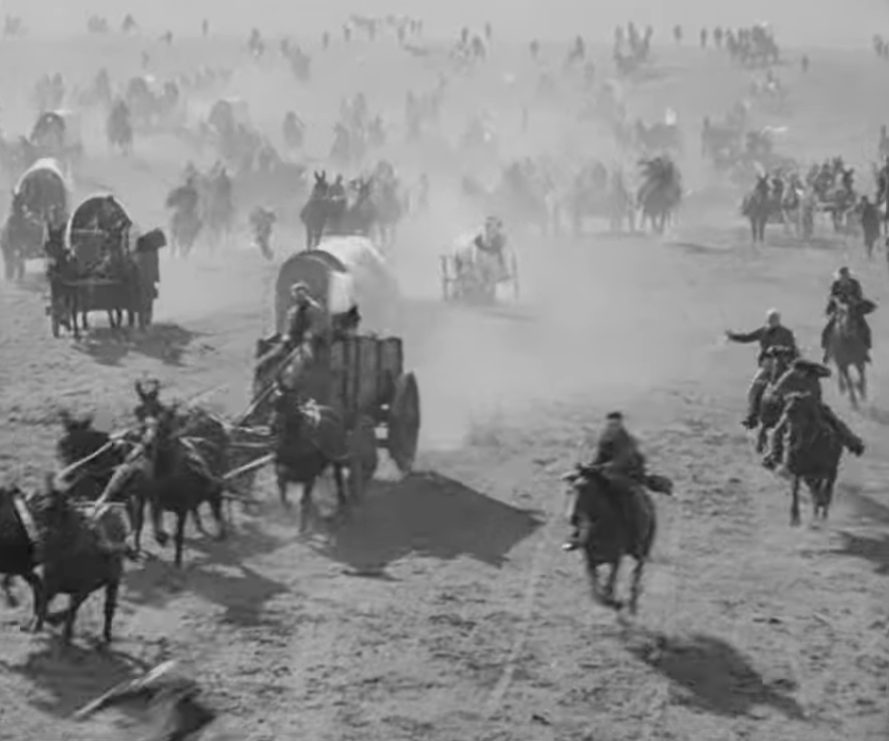
Of course, 1889 feels like ancient history now, but when the film was released, this was just over four decades earlier. This would have been less of a period drama than an exercise in nostalgia. As the film moves forward in time, it references events that many in the audience would recognise – giving the whole tale a depth that the actual screenplay doesn’t quite earn. It ends in 1930, just a year before its release, and the final scenes are all about showing the audience what happened to all these characters that the film has never really bothered to make me care about. In fact the only evolution presented across those decades that I found interesting is that of the place they live in – which over those years transforms from an overnight shanty town to a ‘modern’ metropolis with skyscrapers and big business.
I did not think this was a good film at all – and by some distance the weakest film so far. So why did it win the Oscar? In part, I think it might be because the epic sense of scale would have been really impressive, and the Academy would have wanted to reward that, to inspire more films to chase putting scale on the big screen.
But also: it was an adaptation of a hugely successful book, the best-selling novel of 1930. Maybe that book deals with a lot of the problems I had with the film, exploring character and plot developments that seem ignored on the big screen? This could have meant that audiences were taking their knowledge of the book into the cinema and, as a result, didn’t really feel those absences? They filled in the gaps of character development and insight, while enjoying the spectacle and random set pieces.
It doesn’t surprise me that the Academy might want to reward a film that took a critically well-regarded book and spent money to create a prestige adaptation. It’s just not one that has stood the test of time.

