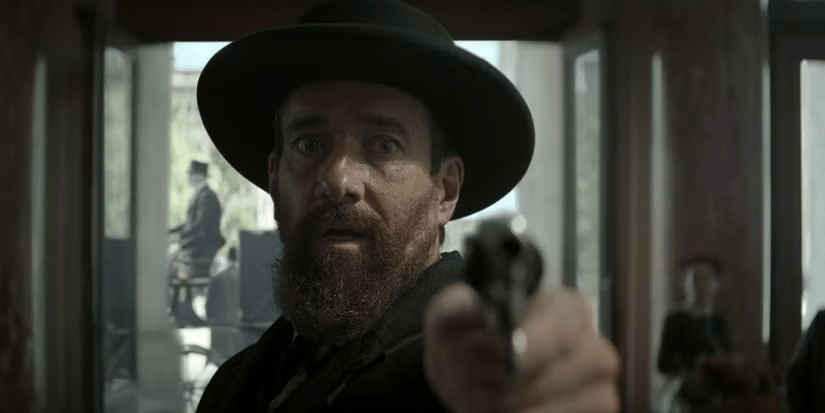
In 1990, Stephen Sondheim’s Assassins came out, a biting musical about the men and women who felt called upon to kill a US president. Through a set of historical characters, from John Wilkes Booth via Lee Harvey Oswald to Sara Jane Moore and Lynette “Squeaky” Fromme (who both attempted, and failed, to kill Gerald Ford), Sondheim shows us his bleak version of the American Dream: “Everybody’s got the right to be happy” – and what better way to achieve happiness and fill the emptiness inside yourself than to kill yourself a POTUS?
All of these would-be and actual murderers are pathetic in their own particular ways. They are angry at the world and the ways in which it doesn’t conform to their wishes. They are attention seekers who wished to put their imprint on America, having little to offer the world apart from their own warped ideas of greatness and how to achieve it. And perhaps none of them are more pathetic than Charles Guiteau: a liar, a thief, a narcissistic failure.
Few people, other than Sondheim fans, know Guiteau’s name. Even fewer know the name of the man Guiteau killed: James A. Garfield, the 20th President of the United States of America.
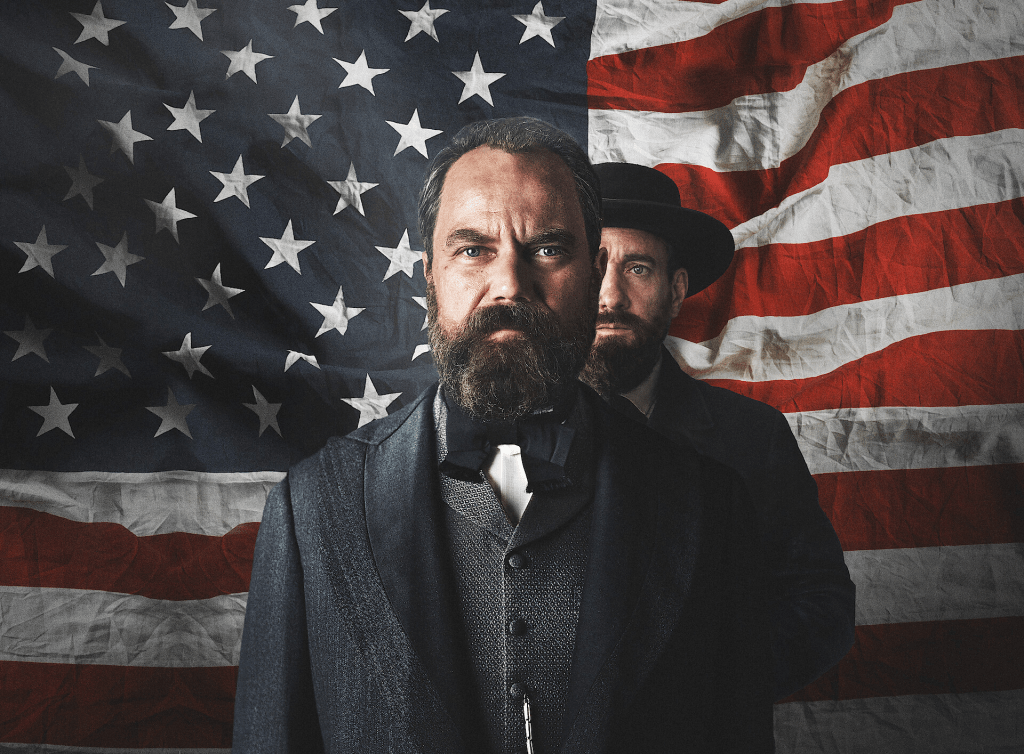
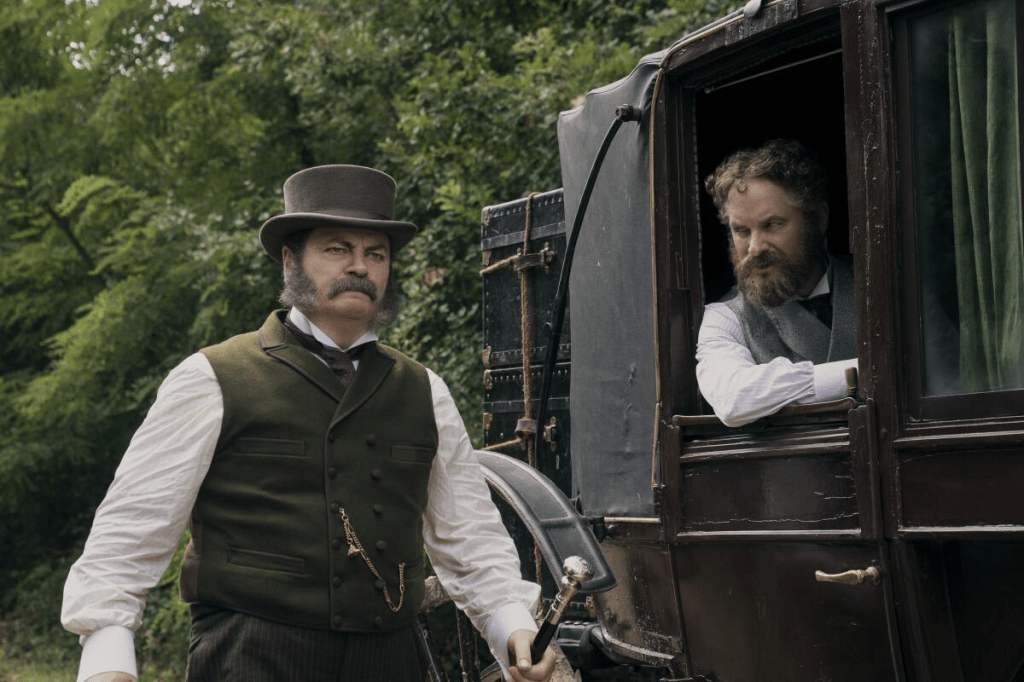
Death by Lightning, a Netflix miniseries, sets out to remedy this. Unsurprisingly, its version of the tragedy of Garfield and Guiteau carries overtones of Assassins – as well as of The Assassination of Jesse James by the Coward Robert Ford (Guiteau is a more wheedling, neurotic cousin to poor, needy Robert Ford) – and Succession. In spite of its Netflix pedigree, the cast of Death of Lightning is as HBO as they get, with the likes of Shea Whigham, Bradley Whitford and Nick Offerman as key players in Washington – and with Matthew Macfadyen as Charles Guiteau, a man who makes the actor’s role as Succession‘s Tom Wambsgans almost look competent and principled. Meanwhile, James Garfield is played by Michael Shannon, who plays the role with a very different energy from the string of roles that had him portray troubled men somewhere on the continuum between insanely intense and just plain insane.
The series has the muted (and, sometimes, overly murky) looks of historical drama, but its tone is often that of political satire, with Garfield, a quietly good man who does not seek political glories, ending up in the White House because he is an antidote to the manipulation and corruption of the Party, while everyone else is clearly in it for themselves. Shannon plays John A. Garfield as a curative to the ills that plague the United States, not only in the 1800s (Death by Lightning doesn’t try to hide its relevance to present-day America). He is also a fish out of water, an almost Capraesque character in a world of opportunists and bullies.
From a very warped perspective, the series’ version of Guiteau could also be seen an idealist – but this doesn’t go beyond Guiteau’s surface. It is never entirely clear to what extent the man believes in his own lies. He wants to have a part in the change that Garfield promises, he wants to latch on to the President in order to be meaningful himself, and he tries to achieve this by wheedling his way in. There is a desperate quality that at times almost cracks to reveal a more tragic dimension to Guiteau, but only almost: people recoil from him and from his unpleasant neediness, his self-delusion and his firm belief that he deserves better just because he wants it. It is quite remarkable that Macfadyen started his career playing decent, even heroic figures, because in recent years he has shown how good, and how funny, he is at playing men who aren’t anywhere near as smart, competent and, perhaps most of all, deserving as they think they are.
It is quickly clear that Guiteau has no place in this world: he does not have the savvy to compete with the power brokers of Washington nor the brains or abilities to be of use to them. He also does not fit into the world that President Garfield is trying to construct: one in which politicians, up to and including the President of the United States, are there to serve the people. Guiteau believes that he wants to be a part of this, but it isn’t that he wishes to contribute: he believes that his mere existence should be enough to make everything better, but in essence he has nothing to bring to the table other than his bottomless need to be of some importance.
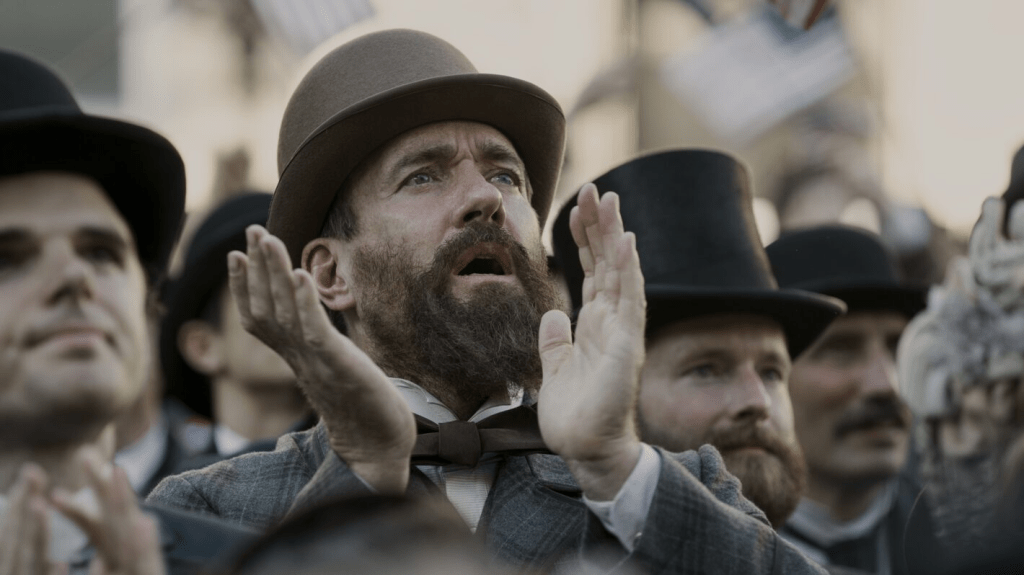
Death by Lightning starts very strongly. The first episode focuses to a large extent on the 1880 Republican Convention, where Garfield unexpectedly finds himself the party’s nominee for the presidency: an extended sequence that plays like a US riff on Conclave. The series also quickly and effectively sets up its main characters: the quiet, plodding idealist who finds himself thrust into a position where he can do good, though only by setting himself against the existing, corrupt hierarchy, and the narcissist who is just waiting for the world to finally give him his due because, damn it, he deserves it. Its cast is more than up to the task, especially Shannon and Macfadyen, but also the supporting actors.
Nonetheless, my recommendation of Death by Lightning is qualified, because the series’ trajectory is finally disappointing: it fails to really fulfil its potential in key ways. For one, it does not really handle its few female characters well. It tries to give them agency and make them important where this fits the plot, first and foremost in Betty Gilpin’s Lucretia “Crete” Garfield, the President’s wife: but while she gets scenes where she emerge as a strong character, she nonetheless remains ancillary. In the end, the attempts to make her more important only end up highlighting the extent to which she is decidedly the B plot – something that could have been handled better in a variety of ways.
The series also suffers from many of its scenes past the first episode repeating what we’ve seen before: Garfield doing good, his political opponents being corrupt, Guiteau showing himself to be a self-aggrandising, delusional creep. When Death by Lightning is good (and it is nowhere as good as in its first episode), it raises expectations of what it could be – but its writing is more often competent than great. It isn’t sharp enough to give the story depth and resonance, even if the actors often hint at what could have been: a version of the story that leans more into the sadness and fury of men like Guiteau who feel that the world owes them, and mercy to anyone who gets in their way. I wish for a version of this story that leans more strongly, and more incisively, into its obvious parallels to present-day US politics, and into the frightening reality that, today more than ever, there are more and more Guiteaus – and they no longer need to kill the president, because they sit in the Oval Office.