
We like to think of Emily Dickinson as a shy recluse, communicating with the good people of Amherst and the world at large only by stringing her poems into small parcels and lowering them out of her first-storey window in a basket on a rope. There is, however, a branch of research into America’s beloved poet that brings the focus away from the cliché of an unravished bride of quietness, and tries to peek behind the scenes. The most conservative scholars, who might see themselves as keepers of the holy grail that is Emily D., might just foam at the mouth. A bit of irreverence never hurt anyone, especially if it’s not unfounded.
Because there seems to have been ravishing. Wild Nights with Emily (2018), a film directed by Madeleine Olnek, based on her own stage play, takes Emily’s relationship with her brother’s wife Susan as the center and goes from there, stating that, yes, Emily lived in Amherst almost all of her life, but only to be near the woman she loved – near in the sense that their houses stood only a few meters apart. Susan, according to this movie, seems to have married Emily’s brother Edward just to be close to Emily, who had a lot of time on her hands and could write love poetry all day because she could catch glimpses of Susan just by peeking out the window.
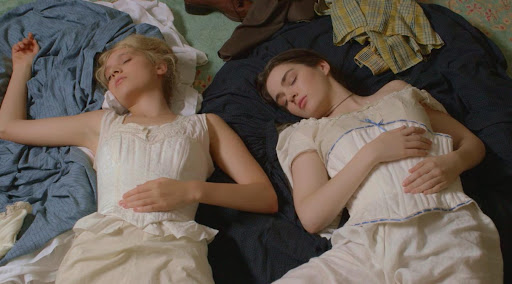
The movie shies away from portraying Emily as cruel and selfish, but there is a moment in the movie where Emily seems to roll in her bed with another lady just to make Susan jealous. She certainly was no womanizer, but that scene destroys the cliché of the virginal poet, because carnal knowledge entered Emily’s and Susan’s relationship in their teenage years, and both women, however spuriously, met other people.
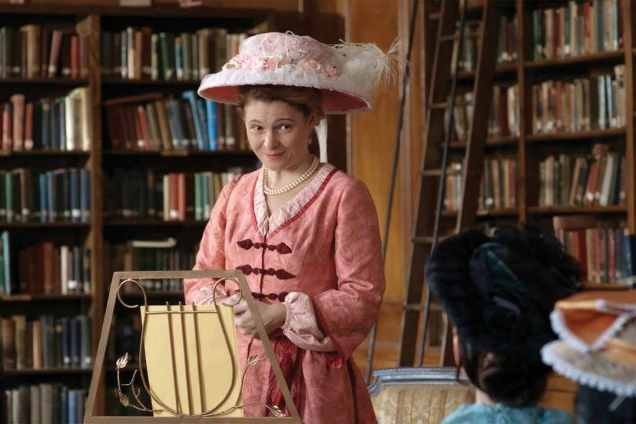
And there is also Mabel, who is hired to play the piano for Emily, but never gets to see her: she is seated on the ground floor while Emily hears the tunes while sitting in her upstairs room, listening on her own. Mabel will go on to seduce Emily’s brother, maybe because she likes him, maybe she wants to get at the poems. The movie pretends that it was her who, after Emily’s death, erases Susan’s name from all of the poetry and suggests that there was a man involved. Mabel also goes on tour, telling the life story of the famous poet whom she has never met in person.
There is also Higginson, editor of the Atlantic Monthly, answering Emily’s letter in person. He says that her poems are not fit for publication. Emily seems disappointed at first, but the movie takes that rejection as the motivation to write even more. Wild Nights with Emily is tamer than the title suggests, but it is a kind of alternative riff on the life and times of Emily D. The tone of the movie is all over the place: it’s part biopic, part Drunk History and part filmed stage-play. Those puzzle pieces do not wholly fit into each other, but the cast saves a lot of scenes that would go nowhere. Molly Shannon plays her Emily as a very determined, lonely, slightly desperate and sometimes bitterly funny woman. In some scenes, I had to think of her as Fleabag before her time. Susan Ziegler plays Susan with the exasperation of a woman who wants to keep her lesbian love a secret but finds Emily’s love letters in places they should not be found. Amy Seimetz has the thankless role of portraying Mabel who seduces Emily’s brother, tells the falsified story of Emily and later forges all the letters, erasing Susan’s name.
Maybe the movie’s strongest argument is this: give Emily a bit of room to breathe. The harder you cling on to the myth of the lonely hermit poet, the more you insist on the argument that Emily’s poems were directed towards an unknown male rather than a well-known female.


 It still gets me, that scene. I think I must have been ten or so, and there was nothing to prepare me for what would come on the telly. No-one in my family was any kind of art-house movie nut, so it must have been a coincidence that Buñuel’s short Un Chien Andalou was on. And then that razor cuts through the woman’s eye. It took me days to recover. Not many other movie moments have stayed with me because of their violence, and none as long as this one.
 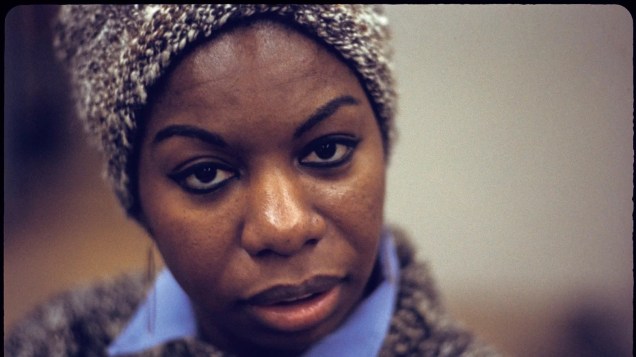 I was in Berlin last summer, getting my bearings back, and I walked past a bar where someone played a live version of Nina Simone’s take on Sinnerman. Honestly, my friends, there cannot be many more songs such as this one getting under my skin like that. She wants to make light because the rhythm of the song wants to sound so jolly, and it does, but then that voice comes in and puts a damper on the cheer, warning about what is going to happen, turning the rhythm from jolly to urgent. And yet there is hope somewhere, not much, but just enough.
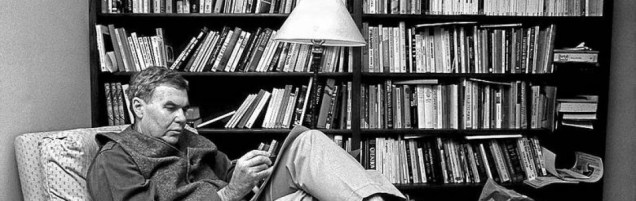 The most grassroots definition of a writer’s writer, I guess, is one whose writing you love to bits and immediately want to tell your friends about. In other words, somebody really good but still undiscovered. Katherine Dunn. Marisa Matarazzo. Esther Morgan. Sofi Oksanen. Greg Hollingshead. Rick Bass. Please feel free to add your own favourite obscure authors, and you will never run afoul of the definition above. Another, slightly looser definition might be that there is a lot you can learn from a writer’s writer for your own writing, such as dialogue from Elmore Leonard, or cliché-free sci-fi from China Miéville.
  A Damn Fine Cup of Culture