Welcome to ancient Rome, filtered through Federico Fellini’s sensitivities – which may as well be saying: unfiltered. But this isn’t your parents’ ancient Rome, or perhaps it is exactly your parents’ ancient Rome: one that is filled with corruption, debauchery and cruelty. Expect images, scenes and ideas that go far beyond the strangeness and excess of earlier Fellini films: here’s a beautiful young woman who won’t put out to just anyone, so an old sorcerer curses her so that fire comes out of her vagina (which the villagers use to light their kindling), and there’s a dead poet whose last will was that his belongings go to those who will eat his remains, so they begin to tuck in.
Welcome to Six Damn Fine Degrees. These instalments will be inspired by the idea of six degrees of separation in the loosest sense. The only rule: it connects – in some way – to the previous instalment. So come join us on our weekly foray into interconnectedness!
Choice is a blessing. I grew up in a place and at a time when only a handful of TV channels were available, and you were at the mercy of an antediluvian evil called the “TV programme”. You were bored on a Wednesday afternoon after school? Well, though, there’s nothing on. Wait an hour and you might get some anime adaptation of a European kids’ classic, with a black-haired moppet running around the Swiss Alps – and that’s if you were lucky. As a child, I watched a lot of TV, and usually not what I wanted to watch but what was available – so I’d will myself, not always very successfully, into thinking that what was available was also what I wanted to watch. And sure, as I grew older, my choices grew alongside me: more TV channels, plus there were the video tapes sent to us by my uncle in the UK – but especially TV remained this wasteland of non-choices: it’s Friday evening, the parents are out, I can watch whatever I want… as long as it’s a stupid Italian action comedy, or a French film about a couple of parents whose child dies, or perhaps, if I’m lucky, Ghostbusters or Raiders of the Lost Ark… dubbed into German. And that was one of the good evenings!
These days, TV channels still exist, but do people still watch them? Do they still follow the TV programme, and go, “Oh, look, The Godfather Part III is on, let’s watch that – or would you rather see that movie in which Idris Elba and his daughter are stalked by a lion they’re showing on Film Four right now?” More likely, people grab the device of their choice and go, “Hmm… Is it a Netflix evening or a Disney+ one?” And there, at their fingertips, are hundreds of films and TV series, and these days even games, that all come with the subscription to the streaming channels. All that choice – and it’s a curse. When you can pick from a hundred things what to watch, how can you pick? It’s a miracle that more people aren’t found dead in front of the streaming device of their choice, their finger forever poised to scroll further down on the feed.
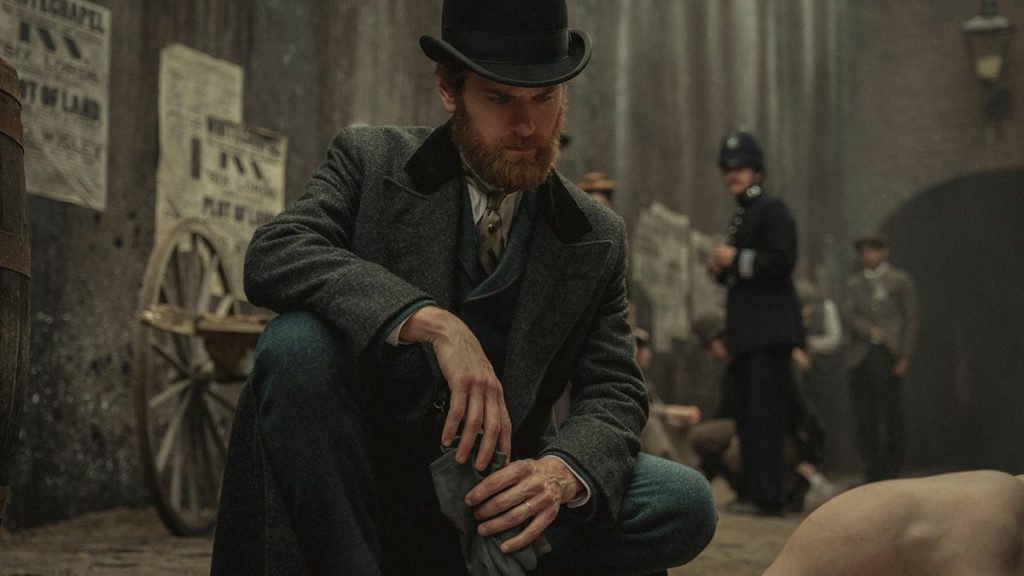
Imagine: a body is found in a London alley in 1890. The man is naked, and it looks like he was killed by a gunshot to the head – or, more accurately, to the left eye. He also has what seems to be a strange tattoo on his left wrist. But that’s not all: the same body is found in the same place… in 1941. And, again, in 2023. In 2053, the man is found, but he isn’t dead yet – he’s clinging on to life. And four detectives from the Metropolitan Police investigate the mystery in four eras.
Sound intriguing, if perhaps in a somewhat mystery-boxy way?
Now imagine: you’ve got an engaging hook, with lots of pulp sci-fi potential – only to squander it away in a story that rehearses the same old tropes of time loop narratives and dystopian fiction, with characters that are either drab or clichéd or both, and a script that could have been written by generative AI. And the cinematography is as dreary and flat as the writing. And, in case you haven’t guessed: yup, it’s a Netflix production.
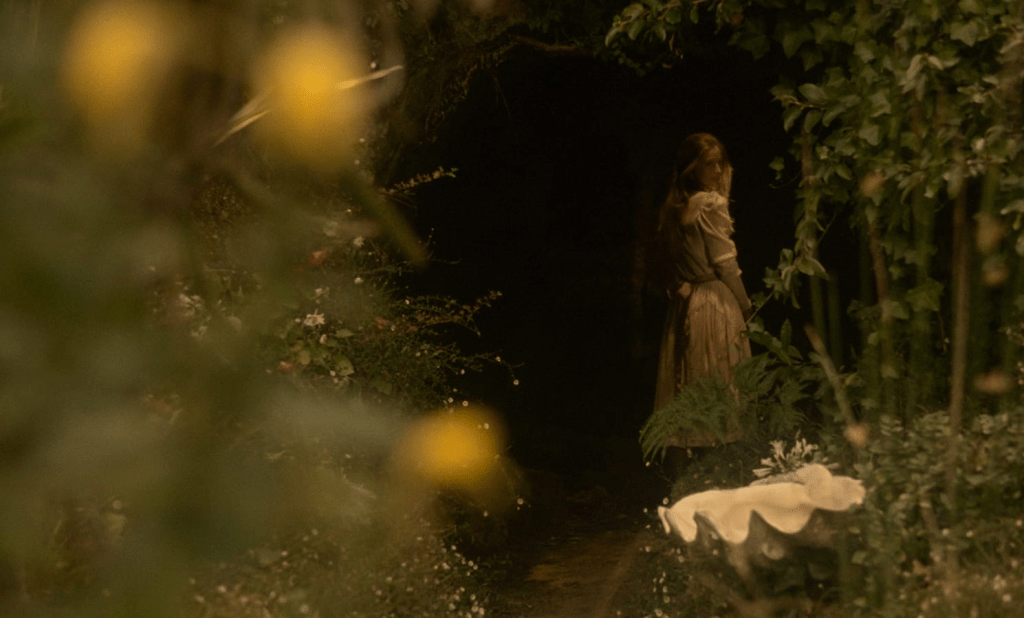
Stop me if you’ve heard this one before: pupils from a girls’ school in Australia go on an outing to a nearby geological formation. Some of the girls go to explore the area – and disappear. One turns up later, with no memories of what happened. The others remain gone. No traces are found, no blood, no bodies. Nothing.
The mystery is never solved. And it is this, not knowing what happened, that begins to corrode the lives of those left behind.
We’re back, several months after 8 1/2 (sorry!), with a film that I find frustrating and confounding – and yet I’m difficult to shake it off: Juliet of the Spirits. Two years after Fellini’s last film, and after two movies in which Marcello Mastroianni played variants (albeit more overtly attractive ones) of the director himself, Fellini cast his wife Giulietta Massina, for the first time in eight years (he’d last directed her in Nights of Cabiria) – and, in a twist on what he’d done with Mastroianni, Masina plays a character not dissimilar from herself: Giulietta Boldrini is an upper-class housewife, married to a philandering, self-centred husband, and while the details are vague but specific enough to show that the Boldrinis aren’t literally Fellini and Masina, the constellation of their marriage isn’t a hundred miles from that of the famous film-making couple.
Welcome to Six Damn Fine Degrees. These instalments will be inspired by the idea of six degrees of separation in the loosest sense. The only rule: it connects – in some way – to the previous instalment. So come join us on our weekly foray into interconnectedness.
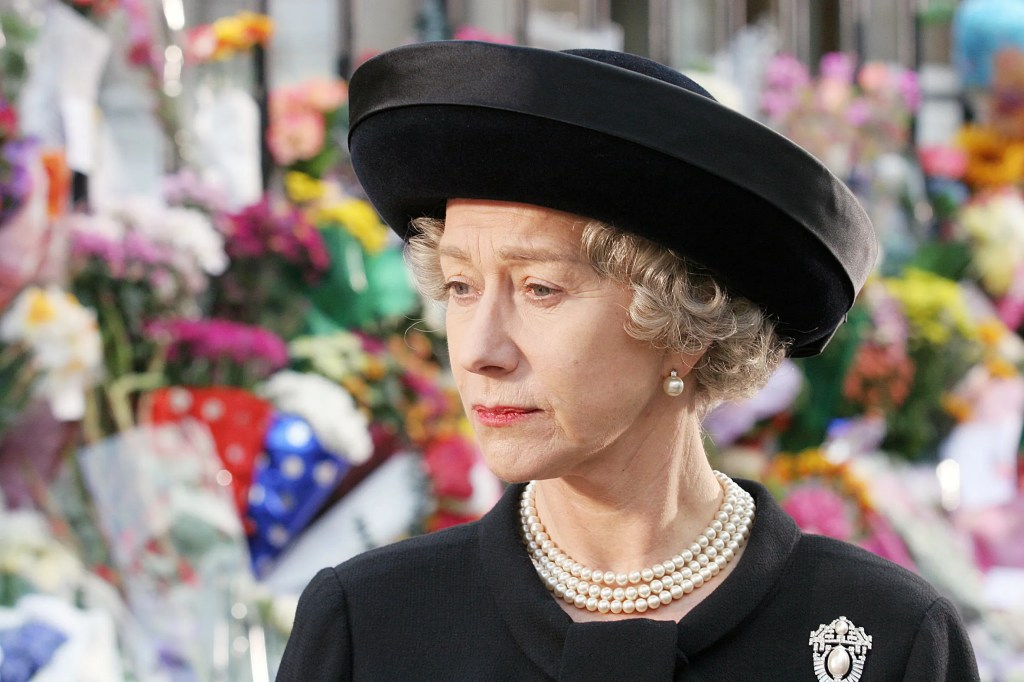
There’s always something strange to watching an actor play a real person, doubly so when the actor in question is one we know, and know well, from other parts, and triply so when that real person is still alive. Oh, look – there’s Gary Oldman playing Lee Harvey Oswald, and there’s Bruno Ganz as Adolf Hitler! There’s Helen Mirren or Emma Thompson (did you know that?) playing Queen Elizabeth II! Is that a trio of Truman Capotes or is that Philip Seymour Hoffman, Toby Jones and Tom Hollander having a chat? We recognise Taron Egerton, but we also recognise the bespectacled pop star he’s playing. We know that neither Michelle Williams nor Ana de Armas are Marilyn Monroe, but when we watch them on screen they are somehow both. And is it comforting or monstrous (or both at the same time) that the horrible person in the Oval Office isn’t actually Donald Trump but Brendan Gleeson playing the man?
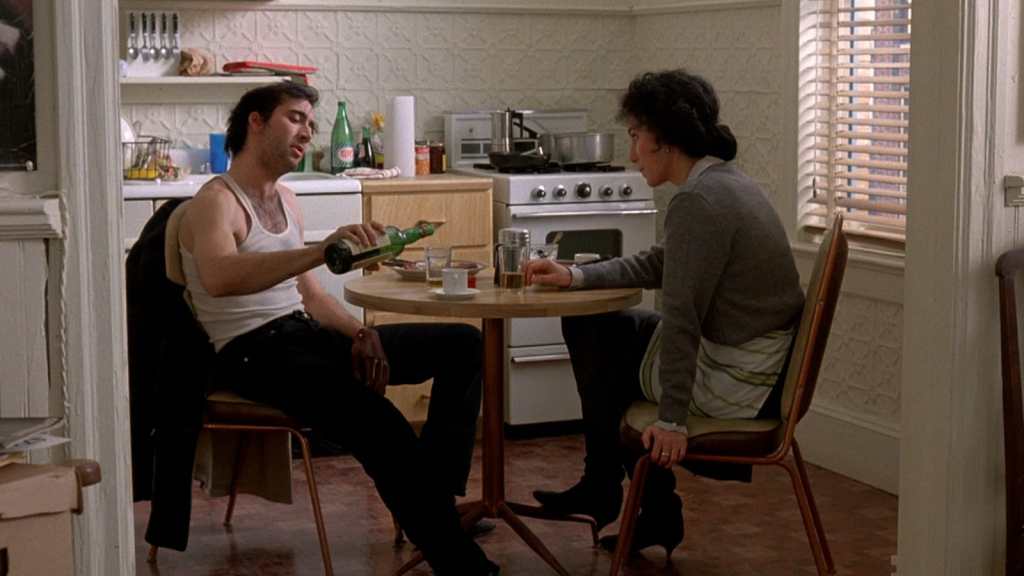
I’ve said so in the past: I’m the wrong person to talk to about romantic comedies. I don’t dismiss the genre altogether, but I find too many of them twee, manipulative and rather toxic, and that has coloured my perception of the genre as a whole. All too often, these films embrace iffy ideas of what relationships are and what they’re supposed to be, and even when they try to be hip and with it, they tend to espouse notions of gender that aren’t just heteronormative but downright reactionary.
But: I love it when a romantic comedy really hits. And Norman Jewison’s 1987 hit Moonstruck – which went on to win multiple Academy Awards – is certainly a prime example of this.
One of the things that video games can do magnificently is create worlds. These posts are an occasional exploration of games that I love because of where they take me.
Still Wakes the Deep is a recent horror game made by the developer The Chinese Room, who had previously released two games I’ve written about, Dear Esther and Everybody’s Gone to the Rapture (the latter of which I wrote an entry in this series about). While the staff turnover at The Chinese Room has resulted in a company that looks very different from the one that made these earlier games, Still Wakes the Deep nonetheless carries the DNA of earlier titles by the developer; perhaps many of the people working at The Chinese Room these days were inspired by the likes of Dear Esther and Everybody’s Gone to the Rapture to apply at the company.
Thinking back to television when I was a kid – that is, the early 1980s in Switzerland -, I mainly remember these: German entertainment shows featuring all the beige in the world, the cheesy US series of the late ‘70s and early ‘80s, the likes of Simon & Simon and Knight Rider, and the Japanese anime adaptations of (mostly) European children’s literature, from Heidi to Pinocchio. Just as much as the daily and weekly fare, though, I remember the ‘prestige television’ of the time: the big miniseries that featured impressive casts and that by and large were concerned with more mature themes. I remember these being something of a family event that we’d gather in front of the TV to watch: Roots, Fatal Vision (starring Karl Malden, that big-nosed embodiment of integrity), the German Das Boot (which I’ll always think of as a miniseries, since I don’t think I ever saw the original cinema edit). To pre-teen me, these felt excitingly like grown-up television, and while I would probably not have put it like that at the time, they felt so much less generic and more ambitious than the ongoing series I was otherwise watching at the time.
Hirokazu Kore-eda‘s Still Walking was the second or third film by the Japanese director that I watched, after After Life and probably Nobody Knows. In some ways, I now recognise it as a more typical film for Kore-eda than After Life, in terms of its themes and character constellations. Where the earlier filmundoubtedly has the feel and emotional heft that I’ve come to recognise as typical of a Kore-eda film, it is much more high-concept in terms of its premise and plot. More than that, though, when I think of Kore-eda, it‘s his families, both biological and found, that come to mind, and where family isn‘t as obviously a theme of After Life, Still Walking is very much about this: the families we find ourselves saddled with, the ones we make for ourselves.
But family isn‘t just about the people we have in our lives, it is also about those we have lost. Still Walking is focused on a theme that is central to many of the director‘s films: considering the kindness and warmth that are perhaps the most apparent characteristic of Kore-eda‘s films at a first glance, it is striking how many of them are in no small part about death.





 A Damn Fine Cup of Culture