Lars von Trier is a highly talented artist. He is also a bit of a troll – not due to this Nordic origin but his obvious enjoyment of getting a rise out of people in often obnoxious ways. I’ve found the handful of his films that I’ve watched a mixed bag: at turns intriguing, affecting and annoying, as well as manipulative in ways that are skilled but a little too obvious at times.
Melancholia lacks the impishness of some earlier works of his, except perhaps on an aesthetic level – I’d be surprised if von Trier hadn’t banked on the slo-mo beginning of the film raising a few eyebrows and tempers (and prompting some people to ask for their money back because they felt they’d ended up in Zack Snyder’s movie adaptation of Millais’ “Ophelia”). For a von Trier, Melancholia is remarkably sedate, not to say mature (a word I expect the director would not be too happy with). It lacks the borderline sadistic, “Let’s see how far we can take this” showiness of, say, Dogville, but it is no less intriguing for this.
To a fan of the director’s work, does Melancholia feel like a compromise, an appeal to more mainstream audiences? Both von Trier and his fellow European provocateur, Michael Haneke, received praise from the critics’ establishment for their most recent works, yet at least in the case of the former there was a faint note of disappointment: if we can’t trust the vicious jester of cinema to irritate us in inventive ways, who will do it instead? As a non-fan who has rarely felt the visceral annoyance that some people get from von Trier, nor the equally visceral enjoyment that others feel, I found Melancholia intriguing, beautifully acted and absolutely gorgeous to look at. Without going for a conventional aesthetic, von Trier brings an evocative, painterly eye to the film, playing especially effectively with the haunting light the eponymous planet threatening Earth throws on the film’s protagonists and scenery. In terms of cinematic apocalypses, this is one of the more subtly effective ones, evoking an intimate sadness that is miles from von Trier’s sometimes tendency to, well, troll his audience.
P.S.: As far as end-of-the-world movies are concerned, my favourite may still be Don McKellar’s Last Night, a film that couldn’t be much more Canadian if it tried and that gives the wonderful Sandra Oh a blessed chance to shed her hospital duds.
It’s time for some superlatives: to my mind, Michael Fassbender is one of the most exciting actors of his generation, and Steve “Not that one!” McQueen is one of the visually most accomplished directors making films these days. Not many people could make fecal mandalas on prison walls intriguingly beautiful, but McQueen managed this with a deceptively effortless grace in Hunger, his film about Bobby Sands’ death. Not coincidentally, the other main strength of Hunger was Michael Fassbender’s electric performance.
Fassbender and McQueen seem to bring out the best in each other, since their 2011 film Shame is yet another movie with amazing visuals and a brave central performance that serves the film’s story perfectly. On paper it sounds like festival fodder: Shame depicts a sex addict’s descent into his personal hell after his sister, with a whole set of issues of her own when it comes to relationships, comes to stay with him. Yet in the hands of its director and star, and with the more-than-capable help of Carey Mulligan, Shame doesn’t feel like it’s pandering to a particular audience, doing its own thing instead, and to great effect.
If there’s a list of films featuring depressing sex, Shame is definitely in the top 5 (other candidates would be 28 Grams and Blue Valentine – a threesome between those three movies would probably create the sad sex singularity that effectively ends the world because no one would ever procreate naturally again). Strangely, though, for all the joylessness of Brandon’s sexual misadventures, there’s a genuine joy to watching a film as confidently handled, visually entrancing and perfectly acted as this.
P.S.: Some reviewers and bloggers accused Shame of homophobia, as during his climactic (no pun intended) long night’s journey into hell he gets a temporary fix by getting a blowjob in the underworld of a dungeon-like gay club, the argument being that McQueen depicts gay sex as the absolute lowest point in Brandon’s odyssey towards some sort of happiness. To my mind, those reviewers ignore that while the encounter is demeaning and joyless, the same is true for practically each of Brandon’s sexual encounters. The scene is followed by an extended threesome with two (female) prostitutes, which is arguably more aligned with generic male fantasy, yet this menage à trois is presented as no less demeaning, nor any more enjoyable. There is nothing in the blowjob scene to suggest that it’s to be read as worse for the character than what happens before or after it. If McQueen had wanted to show gay sex as the worst option for a sex-addicted straight man, surely a director as in control of his material as him would have found a more effective way of showing this, wouldn’t he?
In case you were wondering whether I was ever going to write another blog post, fret not – I’m back with material for the next few posts. And yes, this warrants me taking issue with one of the little green jedi master’s famous pronouncements: sometimes size matters indeed.
Let’s contextualise this so your imagination doesn’t run away with you: as a film geek I like to see my movies on a big screen, so at home I’ve got a 50″ plasma HDTV that I’m fairly happy with – friends of mine buying bigger televisions notwithstanding. Most of the time I’m absolutely happy with the size of my screen… but then there are those times when a TV of that size doesn’t feel all that much bigger than the televisions of my childhood.
And one of those times is when watching Lawrence of Arabia on Blu-ray.
The cinema of David Lean is generally of the grandiose kind, calling for the big screen experience – though never more so than with Lawrence of Arabia. This isn’t just about beautiful visuals, by the way; it’s been years since I’d last watched the film, but even among visually stunning movies it stands out. Some of its brethren live almost entirely off their visual splendour, and once this aspect is removed they’re nice but by no means spectacular. Lean’s masterpiece, though, uses its cinematography to amplify the effect of its story and characters. It is undoubtedly epic, yet at the same time it is one of the most intimate epics I can think of. The size of the screen it’s viewed on doesn’t just make for pretty desert shots (and undoubtedly they are very pretty), it also pulls you that much more into the character of T.E. Lawrence (as played by a Peter O’Toole that has rarely been better), an intriguingly ambiguous character.
It is often said that “they don’t make ’em like this any more” when talking about modern Hollywood cinema, which may or may not be facile nostalgia hankering for a past that was rarely as good as (or in the ways that) people think it was. I wonder whether they ever made ’em like Lawrence of Arabia, though – this is not the big-emotions, big-visuals melodrama of Doctor Zhivago (a film that’s much better than I’d originally remembered, mind you), nor is it the action of The Bridge on the River Kwai, although both of those have some elements that recall Lean’s desert epic. No, for all the moments in other films that recall this one, Lawrence of Arabia is very much one of its kind, like its eponymous character.
And yes, it may just be the best advertising for a truly big TV screen.* Titanic? Avatar? Prometheus? Sit down and let the grown-ups show you how it’s really done.
*Okay, if it’s just visuals you’re looking for, any Terrence Malick or even Andrei Tarkovsky might do the trick – but a world where shops selling televisions showcase their wares with The Tree of Life or Stalker are likely only to exist in long-lost episodes of Fringe.
P.S.: In spite of my pinko liberal credentials, I find myself entirely unbothered by the Brits and Mexicans in brownface playing Arabs. Go figure.
Computer games are a strange medium for art, and gamers are a strange audience for it. As soon as a game comes out that aspires to art, it takes about five seconds before someone on the internet gets out the big word: “Pretentious.” Give it another ten seconds and someone will say, “Ah, but is it a game?” It’s as if too many gamers would prefer their medium to be one thing only, forever, with no potential to become something more. And that’s ignoring the other side of the debate, the old-timers shouting, “Get off my MOMA-curated front lawn, you kids!”
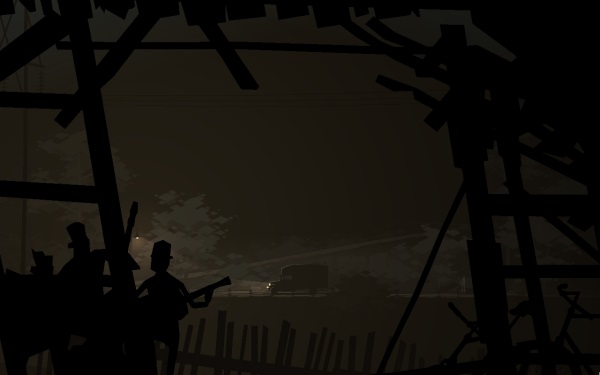
I wonder what Old Man Ebert would say about Kentucky Route Zero, an indie adventure game whose first part (or Act – the game wears its many artistic inspirations on its sleeve) came out a couple of months ago. It’s as if David Lynch, Edward Hopper and Gabriel Garcia Marquez had collaborated on an old-school point-and-click adventure – but while it’s easy to point out how Kentucky Route Zero derives from a number of artistic traditions, in its first act it already manages to become something entirely its own and entirely of the medium, doing things that wouldn’t be possible in this particular way in any other medium.
The game excels at atmosphere, evoking a mood that is homely and uncanny at the same time, nostalgic and unsettling. As much as Lynch at his best, Kentucky Route Zero is dreamlike, surreal around the edges, but without giving in to the facile randomness that surrealism is sometimes prone to. The art, the writing, the soundscapes and music – all of these come together to create one of the most unique, compelling experiences I’ve played, well, since I took hold of a joystick in the early ’80s.
It is likely that hardcore old-school gamers without an interest in unique experiences with, yes, artistic pretensions will have issues, though. Compared to the classic games of the genre, Kentucky Route Zero doesn’t offer challenging puzzles. In fact, there are hardly any puzzles in the conventional sense as well. What the game does offer, though, is exploration – in more than the expected way. The characters, the conversations, even such simple things as a ride through an old mine on a cart, all these offer glimpses into a world one step away from our own.
It’s difficult to give any criticism that seems adequate. Yes, Kentucky Route Zero Act I is a short pleasure; in the conventional terms of game longevity, it does lend itself to multiple playthroughs so the different conversation choices can be explored, but for the asking price of $7 it offers a couple of hours of gameplay only. However, for gamers in any way receptive to the moody, fascinating world the game evokes, those couple of hours will linger long after Act I closes.
P.S.: Act II is to come out within the next month or two; the entire game can currently be bought for under $20. For anyone who’s simply curious to check out the look and feel of Kentucky Route Zero, the developers have released a free tech demo called Limits & Demonstrations that provides a glimpse especially into the project’s overall artistic sensibilities and the writing. Well worth checking out, which shouldn’t take more than half an hour.
What is a film director’s job? Ask a number of different directors and you’ll get very different answers. For some, working with the actors is an integral part of the job; for others (such as Ridley Scott), acting is solely the responsibility of the actors and the director’s there to focus on the look and feel of a film. (At which point the cinematographer may be going, “What about me?”) Here’s what Wikipedia has to say:
Generally, a film director controls a film’s artistic and dramatic aspects, and visualizes the script while guiding the technical crew and actors in the fulfillment of that vision.
Remember Tom Hooper? He directed The King’s Speech, the HBO miniseries John Adams – and Les Misérables, the film version of the Boubil and Schönberg musical. Based on all of these, I am confident in saying that Hooper does a magnificent job at getting great performances out of actors. I am equally confident in saying that, at least according to the Wikipedia definition as well as my own understanding of what a film director does, Tom Hooper is one of least talented successful directors of recent times.
I don’t want to get into the whole discussion of Les Misérables‘ recording the actors’ singing on set. I don’t even mind (well, not all that much) that Russell Crowe can’t really sing and that he butchers Javert’s songs in the film. When there’s a choice between flawless singing and acting at the expense of voice, I tend to favour the latter, but then musical fans may wonder what’s the point of having your actors singing if the acting gets in the way of a good tune.
What I do want to get into is Hooper’s downright obnoxious use of the camera. Already in John Adams, a handsomely produced, beautifully acted, intelligently written series, the director kept throwing in jarring dutch angles, their main effect being that they drew attention to themselves. It didn’t feel like a conscious use of a technique in order to achieve a certain effect; instead it felt like a directorial gimmick, a distracting flourish with little to no relation to what was going on on the screen.
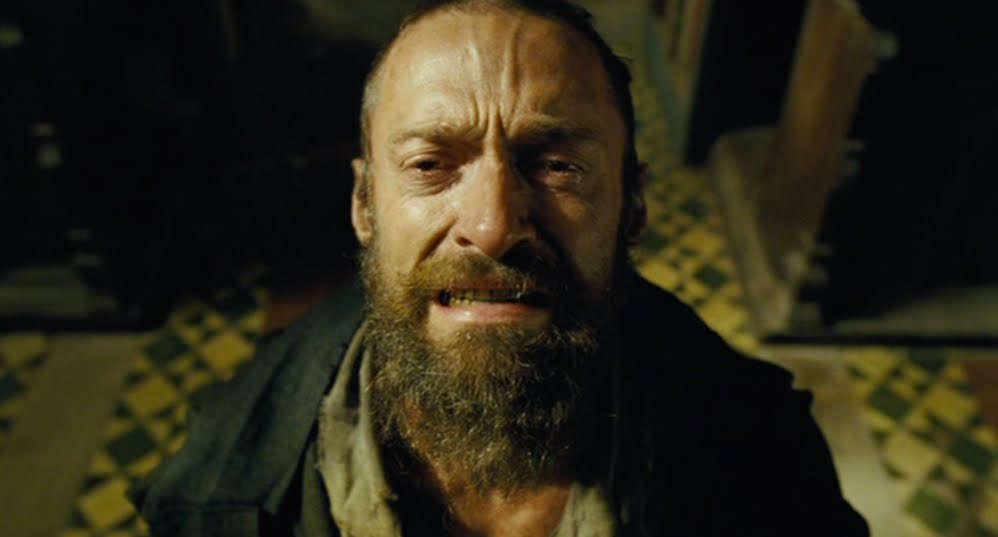
This obnoxious use of ostentatious techniques is taken to extremes in Les Misérables. Practically the whole film is shot in hand-held, dizzying close-ups – and it’s too intimate. It’s too intrusive. And where it’s effective for a few minutes, it turns into a freakshow – less a method of putting as little distance between the acting and the audience and more a “Check out the tears! The snot! The blood! It’s all real!” Apart from the technique becoming almost exhibitionist when it’s used in 90% of all the shots, there’s no modulation, no rhythm to the images. Crowd scenes, intimate moments of soul-searching, Hooper treats them all the same, to the point where you have to wonder what the hell the director’s doing.
The sad thing is, for every moment where Hooper’s technique is effective there are ten scenes where it’s irritating and distracting. We’re supposed to feel with the characters, and the poor actors are acting their hearts out, but the camera keeps putting us uncomfortably close, so that scenes tip into becoming embarrassing or involuntarily comical. When the film is at its worst, what should come across as earnest and heartfelt becomes pushy and needy. As a result, the film rarely works as the grand spectacle it was written as, and it rarely works as intimate drama. Mr Hooper, seriously – techniques should be geared towards what the film needs, they shouldn’t be an affectation or a nervous tic. You do great when it comes to getting performances from your actors… and then you shoot yourself in the foot with everything else. Do me a favour and read this before you make your next film, ‘kay?
I’ve been underwhelmed by three of the most recent films I’ve seen: Zero Dark Thirty, Django Unchainedand Lincoln. Yet these are all films that have received rave reviews from the critics; for instance, Kathryn Bigelow’s latest received a Metacritic score of 95/100, Django Unchained has a Rotten Tomato score of 88 out of 100, and all three were Best Picture nominees at the recent Academy Awards.
Obviously an argument can be had about the Oscars and whether they truly reflect what’s best about movies – an argument I’m not particularly interested in getting involved in. What I’m more interested in is this: do all these films depend on the particular culture that gave birth to them? More specifically, to what extent do they depend on an American audience?
As a non-American, it’s not that I’m disinterested in the films’ topics, but I don’t have any connection to them. Slavery, particularly as it was practised in the United States, and the hunt for Osama Bin Laden – neither of these have any particular, personal relevance to me. Going into the films, though, I felt that they required, perhaps even demanded such a personal connection to be at their most effective. For an audience that saw the 9/11 attacks as aimed at them – not at the Western world in general, but at them as Americans – it might be easier to identify with Zero Dark Thirty‘s heroine and her obsessive hunt for Bin Laden. For an audience that culturally still lives in the aftermath of slavery and its legacy, the sight of a black gunslinger exacting brutal revenge on the one side of the cinematic spectrum, on the other a tall, gangly president seeking to end not only a war but a racist, inhumane practice deeply entrenched in the national culture – I expect that these resonate in ways particular to that audience.
Except that resonance wasn’t there for me. Whereas 9/11 felt like a shared event even on this side of the Atlantic (with some caveats – the discussion on the terrorist attacks very quickly became critical of the United States in Europe), the hunt for Bin Laden didn’t. The most personal connection I have to slavery is remembering seeing Roots on TV, which barely counts. Yet there are films that manage to make essentially American topics more universal, where I don’t feel I have to have grown up in a specific culture to connect to them. Did these three films end up less effective, and less successful as movies, because they were aimed at a very specific audience?
It’d be interesting to hear some opinions on this issue. What were readers’ opinions of these three films? To what extent did you feel that they spoke to you – or failed to speak to you?
Note: While Argo could also be said to be about a particularly American topic, it didn’t feel like it to me. This doesn’t mean I agree with the Academy’s opinion on the film – I enjoyed Argo but would call it a good film, not a great one – but in the end I enjoyed it more than either Zero Dark Thirty, Django Unchained or Lincoln. Then again, I haven’t fully enjoyed any of Spielberg’s movies in a very long time… but that may be material for another blog post.
I’ve written about the first season of Charlie Brooker’s Black Mirror when it first aired (here and here). I didn’t consider all three of the original episodes equally successful at presenting a dark, satiric funhouse reflection of people in the age of omnipresent smartphones, tablet computers and social media, but Brooker’s takes on how technology reinforces human nature in weird but not always wonderful ways were always eminently watchable.
To my mind, the second series (which recently finished on Channel Four) dropped the ball somewhat on its final episode, but again, it has held a fascinating black, quite possibly Apple-branded mirror up to us, and the reflection is not always pleasant. It’s not necessarily scathing, though, so much as sad; other than in his editorials, though, Brooker tempers his satire with empathy for his characters. Well, some of them. Let’s look at the individual episodes, though:
Be Right Back
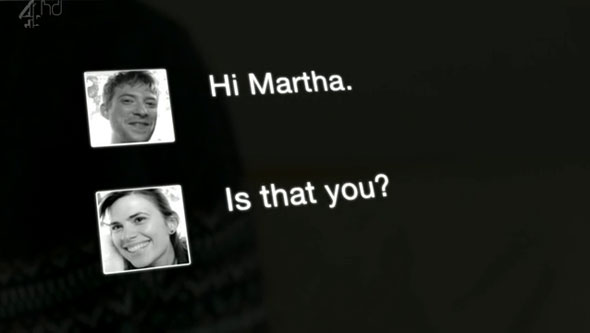
The first episode is probably the one I liked best, and it is the one that I related to most. “Be Right Back” is the story of a woman whose husband dies in a car crash; a friend, also recently bereft, signs her up to a service that creates a simulacrum – first virtual, later physical – of her husband based on his digital footprint: his Facebook posts, his tweets, his e-mails, the many photos and videos. (Sound far-fetched? Check this site out and tell me if it still does.) While initially the simulation consoles her, being almost like her husband in how he talks and acts, that almost becomes impossible to bear, in a sort of emotional uncanny valley effect. So much of him is there, bringing into stark contrast the ways in which the simulated husband falls short of the real thing.
Perhaps more than most episodes, “Be Right Back” needs its near-future vision of where technology will take us to tell a story, but the story it tells is not about this technology. It’s about loss, mourning and the inability to let go. It’s about the characters, which is why it works eminently well but perhaps falls somewhat short in its ability to comment on the titular ‘black mirror’. Still, it makes you wonder: what if the sci-fi tech had created a more perfect copy of the protagonist’s husband? Is it the imperfection of the process, the ways in which its result falls short of reality and memory, that’s the problem? There are shades (or perhaps digital ghosts?) of Solaris that resonate throughout the episode.
White Bear
If “Be Right Back” was tragedy, “White Bear” is closer to the horror genre, reminiscent of 28 Days Later: a young woman wakes up with no memory (except for occasional flashes) of who she is. Trying to figure out her situation, she finds that everyone films her or takes photos on their smart phones, but otherwise they ignore her – except for the masked weirdos wielding shotguns, electric saws and other implements of unpleasantness. They’re the hunters, apparently using the disconnected voyeurism of the watchers to do whatever they damn well please, including torture and murder.
So, a comment on how people make themselves into audiences, how they film violence and atrocities and put these online for all to see, instead of becoming involved and helping those at the receiving end of the violence? Wrong, at least sort of: the episode pulls the rug from under the main character’s (and our) feet, revealing that this whole thing is an elaborate, grotesquely ironic punishment: she is a convicted criminal, having filmed her boyfriend torturing and killing a child, so her memory is wiped and, in a modern twist on Dante’s contrapasso, her crime is visited on her… day after day after day.
In other words, the episode is about mob mentality, witchhunts and how modern media twist justice by ‘democratising’ it, right? Well, that’s partly the problem: the episode is about both of these things, to some extent, but I’m not sure it succeeds at bringing them together in a satisfying way. Arguably, the sort of disconnectedness that can be heightened by perceiving everything through the filter of a digital camera or smartphone can in turn reinforce the mob’s hunger for revenge, which in turn isn’t necessarily far from a simple hunger to see lions tearing apart Christians in the arena. And there’s clearly the irony of the punishment making the ones inflicting it (the audiences with their phones and cameras) into the person they’re punishing, mirroring her crime. But the two themes are an uneasy fit – and perhaps that unease is part of how Brooker tries to make us uncomfortable.
What is way more uncomfortable, though, and in that sense entirely in keeping with Brooker’s series and his themes, is how on so many online review sites a sizeable portion of the (mostly anonymous) commenters felt the episode’s punishment of its main character was absolutely, 100% justified, i.e. the bitch got what she deserved. Democratising justice, eh?
The Waldo Moment
I’m not sure I would have ended the series on “The Waldo Moment”, not least because it’s very clearly the odd one out. If Black Mirror is indeed about the effect the new media and technologies have on our lives, that element is utterly unimportant in the episode: yes, it features a motion-captured virtual cartoon, but the story could pretty much be exactly the same if Waldo, the sarcastic blue bear, were a sock puppet. The episode feels like a left-over from a different project, probably because that’s exactly what it is. (It incorporates material originally written for Nathan Barley, Brooker’s collaboration with Chris Morris of Four Lionsfame.)
“The Waldo Moment” makes a good point about the general cynicism about politics, and how so many of the things we blame politicians for – their pandering to the lowest common denominator, for instance – we’ve fostered in them ourselves. Politicians deserve to be criticised, but at least some of the blanket criticism they’re exposed to is hypocritical: we slam them for being undemocratic when they act differently from what we’d want, and we slam them again for lacking integrity and being in it for the votes only when they act in ways that appeal to the majority. Our cynicism is facile – and, Brooker suggests, dangerous, making us vulnerable to demagogues in the guise of those speaking the truth and sticking it to the man.
The thing is, while I think there’s something to the point, it is presented in a similarly shallow way that simply fails to carry the episode for its full length. Compared to “Be Right Back”, the characters don’t carry the story enough, and the pace is much slower than in “White Bear”. “The Waldo Moment” has material for perhaps half an hour, but even then it isn’t all that perceptive or incisive. There is one strong moment, both funny and chilling, where an American from “the Company” comes to the protagonist, the comedian who breathes life into foul-mouthed Waldo, and suggests a global roll-out, starting in South America. Indeed, if you’re in the business of toppling regimes, why not do it with a friendly blue cartoon face?
Regardless of being underwhelmed with the final episode, I’m curious to see where Brooker’ll take Black Mirror next – or, if he thinks he’s exhausted the topic, whether he’ll find another topic to turn into a fascinating, witty, angry, sad series. Waldo or not, I’ve enjoyed this journey into the near-future with Mr Brooker (to say nothing of the pig).
I want to say, “It’s not you, Quentin. It’s me.” But I couldn’t say it with much conviction.
What’s happened? Why the sad face on my part? It’s this: ever since first watching Pulp Fiction, I’ve been a Quentin Tarantino fan. This doesn’t mean that I love everything the man’s been involved in – I wasn’t too keen on From Dusk Till Dawn or Natural Born Killers, for instance – but I’ve greatly enjoyed his directorial work. While most people would go, “Yeah, I dig Reservoir Dogs, but fuck Jackie Brown, man, what a bore!” or “Kill Bill Part 1 rules, Kill Bill Part 2 drools,” I came away from all of them with a big grin on my face. Yes, even Death Proof, apparently the litmus test for Tarantino fans.
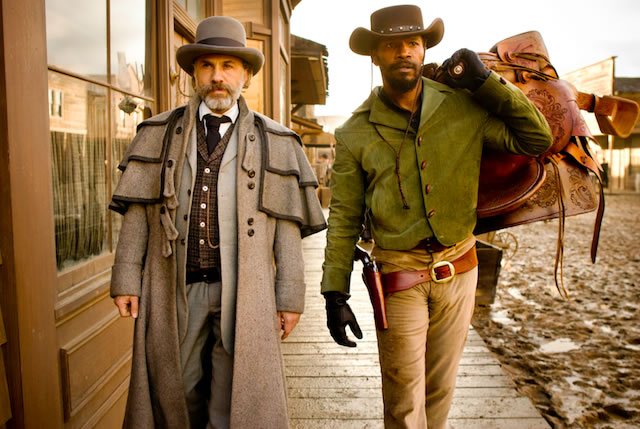
So what was wrong with Django Unchained? Let’s mention the positive first: I found the film very entertaining. It was funny, it had its tense moments, it was well crafted, it had good performances. Christoph Waltz was a joy to watch, Jaime Foxx was effective in the part, Samuel L. Jackson played a very different role from what I’m used to seeing. It’s just… I expect more than “very entertaining” from Tarantino. I remember sitting in the cinema for Jackie Brown and being hooked in the very first scene, thanks to the perfect combination of actress, visuals and music. I remember being pulled into the film immediately when Kill Bill started with a black and white close-up of the bloodied Bride and Bill doing his “Do you find me sadistic?” monologue, followed by the blackout and Nancy Sinatra’s “Bang Bang (My Baby Shot Me Down)”. With Death Proof it took longer – up until the halfway point I was prepared to hate the film for, well, finding it sadistic, but then things fell into place in the second part. And the first scene of Inglourious Basterds is prettymuch perfect in how it creates tension and then ratchets it up to unbearable levels.
I felt giddy about all of Tarantino’s earlier films, sometimes due to the sheer exuberance of what he was doing, often because of the virtuoso way in which he remixed styles and genres to amazing effect, usually because the films had a sharp wit and intelligence that might not be apparent at a first viewing. Django Unchained, though? I never felt giddy. I never felt excited at what Tarantino was doing. The closest the film came was Christoph Waltz’s character and performance, which were pretty much pitch perfect, but other than that the film was strangely flat. No surprising juxtaposition (and no, it’s not enough to have Ennio Morricone and 2pac on the same soundtrack any more), not much in the way of subtext. Especially after Inglourious Basterds, which did some pretty intriguing things with its revenge plot(s), Django Unchained is strangely, disappointingly straightforward – and often it’s the lack of straightforwardness, the eagerness to stray of the most direct path, smell the daisies and cut them to shreds in an ironically postmodern homage to grindhouse gardening (“Alan Titchmarsh stars in The Gardener and his Hoe!“) that make Tarantino’s work stand out.
I’m wondering whether some of my disappointment comes from slavery being much more of a cultural issue in the States, and accordingly it wouldn’t resonate with me in the same way that it might with an audience that is still confronted with its racial past. Perhaps that adds an element that simply wasn’t there for me. Or perhaps Django Unchained is Tarantino light, at least with respect to the things I like best about Tarantino. Anyway, I’m in no particular hurry to see the film again (I saw both Kill Bills three times each at the cinema), but perhaps the film will grow on me if/when I sit down to watch it again. And in the meantime I’ll finally see what Pulp Fiction looks like on my TV…
Wow. Just wow. Breaking Bad season 4 (yes, as always we’re a year or so behind the US) has done the series proud. Is it better than the previous seasons? I admit, there were moments when I felt the plot was spinning its wheels somewhat – we had scenes that were variations on earlier scenes without adding anything new, usually telling us something about Walter White’s personality that we already knew – and the season didn’t always maintain its well honed balance of plot, theme and characterisation, but when it worked (and it often did), boy, did it work… and off the top of my head, and before my first coffee of the day, I could mention scenes and whole episodes that were stronger than anything that had gone before.
And “Face Off”, the final episode of the season? I would put it up there with the most tension-building denouements I’ve seen or read in any medium. The way Vince Gilligan and his team have put together the individual building blocks to arrive at this ending for one of their most memorable characters, and the way it all comes together in Tio Salamanca’s muffled bell-ringing. As I’ve said: wow.
At the same time, Walter White – who I once thought to be a man trying to do as best he could in an impossible situation – has become one of the greatest villains in any visual medium. It’s difficult to read his tone of voice when he says “I won” at the end of the episode (it’s been described as smug and triumphant, but to me Walt’s shaking voice sounded not a little scared by what he’d become), but Bryan Cranston is pretty much perfect in his depiction of the character. Almost every episode of this season could serve as a master-class for budding actors, and a depressing one too – very few people will reaching the dizzying heights of Cranston’s performance and the character he has brought to life.
Just coming off the high of Breaking Bad‘s penultimate season, it’s difficult to segue neatly into the other season we’ve just finished watching, namely season 1 of Treme. I started watching David Simon’s latest with unrealistic, unfair expectations: The Wire is still the best thing I’ve seen on TV in many ways, and since Treme shares some of the earlier series’ main actors (Wendell “Bunk” Pierce, Clarke “Cool Lester Smooth” Peters) it’s even more difficult to shake these expectations. During Treme‘s first 4-5 episodes I kept repeating the mantra, “It’s not The Wire, it’s not The Wire“, which is true but not entirely fair: some of the themes are the same, but Simon and his cast and crew go for a different feel here. The series is much more meandering; it has a few plots threaded throughout the series, but character always comes before plot in this series.
I can’t pinpoint the moment when it all clicked – there were probably different moments for different characters – but by the end of the season, as the last episode of S1 transitioned into the flashback of all the characters preparing for Katrina, it definitely had. The writers and actors of Treme are impressively astute at balancing the depressing realities of post-Katrina New Orleans, at least for these particular characters, and the flashes of hope and humanity. I’ve never understood the people accusing Simon of cynicism (being a pessimist doesn’t make you a cynic!), and his deep sense of empathy has never been stronger than in Treme.
Except perhaps with Sonny, the Dutch louse – but given time even he could turn out to be human. Simon has a history of doing that… and I’ll gladly give him time to do so.
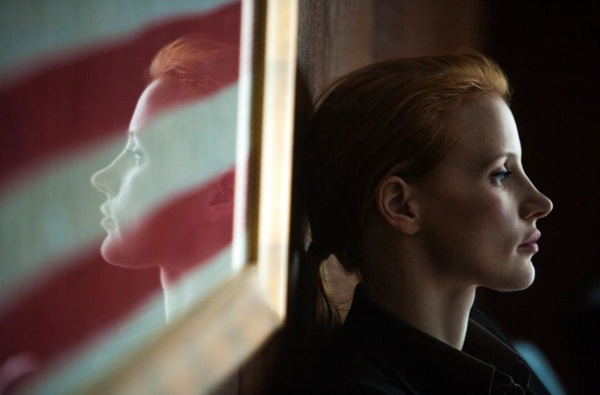
Anyone who’s used the words “Leni Riefenstahl” unironically to describe Kathryn Bigelow and her latest film, Zero Dark Thirty, needs to get a handle on themselves and a sense of proportion (and if they ever saw even an episode of 24, chances are that their frontal lobes would explode into mush). Seriously, if Zero Dark Thirty is supposed to be pro-torture propaganda, it is extremely inept at furthering a pro-torture agenda – and being inept at her craft is about the last thing you could criticise Bigelow for.
No, the problem with Zero Dark Thirty isn’t that it espouses problematic opinions – it’s that the film hardly has any opinion at all. It effaces practically every trace of an ideological or political position from its story, becoming one big Rorschach test in the process. Depending on one’s own view of the issues – the war on terrorism, the hunt for Osama Bin Laden, the use of torture – it’s easy to read any set of diametrically opposed intentions into the film. The same scenes can serve as evidence, with a bit of prodding and tweaking, that Bigelow approves of torture and that she sees it as a dehumanising evil, but without the outside input of the viewer’s opinions the movie does not forward any statement beyond “And then this happened.”
I don’t particularly want to get into the quagmire of What Really Happened. I accept that this is a fictionalised version of the events, added to which I doubt there’s an unadulterated, unbiased, and most importantly unredacted version of what happened that Bigelow – or anyone, really – had access to. My issue with the film isn’t its political position but its blankness, which makes it difficult to engage with the film. I like cinema to be ambiguous, I enjoy making up my own mind and thinking for myself, so it’s not that I wanted Zero Dark Thirty to tell me how to feel about what was happening – but the film, its events and its characters are such blank slates that there isn’t even much there to engage with. There is a distinction between even-handedness and utter neutrality, and Switzerland could learn one or two (or two-hundred) things from Bigelow’s latest.
As a result, I found myself thinking and feeling relatively little about what was happening on the screen, beyond “Yeah, this – or something like it – did probably happen at some point.” Shouldn’t the events on screen carry some dramatic weight? The main adjective describing Zero Dark Thirty for me is this: professional. The film is well directed, shot, acted, edited; there is little to fault (except one clumsily manipulative scene that makes the characters involved look stupid) except its blankness. If anything, perhaps its very basic plotting can be criticised – a mere string of events reminiscent of a schoolchild’s essay on “What I did on my hols hunting for Bin Laden” – or its pedestrian characterisation, but both of these reflect what seems to be Bigelow’s intention, not to impose anything on the audience. But, Ms Bigelow, imposing on the audience and giving them something, anything, to work with, those are two very different things. Should I come away from a film on this topic feeling faintly impressed by the craft, faintly bored by the sheer length of the movie, but mostly just blank?








 A Damn Fine Cup of Culture