Well, those two threads got together, had some glasses of wine and cuddled up under the blankets… and now, months later, voilà!
Because, obviously, Kermode would never have reviewed Tree of Life if it hadn’t been for my blog. Ob-vi-ous-ly. (In any case, it’s not one of the funniest or most cutting reviews, but that’s because Kermode’s reaction to the film, while more negative than mine, is fundamentally respectful if baffled and at times frustrated with Malick’s riff on Genesis, the Book of Job and Walking With Dinosaurs.)
Directed by Phyllida Lloyd of Mamma Mia! fame, no less!
At this point I’m hoping for a Being John Malkovich style mindfuck where everyone is a Meryl Streep character from one of her earlier movies. The sheer amount of different accents would make such a film implode and form a linguistic singularity.
In the game of Six Degrees of Kevin Bacon – The TV Edition, Oz must hold a special place: it seems like every other character is played by an actor who later turned up in The Wire, Dexter or (apparently) Law & Order: SVU. It’s also the first of the heavily serialised HBO programming, a trailblazer for later series such as The Sopranos, Deadwood and the aforementioned Bawlmore epic, The Wire.
Arguably, it’s also the weakest of all of these series, the one that holds up least well. No doubt about it – the people involved in this series are smart and talented, and there are wonderful moments throughout… but the longer the more, the individual moments of great writing or brilliant acting are hampered by the series’ tone. It tries too hard to be brave, hard-hitting, ironic, poignant, human, cynical, all mixed into one, and the result is that Oz can feel, clumsy hysterical and inauthentic. I don’t mean ‘unrealistic’ – I have no problem with a stylised approach. What the series does at times is manipulate the plot, characters and presentation To Make A Point. These moments come across as a mix between a heavy-handed editorial on social issues and a stand-up comedy routine by someone who’s less funny than he thinks he is.
It’s a shame, because the material is there, the actors are there, the themes are there. If the show runners had trusted Oz more to achieve what it sets out to do without trying so goddamn hard, the series would be up there with the best of HBO, I believe. Even as it is, there are moments that are fantastic TV – but then the next scene is likely to be as blaring and obvious as the soundtrack. Oh, the soundtrack. It’s as bad as the music in a Mike Leigh film, but more embarrassing.
We’ve got 2 1/2 seasons to go, and I’m by no means at a point where I resent the series. It’s still watchable and worth it for the moments when it all comes alive, when what the series could be isn’t weighed down by what its makers think it ought to be, and what it ought to express, turned up to 11.
But I’m sure that by the last episode, one question will remain, a question that puts all the mysteries of Lost to shame… Just how does Adebisi keep that ridiculous cap of his on his head?
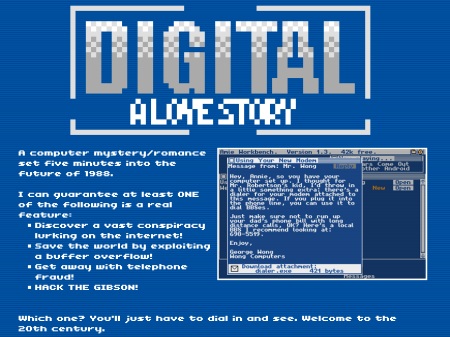
Can one fall in love with a fictional character? More to the point, can one fall in love with a character in interactive fiction, experienced only through (fictional) e-mails? And what if that character turns out to be an Artificial Intelligence?
Welcome to the nostalgia soaked world of Digital: A Love Story, an interactive fiction by the improbably named indie game designer Christine Love. Interactive fiction: does that mean Digital is a game? Well, it is, although it lacks many of the conventional traits of games – it cannot be lost, it isn’t difficult as such (there are a handful of puzzles that are well integrated into the plot, but that’s that), in many ways its not all that much more interactive than HTML pages filled with hyperlinks. The notion of an indie interactive fiction, especially one concerned with a theme as weighty and overdone as love, may strike some as pretentious, that most overused and pointless of critical words.
Don’t let any of that keep you away from Digital, though. I’d imagine that Love’s beautiful, intelligent and moving game works best for those who used computers in the late ’80s already and who are at least not completely opposed to the cyberpunk fictions of William Gibson. Digital‘s use of cyberpunk sci-fi is subtle and her interest is always in characters and emotions rather than in technology (at least as anything other than the vehicle for relationships). Her main interest, at least on the basis of this and its successor, the wonderfully titled don’t take it personally, babe, it just ain’t your story, is relationships and feelings – though not in a soppy way, as her writing and especially her use of the medium shows her to be eminently smart at what she’s doing.
The whole of Digital happens in the low-tech environment of BBSes or bulletin board systems – basically the pre-internet versions of webpages and message boards. As the player exchanges messages with other users of a number of BBSes, a plot emerges… and a romance develops between yourself, the player, and another user called Emilia. One of Love’s smartest decisions is that the player’s messages are never spelled out. You learn from the replies what you must have said, but the exact words, the details, everything that makes up your personality, is left up to you. It’s this specific kind of gaps in the narrative that is unique to games, pulling you in a way that is very different from how prose fiction engages its readers – and it’s difficult to imagine such compelling experiments in interactive fiction in big-budget mainstream games development. It’s the low-tech environment of indie gaming that makes gems such as Digital feasible.
There’s a twist roughly halfway through Digital, and (perhaps due to half-remembered spoilers in reviews) I’d figured it out fairly early into the game, but it doesn’t matter: Love deftly tells her story with the player’s help in a way that makes it much less about what happens than about how you react emotionally. As Digital came to an end, I found myself sitting there almost crying. A synopsis of the game, even a more detailed retelling, could not evoke the feelings I was going through: it was the sensation that this was my story, that I was living it as it happened, and that it would always be a part of me. Even as I could see the strings by which the puppets were manipulated (me included), there was an emotional reality to Digital that is rare in most fiction, whether interactive or not.
And if I haven’t already turned you off the game, consider this: it’s free. Want to see whether there is anything to my effusive praise? Download Digital here, play it, and then come back and tell me what you thought of it.
There should be a sci-fi subgenre called “brain in a box”. You know the type of story: the protagonist goes about his normal life (are there any female brains in a box in those stories?), but suddenly things start being… off. Things become strange around the edges. And then comes the revelation: the protagonist’s reality is actually ‘reality’. He’s plugged into some system that simulates life for him, often because he’s no longer a full-bodied human being. He’s a brain in a box. Cue existential despair and dramatic irony, though the upside is vastly reduced rent to pay.
Duncan Jones’ Source Code belongs to that sub-genre, even if strictly speaking Jake Gyllenhaal’s character is more of a torso in a box. It’s definitely a clever, fun addition to the BiaB family – but unfortunately it isn’t quite clever enough. See, it also belongs to a different sub-genre: that of “the one before that was way better.” Duncan Jones set the bar pretty high with Moon, another philosophical, existentialist sci-fi conundrum. Moon was perhaps a tad too ambitious for its own good – it tried to tell two stories but only ended up telling one (who am I, and why are there two of me?) really well, while fumbling the other (heartless corporations are heartless). It was, though, a fantastic first movie: smart, entertaining, poignant.
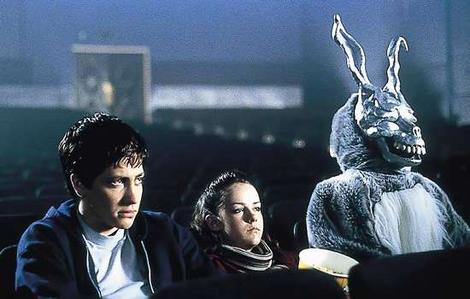
By comparison, Source Code is the earlier film’s cute but not quite as smart cousin. It’s unashamedly more Hollywood, which is fair enough – films want to be liked too! – but ends up being faintly disappointing. Perhaps I’m just a sucker for poignancy and melancholy, but what makes Source Code the lesser film is that it doesn’t balance its sci-fi plotline and its human element as deftly as Moon. Similarly to another Jake Gyllenhaal movie (think rabbits…) it’s most effective when it’s about a guy who tries to stay in control of his increasingly unhinged life, but when it decides it’s actually about these quasi-metaphysical sci-fi machinations the character drama becomes less touching, less real. It’s more difficult to care when the film geeks out over its sci-fi gimmick.
Not every sci-fi story has to have a strong human element, and not every story needs to be poignant. But Source Code tries to have its cake and eat it – be about the futuristic MacGuffin and be about its protagonist’s existential conundrum) without being quite clever enough to pull it off. Again, without its loony predecessor I might have liked it better, so perhaps I’m not being entirely fair; but in the end I can’t help thinking that Jones could do better than somewhat clever, somewhat entertaining, somewhat engaging. He has done better.
And perhaps, in some parallel universe he did do better the second time round, and there’s a quantum me writing a blog about how the successor to Moon was even better, even smarter – and so poignant it makes your tear ducts quiver with bittersweet glee…
If the cosmic astronaut God-baby from the end of 2001 came back to earth and made a movie, this would be it. (And we wouldn’t understand what it was trying to tell us, either.) – Andrew O’Hehir, Salon
There can be no doubt about it – Terrence Malick has made some of the most visually beautiful films in the history of cinema. Narrative coherence, strong characterisation, those are not what anyone should look for going into a Malick movie, but they can expect to see awesome images. And not in the Michael Bay, big explosions, expensive CGI and Megan Fox’s cleavage way; Malick and his DPs create images that are poetic, both grand and intimate, and they’re masterful at evoking moods and emotions. Even if all the dialogue were stripped from his films, they’d still be powerful pieces of cinema.
In fact, perhaps the films would be more powerful without the dialogue. Malick is often accused of pretentiousness, and especially from The Thin Red Line onwards the voiceovers are less and less about characters and increasingly about giving voice to Malick’s philosophical concerns. The problem is that the questions voiced are not only grand but veer towards vague commonplaces. Why are we here? Why does Man fight against himself? Where are we going? Are we there yet?
No doubt, these are big and important questions, but they’re so big that they need to be broken down to be addressed, unless you’re having one of those student dorm, 2am, after a bottle or two of cheap red wine conversations. At his best, Malick breaks them down by providing many individual moments and perspectives, all of them contributing in impressionistic fashion towards answers. At his worst, the voiceovers evoke a sarcastic “That’s, like, deep, man!”
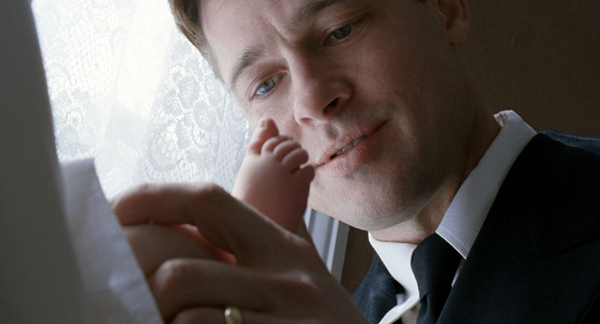
The Tree of Life has some of Malick’s most beautiful, evocative images to date, and I enjoyed the film more than his last, The New World. (I’m a Thin Red Line man, myself – and give me Days of Heaven any day.) It also relies less on voiceovers, which is good, because the more verbal Malick gets in his last few films, the more he risks becoming preachy and annoying, like one of those dreadful slim volumes of facile sub-Zen meditations on life. But in its elliptic nature, The Tree of Life becomes vague in ways that are condusive less to deep thought than to confusion. Who’s that kid? Is he one of the brothers? Are those Jack’s parents fighting? Why are we watching a dinosaur step on another dinosaur’s neck? Is Jack dead? Are those angels? Is that Aunt Petunia? Isn’t Smetana’s “Moldau” a beautiful piece of music, even if it’s criminally overused? Should I get a Coke in the break?
During the film’s strongest moments, its insistence on narrative ellipses is as evocative as the visuals. Malick can pull this off as well as Tarkovsky. At its worst, though, The Tree of Life is so intent on letting its visuals and the audience do its work, meditative becomes soporific and self-consciously coy. Does it make the film deeper, more meaningful that there are three brothers, if two of them barely become more than cyphers? Do glimpses of some kid having an epileptic fit in the background, while Jack is being led away, add to the experience if we have no idea whether that kid is a neighbour or a brother or just some random kid off the street? Gaps in the storytelling can be great starting points for our own thoughts, but if the gaps are too big, our thoughts become random – we’re as likely to think about what we need to get from the shops the next day as we are to ruminate about our existence and the grandiose beauty of creation. And the ending? I was torn between being moved, intrigued, “Huh?”ed and thinking, “I remember when this was an Orange ad.”
Would I recommend The Tree of Life? Probably not. Did I enjoy it? That’s a qualified yes. Was it beautiful to look at? Definitely, almost achingly so. Just don’t think too much about that plesiosaur. Just be awed, and don’t feel too bad if your thoughts wander to the shopping list.
P.S.: Is it just me, or is Hunter McCracken (who plays Jack as a child) almost eerily like a young version of Jim Caviezel’s character in The Thin Red Line?
No, this isn’t another post on The Road. (I’ve written interminable entries about one Nick Cave-scored film, I don’t need to add another one at this time.) It’s about the book I’ve just finished reading: Must You Go?, a memoir by Antonia Fraser about her life with Harold Pinter. I’m usually not much into memoirs and biographies – I’m very much a fiction reader – but this one was a present from a friend, and a fitting one; I’d directed that friend in a student production of Pinter’s The Dumb Waiter 13 years ago.
Fraser’s book is eminently readable, even if during the middle third or so it feels like it consists primarily of encounters with famous people and praises of Pinter’s writing – though obviously one wouldn’t go to a widow’s memoir for an in-depth appraisal of an author’s literary output. Must You Go? is also a sad book, as its final 100 pages lead up to the death that answers its titular question in the depressingly affirmative. But throughout the book there are passages that made me smile, grin and every now and then even laugh out loud. And there’s something so wonderfully British about the diary entry that describes what happened after Antonia Fraser told her husband at the time, Hugh Fraser, about her affair with Harold Pinter:
In the end I summoned Harold round. He drank whisky, Hugh drank brandy. I sat. In a surreal scene, Hugh and Harold discussed cricket at length, then the West Indies, then Proust. I started to go to sleep on the sofa. Harold politely went home. (p. 23)
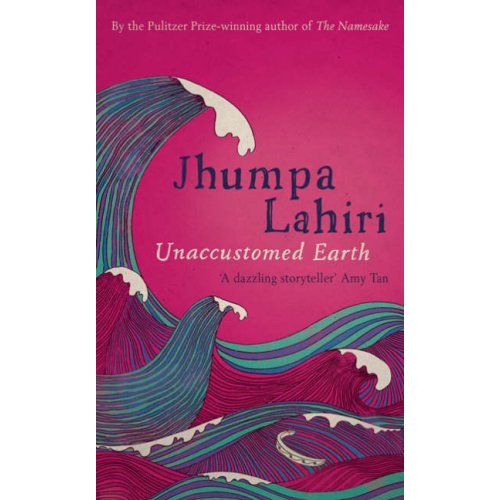
So there was the book, on top of my “to read” pile. An uninviting purplish-pink (dare I say ‘magenta’?), with some turquois waves, looking a bit as if it had been designed on an old CGA screen. The title was a bit more intriguing: Unaccustomed Earth, by Jhumpa Lahiri. I’d read some Lahiri years ago when preparing for an exam, or at least I thought so, but I couldn’t remember the first thing about it. For all I knew, I’d put the book on my reading list and then forgot all about it. Just as I’d forgotten why I had this book. Did I buy it, and if so, why? Had it been given to me as a present? (… perhaps by someone reading this blog, in which case I will be duly embarrassed?)
I picked it up and started to read it, more due to a vague sense of obligation than anything else. My bleeding heart pinko liberal Spidey senses were telling me that it’d be good for me to read this, as it’s good for me to eat spinach and the like.
Unaccustomed Earth, I’m confident to say after having read it, is one of the best books I have read in the last ten years. Lahiri’s use of language is economical but never stingy, precise but not fussily so. Her characters feel real, but not because of the accumulated weight of details that you get with other writers; she deftly sketches their personalities with an elegance that is humbling. And her plots, while deceivingly simple, often carry a sting that is quite devastating.
I have an ambivalent relationship with short story collections. They’re often moreish, like a pack of Toffifee – one is so short and light that you’re sure another one won’t hurt… and then another, and another. And then you’ve had too much and feel faintly sick. There was no such moment with Lahiri’s stories – also because, unlike some other collections, it doesn’t feel like she’s belabouring a theme. There are motifs that are touched upon in all the stories, mainly because the majority of characters are the children of Indian migrants, but the book is definitely not dully monothematic.
Most of her stories are sad. They’re not grand tragedies (except, perhaps, for “Hema and Kaushik”, the final three-part story that almost qualifies as a novella), but loss runs through all of them, and more than once did I find my breath taken away by the feelings Lahiri evoked.
If you haven’t read any Jhumpa Lahiri, or if – like me – you’ve read her before but simply can’t remember whether you like her or not, give yourself a gift. Buy Unaccustomed Earth. Put it somewhere on your “to read” pile, preferably towards the bottom. Forget that you ever got the book and come upon it as if by accident. Give it a chance. I’m willing to bet you won’t regret it.
P.S.: If I did get this book as a present from someone reading this blog: thank you, thank you, thank you!
P.P.S.: After this one, I will definitely have to revisit The Interpreter of Maladies, if only to find out whether I did indeed read it. If so and I found it forgettable, the pre-exam pressure of “Gotta read x books by the weekend! No time to enjoy!” may have been to blame.
Is The Road a depressing movie? Do cannibalistic chickens have lips? Good question, actually – does a beak count as lips? Anyway, I’m ambivalent on the matter… not of poultry and their facial appendages, but of The Road‘s overall outlook on life. It is a powerful piece of cinema, though – perhaps almost too powerful. I wouldn’t be too surprised if a number of audience members found the grim, sad plot and atmosphere of the film so overbearing they resisted its effects and perhaps even resented its relentlessness.
And relentless the film is, which probably doesn’t come as a surprise to those who have read Cormac McCarthy’s novel – yet it’s not the relentlessness of so many post-apocalyptic films. There are moments that in other films might be thrilling, scenes where the film’s wandering father and son are pursued by cannibalistic survivors (no chickens, though), but in the end it’s not these fleeting moments of jeopardy that are the greatest threat to survival in the world of The Road. It’s finding the strength each morning to go on. The father played by an increasingly Giacomettian Viggo Mortensen has his son to keep him going, but most of the survivors we see don’t even have that. They seem to be alive simply because they haven’t died yet.
Nevertheless, The Road is about survival, not only physical survival but that of the soul, of the part that makes us more than glorified animals. As the son puts it in his childish words, “Are we still the good guys?” You’d think that good and bad would become relative in a world where you avoid other survivors because it’s more than likely that they only survived by preying on others, and the father’s reluctance to show compassion for others makes perfect sense. The son’s insistence on doing the right thing is naive and borders on the suicidal – yet survival, to the son and eventually the father, should not simply be about delaying the inevitable. And it is in this insistence that there is more to living than simply not having died yet, even in a world that seems to be all about death, that The Road, for all its horrors and sadness, is an idealistic story.
This may be the point where The Road loses some: it is difficult to accept the hopeful notes scattered throughout for the sheer weight of all the horrors we’re presented with. Does a single surviving beetle, a dog that’s alive against all hope (and hasn’t been eaten by its famished keepers) constitute a convincing ray of sunshine against the billions dead, the destroyed wildlife and decaying forests (by the way: this is the first film where I had to switch off the subwoofer – because the trees crashing to the ground were simply more than we wanted to inflict on our neighbours!). I bought both the despair and the glimmer of hope, but the former may overpower the latter for many.
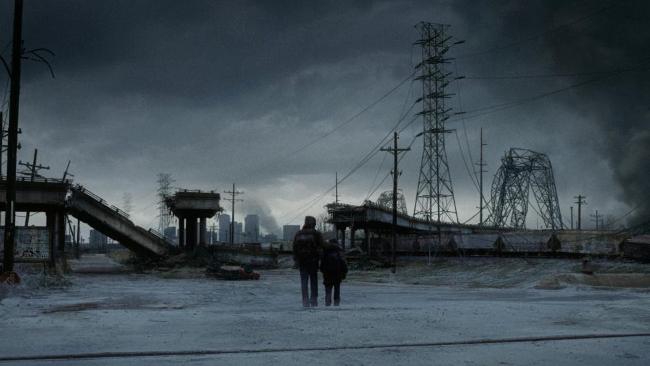
Through it all, though, the one thing that’s stuck most in my mind is the desolate, grim beauty of the world Hillcoat depicts in his adaptation. There’s dark poetry in McCarthy’s prose, and the visuals of the film capture this poetry impressively well.
I have found a new addiction. It’s called Mark Kermode. And the last couple of days I’ve been bingeing on his reviews (either on the BBC website or on YouTube).
What makes a good reviewer? I think that most people, me included, tend to respond first to those critics who agree with them. I also respond to critics who take a film on its own terms, something that Roger Ebert ten years ago (less so now, as far as I’m concerned) used to be brilliant at. A good critic should be able to acknowledge that in terms of what it achieves a brilliantly made genre piece (say, Raiders of the Lost Ark) is up there with the best of cinema, even if it may not be about ‘important’ things.
The best critics are the ones whose reviews you may disagree with completely, but that a) show you that the critic cares about the medium they’re writing about, b) make you think (and about something other than, “What’s this guy going on about?!”) and c) know how to write. Kermode hits all three of these, and trust me, there are a couple of reviews where my take on the film is practically 180° in the other direction. Fair warning, though: he can be smug and he is at times somewhat in love with his jokes – but he also seems self-aware enough to laugh about himself.
Anyway, enough from me. Here are two recent(ish) reviews by Mr Kermode that I liked a lot – enjoy!




 A Damn Fine Cup of Culture