… but this is pretty damn awesome, David Beckham notwithstanding.
Author: Matt
The internet is for (green) porn
Okay, I’m still working up to that epic blog entry on Happy-Go-Lucky (now it can only be a disappointment, can’t it?), but in the meantime I want to keep you guys diverted… so here’s some deeply weird shit, courtesy of Ms. Isabella Rosselini. This woman was once an item with David Lynch, but these films make me think that she could outweird David any day of the week, and twice on Sundays. (Just don’t get D-Boy started on transcendental meditation…)
So, without much further ado, witness the true horror of the sex lives of whales, slugs, spiders etc. It’ll make you wonder how you could ever live without having seen Isabella dressed up as a whale with a 6ft. penis.
How the West was won, pixel by pixel
Nothing big to add here – I’m still working on a blog entry on Mike Leigh’s Happy-Go-Lucky in my mind (these things take time, and it’s not as if the film’s already years old), but since I’ve posted the odd entry on Ebert’s big “Video games cannot be art” shtik, I wanted to post this link: The Observer has two gamers and their regular film critic Philip French give Rockstar’s Red Dead Redemption a whirl. French is obviously not a gamer, but he knows his films, and it’s good to read a critic who’s at least willing to take the artistic potential of games seriously. He doesn’t use the A word, but that’s fine – any discussion of art that circles around what art is tends to vanish up its own backside anyway.
And now for some heavy-duty shilling of the game, because it does look quite good – western fans take note, and don’t be put off by the sucky stills below:
Retro pixelly goodness – The Movie
Funny coincidence: my last blog entry was about pixel art, and what does Rock Paper Shotgun do? They post a cool video on pixel art. Well, allow me to repost.
Retro pixelly goodness
What is it about pixels that makes Original Gamers like me all gooey and nostalgic? Show us mid-90s polygons and we’ll go, “Ugly! Get it outta my sight!” Show us one of the original Space Invaders, or Inky, Blinky, Pinky or Clyde, and we get teary-eyed as if we’d just seen the first glimpse of our PC after having been held hostage by computer-hating luddites for six months. Mix it with those bleepy sounds of yesteryear (or, more accurately, yestercentury), and we’re back in the past, back at school where we consider ourselves much cooler than the Chess Club set but are just as incapable of getting a date… but at least we’ve got a firm grip on our joysticks, haven’t we?
There’s an entire branch of computer-based painting called Pixel Art (and if anyone goes Ebert on the term, I’ll make sure that they wake up gnawed at by an army of rabid hamsters) that is all about using the limitations of pixels to nostalgic effect. Pixel art isn’t necessarily as rough and basic as the original Donkey Kong – higher resolutions mean more pixels – but it tends to have a similar style as those Where’s Waldo? books. Check out this Pixel Art London (click on the pic for the full effect):

What is it about pixels that has that effect, at least on those of us who’ve been playing games since the heady days of the C-64, NES or Spectrum ZX? Is it the Lego-combined-with-OCD look? Is it a hankering for simpler, better times when we didn’t need to upgrade our computers every year to make games run well, when we didn’t need to download half-a-gig patches just to make the games work that we’ve just bought? What makes a good instance of pixel art much more charming than 90% of current-gen polygons (other than the fact that all too many current games cater to frat-boy, jock-straps-and-boobies tastes that never did much for me)?
I don’t know, but I want to leave you with this video – one month later than the rest of the internet, mind you:
Up in the air with flying foxes and less-than-fantastic goats
What’s the best thing about an11-hour flight? It can’t be the dodgy movies on the in-flight entertainment system, can it? (I once failed to go to sleep on a flight that showed Marley & Me and Paul Blart: Mall Cop on all the screens. The lambs have barely stopped screaming on that one, Clarice.) Well, yes, it can, on one of those snazzy new planes where even down in Economy Class, with all the third class Oirish having a fun time before the plane hits the iceberg, you have a choice of oodles of films, music and games. And since Who Wants to be a Millionaire? loses its interest after a handful of games, especially when there’s no oily showmaster-wala with an Indian accent to foil your attempts to get the money and the girl, I decided to dedicate at least some of my flying time to watching first The Men Who Stare at Goats and then The Fantastic Mr. Fox.
Men, goats, intense stares… George Clooney, Jeff Bridges and Kevin Spacey – what could go wrong? Well, it’s not so much what went wrong; it’s more that way too little went right. The film is a brilliantly cast neat idea spun out over 1 1/2 hours, which makes for a great trailer (minus Ewan McGregor’s horrid American accent) and a decidedly mediocre film. It isn’t really worth saying all that much more about it, except to bleat mournfully.
The Fantastic Mr. Fox, though? I’m still surprised to say that I genuinely enjoyed it. I’ve had problems with the two Wes Anderson films I’d seen, The Royal Tenenbaums and The Life Aquatic. Anderson’s a great aesthete, but his style got in my way of enjoying both movies to a large extent. The problem is that the films and their characters are so stylised, in their looks, behaviour and neurotic quirks, that they feel wholly static – so when the plot contrives to make them tragic, I don’t buy it. The pathos turns into mawkishness, and when it kind of works in spite of the artifice, it’s largely due to the borrowed emotions of the songs Anderson chooses. To my mind, characters can only become tragic if there’s the illusion that they are free, or at least struggling to free themselves, from the master puppeteer that is Fate, the Script and/or the Director – Anderson’s characters have often struck me as being puppets at the mercy of a master stylist who doesn’t have freedom anywhere on his palette.
[https://www.youtube.com/watch?v=W460QxYQgh4]
I suspect that what makes Mr. Fox work for me is this: animated films are stylised to begin with. They are entirely created. And ironically that makes Mr. Fox feel less constricted by Anderson – whereas real people in a live-action film are made less unreal by the artifice that seems to be his favourite stylistic choice, the animated foxes, moles, possums and badgers, not to forget farmers Boggis, Bunce and Bean (one fat, one short and one lean), are infused with humanity, for want of a better word. The style becomes a part of the whole rather than being the whole and thereby threatening to suffocate both the actors and the characters.
The Fantastic Mr. Fox is very clearly a Wes Anderson film – the look, feel, costumes, even the character setup (father-son conflict anyone?) feel familiar… but by sidestepping live-action for once, Anderson’s made the first film that, being entirely artificial due to being animated, feels real to me.
And it’s got this lovely scene with Michael Gambon (as farmer Bean) and Petey, as played by Jarvis Cocker:
Don’t stop-
As always, I’m pretty late to the party, so please bear with me as I write about the pop culture event of the year… 2007, that is. “Remember when” may be the lowest form of conversation according to some – but remember when The Sopranos ended on the ten seconds of silence heard around the world?
The Sopranos has been with me for a long time. It has a special place in my heart for accompanying the most important relationship in my life. Even beyond its personal significance, it was the first HBO series I got into – arguably it’s the one that got me hooked and that led to Six Feet Under, Deadwood, The Wire, and so on. And while it had its ups and downs, feeling at times like it had continued past its prime, it is clearly one of the strongest pieces of TV fiction ever, featuring one of the best written, best acted core casts.
In seasons 4 and 5, I felt that while the individual episodes were strong, the series wasn’t going anywhere. The episodes were exchangeable. There wasn’t all that much of a compelling story arc (they should’ve had Christopher writing the series – there’s a man who knows about the importance of arcs). Idiosyncratically named season 6 part 1 (if you want to top that, you need to go to video games and check out Star Wars: Dark Forces III: Jedi Knight II: Jedi Outcast) was a mess in some ways, but it tried, and succeeded, in getting the series out of its rut. The whole of season 6, but especially part 2 (the final nine episodes, that is), had a sense of purpose: we were spiralling in on the destruction of everything that Tony holds dear, often at his own hands.
“Made in America”, the final episode, ended… strangely. Was it a massive anti-climax? Was it a subtle way of saying that Tony’d been whacked? Was it a “Fuck you!” to the fans who’d been loyal to the series for almost a decade? Personally I’m leaning towards the “Tony’s dead” interpretation myself, since it’s pretty stringent – the strongest argument being Bobby Baccalieri’s line earlier in the season, referring to the moment when you get shot: “You probably don’t even hear it when it happens, right?” A lot of things point, more or less strongly, towards Tony’s violent death.
At the same time, though, season 6 part 2 (paragraph A, line 23) is a season of red herrings. There are several episodes that ratchet up the tension, suggesting very strongly that by the end of it, character X would be dead: Paulie Walnuts, Hesh, Bobby, Christopher. The latter two do end up dead, but only after a bait and switch pulled by Chase. “Made in America” works pretty much the same way, with everything pointing towards that final gunshot – but then we get nothing. Blackness. Silence. “Don’t stop-” indeed. Does it stand for death? Tony’s death? The series’? Or for Chase denying us the closure we want, whether that is Tony getting away with it all or getting the punishment he undoubtedly deserves?
Shrodinger’s Tony aside, though: the episode is perhaps the strongest of the entire series in terms of filmmaking, and the final five or six minutes are a brilliant example of this. I can’t think of many films or series that ratchet up the tension so deftly while showing what can easily be seen as wholly innocuous. Add to that Chase’s usual good hand at picking the perfect soundtrack for this series: “Don’t Stop Believing” will forever be stuck in my head together with this scene. And cutting off the music when it does? Perfect. What better moment to end than in mid-sentence, right after “Don’t stop”?
Farewell, Tony. Farewell, Carmela, A.J., Meadow. Good bye, Sil, Chrissie, Uncle Jun, Paulie, Bobby, Janice, Livia. Ciao, Dr. Melfi. Many of you were pricks with an over-inflated sense of entitlement – always with the drama! – but damn, if you didn’t make these ten years of TV watching memorable as hell. (Quite conceivably a hell run by the Irish, where every day is St. Patrick’s Day.) Wherever you are, whatever you’re doing-
P.S.: Another nail in the “Tony’s dead” coffin, and one that I find pretty convincing: there’s no reason to end before the entire family’s together, but we don’t get to see Meadow with her parents and brother. If the end was supposed to be open, it would’ve ended with all four of them; instead, we get the Blam! of the black screen just before Tony sees her. Either Chase’s fucking with us, which I don’t believe – or something interrupted the family union. Something pretty final.
P.P.S.: Think what you want about the woman, but Hilary Clinton’s Sopranos spoof campaign ad had class:
It’s a mad, mad, mad, mad world
It’s a detail, a cinematic in-joke invisible to all but film afficionados, but it adds to the ominous atmosphere on Shutter Island: the two head wardens of the mental hospital are played by Ted Levine and John Carroll Lynch – Jame “Buffalo Bill” Gumb from Silence of the Lambs and Arthur Leigh Allen, the main suspect from David Fincher’s Zodiac. With these two in charge of security at Ashecliff Hospital, you wonder: are the inmates in charge of the asylum, or are the patients even more insane? Even the benevolent doctor, played by Ben Kingsley at his most unctuous, serves to make us more paranoid rather than comforted.
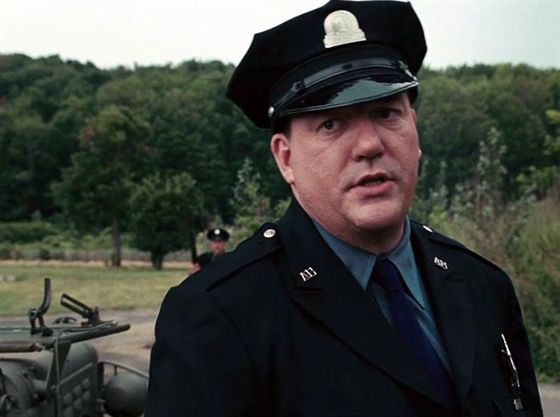
The main attraction in this Scorsesean Gothic horror, though, is Shutter Island itself: the location immediately joins an exclusive list together with Bates Motel, the Overlook Hotel and the abbey in The Name of the Rose, as one of those places that feed the imagination. Anything might be hiding in that old lighthouse, and the carpets of Dr. Cawley’s residence exude a sense of foreboding. The place breathes a diseased past: you get an almost tactile sense that things have happened here, things that shouldn’t be.
Things that, in fact, didn’t happen. The true horror house, as so often, is the human mind, protecting itself as it knows best: by inventing alternative histories that become more real, more believab le, and certainly more necessary than what has really happened.
Scorsese and Lehane’s psychological horror yarn isn’t original, and those who have seen or read similar stories will not be overly surprised by the main twist ten minutes before the end. But it’s been a while since the twist, its lead-up and denouement havve been told with such sensuality. The film is rarely subtle, but damn, if you don’t feel the clammy fog of Shutter Island stick to your skin as you leave the theatre.
Having said that, though, I have one quibble with the film. For the most part it plays fair with what is and what isn’t real. It doesn’t fool the audience in cheap ways and is usually pretty clear with respect to what’s in the protagonist’s mind. Hallucinations aren’t played for a cheap “Huhwha?” effect. There is one big exception to this, though, a scene which logically must be a hallucination, yet it plays more realistically than most other scenes in the film. On one level it helps that it features the always wonderful Patricia Clarkson, who invests the scene with a fevered intensity and conviction; on the other hand, it’s exactly the fact that she’s so believable in her part, her presence to solid, and the moment not a brief flash of unreality, that it takes on a solidity it shouldn’t have – logically, it must be a hallucination, yet it doesn’t have the markers of unreality that the film has established previously. And that’s why the scene keeps niggling at me. It stands out, yet I can’t help feeling that it doesn’t play fair. It’s a cheat – an eminently well-executed cheat, but a cheat nevertheless. And yet, and yet… Perhaps I need to see the film again to figure it out. Just when I thought I was out, Shutter Island pulls me back in. (Thank you, Sil.)
Fool me once…
Yup, I know… For one thing, it’s been ages since I last posted an entry. Shame on me. For another, April 1 has been and gone, so this is pretty late. Still, it bears reposting for the sheer geeky awesomeness: comic book publisher Top Shelf posted the following update on Alan Moore’s League of Extraordinary Gentlemen last Thursday. Shame it’s a joke.

Here’s the blurb they came up with:
When war-hero-turned-handyman Kesuke Miyagi is found drained of blood, it becomes clear that the occult gang known as the Lost Boys are targeting the only individuals that can stop them from complete domination of America. It’s the perfect case for the League of Extraordinary Gentlemen–except that their government contact, Oscar Goldman, disbanded the team in 1979 after they defeated Mr. Han’s army of the living dead.
Now, disgraced scientist Emmet Brown has to put together a new team to combat the growing threat of the Lost Boys and their leader, a newly resurrected vampire kingpin Tony Montana: Transportation specialist Jack Burton, ex-commando B.A. Baracus, tech wizard Angus MacGyver and the mysteriously powerful femme fatale known only as “Lisa.” But will Brown be able to stop the Lost Boys before time runs out?
On a somewhat less fun note, apparently the next real chapter of LOEG has been delayed until 2011. Bother.
My favourite kinds of imperialism
We’re getting close to the end of The Sopranos. Both Rome and Carnivale only have one more season to offer us. And at the speed at which we’re going through West Wing, President Bartlett will have finished his second term in record time.
How to find good, new series? Used to be, I could pretty much get three out of four HBO series on DVD and be happy for the next year or so. Even if some of them found an untimely end, the journey was absolutely worth it.
Now, though? Can’t say I’m all that interested in Hung, and I’m not sure I would enjoy Big Love (which may be due to my lack of trust in Bill Paxton’s acting abilities – “Game over, man!”, indeed…). What about all these new series starting on other channels, though? The Elmore Leonard series Justified sounds like it might be fun, and I’m definitely hoping to get Caprica, provided that it doesn’t get cancelled after one series.
However, HBO seems to be stepping up its game, with not one but three series premiering this year. The one I’m currently most excited about is the one I only found out about five minutes ago: Boardwalk Empire, by Sopranos alum Terence Winter and Martin Scorsese – yes, you read that right, the Raging Bull of mob cinema himself! Check out the trailer, which looks like the murderous bastard child of Once Upon a Time in America and The Sopranos:
Also looking quite promising, although in a more Norman-Rockwell-meets-Interracial-Slaughter way: The Pacific, which seems to be a sort of companion piece to Band of Brothers. Oh, and it stars the little kid from Jurassic Park, all grown up. Listen, boy, you should know better than to return to island jungles! (Cue bad “Doyouthinkhesaurus?” jokes about jungle warfare…) Again, let me peruse YouTube:
Finally, the creators of my favourite series (it shares the pedestal with Six Feet Under) are doing a new show on the aftermath of Hurricane Katrina. It’s called Treme and it’s got the usual awesome cast of actors, including Wendell Pierce and Clarke Peters. It’ll be good to see Lester Freamon and Bunk Moreland back in action!
 A Damn Fine Cup of Culture