One planet, one vote!

I did it.

I finally finished Augusten Burroughs’ Running With Scissors. And boy, am I glad.

By the time I got to the last chapter, I no longer hated it. I simply didn’t have the stamina for that. I simply found it boring and annoying – and boringly, annoyingly unfunny. There’s little structure in the novel, so the single episodes could all be jumbled up and re-ordered with little to no effect on the book. There’s barely any character development. I’m sure you can write enjoyable novels without character development or structure, but you have to be a hell of a lot better than Burroughs and your story has to be a hell of a lot more interesting. Up to the very end, I felt I was reading the self-indulgent, self-dramatising journal of a drama queen – admittedly one whose childhood and adolescence (as told) were quite horrible, but suffering in itself does not a good novel make.

Anyway, it’s over, and I’ve now started on Haruki Murakami’s short story collection Blind Willow, Sleeping Woman. I recently read his Kafka on the Shore, which was okay but faltered a lot towards the end, and it suffered a lot from having come after The Wind-Up Bird Chronicle, which I think is what the Germans surreally call “ein grosser Wurf”. (Roughly translateable as “a great success”; literally, it means “a great throw”, which might make sense if the Germans played baseball.) I enjoyed a lot of Murakami’s earlier short fiction, perhaps mainly because his excursions from the main plot are always fascinating… and in a short story there’s less of a risk that he runs out of steam and the novel peters out. Murakami is a great writer, but endings aren’t his forte.

What else? I’ve played on in Anachronox, and it’s as delightfully inventive as I remember. I’ve just left Democratus, one of the great inventions of the game: a planet that makes Switzerland’s political system look positively efficient. On Democratus, every decision requires a vote. Every decision. And every decision has to be discussed in great detail, so that the planet’s High Council even fails to come to a decision about the 64 lethal missiles aimed its way by an aggressive insect race. But watch for yourselves:

Since few of you are likely to still find the game and play it, I’ll go ahead and spoil some of the further plot for you: after you save Democratus, the Council decides to reward you by having the planet shrunk and joining your party. As Wikipedia puts it, “the most annoying civilization in the universe shrinks their planet to five feet in diameter and begins following the team around.” And there’s little as boggling as the sight of that man-sized planet happily floating after you, squabbling about your every decision.

Did that soldier just shoot the fourth wall?

Yesterday evening I finished Metal Gear Solid 2. The ending was decidedly underwhelming, for all its action and its cascade of relevations, one topping the other. It was also facile and preachy, and it hadn’t earned the right to be preachy. I wasn’t as annoyed at it as many people seem to have been, though, based on reviews and posts on the internet.

Penny Arcade’s take on the MGS2 ending

What seemed to annoy them most, however, was the metafictional self-awareness that crept into the last 2-3 hours of the game. Your superiors, who keep contacting you via radio throughout, start to make increasingly explicit references to everything that’s gong on being a game, even telling you at one point to switch off the console. While this isn’t postmodern fiction on a par with Pynchon or Auster, it’s still a refreshingly clever take on most videogame narratives, where you, the player, are as much of a puppet as your in-game avatar, following orders that the game’s narrative imposes on you, with little or no choice. The self-referentiality is also represented quite wittily, with everything that’s overtly game-like – the ‘continue’ and ‘save game’ screens, for instance – playing into it.

Why is it, though, that people – gamers as much as readers or movie and TV audiences – hate self-awareness so much? Read IMDB comments (admittedly, hardly the most critically-minded crowd) and you’ll see that self-aware fictions tend to get extremely strong reactions. Audiences, by and large, don’t want to be told that what they’re watching or playing is a film, a game. They prefer to submit to the illusion that ‘this is real’. In fact, they resent narratives that don’t allow them the comfort of that illusion. Because if something that we want to believe to be real is actually a fiction, it raises questions that may be a tad uncomfortable. Or perhaps I’m just a snobbish post-structuralist… But I think that at its best, you can see the puppeteer’s strings and appreciate his illusion-making, yet still feel for the puppets as if they were real.

And now, so’s you don’t get bored: a movie!

On a different note: What do you do if you get a book as a present, and you want to honour the present – but you hate the book? After Miéville, I moved on to Augusten Burroughs’ Running with Scissors, and I keep wondering whether I really want to be reading this. It’s one of those “you have to laugh to keep yourself from crying” type of memoirs, where the things that are (supposedly) tragic are drawn in an exaggerated, cartoony fashion. According to the blurb on the back, it’s “hilarious… Adrian Mole scripted by Hieronymus Bosch”. The problem is, I don’t buy any of it. I’m not saying that Burroughs concocted the whole thing from scratch, but its over-the-top, camp tone and narrative feel fake to me. Augusten, a ceaseless self-dramatiser, is one of the most annoying narrators I’ve read in a long time. Is he a poor sod? Yes. Do I want to listen to him being a poor sod? No. And for all of its outrageousness, its lurid sexuality and forthright storytelling, there’s something disappointingly conventional and even prudish to the novel. Which may be true to the young protagonist, but that doesn’t make him or the book any more interesting.

So why am I still reading it?

Loose baggy monsters. And they suck out your brain, too.

I used to love reading fantasy and science fiction literature. Or rather, I used to love the idea of sci-fi and fantasy. My parents never got that I enjoyed stories that were out of this world, so to speak. (One of my defining childhood moments: My uncle sends us Star Wars: A New Hope on Betamax tape, taped from Channel 4. We watch it, and I love it. My parents think it’s a waste of time and tape over it the next day. It’s a miracle I didn’t go Michael Myers on them. And by that I mean Halloween Michael Myers, not the “Groovy, baby!” kind.) I loved The Lord of the Rings, Madeleine L’Engle’s Wrinkle in Time and Diana Wynne Jones’ Chrestomanci books.

Randalf the First 

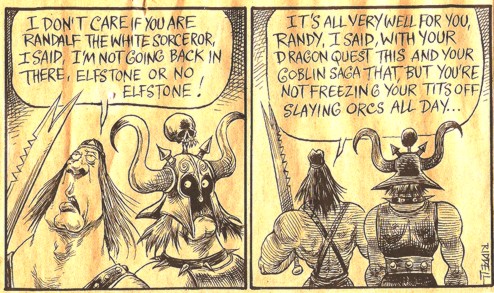
And then I read too much fantasy. I watched too much sci-fi. And so much of it is poorly written, derivative dribble, disposable junk. I was fed up with bearded, grumpy wizards trying very hard not to be Gandalf, I was sick and tired of chosen ones and ancient prophecies and evils sweeping the land. I had enough of names that looked like the deformed offspring of multiple apostrophes and the bottom of the bag of letters at the end of a game of Scrabble.

Randalf the Second

It was Joss Whedon’s Firefly that reinstated my belief in good science-fiction. Neil Gaiman largely did the same for fantasy, but I didn’t like his last couple of books that much – apart from which he tends to write metafiction rather than straight fantasy (whatever that may be). There’s always a self-aware, postmodern twinkle in his authorial eye, it seems.

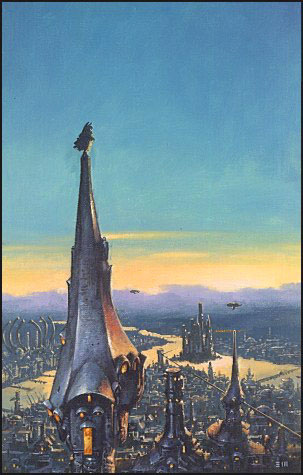
Yesterday I finished China Miéville’s Perdido Street Station. Arguably it’s fantasy, although it’s set in a universe that is closer to our world than to Middle-Earth or the books of Terry Brooks or Robert Jordan. There are no elves, dwarves or dragons (nor thinly veiled copies of them). Magic is a technology, essentially. And New Crobuzon, the monstrous city in which the story takes place, is reminiscent of Victorian London much more than of the pastoral fantasies or the hackneyed medieval towns of your common garden variety of fantasy.

What sets Perdido Street Station apart from those other fantasies is that it feels real. Not epic. Not mythological. Real. It’s fantastic enough to serve as escapist fare, but it’s not the sanitised, Disneyfied kingdom of Far, Far Away. What also sets it apart, and this may surprise some of those who have read it, is the economy of Miéville’s writing. Yes, the book is long – it’s over 800 pages long, in fact – but in the end I felt that no character, no scene, no piece of description didn’t serve a function. So often, bad or mediocre fantasy novels are filled with pages and pages of clumsily handled world creation, which feels like the author trying to show off his or her imagination, more often than not:

“Hey, look at this sentient bird-fish-dinosaur creature I’ve just come up with! And the deities it worships! And the weird, elaborate rituals in which the sentient bird-fish-dinosaur sacrifices his firstborn! And now we’ll never hear anything about them again. Because I’m so inventive, I don’t even have to use my bird-fish-dinosaur for anything else than showing off my imagination!”

Not so in Perdido Street Station. The book is wildly inventive, but everything is there for a reason. Yet the novel feels organic rather than constructed. And I never felt the sort of laziness you get in generic fantasy, namely that the author is simply ticking off all the things the readership wants: Old mentor figure: check. Orphaned hero-to-be: check. Evil lord, comes with his own minions: check. Instead, we have a novel that doesn’t have a clear-cut antagonist. The protagonists aren’t heroes, even if they end up being heroic, more as a way of staying alive than anything else. Some of the novel is genuinely unsettling. And it’s a deeply, densely political world – not the way George Lucas tried to bring in politics in his Star Wars prequels, but infinitely more believably and fascinatingly.

Perdido Street Station 

I don’t want to go on at great length (already having done so, of course), but my suggestion is this: if you used to love fantasy but then grew tired of it, or if you believe that you “outgrew” the genre – give Miéville a try. Check out Perdido Street Street Station. And if you don’t like it, write me… so I can tell you how and why you’re just, like, so wrong.