Do hackers dream of digital love?

Can one fall in love with a fictional character? More to the point, can one fall in love with a character in interactive fiction, experienced only through (fictional) e-mails? And what if that character turns out to be an Artificial Intelligence?

Welcome to the nostalgia soaked world of Digital: A Love Story, an interactive fiction by the improbably named indie game designer Christine Love. Interactive fiction: does that mean Digital is a game? Well, it is, although it lacks many of the conventional traits of games – it cannot be lost, it isn’t difficult as such (there are a handful of puzzles that are well integrated into the plot, but that’s that), in many ways its not all that much more interactive than HTML pages filled with hyperlinks. The notion of an indie interactive fiction, especially one concerned with a theme as weighty and overdone as love, may strike some as pretentious, that most overused and pointless of critical words.
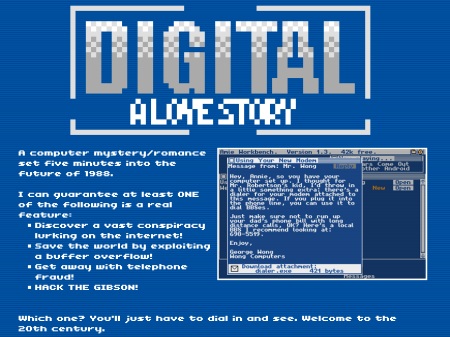
Don’t let any of that keep you away from Digital, though. I’d imagine that Love’s beautiful, intelligent and moving game works best for those who used computers in the late ’80s already and who are at least not completely opposed to the cyberpunk fictions of William Gibson. Digital‘s use of cyberpunk sci-fi is subtle and her interest is always in characters and emotions rather than in technology (at least as anything other than the vehicle for relationships). Her main interest, at least on the basis of this and its successor, the wonderfully titled don’t take it personally, babe, it just ain’t your story, is relationships and feelings – though not in a soppy way, as her writing and especially her use of the medium shows her to be eminently smart at what she’s doing.

The whole of Digital happens in the low-tech environment of BBSes or bulletin board systems – basically the pre-internet versions of webpages and message boards. As the player exchanges messages with other users of a number of BBSes, a plot emerges… and a romance develops between yourself, the player, and another user called Emilia. One of Love’s smartest decisions is that the player’s messages are never spelled out. You learn from the replies what you must have said, but the exact words, the details, everything that makes up your personality, is left up to you. It’s this specific kind of gaps in the narrative that is unique to games, pulling you in a way that is very different from how prose fiction engages its readers – and it’s difficult to imagine such compelling experiments in interactive fiction in big-budget mainstream games development. It’s the low-tech environment of indie gaming that makes gems such as Digital feasible.

There’s a twist roughly halfway through Digital, and (perhaps due to half-remembered spoilers in reviews) I’d figured it out fairly early into the game, but it doesn’t matter: Love deftly tells her story with the player’s help in a way that makes it much less about what happens than about how you react emotionally. As Digital came to an end, I found myself sitting there almost crying. A synopsis of the game, even a more detailed retelling, could not evoke the feelings I was going through: it was the sensation that this was my story, that I was living it as it happened, and that it would always be a part of me. Even as I could see the strings by which the puppets were manipulated (me included), there was an emotional reality to Digital that is rare in most fiction, whether interactive or not.

And if I haven’t already turned you off the game, consider this: it’s free. Want to see whether there is anything to my effusive praise? Download Digital here, play it, and then come back and tell me what you thought of it.

More than fine

I’m not a big fan of Heavy Metal. Perhaps it’s that I’ve never had the hair to go with headbanging. Perhaps it’s that I dislike the sexism that often seems to go with it. Perhaps it’s simply that I was raised on Prokofiev’s Peter and the Wolf and that has influenced my entire musical development. I’ve always been more into borderline pretentious psychedelic prog rock, if anything, and then lots of indie singer/songwriter stuff than the leather-and-studs bridgade. I enjoyed This Is Spinal Tap, but half the jokes probably went straight over my head. Other than Ozzie, I’m not sure I could pick any of the greats of Metal out of a police line-up.

Imagine my surprise, then, when I started playing Tim Shafer’s Brütal Legend (savour that umlaut!) – and immediately fell in love with the world and atmosphere of the game.

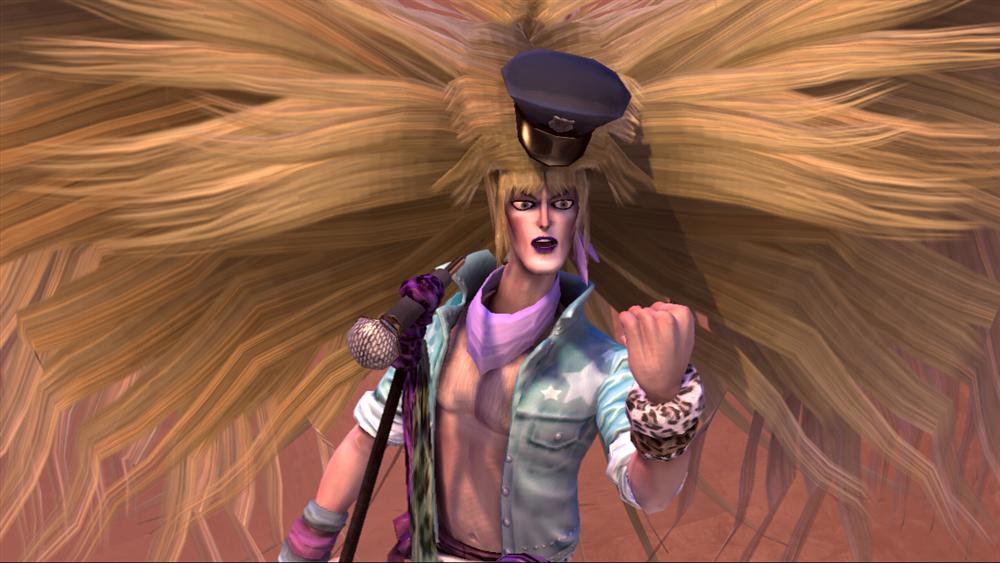
Tim Shafer could be called the Tim Burton of the videogame world – if you disregard Burton’s creative stagnation, his repetitiveness and his increasingly mannered goth shtik. His games are strong on character, world building and storytelling, to the point where the gameplay becomes secondary. He’s the guy who spliced together Casablanca and the Mexican Day of the Dead and who created a summer camp for the psychic. And he’s the mastermind behind Brütal Legend, a game that takes as its inspiration Heavy Metal – not only the music, but the aesthetic, the ethos, the feel of it all (minus the “Smell the Glove” misogyny, mind you). Its world is designed to look like all the Metal album covers you can imagine, turned up to 11. It’s inhabited by laser-eyed black panthers and mastodons with gleaming metal tusks. It should be tacky – but instead it pulls off its loving hommage with style, with a little help from Jack Black. I mean, how can you not warm immediately to a game featuring lines such as these:

– Ever feel like you were born in the wrong time – like you should have been born earlier, when the music was… real?
– Like the seventies?
– No. Earlier… like the early seventies.

What is perhaps most amazing is that in a game featuring KISS-faced Amazons, phony big-haired rock stars (even the guys from Spinal Tap would find General Lionwhyte embarrassing – and yes, he’s one of the game’s villains) and a very familiar-looking Guardian of Metal, Shafer manages to pull off a story that takes turns being funny, thrilling and finally poignant. It’s difficult not to wipe away a manly Metal tear at the game’s ending. In a medium that’s full of teenage male wish fulfillment gone wrong (or just stale), that’s a rare gift.

Le retour du sous titre

You know what’s almost as bad as not having any subtitles in a series of films filled by mumbling Yorkshiremen? (Note that in the meantime a friend’s lent me the German edition of Red Riding, which features subtitles along with the English audio track. Blessings upon their Teutonic heads!) Buying a DVD that advertises, right on the back, subtitles in every language under the sun, or at least in English, German, French, Russian and a fair number of other languages – but then the actual DVD bears little resemblance with what’s promised on the box.

Other than featuring Andrei Tarkovsky’s enigmatic Stalker, that is. I’ve been interested in the film for, oh, about 15 years now, ever since a friend mentioned to me that it’s one of his favourite movies. My interest was piqued even more when I played the Stalker games, although they’re based less on the movie than on the novel Roadside Picnic (and ironically, while the games are relatively thoughtful, they still look like an ’80s action movie next to Tarkovsky’s film). I ordered the DVD on Amazon.fr ages ago – precisely because the edition promised subtitles in lots of different languages – but only got around to seeing the film now.

First impression: man, my French sucks. I was never very good at it, but after letting what ability I had rust for 15 years I understood perhaps 40% of what was being said. (Or rather, 40% of the subtitles; I understood even less of the Russian dialogue, although I did understand “бутерброд”!)

Second impression: even if I understand fairly little and the film is extremely slow – there’s something eminently compelling to Tarkovsky’s style. Even more than Solaris (which suffered somewhat from being set in an outdated future, the fate of so much sci-fi) Stalker is hypnotic… and gorgeous to look at. It is atmospheric without going for any of the predictable tools of atmospheric film makers. The world of Stalker is ominous and eerie, yet at the same time naturalistic, creating an effect I haven’t seen in any other film. There’s something almost documentary in its visuals, yet there’s a dream-like quality – and it’s this seeming contradiction, this tension, that is utterly fascinating.

More than that, perhaps it helps to see the film in a language I don’t fully understand. Films that are put in the ‘art film’ box tend to have a certain portentous, somewhat affectated quality to them; as much as I like Bergman, for instance, a number of his films have a certain self-aware heaviness that can be more alienating than is necessary. Perhaps Tarkovsky’s work has this same quality if the viewer understands the dialogues enough to realise that they’re unintelligible – but my impression was that while the world and themes of the film are portentous, the characters feel real. Not 100% and not all the time, but they’re more than just vehicles for themes.

In the end, though, I can really only judge Stalker as a visual experience until I’ve rewatched it (after a French refresher, perhaps), and on those terms alone it’s well worth seeing. Even if there’s a relative scarcity of Ukranian mercenaries, radioactive mutants and frantic gunfights.

But if I get my hands on the people responsible for that mendacious DVD edition, je m’occupe de vos miches à la médiévale!

Light sabres… for kids, you know?

I’m one of the lucky ones – I was a kid when the original Star Wars trilogy came out, so I like the Star Wars movies that it’s okay to appreciate. Like so many boys of my age I wanted to fly an X-Wing or a snowspeeder, bringing down the Empire one AT-AT at a time. I got really good at making bad light sabre noises. It took me a long time to see anything other than A New Hope, because my parents were decidedly uninterested in anything sci-fi or fantasy; I still haven’t completely forgiven them for taping over the original movie the day after we got the Betamax tape from my uncle, recorded from ITV. By the time I watched Return of the Jedi, I still thought that TIE Fighters, Death Stars and raspy-breathed evil space samurai were cool, but Ewoks were just overgrown teddy bears.

I remember the original teaser for The Phantom Menace giving me goosebumps at the cinema. This wasn’t just nostalgia, it was nostalgia distilled, and then the distillation distilled again. It was all the best things from my childhood without the stuff I’d worked hard to forget or repress. It was Star Wars, for crying out loud.

Well, we all know what happened when the prequels came out and millions of nerd voices suddenly cried out in dismay. Let’s face it, though, Teddy Bear’s Picnic should have prepared us for Jar Jar & Co. In any case, if I wanted to write about the disappointment of the prequels, I’d be even more ludicrously late than I am with most of my blog posts.

What I really want to write about is this: that fine distillation of childhood with all its best bits left in exists. And next to Rock Band, it’s the best fun I’ve had with any video game playing with my girlfriend.

Lego Star Wars gets the appeal of Star Wars: its universe is a playground for overgrown kids – but while it’s childlike, it isn’t childish. It isn’t embarrassing the way the Gungans are in Episode 1, nor does it take itself as seriously as the worst moments of Episodes 2 and 3. The trials of Anakin are more relatable when he’s a mute toy figure… and the “I am your father” moment in Lego is simply perfect.

The Lego series of games extended to other fictional universes after covering the Star Wars movies in bric-a-brac glory: there’s Lego Batman, Lego Harry Potter, two Lego Indiana Jones titles… and Lego Pirates of the Caribbean is in the works. The games are all basically the same, with small variations in the designs – but for someone who grew up trying to imitate the roar of an Imperial fighter screaming past your cockpit, it’s the Star Wars game that carry a special magic. And sitting on the sofa, teaming up with my girl to dismantle the Empire brick by evil brick is bliss.

As is the ability to hit Jar Jar with an itty bitty light sabre. Again and again and again…

True West

I’ve made a couple of posts on the subject of games, films, art, yadda yadda yadda. Boring stuff, and anyway, who cares whether Roger Ebert knows a gamepad from a Wiimote?

Rockstar, the makers of the infamous Grand Theft Auto series, take a strange position in the whole game/film argument. There are few games that borrow as liberally, and as successfully, from the movies and from TV as Rockstar’s. This has never been as obvious as in their latest, Red Dead Redemption, which is in equal measures Once Upon a Time in the West and Deadwood. The ghost of Sergio Leone haunts the game’s arid landscapes. I’ve rarely seen as effective and evocative an interpretation of the West as the one Rockstar have conjured up. Yet their games never become that most frustrating of hybrids, the interactive movie. They are both grandly cinematic and great games.

More than anything else, Rockstar excels at creating worlds to explore that feel alive: the faux ’80s Miami of GTA: Vice City, the parallel LA, San Francisco and Las Vegas of San Andreas and the not-quite-NY that is Liberty City.

None of these measure up to the accomplishment of Red Dead Redemption, however. I’ve played the game for five to ten hours, and in terms of gameplay it’s nothing revolutionary – missions here, duels there, horse riding, cow herding and poker minigames elsewhere – but it creates a sense of place that is simply amazing, as the video of the game’s time-lapse day/night cycle shows:

John Hillcoat, director of Australian neo-western The Proposition and the film adaptation of Cormac McCarthy’s The Road, was asked to direct a short film using footage from the game – possibly a gimmicky way of advertising its release, but one that’s pretty gutsy, speaking not only of Rockstar’s confidence in their creation but also in their chosen medium. Is Hillcoat’s half-hour take on Red Dead Redemption an overly idealistic barrage in the Great Movie/Videogame War of the ’00s? Is it just something to do in between directing grim, gritty and depressing movies? Judge for yourselves.

Dream a little dream

Inception. One of the coolest, smartest action flicks this side of The Dark Knight. A fun, brainy conundrum for those who prefer a bit of smarts in their big-budget entertainment.

And the source of some truly weird YouTubes.

Remember a year ago, when I posted about Psychonauts, a computer game that’s the bastard offspring of Tim Burton (when he was still good) and Terry Gilliam, where you explore psyches made real, tangible and pretty frickin’ weird locations? Well, this mash-up is beautifully executed and works disturbingly well:

Want to see (or rather hear) something weirder, though?

Reminds me of watching The Wire with my girlfriend and the two of us intoning the ending music. Good times.

P.S.: Next entry’s going to be more of a proper blog entry, with more than one sentence before there’s a picture or a YouTube video. Promise!

You know, for kids!

Alice in Wonderland (and its sort-of-sequel, Through the Looking Glass) is an odd book, and my memory of it is just as odd. I can remember liking it, but when I try to remember the book, what comes to mind is John Tenniel’s illustrations, images from the Disney movie, scenes from Jan Svankmajer’s surrealist dream/nightmare – or, more recently, American McGee’s Alice with its twisted, dark Wonderland and music by Chris Vrenna.

Anything, but not the actual Alice in Wonderland. The original has become a sort of collection of memes: the Mad Hatter, the Cheshire Cat, the Jabberwocky. It’s a hypotext whose influence throughout literature, cinema, comic books, video games etc. is strong, but Alice itself has become distorted and murky behind all the copies, pastiches and parodies.

Tim Burton’s most recent film is called Alice in Wonderland, but it’s less of a direct adaptation than a hodgepodge of half-digested ideas and images from over 100 years of Aliceology. Like most of Burton’s films, it looks gorgeous, but like too many of his recent movies it feels like warmed-over Burton, down to the Danny Elfman score. The visuals are admittedly cool (and I have to admit that I watched the film on a BA transatlantic flight – small, fuzzy screens aren’t the best way to appreciate a Tim Burton film), with some fantastic character design, but the plot is predictable, the dialogues leaden and most of the acting vanishes behind the CGI. It’s as if Burton was given a beautifully surreal world but basically decided to tell Generic Fantasy Story X in this world. Despotic ruler, check. Chosen one, check. Needs to discover her powers and believe in herself, check. Special blade, check.

It’s a shame that such a creative, talented cast and crew could have come up with something that combines Lewis Carroll’s original story and Tim Burton’s sensitivities in weird and wonderful ways – but Burton’s sensitivities at this point seem to be a pale shadow of his earlier creativity. Worst of all, the man seems to have gotten old the way that Steven Spielberg has gotten old, meaning that in creating something that should burst with childlike energy and wonder, he’s come up with something that feels like a director in a midlife-crisis trying to pander to what he thinks is youthful and energetic. The worst example of this is the dreadful dance the Mad Hatter does towards the end of the film: even Johnny Depp with his considerable talent and charm can’t make it into anything other than an awkward attempt by the film to be ‘cool’ and contemporary.

Anyway, enough about Alice in Wonderland. I may get back to my 12 hours of blurry free films at a later date, but for now I want to leave you with this strange, strange video telling the Complete History of the Soviet Union through the lens of Tetris:

Seeing through the eyes of a gamer – and an announcement

There are some games that, while I’m playing them, change the way I look at the world around me. I remember times spent playing real-time strategy where in my mind’s eye I’d draw selection boxes around the people I’d see, or around a herd of sheep, and I’d plan out strategies of where to send these people to do my bidding. (I was young and silly at the time.) Or, when I was a teenager and had to bike to school, I’d see everything through the lens of the X-Wing and TIE Fighter games, zooming down the deathstar trench and evading incoming laser fire. Yes, I was and still am a geek.

One of the games I’ve been playing a lot of lately, Assassin’s Creed II, has definitely taken hold of my visual cortex – not least because of where I live. Check out these videos from the first and second Assassin’s Creed games, taking place in medieval Acre and Renaissance Venice respectively:

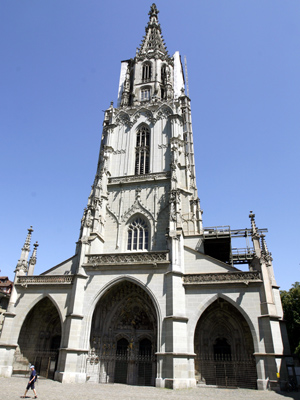
Living in Bern, I can’t help looking at the 17th and 18th century architecture and thinking, “Hmm… If I jumped up there and grabbed that ledge, then pulled myself up there and did a leap over to the other side… and the spire at the top should give me a great vantage point from which to plan my next assassination.” (Note: by ‘assassination’, I mean ‘shopping spree’. Or ‘cuddly kitten’. Or something else that’s inoffensive and doesn’t make me sound like a psycho.) Frankly, though, I think there’s only a slim chance that Assassin’s Creed III will feature the best of Swiss sandstone architecture – although Swiss banking would fit in nicely with Assassin’s Creed‘s conspiracy storyline.

More importantly than my geek musings, though, I’ve got an announcement to make that’s been a long time coming: a friend of mine will be posting book reviews on Eagles on Pogo Sticks. I asked him ages ago but then never got my act together. No more excuses, though – please give my friend a round of applause as he gets ready to introduce himself.

I am not Prince Dastan, nor was meant to be…

In storytelling terms, Prince of Persia: The Sands of Time – the game, not the film of the same name – is quite possibly the most elegant game I’ve had the pleasure to play. It’s not deep, it’s neither Ulysses nor Shakespearean tragedy nor Moby Dick, but within the medium it tells a story, tells it well and does certain things that would be difficult to pull off as nicely in any other medium. Differently from the film, it also knows throughout that it’s basically a tale from the Arabian Nights. It doesn’t try to complicate things. It’s straightforward, and in that straightforwardness it finds a grace the film can only dream of.

There’s something ironic in Prince of Persia: The Sands of Time – the film this time – being more video game-like than the game that spawned it. It features a dagger with a big red button (okay, it’s a ruby, but it’s basically a button on a sharp, pointy gamepad) without even a sense of self-awareness. It does the whole slow-motion thing just to look cool. It has big-name actors called in to do very little of interest, but in grandiose RP accents.

What it mainly has, though, is a director who doesn’t know how to direct action in an interesting way, who doesn’t even seem to be interested in action scenes – which is fine, if you’re directing, say, Donnie Brasco (which I still like a lot), but I already thought that Mike Newell was the wrong man for Harry Potter and the Goblet of Fire. Funnily enough, that film felt like a video game to me: in this level, you need to retrieve the golden egg, in that level you must free your friends from the mermaids’ realm, and in the final level you must navigate the hedge maze and face the boss enemy. (Thing is, levels are okay in games, but in movies they make for clumsy, mechanical structure.)

There are many action setpieces in Prince of Persia: The Subtitle of Subtitles – but they’re largely handled in a clumsy way that breaks the flow when that is the last thing you want to do. Have a main character whose talent is for parkour? Don’t film and edit the scenes in a way that makes it hard to believe the guy is actually doing all those tricks. Tighly controlled continuity is key in such scenes (Casino Royale did this pretty well in its Madagascar sequence), but Newell insists of cutting after an acrobatic movement’s already begun and/or before it finishes, so what we get is disjointed staccato scenes that have as much flow as mud.

What is just as sad: the film aims for charming banter between its two main leads, but much of the time I found myself thinking, “The game had better banter.” Disregarding the plot differences between film and game (and there are many), if a computer game has banter that is better written than that of its big screen adaptation, you need to get a better script. I wouldn’t go so far as to say that Prince of Persia: The Thingamy of Doodah featured horrible writing – it was serviceable for most of the time, but it was oh so plodding. It was clunky. And whoever okayed Ben Kingsley’s lines and then decided to give him the direction, “Act as if you want the audience to find out you’re actually the villain five seconds into the movie”… Well, as I said: I don’t think that Mike Newell was the right man for the job. He wasn’t even the right man for the non-action scenes. And I’m starting to think that Donnie Brasco was a fugazi. Fuggedaboutit.

P.S.: One of my favourite parts of the game – the story is told in retrospect, by the Prince who has already lived through the adventure and is trying to convince the Princess of his tale. (Great reverse Sheherazade move, that one.) When his tale comes to the point where he falls to his death, is impaled by spikes or cut in half by a spinning blade (due to player carelessness), he stops himself and goes, “No, that’s not right. I didn’t die. Let me retell this part.” He basically retells those bits until he gets the storytelling (and the player the moves) right. Lovely touch of meta.