Flash fiction of the dead

Telltale’s The Walking Dead was a surprise to most critics. While many of their earlier adventure games received moderately positive reviews, no one expected them to deliver one of the critical successes of 2012, and they definitely didn’t expect anything as emotionally engaging and harrowing as what we got. I was just as surprised myself; I’d read the comics and seen some of the TV series, but to my mind the game was by far the most effective of the three incarnations of The Walking Dead. The TV series delivered on the action, but it meandered and had too many characters it didn’t know what to do with, whereas the comics to my mind decided that the most effective way to get to the readers is to shock them.

Myself, I quickly got bored with the escalating brutality and gruesomeness of the comics. It very much felt like they were telling variations of the same story, turning up the volume as the story progressed. The underlying emotional arcs, though, remained the same – and progressively got drowned out by the visceral cruelty.

The Wlaking Dead

Telltale’s game series didn’t skimp on bitey walker-on-human action, but it didn’t rely on shock to carry most of the weight. It mainly worked on the strength of the central relationships that developed slowly, decision by decision. Would you have the protagonist side with this character or that one? In a split-second decision, who would they save? In the long run, your decisions didn’t change what happened, but they changed how you felt about things. They made the story personal, and this was reinforced by the quiet moments. Similarly to Cormac McCarthy’s The Road, the story was less about “Will you be butchered horribly by cannibals and your flesh devoured by crazed survivors?” than about feeling responsible for another person succumbing to despair or clinging to hope. Yes, there were crazed cannibal survivors, but they were the background to a story that was relatably human.

Time was an essential factor in the game, however. The Walking Dead got players to care about its characters over several storylines, developing relationships slowly. You didn’t feel the same way about little Clementine at the end of the first episode as you did when the final credits rolled when you finish episode 5. When Telltale published the extra episode “400 Days”, with few direct links to the game’s first season, they decided to do away with what had worked so well: “400 Days” tells five stories, in chunks of no more than 15 minutes, starring five different sets of characters. By the time you’ve got to know one of them, you’re whisked away to play a different character. It’s zombie flash fiction, basically, and it’s a strange choice, coming from a developer whose most successful game depended on slow, gradual character development.

“400 Days” is not an unconditional success. Not all of the storylines are equally engaging, and as with all zombie fiction, there’s a risk of diminishing returns – there are a handful of tropes that stories of the undead keep returning to – but I was surprised by how effective the extra episode was nevertheless. The game ends with another survivor trying to recruit the protagonists of the individual episodes for a settlement up north, and they accepted or declined based on the decisions I’d made a few hours earlier. It didn’t feel like winning or losing the game: and when several of the characters decided to decline the offer and set off on their own, it felt like I’d failed them. I’d failed to show them that even in a world of the dead trust was something worth pursuing.

Both players and reviewers, while largely intrigued by “400 Days”, noted that whatever emotional resonance the game had was less strong by its end than the ones developed in the original five episodes of the first season. This is undoubtedly true – but as developers experiment with different story formats and different ways of engaging the player, we only benefit. Not all such experiments work, and few work 100%, but there are many as yet untried methods of telling stories with the medium. Doesn’t mean that every game has to tell a story in the first place, or that every game must be a formal experiment – but games are a literal playground for storytellers, from the likes of Braid and Journey to Dear Esther and The Walking Dead. Personally I’m excited to see where they’ll take us next.

The Walking Dead: 400 Days

Oh, the places you’ll go!

I’m sure I’m not the only one who finds it difficult to make it clear to non-gamers what I enjoy so much about computer games at their best. While I think the medium has made great strides, it’s still quite alien to people who don’t get the same kind of enjoyment out of games. They see the silly writing, the weird genre conventions, the way that so much gameplay seems to be about doing the same thing over and over and over again, which should bore any sane grown-up, one would think.

For me, the main attraction of playing games is that it takes me to worlds I couldn’t go to otherwise. I’m not even talking about escapism, at least not in any conventional sense: just like fiction allows me to meet and spend time with people I wouldn’t meet otherwise, at its best gaming can put me in places that, whether they’re subtly or wildly different from our world, I could otherwise only enter in dreams. A good game is like a lucid dream. It’s not the power fantasy, at least for me – I can get as much enjoyment out of walking around a virtual deserted island exploring its nooks and crannies as I might get out of running and gunning.

This is also one of the attractions Virtual Reality – or rather, VR done right *coughOculusRiftcough* – has on me. It’s about putting me there in those worlds, with no obvious demarkation line where the screen ends. And that is why projects such as YouTube user ultrabrilliant’s Other Places hold such a fascination for me. Other Places shows video game worlds through the same eyes as Alastair Fothergill’s BBC documentaries show our planet.

So, since it is tritely said that pictures speak a thousand words, here are three epic monologues. Enjoy! (Ideally in full screen and with the resolution turned up as high as possible.)

It’s the idiom, stupid!

In the conversation about the artistic legitimacy of video games, it’s sometimes instructive to take a step back and consider what any given game looks like to a non-gamer. Take the current big-budget game with artistic aspirations du jour, Bioshock Infinite: this is a game that addresses big issues such as racism, revolution, free will and redemption. It throws around allusions to quantum physics, US history and philosophy. Its art design and music are beautiful and filled with a wide range of allusions.

Yet it is also a game where you run around shooting gaudy bad guys in the face with a shotgun just before searching a trashcan to find a hotdog and some popcorn. You scarf them down, healing the damage you’ve taken from being shot at. And then you throw an exploding fireball at your opponents with a flick of your wrist, just before jumping up 20 feet to catch a ride on a metal rail.

BioShock-Infinite

So, to someone who isn’t into games much of the actual gameplay may look grotesque. Why is the player eating from trashcans, and why does this heal him? Why is he spending 90% of his time inflicting grievous bodily harm? And doesn’t all of this rather hobble any aspirations the game has to resonate with the player’s emotions one moment and tickle his grey matter the next? Bluntly put, how can anyone take this sort of tonal mess seriously?

I’d say that there is some justification to this line of argument. As someone who’s been playing games for, oh, 30 years, I don’t see this sort of thing as weird anymore – I’ve become largely inured to what has been called ludonarrative dissonance, unless I choose to. But yes, gameplay and plot – or gameplay and a game’s striving for meaning beyond “I have big gun. He has big gun. I shoot him. He dies.” – do often clash. Take Grand Theft Auto IV‘s guilt-riddled Nico Bellic and his quest for redemption for the horrible things he’s done in his past, which sit oddly next to the multiple killing sprees he engages in during the game’s missions.

Ideally games either explore ways to reconcile their gameplay and whatever meaning they aim at, or they use the tension between the two to interesting effect. However, I’m wondering whether to some extent the discussion ignores one important thing: each medium develops its own medium. Yes, to non-gamers a lot of the medium’s particular idiom is strange – something that is rife for parody – but then, films and TV series have their own idiom, as do books, and to some extent those idioms don’t strike us as weird and ridiculous because we’re used to them. They’ve become invisible to us. (Check out TV Tropes for a comprehensive, time-consuming list of tropes that make up the idiom of various media.)

Compare, for instance, someone who watches his first opera. Is the tragic heroine’s extended death aria, possibly while she’s clutching the dagger in her ample bosom, any less silly than the trashcan hotdog imbued with healing powers? Or Shakespeare: are end-rhymed heroic couplets or stage directions expressed via dialogue any more believable than conventions in games?

Seriously, guys, can we wrap this up? I'm supposed to go out tonight... Oh, okay. One more arrow, but then we call it a day, 'kay?I’m not saying that we should give games a free pass because we’re so used to the medium’s tropes that they’re invisible to us. Tropes can be useful shorthand, but they can also be a crutch – and ludonarrative dissonance is something games have to contend with. After all, how would we react to a big-explosions, brutal action flick doubling as a harrowing intimate drama if the tonal inconsistencies weren’t addressed, let alone resolved? At the same time, critics have to accept that all media and all genres rely on cultural conventions and tropes to some extent, and a certain familiarity with (and, indeed acceptance of) these conventions is required when it comes to enjoying games as much as movies, TV series, stage plays, ballet, opera – and even paintings. After all, wouldn’t I be silly to dismiss most of the paintings of St. Sebastian out there because the arrow-addled martyr usually looks mildly bored rather than in agony?

So, rather than pointing at gaming tropes and saying something along the lines of “This is why we can’t have nice things”, perhaps it would make more sense to become more aware of these conventions, how they are used, and how they can be used better, more intelligently, more subversively – how they can be played with, for want of a better word.

Insert Coin to Arthouse

Computer games are a strange medium for art, and gamers are a strange audience for it. As soon as a game comes out that aspires to art, it takes about five seconds before someone on the internet gets out the big word: “Pretentious.” Give it another ten seconds and someone will say, “Ah, but is it a game?” It’s as if too many gamers would prefer their medium to be one thing only, forever, with no potential to become something more. And that’s ignoring the other side of the debate, the old-timers shouting, “Get off my MOMA-curated front lawn, you kids!”

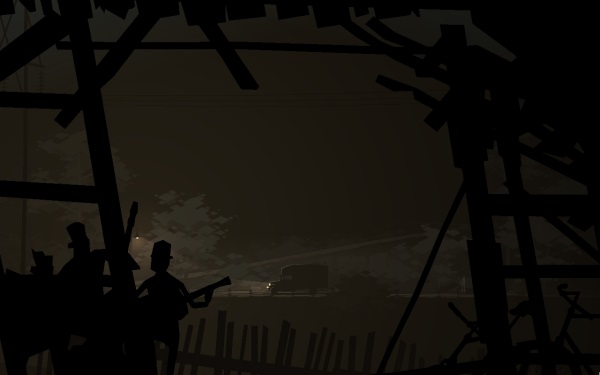
I wonder what Old Man Ebert would say about Kentucky Route Zero, an indie adventure game whose first part (or Act – the game wears its many artistic inspirations on its sleeve) came out a couple of months ago. It’s as if David Lynch, Edward Hopper and Gabriel Garcia Marquez had collaborated on an old-school point-and-click adventure – but while it’s easy to point out how Kentucky Route Zero derives from a number of artistic traditions, in its first act it already manages to become something entirely its own and entirely of the medium, doing things that wouldn’t be possible in this particular way in any other medium.

Kentucky Route Zero

The game excels at atmosphere, evoking a mood that is homely and uncanny at the same time, nostalgic and unsettling. As much as Lynch at his best, Kentucky Route Zero is dreamlike, surreal around the edges, but without giving in to the facile randomness that surrealism is sometimes prone to. The art, the writing, the soundscapes and music – all of these come together to create one of the most unique, compelling experiences I’ve played, well, since I took hold of a joystick in the early ’80s.

Kentucky Route Zero

It is likely that hardcore old-school gamers without an interest in unique experiences with, yes, artistic pretensions will have issues, though. Compared to the classic games of the genre, Kentucky Route Zero doesn’t offer challenging puzzles. In fact, there are hardly any puzzles in the conventional sense as well. What the game does offer, though, is exploration – in more than the expected way. The characters, the conversations, even such simple things as a ride through an old mine on a cart, all these offer glimpses into a world one step away from our own.

Kentucky Route Zero

It’s difficult to give any criticism that seems adequate. Yes, Kentucky Route Zero Act I is a short pleasure; in the conventional terms of game longevity, it does lend itself to multiple playthroughs so the different conversation choices can be explored, but for the asking price of $7 it offers a couple of hours of gameplay only. However, for gamers in any way receptive to the moody, fascinating world the game evokes, those couple of hours will linger long after Act I closes.

P.S.: Act II is to come out within the next month or two; the entire game can currently be bought for under $20. For anyone who’s simply curious to check out the look and feel of Kentucky Route Zero, the developers have released a free tech demo called Limits & Demonstrations that provides a glimpse especially into the project’s overall artistic sensibilities and the writing. Well worth checking out, which shouldn’t take more than half an hour.

These Dead are made for Walking

Zombies. How’s that for unlikely media stars? I used to think it’s only geek culture that goes for zombies in a big way, with stuff like the Marvel Zombies series (seriously!) and with even the most unlikely games having to shoehorn in a mode where you battle the undead hordes.

But no, zombies have arrived in a big way, and they seem to be here to stay. Perhaps the biggest success in this respect has been Robert Kirkman’s The Walking Dead, a comic series started in 2003 which by now has generated not only a TV series that is currently in its third season – and an adventure game series by Telltale Games that is one of the most unexpected gaming hits ever. Adventure games are a bit of a zombie genre themselves; back in the ’80s and ’90s there were many best-selling series, from the Monkey Island games to Sierra’s countless Quest titles, but these days there simply aren’t any triple-A graphic adventures. Telltale, too, have not always produced sterling games, often resorting to tired genre clichés in various series of games trying, with varying success, to revive old franchises, including video game follow-ups to the Back to the Future and Jurassic Park series of films.

To be honest, I didn’t expect much from The Walking Dead. I read the comics but quickly gave up; they start well and are admirably ruthless at depicting a world after the zombie apocalypse where no one is safe from being chowed on by shambling corpses, but the writing is often clumsy and the plotting increasingly became about little other than escalating worst-case scenarios with a touch of sadism towards the characters. (I don’t expect the scenario to be all sunshine and lollipops, but ceaseless grimness and brutality quickly become boring.) The TV series seems well made enough, but zombie fiction tends to rehearse two plots over and over again: 1) the zombies are coming! and 2) man is wolf to man (oh, and the zombies are coming!). How much story can you squeeze out of the overall setup?

Telltale Game’s The Walking Dead doesn’t tell a story that is fundamentally new, but it succeeds at taking the shopworn premise and giving it a spin. For anyone who’s ever despaired at people seriously discussing how they’d fare in the undead apocalypse (and listening to the kind of guys who’d seriously claim that they’ve got it all figured out: “Man, all I need is a sharp katana and 500 tins of baked beans…”), the game puts you in the shoes of a survivor and makes you take some hard decisions. Do you save the person who’s most likely to be of use but who hates your guts or do you throw him to the undead in favour of the woman you’re kinda sweet on? Do you distribute your limited food and water among the group or do you keep them for yourself and the eight-year old girl you’ve taken under your wing?

The game was advertised on the strength of the choices it gives the player, but admittedly the plot doesn’t change in any major ways based on what you do. What does change, though, is how the characters feel about you and how you feel about the characters. What Telltale does magnificently is engage you in the story of a small band of characters – none of which fit the typical video game template (no super heroes, space marines and busty female archaeologists in this one!) – and make you feel the escalating dread and weariness. Whatever you do, you don’t end up saving the world. You might not even save yourself. In The Walking Dead, winning may mean making sure that Clementine, the little girl that ends up in your care, survives another day, that she gets to eat, and that you’ll manage to keep her and the dwindling group of survivors from losing not only their lives but indeed the will to live.

In the end, Telltale’s take on the Walking Dead universe reminds me of nothing as much as of Cormac McCarthy’s The Road. It doesn’t have the same beautifully sparse prose, but it has the same trajectory – and it effectively puts me in the shoes of The Road‘s father, desperately wanting to make sure that the child I’m looking after is safe but at the same time knowing that I must not do so at the price of my own humanity. The relationship between Lee, the player character, and Clementine is one of the most successfully executed relationships in any game I’ve ever played, and it beats most similar relationships in films and TV. Hell (on earth), even Mr Ebert might appreciate this one when he isn’t yelling for those damn brain-eating kids to get off his laaaaarrrrgh-

P.S.: My apologies for the pun in the title – the only thing that’s funny about it is its smell…

Payne Killer (part 2)

This post follows from my previous meanderings on Max Payne. For those who have not played Max Payne 3, beware: there will be spoilers.

While I am not an outright fan of explicit violence in modern media, I’m not particularly squeamish either. I have no interest whatsoever in the gore extravaganza of much modern horror, but neither am I put off by the viscera of some of Tarantino’s more recent offerings, and some of the TV series (e.g. Rome or Game of Thrones) I’ve enjoyed most over the last couple of years don’t skimp on the red gushing stuff.

And yet, Max Payne 3 almost made me switch off the game, not just once but twice, due to the brutality it depicts.

And this is in no way an indictment of the game.

Max Payne 3 is a brutal game – and more than any shooter I’ve played it does a remarkably horrid job of showing what bullets do to bodies. Does the game revel in showing exit wounds? I think I’d be lying if I said it wasn’t – MP3 does not present its violence with the frat boy, fist-pump glee of other games, but it has a fascination for showing the damage done, both to people and to interior (and exterior) decorating, in slow motion. So much so that checking out some of the videos on YouTube makes me queasy – less with the game than with the Beavis and Butthead-ish tone of the video description and comments.

But it’s not so much seeing the carnage I’m authoring that made me wince, at least not after the first ten minutes or so. (There is definitely something numbing to seeing henchman after henchman dying horribly at the business end of my gun – and it’s this repetitiveness that’s a major flaw of the game in my opinion.) It’s two key scenes: in one, I finally find the beaten, bleeding trophy wife of a São Paolo business man earlier abducted by a favela gang, only to see one of the gangbangers put a bullet through her head. In another, the business man’s brother is covered with petrol and burnt alive. The game has previously shown the man as shallow, narcissistic and rather pathetic – but the way the game depicts his death got to me, and quite possibly more so than a similar scene would have in a film.

I don’t want to get into the question here of whether games are becoming too violent or whether people are desensitised to real-life violence and cruelty due to watching brutal films or playing violent games. That question is much bigger and deserves a longer discussion in a wider forum. What I’m interested in is this: why did these two scenes get to me to the extent where I wasn’t sure I wanted to continue playing (keeping in mind, as I’ve said, that I’m not all that squeamish)?

I think it’s this: games make a big thing of player agency – as gamers it’s our finger on the trigger, we decide who lives and who dies, it’s, like, interactive! – yet in practice our agency is always limited, it’s circumscribed in a hundred ways: by a game’s design, its user interface, our character’s abilities and, often frustratingly, by the story a game tells. You’re Superman while playing the game, you’re John McClane, you’re Neo – and then comes a pre-rendered sequence, and what’s pre-rendered as well is your impotence in the face of the great god, Plot. The villain jumps from the shadows and skewers your love interest with his great big sword. (I’ve never played Final Fantasy VII, but apparently this is one of the primal scenes of so many gamers into Japanese role-playing games… and I wonder whether the cod-Freudian subtext is as heavy when you’re actually playing.)

Many games use this in a frustrating way that feels like the program is cheating, in revenge for decades of players using hidden cheats and God modes to become invulnerable. Think you’re all-powerful, gamer? Take that! Ooh, that must’ve hurt! The two scenes in Max Payne 3 that I mentioned earlier (and there are others, although none as pointed) may have an element of this, but I think the game is being cleverer than that: Max Payne, from the first game onward, told a story about revenge and redemption. I’m not sure to what extent it manages the latter all that well, although there’s a lot of quasi-Noirish verbiage in the game about it – but especially Max Payne 3 never lets you forget that the revenge you’re effecting is finally hollow. Yes, you might get to kill hundreds of bad guys in bloody, bone-crunching ways, but Max’ loss is the constant foil through which the player views this revenge. For every henchman killed, for every villain stopped, Max’ wife and child is not a single bullet closer to being alive. For a game that’s entirely about revenge and redemption, it’s bleakly ironic that revenge is shown to be pointless and redemption all but impossible. Max Payne’s extended trauerarbeit (and I don’t think this is wankerish pseudo-analysis imposed on the game – every second line of dialogue is about Max’ ongoing, futile quest to find some sort of meaning in a life that’s had all meaning shot to hell), like the hundreds of painkillers he keeps popping, only serves to dull his pain momentarily.

I’m not saying that Max Payne 3 is a deep, philosophical treatment of mourning, revenge and the futility of redemption – but it does address these issues within the rules it has set up for itself… and, like Rockstar’s earlier Red Dead Redemption (although my vote still goes to RDR for doing more interesting, complex things with the theme) it goes a long way to disabuse the player of this crazy idea that just because he’s got his finger on the trigger he can make everything all right.

Payne Killer (part 1)

It has to be said: as a gamer it’s sometimes difficult not to be embarrassed by video games. Most people with a modicum of taste would take one look at a game called Max Payne (its central character of that name the proverbial Cop With Nothing To Lose, which doesn’t exactly make it less embarrassing) and snort derisively. It sounds about as classy and grown-up as one of those superhero comics where the women have breasts the size of battleships and waists with the circumference of a ripe peach.

The surprising thing was that Max Payne, while not exactly A la recherche du temps perdu (or even Pulp Fiction), was fairly smart and knowing in its writing, at least for a video game in the early years of this millennium, and its sequel, The Fall of Max Payne even more so. Mixing neo-noir cynicism and post-Matrix bullet time with comic book aesthetics, surreal dream sequences and a parodic style that was more Scream than Scary Movie, Max Payne didn’t take itself overly serious, yet it still pulled off that neat trick where we come to care about the characters. They’re funny, but they’re not just the punchline to a joke.

Not even poor, doomed mob underboss Vinnie Gognitti in his Captain BaseballBatBoy costume. Okay, perhaps a bit.

Max Payne 2 pulled off something strangely akin to Tim Burton’s Batman Returns. It shouldn’t work. It should be an incoherent mess of incompatible parts. Dark romance, surreal comedy, cartoon noir and self-referential humour shouldn’t come together to form something that’s somehow more than the sum of its parts – yet it does. Or perhaps it’s a variation on Stockholm Syndrome, where someone who enjoys playing computer games but also enjoys good writing and interesting characters convinces himself that purple prose such as “There was a blind spot in my head, a bullet-shaped hole where the answers should be. Call it denial. I wanted to dig inside my skull and scrape out the pain.” congeals into something that by some process of video game alchemy manages to transcend the clichés it’s assembled from.

What’s the occasion of all of this reminiscing about old games? Call it exposition, call it setting the scene – it’s basically a glorified lead-in for my thoughts on Max Payne 3, the latest (and possibly last?) game in the series, coming soon to a blog near you. Did the series manage to reinvent itself, almost ten years after its last instalment, by transposing its New York neo-noir bullet ballet to the sun-drenched favelas of Sao Paolo viewed through the camera lens left behind by Tony Scott?

Game on, John

I’m sorry, this isn’t the promised Breaking Bad post yet – I got started on that one, but life (and exhaustion) got in the way even of mediocre writing. So, to distract you, here’s something shiny! (To my occasional guest blogger: I have an inkling that this may not be your kind of film – but hey, the trailer features John C. Reilly!)

So, for those of you whose childhood was sadly devoid of “Insert Coin” and “Press Button to Continue”, and whose dreams aren’t haunted by the WAKA-WAKA-WAKA of Pacman’s eating disorders, here’s another trailer, which is a good bit and has Christoph Waltz in it.

Here comes the rain again

Hang on, weren’t computer games about (male teenage) wish-fulfillment? Weren’t they about pretending to be overly-muscular he-men carrying weapons the size and weight of Texas, or knight templars wielding enchanted swords, or cocky, ersatzIndiana Jones explorers making sexy small talk while exploring dark tombs looking for the Whatsit of Certain Doom?

Instead I’m spending time in front of the telly running after my son, knowing I won’t get to him before something horrible happens. I spend time shaking the controller so that my overweight on-screen avatar shakes his asthma inhaler, then I press right on the analog stick so he actually takes a puff of his medication. And all the while the rain keeps pouring down.

Heavy Rain is a weird game. It’s derivative: the atmosphere is pure Seven, which is nowhere as obvious as when I visit a suspect’s apartment and the man, a religious nutter, has crucifixes hanging from his ceiling like so many Little Trees car air fresheners, and the music sounds like Howard Shore’s B-sides. The characters lack subtlety and their dialogues often clunky. There’s something almost laughable about how hard the game tries to be melancholy, weighty, tragic. And the gameplay feels like a mix between Dragon’s Lair quick-time events (press R1 now not to get knocked out by the prostitute’s choleric john!) and one of those hipster-witty, highly meta indie games mocking the usual epic dick-waving of video games by making you do utterly mundane, pointless things: yes, you can open the fridge, take out a carton of orange juice, shake it (wouldn’t want all the pulp to remain at the bottom of the juice carton!) and take a gulp, but it won’t get you any closer to finding the Origami Killer. In fact, I’m a couple of hours into Heavy Rain and most of the interaction I’m offered is of the juice-carton or asthma-inhaler shaking kind. There are important decisions (do you shoot a suspect? do you foil a robbery?), but they don’t make up the bulk of the game. Is this some weirdo wish-fulfillment for pretentious, self-aware dweebs approaching middle age – an ironic power fantasy for the disillusioned?

The thing is, though, the gameplay, allowing for actions veering between boringly banal and surreally pedantic, works in one important way: it puts you in the role of the character you’re playing in a most effective way. Heavy Rain provides the player with agency that precisely isn’t of the “I am a Jedi!” kind, which is always essentially “I am myself, but I am also invincible! Take that, 3rd grade bully who’s become an Imperial Stormtrooper!”; instead it makes it easier to slip into the skin of depressed father Ethan Mars or asthmatic private investigator Scott Shelby. It’s a bit like acting, where it can be the small actions and gestures, irrelevant to the plot, that make a character come alive – it’s the bits in between the showcase fights and high-tech investigation, between entering a suspect’s apartment and fighting off hooded intruders, that make the player empathise.

I’d hesitate to call Heavy Rain a good game. I’d definitely not want other games to copy its gameplay. But as an experiment in the potential and the limits of agency in gameplay, and in player identification, it’s fascinating. And I want such experimentation to be possible not only in small-scale indie games but also in Triple-A titles. Just like L.A. Noire, Heavy Rain may get quite a few things wrong, but what it gets right it does in ways that few other games have even attempted.

Dark is L.A. and full of terrors

When it comes to creating virtual worlds, Rockstar may just be the true heir of Origin Systems. Whether it’s the Liberty City of Grand Theft Auto 3 or GTA4, the fictionalised versions of Los Angeles, San Francisco and Las Vegas in GTA San Andreas, the boarding school and small town of Bully or the dying Old West of Red Dead Redemption, in my opinion Rockstar’s greatest creation to date.

L.A. Noire‘s sun-drenched yet crime-riddled 1950s Los Angeles is both an amazing feat and, quite possibly, Rockstar’s greatest wasted opportunity. It’s an impressive recreation, looking just like the movies, from Chinatown to L.A. Confidential – but where I enjoyed exploring San Fierro, New Austin and Liberty City, I never felt at home in this noirish L.A. In Rockstar’s other games, I’d forgo all automated options of getting around the place, I’d drive everywhere myself, just because I enjoyed hanging around in these cities. The games and their locations, they were one and the same. In L.A. Noire, though, I quickly started to ask my partner to do all the driving. In spite of the game’s title the place itself, Los Angeles, is a mere backdrop – and as it’s rarely integrated well into the game, it feels like an elaborate loading screen, or like a technically impressive but essentially lifeless cardboard backdrop – like The Truman Show‘s Sunhaven, and I was the unwitting Truman stuck there.

Unfortunately, L.A. Noire is full of wasted opportunities. The writing is great, as is most of the (voice) acting, but the game’s signature motion-capture technology veers into Uncanny Valley as often as it succeeds at bringing its characters to life.

The occasional disconnect between the characters’ faces and their bodies is one thing; another is that L.A. Noire doesn’t do photo-realism, doesn’t try to, so the animations, realistic down to the imperfections of involuntary twitches, don’t gel with the more stylised look. It doesn’t matter whether the latter is due to technical limitations – the result, while often impressive, does pull its audience out of the moment too often.

L.A. Noire could have managed to pull everything together with its gameplay, but alas, that’s another strike against the game. It’s not so much that it plays badly – what hurts L.A. Noire is that as a game it is bland. Rockstar’s other titles tend to be generous to a fault in the gameplay department, where you might get new elements introduced two thirds into a game’s plot. In its ’50s crime-and-punishment saga you’ll be doing pretty much the same from the first case you’re working to the last. Here a foot chase, there a car pursuit – and the game’s signature interrogations suffer from a lack of internal logic (seriously, guys, at times the choice between Doubt and Lie seems to have been down to a coin-toss).

In spite of all this, though, I’d be lying if I claimed that L.A. Noire didn’t have its compelling moments. As you progress from the first crime desk (Traffic) to the second (Homicide), the single cases start to connect, and the story ties in cleverly with the Black Dahlia murder. As the plot begins to cohere, the characters become more interesting, and the protagonist Cole Phelbs, while rarely likeable, turns into one of Rockstar’s trademark flawed anti-heroes. By the game’s ending, I felt for the guy and his messed-up issues.

In the end, L.A. Noire is a weak game with strong elements – and for a Rockstar game, it’s a failure. It’s a fascinating failure, though, and I’m curious to see how its experiments and assets – the motion-captured acting, the story structure, the ‘real’ location – pay off in future titles by the developer. Grand Theft Auto V will again be set in Los Santos, Rockstar’s earlier take on LA; I, for one, wouldn’t mind seeing L.A. Noire‘s fingerprints on it.