Nope, I haven’t handed in my nerd credentials and stopped playing computer games. As a matter of fact, I recently got a new graphics card, so I’ve been diligently playing those games that didn’t run that smoothly before the upgrade. One of the titles I’d most been looking forward to is Stalker – Shadows of Chernobyl. (Well, technically it’s called S.T.A.L.K.E.R. – Something of Doodah, but unless someone can tell me what the abbreviation is supposed to stand for, I refuse to use that wannabe leet name.)
There’s been a discussion about games as art for a while now. If we look at them as narrative art, then I’d agree that there are few games that tell a story that’s better, or even as good, as your average mainstreamy Hollywood genre piece. (There are exceptions, but that’s material for another entry.) What games can excel at, though, is atmosphere – and that’s what Stalker has in spades. It’s based, though loosely, on Andrei Tarkovsky’s enigmatic film of the same name (which I haven’t seen yet – shame on me!).
The game is set in the area around the radioactive wasteland surrounding the defunct nuclear reactor in Chernobyl. Stalker‘s version of the Zone is populated by lone adventurers, bandits, militia and mutated animals. It is dotted with anomalies that tend to mean your death if you wander into any one of them unawares. (There is grim fun to be had of watching packs of mutated dogs happen into an anomaly that pretty much spins them around like the cow in Twister – and then tears them apart.)
Stalker manages to be one of those games that’s greatly enjoyable but not a lot of fun, and that’s mainly down to its atmospheric setting. On my first day in the Zone, I happened across a camp that other Stalkers had made amidst rusty cars and a broken down Hind helicopter. Just as the sun set, a group of bandits attacked, and most of what I could make out were bursts of fire in the darkness and the flashlight’s circle of brightness illuminating burnt out Ladas and the occasional bandit aiming his semi-automatic at me.
In general, the nights in the Zone are tense and scary – mostly because they are actually dark. Walking towards distant lights, your flashlight barely illuminating the bushes in front of you, while you hear strange animal sounds, and suddenly a pack of dogs attacks, their eyes glinting in the dark… Definitely beats the hell (pun only semi-intended) out of Doom 3‘s predictable haunted house ride and its rubber zombies.
I’m not very far yet, but I’m looking forward to getting closer to the shut-down reactor and entering the parts of the Zone that used to be residential areas. Until then, I will continue being the bane of mutated dogs and hogs everywhere… until I run out of ammo. I run pretty fast (’till I stumble into one of those amusing anomalies and it proceeds to turn me inside out).
Okay, I have to warn you. This is not one of those “I like game/movie/book XYZ enough to bore you with the details” posts. It’s an opinion piece. And it’s about one of those boring topics that the media keep coming back to, usually in the most facile, over-the-top way possible. Especially in the German media, you often get the equation: video gamer = potential murderer and sadist.
Which ticks me off. But what ticks me off just as much are gamers who aren’t able to look at the issue with some critical distance. You can’t have a decent discussion with the likes of Jack Thompson, people who believe that games train you to kill and maim (the word “murder simulator” pops up in their rhetoric), but it’s just as impossible to have a decent discussion with people who don’t have any second thoughts about a game where you’re rewarded for stealthy behaviour with extra-gory executions, and that’s part of the fun. (Warning: the video, showing Manhunt, is quite explicit.)
The people who think that any depictions of violence in games are fair game usually bring up three arguments: 1) “Movies such as Saw or Hostel are just as violent, they’re more realistic than pixellated polygon carnage, and adults can watch them, so it’s hypocritical to want to censor games!” 2) “It’s just a game, and personally I can tell the difference between a game and reality. If you can’t, that says more about you…” 3) “Censorship is a restriction of free speech! And that’s un-American! Why don’t you go back to Russia, commie?”
1) “Many movies are just as violent, but you don’t see them being banned, do you?”
It’s definitely true that films such as Saw or Hostel are at least as violent. They’re also more realistic, because while games have advanced quite amazingly in terms of visual representation, you still wouldn’t mistake a game’s version of reality for the Real Thing(tm). (One point that’s often raised together with this one is that games aren’t kiddies stuff per se. I agree with that – just like not all animation is Disney fare but may be aimed at an adult audience, not every game is Super Mario World.) However, it’s silly to ignore the fact that games are interactive, whereas films aren’t. Quite often, game violence is inflicted by the player’s avatar, controlled by the player. It’s too simplistic to say that you, the gamer, are committing the violent acts, but there’s obviously a causal link between your actions and the on-screen violence.
I’m not saying that this automatically programs gamers to become murderers, or simply to become more violent and aggressive. Most of the studies I’ve seen that suggest such a correlation are questionable in terms of methodology – for instance, they measure an increase in aggressivity in ways that would apply to football or any other competitive sports as well. On the other hand, though, there aren’t that many good studies that show the violence in games to have no effect whatsoever. Until there’s more, and especially better, unbiased research, the argument simply doesn’t hold. And just because individual gamer X who’s been playing violent games since he was 12 hasn’t taken a knife to his parents yet (you gotta love anecdotal evidence!), that doesn’t mean that there might not be other, more subtle effects.
Does this mean we should prohibit all violence in video games? No – but it does suggest that we, critics as well as defenders, should keep a more open mind.
2) “It’s just a game, man! Ever heard of fiction? It’s this thing that isn’t reality!”
When Goethe published his novel The Sorrows of Young Werther which ends with the protagonist’s suicide (yeah, I’ve just spoiled the novel’s ending for you! deal with it!), there was a rash of copycat suicides. People cheer when bad guys get killed in movies. They cry when their favourite characters in a series die. Yes, the emotional reaction is safe to some extent because it’s based on fiction – but it is nevertheless an emotional reaction.
And while the relationship between fictional representations and the reality they represent is highly complex, would anyone really, honestly deny that there is a relationship? Horror movies scare – why else would people watch them? Romantic comedies make you all warm and fuzzy. How many people sit in their seats thinking “Yeah, right, but it’s not real, is it? That’s just an actor, that’s ketchup, and those are digital effects.” Much of the time we watch fiction in order to get lost in it. Fiction can have a real effect on us, so saying that when you put a virtual knife in some poor virtual henchman’s virtual eyesocket it’s just fiction strikes me as naive at best, and disingenuous at worst.
Again, this doesn’t mean that violence in games should be made illegal outright. It just means that the argument is becoming increasingly facile.
3) “Freedom of speech, yadda yadda yadda…!”
Okay, I’m going to out myself here. I don’t necessarily believe that absolute freedom of speech is such a great thing. In the best of all possible worlds it is. In a world filled with responsible, mature people who can look at themselves and their own actions with a minimum of critical distance, free speech would be one of the greatest goods.
In a world where people think that just because you’re allowed to say something it’s right to say it, and where people don’t think that every now and then it’s better not to say something… well, in such a world, I must say that I can live with restrictions to free speech. There is no such thing as absolutely free speech anyway – there are always limits imposed by others. Sometimes these limits are institutionalised (for instance when the government issues laws against hate speech), sometimes they’re internalised. (“You don’t say XYZ because…”.)
I often find that you can’t really talk to people who act on pure principles – because principles, if applied as purely as they’re usually argued, ignore context. And that’s what is woefully missing from this entire debate: people fight over examples of videogame violence, but they don’t really look at the individual contexts. Do I think it’s right that the BBFC denied Manhunt 2a certificate, in effect banning it in the UK? I don’t think it’s wrong, although I think this sort of thing should be applied only after a lot of consideration, and it should be open to appeal. I think it’s important to discuss whether “freedom of speech” means such games should be made and sold. I think it’s important that the in-game context of violence should be looked at critically. Who is the player character, what does the violence consist of? How is it integrated into a plot? Who is it committed against? Does the game reward violence, does it punish it, or does it simply show it? All of these are interesting, important questions that are so often ignored by both sides of the debate. The same act of violence may mean something vastly different depending on context.
If anything should go in games, because they’re fictional and because artistic freedom should be absolute (i.e. it should include such things as gamers being able to chainsaw their opponents in the throat and then dismember the corpses – it’s art, innit?), then there’s nothing wrong with rape games or concentration camp simulators. These games exist (they’re amateur productions), and they won’t stop existing if there’s legislation. But unless the defenders of videogame violence are willing to have an mature, differentiated debate about the issue, acknowledging its complexity, I can live with limits to what is acceptable in games.
Until a game is banned that I really like, and that’s when I’ll probably be shouting the loudest.
(Note: That last sentence is there to acknowledge the contradiction in me advertising GTA: San Andreas one day and ranting against violence in games the next. Hey, I’m a contrary bastard! Also, I’d rather continue the discussion in the Comments, if anyone’s interested. This issue should be debated, and not just in black/white terms.)
Okay, it’s “Plug an old game” time. Yesterday I finished my second or third playthrough of Grand Theft Auto: San Andreas. And it’s still one of the most versatile games I know – it’s probably the truest “sandbox game” that’s out there. For those of you who aren’t computer game nerds like myself, here’s a handy definition from Wikipedia:
A sandbox-style video game (or a video game with an optional sandbox mode) is a video game with an open-ended and non-linear style of gameplay, or a mode of gameplay within a game that is more often played in a goal-directed manner. The sandbox analogy is used to describe this style of gaming because, as with a physical sandbox, the user is simply allowed to do what he or she wishes (with the available game elements and within the limitations of the game engine — the metaphoric toys within, and boundaries of, the sandbox).
Now, what does that mean in concrete terms? San Andreas is a story-heavy game, it’s “played in a goal-directed manner”, but it gives you a lot of freedom in a) how you go about achieving the goal and b) how you spend your time in between missions. The game world is huge – you’re given three virtual cities/states to play around in: LA-inspired Los Santos, San Fierro (based on San Francisco) and Las Venturas, which is eerily similar to a certain desert city replete with casinos and organised crime. And while the story itself is enjoyable enough, some of the most fun can be had just boarding one of the many vehicles (cars, bikes, boats, planes) and zooming around. Personally, I get most of a kick out of navigating the hills of San Fierro on my trusty BMX bike, but here’s some of the fun’n’games that others came up with.
“The Enrichment Center is committed to the well-being of all participants. Cake and Grief Counseling will be available at the conclusion of the test. Thank you for helping us help you help us all.”
“Did you know you can donate one or all of your vital organs to the Aperture
Science Self Esteem Fund for Girls? It’s true!”
Portal is probably this year’s most written about game, even more so than Halo 3. And for good reason. It’s the first game I’ve every played (and I’ve been doing this since 1982, roughly) that I would call perfect. This weirdly wonderful offshoot of the Half-Life franchise, feeling like the movie Cube, if it had been written by Charlie Kaufman, doesn’t take a single wrong step. The brilliant idea that forms the premise of the game gets the usual Valve polish, but it’s the script that turns this into something special.
Which is also why I’d rather show than tell. So, here goes, courtesy of YouTube:
P.S.: Portal‘s AI GLaDOS, who gives good old SHODAN a run for her money, is brilliantly written. The funnier she gets, the more disturbing she gets. And the song at the end makes me want to cuddle and cuddle and cuddle this game.
I finally finished Augusten Burroughs’ Running With Scissors. And boy, am I glad.
By the time I got to the last chapter, I no longer hated it. I simply didn’t have the stamina for that. I simply found it boring and annoying – and boringly, annoyingly unfunny. There’s little structure in the novel, so the single episodes could all be jumbled up and re-ordered with little to no effect on the book. There’s barely any character development. I’m sure you can write enjoyable novels without character development or structure, but you have to be a hell of a lot better than Burroughs and your story has to be a hell of a lot more interesting. Up to the very end, I felt I was reading the self-indulgent, self-dramatising journal of a drama queen – admittedly one whose childhood and adolescence (as told) were quite horrible, but suffering in itself does not a good novel make.
Anyway, it’s over, and I’ve now started on Haruki Murakami’s short story collection Blind Willow, Sleeping Woman. I recently read his Kafka on the Shore, which was okay but faltered a lot towards the end, and it suffered a lot from having come after The Wind-Up Bird Chronicle, which I think is what the Germans surreally call “ein grosser Wurf”. (Roughly translateable as “a great success”; literally, it means “a great throw”, which might make sense if the Germans played baseball.) I enjoyed a lot of Murakami’s earlier short fiction, perhaps mainly because his excursions from the main plot are always fascinating… and in a short story there’s less of a risk that he runs out of steam and the novel peters out. Murakami is a great writer, but endings aren’t his forte.
What else? I’ve played on in Anachronox, and it’s as delightfully inventive as I remember. I’ve just left Democratus, one of the great inventions of the game: a planet that makes Switzerland’s political system look positively efficient. On Democratus, every decision requires a vote. Every decision. And every decision has to be discussed in great detail, so that the planet’s High Council even fails to come to a decision about the 64 lethal missiles aimed its way by an aggressive insect race. But watch for yourselves:
Since few of you are likely to still find the game and play it, I’ll go ahead and spoil some of the further plot for you: after you save Democratus, the Council decides to reward you by having the planet shrunk and joining your party. As Wikipedia puts it, “the most annoying civilization in the universe shrinks their planet to five feet in diameter and begins following the team around.” And there’s little as boggling as the sight of that man-sized planet happily floating after you, squabbling about your every decision.
Videogame critics keep saying that there’s precious little humour in video games (or at least humour that isn’t unfunny at best and cringeworthy at worst). Now, it may be true that the humour in most games is made up of stale wisecracks and one-liners that make you groan… but then, most movie comedies aren’t really very funny, are they? There’s little good comedy in games as in films, but there are of course gems in both media. The games I’m thinking of, for instance, are many of the old LucasArts adventures (Grim Fandango, Sam & Max Hit the Road, the Monkey Island titles minus Escape from…), No One Lives Forever, Psychonauts – and Anachronox.
I never finished Anachronox when I originally played it; the pre-patch version was so buggy that it started to crash frequently halfway through the story. Now, thanks to some new tech and inofficial patches, I’m finally able to play it again, and in spite of the engine showing its age, I’m riveted. The game’s the strange offspring of Japanese RPGs, The Hitchhiker’s Guide to the Galaxy and Raymond Chandler crime novels. It’s got some of the best writing and voice acting ever in computer games. Even though I don’t particularly enjoy the gameplay itself, I still can’t stop playing, no matter that I’ve got newer games waiting for me both on my computer and on PS2.
It’s a shame the game didn’t sell very well at all, since it was meant to be followed by a sequel. As it is, Anachronox ends on a cliffhanger, and it’s unlikely that we’ll ever get the follow-up. Which is roughly like ending Lord of the Rings on The Fellowship of the Ring, with Frodo and Sam going off to Mordor – THE END. NO, WE WON’T TELL YOU WHAT HAPPENS. It’s a crying shame that good writing sells less well in videogames than big boobs, big guns and uninspired franchises.
P.S.: Anachronoxis a good illustration of my theory that humour is usually funnier when the characters aren’t just Punchline Delivery Agents(tm), but are actually fleshed out. There are moments of surprising poignancy in the game, which make the comedy shine more brilliantly.
P.P.S.: Here are some more trailers of genuinely funny games – because it’s these kind of games the medium needs if it wants to be more than just adolescent (male) power fantasies. I also hear that the new game Portal, scripted by Eric Wolpaw of Psychonauts fame, is very funny, and very good.
Yesterday evening I finished Metal Gear Solid 2. The ending was decidedly underwhelming, for all its action and its cascade of relevations, one topping the other. It was also facile and preachy, and it hadn’t earned the right to be preachy. I wasn’t as annoyed at it as many people seem to have been, though, based on reviews and posts on the internet.
What seemed to annoy them most, however, was the metafictional self-awareness that crept into the last 2-3 hours of the game. Your superiors, who keep contacting you via radio throughout, start to make increasingly explicit references to everything that’s gong on being a game, even telling you at one point to switch off the console. While this isn’t postmodern fiction on a par with Pynchon or Auster, it’s still a refreshingly clever take on most videogame narratives, where you, the player, are as much of a puppet as your in-game avatar, following orders that the game’s narrative imposes on you, with little or no choice. The self-referentiality is also represented quite wittily, with everything that’s overtly game-like – the ‘continue’ and ‘save game’ screens, for instance – playing into it.
Why is it, though, that people – gamers as much as readers or movie and TV audiences – hate self-awareness so much? Read IMDB comments (admittedly, hardly the most critically-minded crowd) and you’ll see that self-aware fictions tend to get extremely strong reactions. Audiences, by and large, don’t want to be told that what they’re watching or playing is a film, a game. They prefer to submit to the illusion that ‘this is real’. In fact, they resent narratives that don’t allow them the comfort of that illusion. Because if something that we want to believe to be real is actually a fiction, it raises questions that may be a tad uncomfortable. Or perhaps I’m just a snobbish post-structuralist… But I think that at its best, you can see the puppeteer’s strings and appreciate his illusion-making, yet still feel for the puppets as if they were real.
And now, so’s you don’t get bored: a movie!
On a different note: What do you do if you get a book as a present, and you want to honour the present – but you hate the book? After Miéville, I moved on to Augusten Burroughs’ Running with Scissors, and I keep wondering whether I really want to be reading this. It’s one of those “you have to laugh to keep yourself from crying” type of memoirs, where the things that are (supposedly) tragic are drawn in an exaggerated, cartoony fashion. According to the blurb on the back, it’s “hilarious… Adrian Mole scripted by Hieronymus Bosch”. The problem is, I don’t buy any of it. I’m not saying that Burroughs concocted the whole thing from scratch, but its over-the-top, camp tone and narrative feel fake to me. Augusten, a ceaseless self-dramatiser, is one of the most annoying narrators I’ve read in a long time. Is he a poor sod? Yes. Do I want to listen to him being a poor sod? No. And for all of its outrageousness, its lurid sexuality and forthright storytelling, there’s something disappointingly conventional and even prudish to the novel. Which may be true to the young protagonist, but that doesn’t make him or the book any more interesting.
– What’s going to happen to us?
– There, there. We always end up in a universe where we exist. Remember Copenhagen?
Remember the self-aware, postmodern hospital soap opera that Nate watches in the first episode of season 3 of Six Feet Under? Well, if that network – COMA TV? – had a 24-type series, chances are it’d be pretty much like Metal Gear Solid 2: Sons of Liberty, the PS2 game I’m currently playing.
Quite honestly, I’m not certain whether MGS2 is a badly scripted, badly acted mess of a soap opera as done by Tony Scott, or whether it’s a clever parody of existentialist hi-tech conspiracy thrillers (ah, that old chestnut!). Whichever it is, the game is a weirdly compelling guilty pleasure. But yes, the writing makes Final Fantasy X seem a masterpiece of subtlety.
In part, the game is obviously tongue-in-cheek; the absurd conversations with Otacon when you save the game, or scenes like the one where you have to sneak across a walkway underneath a guard answering the call of nature make that clear. But what about the bathos of Otacon’s relevations concerning his quasi-incestuous relationship with his stepmother? And what about Peter Stillman (Paul Auster fans note the name!), the anti-demolitions expert who faked having a fake leg for years in order to gain sympathy? While the latter reads like bizarre black comedy, the game plays it absolutely straight-faced.
I can’t say I ‘get’ MGS2, nor can I gauge its tone most of the time, but I definitely want to know how it ends – even if people have it that it’s the sort of ending that makes you want to throw your Playstation out the window. But, dagnabit, did they have to make the cutscenes that long? I feel like I should take a day or two off in anticipation of an ending cinematic that’s bound to be (or at least feel) as long as Peter Jackson’s King Kong.
I used to love fantasy role-playing games. I’d devour all the Bard’s Tales, Ultimas and Baldur’s Gates I could get my Hands of Great Fingeritude +2 on. Some of my fondest geeky childhood memories are of drawing maps of enormous dungeons (back before the days of wimpy auto-mapping features) and adorning them with clumsy doodles of ringwraiths, dragons and beholders. I got a kick out of reading the rulesets for Dungeons & Dragons and imagining my own (predictably generic) fantasy world, although I never got a successful campaign off the ground – mainly because one of the players was quite mad and better at chewing up PET bottles, skulking off to a corner and rambling incoherently than at role-playing his dwarven fighter. (And no, I don’t think that sort of behaviour qualifies as valid role-playing for a dwarf.)
I still have a weak spot for the Ultima games, mainly because they got two things right: the world and the characters. If I had unlimited time, didn’t have to work and wasn’t worried about my girlfriend thinking I’m even more of a geek than I am, I would try to recreate the series’ Britannia as a huge mod for The Elder Scrolls: Oblivion. And then I’d get a kick out of walking from one end of the continent to the other, stopping every now and then to see the sunset over Brittany Bay or to watch a thunderstorm from some mountain peak. Sad, isn’t it?
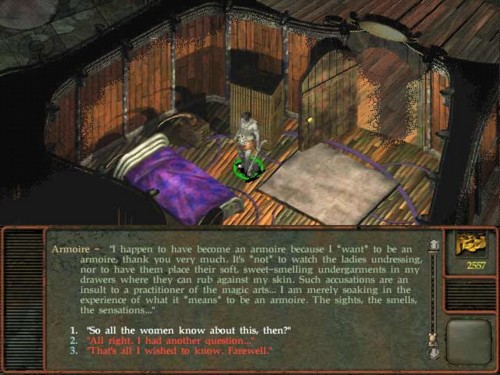
Anyway, to get back to the issue at hand: I bought Neverwinter Nights 2 last year, an RPG based on the Dungeons & Dragons ruleset. I’d heard good things about its story and writing. Somehow I never made it past the tutorial when I got started on it last year, but now I’ve started playing it again. And while it’s okay and competently executed, I realise I’m tired of what the 1UP review calls a “wonky fantasy geekfest”. I’m tired of the D&D ruleset. I’m tired of grumpy dwarfs, aloof elves, of slaughtering cheap orc knock-offs (doesn’t matter if they’re called “bladelings”). Yes, the writing is quite good, but not enough so to make the game much less generic. The characters seem fun – but not enough so to make me care much about the world or about what’s going on. Big evil threatening the Forgotten Realms, and only you can save the world? Please. Give me Planescape Torment instead any day, with its hyper-intelligent hive-mind rats, its puritanical succubus, floating skulls, and the best amnesia story this side of Memento. And its enchanted panty-sniffing armoires. Let’s not forget about the panty-sniffing armoires.
Anyway, enough of a rant about generic fantasy RPGs. More later, perhaps. And for those of you who tune in for the movie and TV musings, don’t worry – they’ll be back before long. It’s just that watching anything is more fun if my special someone is sitting beside me. And yes, that’s the kind of soppy, sentimental bastard that I am. Don’t say I didn’t warn you.


 A Damn Fine Cup of Culture