Welcome to Six Damn Fine Degrees. These instalments will be inspired by the idea of six degrees of separation in the loosest sense. The only rule: it connects – in some way – to the previous instalment. So come join us on our weekly foray into interconnectedness.
There is certainly joy in encountering anything perfectly crafted. Whether we’re talking about films or books or songs or games, there are examples that are exactly what they set out to be and you can’t see a single thing you’d change. Such craftsmanship is exceedingly rare, but to see it is always amazing.
And yet: sometimes it’s the imperfection of something that makes it especially memorable.
Welcome to Six Damn Fine Degrees. These instalments will be inspired by the idea of six degrees of separation in the loosest sense. The only rule: it connects – in some way – to the previous instalment. So come join us on our weekly foray into interconnectedness!
There is something intensely likeable about movie quizzes. If you know the answer, you feel really quite smug: Yes, I’ve seen the movie, and I know a whole lot about that film – it was even produced by someone you wouldn’t expect. You get that warm, fuzzy feeling in your stomach because you’ve scored a point, while a lot of the others didn’t, you can tell from their puzzled faces, and you are inching just a tiny bit closer to the top spot. And on the other hand, if you don’t know the answer, you go into instant detective mode: I should know the answer, now how can I deduce that from the other movie that very same director has made just before this one? Hmmm… You rack your brain about a name, and then, with your last ounce of with and memory, you may just come up with the right answer. Most of the time, anyway.
One of the things that video games can do magnificently is create worlds. These posts are an occasional exploration of games that I love because of where they take me.
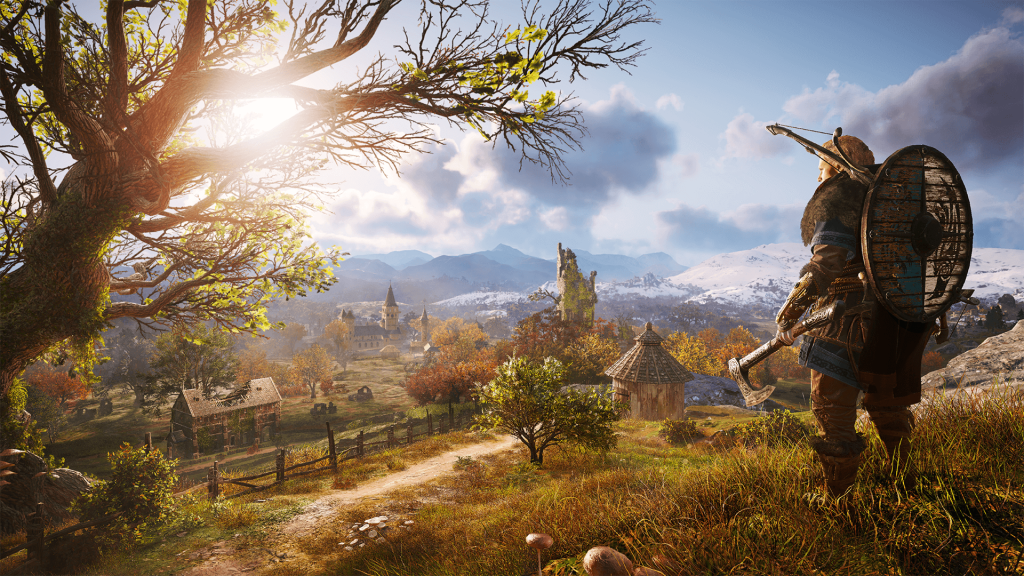
To be honest, I thought I’d burned out on the Assassin’s Creed games. For a long time, they were a staple in my gaming diet: a series of Dan Brownesque stores in which global conspiracies rub shoulders with ancient civilisations – and where you run around stabbing people. A lot. Mind you, while I kinda enjoy the ludicrousness of the setting, that’s not why I kept playing every single instalment in the series for the longest time. No, what kept bringing me back to the Assassin’s Creed well was that each game is mostly set at a specific place and time in history: I’ve climbed cathedrals in the Holy Land during the Third Crusade as well as in revolutionary Paris and late Victorian London. I’ve scaled Venetian palazzi and Egyptian pyramids. I’ve hobnobbed with the likes of Cleopatra, Blackbeard, the Marquis de Sade, half the Medici family, Dickens, Darwin and Marx. In short: I enjoyed the Assassin’s Creed games because they let me be a tourist, travelling less to distant countries than into the past.
One of the things that video games can do magnificently is create worlds. These posts are an occasional exploration of games that I love because of where they take me.
If I were to reduce the specific appeal that video games hold for me over any other medium, it wouldn’t be the predictable one. It wouldn’t be interactivity. Obviously it’s cool that games react to your actions, but let’s be honest: that interaction is often pretty limited – and, ironically, it tends to highlight the many ways in which the games aren’t actually particularly interactive. You can choose between option A and option B, or you choose whether to run left or shoot right. These actions can be fun, they can even be meaningful, but the freedom they offer isn’t exactly enormous.
No, the thing I’ve found that appeals to me most in games is exploration – and this is where I experience the freedom of games the most.
Join us every week for a trip into the weird and wonderful world of trailers. Whether it’s the first teaser for the latest instalment in your favourite franchise, an obscure preview for a strange indie darling, whether it’s good, bad, ugly or just plain weird – your favourite pop culture baristas are there to tell you what they think.
One of the things that video games can do magnificently is create worlds. These posts are an occasional exploration of games that I love because of where they take me.
I am currently replaying one of the Assassin’s Creed games, in which players are invited to go back in time and hobnob with the likes of Queen Victoria, Leonardo da Vinci and Cleopatra in 19th century London, renaissance Florence and Ptolemaic Egypt. They’re wonderful games for tourists – but they’re also shallow and repetitive, filled with busywork and ludicrous plots about ancient conspiracies and precursor civilisations. For a long time, I would buy each new Assassin’s Creed and play it excitedly, like the history nerd I am, but almost always I would get tired of them before I was even close to the ending.
Nonetheless, when I’ve got a phase where I’m tired from work in the evenings and don’t want anything that engages me too deeply, I often revisit an Assassin’s Creed game, because of the sightseeing. I don’t always need deep, engaging gameplay or storylines – sometimes what I want to do is climb the clocktower of the Palace of Westminster and look out over Dickensian London, smog, chimney sweeps’n’all.
One of the things that video games can do magnificently is create worlds. These posts are an occasional exploration of games that I love because of where they take me.
In the early years of video games, their aesthetics were limited mainly by technology: by the resolution of the graphics or the number of colours that a system could produce and display on the screen at the same time, or by CPU speed. The best programmers and artists could do wonderful things within those limitations, and you can enjoy great pixel art even today, when computers can produce real-time visuals that are vastly more complex.
These days, video game graphics are much less limited by the tech the games run on, so a lot of games – especially in the so-called AAA segment, i.e. the games with the biggest budgets and the largest teams of developers – aim for photorealism. At the same time, smaller developers who don’t necessarily have the resources to create virtual worlds that visually are getting less and less distinguishable from reality, have a vast range of possibilities to work with those very different limitations: they might create games that use different kinds of stylisation, that look like vintage animation or paper cutouts or jagged fever dreams. In modern games, we may find aesthetics that don’t harken back to the ’70s and ’80s, with their blocky pixels and four-frame animations, but to times when video games were entirely inconceivable.
Join us every week for a trip into the weird and wonderful world of trailers. Whether it’s the first teaser for the latest instalment in your favourite franchise, an obscure preview for a strange indie darling, whether it’s good, bad, ugly or just plain weird – your favourite pop culture baristas are there to tell you what they think.
There are some gamers who seem to seek validation from some game that they spent dozens of hours on being adapted for cinema or TV. Is it because Roger Ebert put down our hobby decades ago when he was still with us? (Okay, to be fair, a certain someone who shall remain me had some definite opinions on Ebert’s verdict at the time and wrote an article in response that got translated into Italian and published; at this point I wouldn’t understand that article if I tried to read it.) So, when HBO announced a few years ago that it’d bought the rights to adapt the bestselling game The Last of Us: hey, how much more validation can you get? The network that ushered in the Golden Age of Television with modern classics such as The Sopranos, The Wire, Deadwood – and, more than that, the series runner would be Craig Mazin, whose outstanding miniseries Chernobyl had made people forget that he’d written the third and fourth instalment in the Scary Movie series.