They create worlds: the melodies of Silksong

One of the things that video games can do magnificently is create worlds. These posts are an occasional exploration of games that I love because of where they take me.

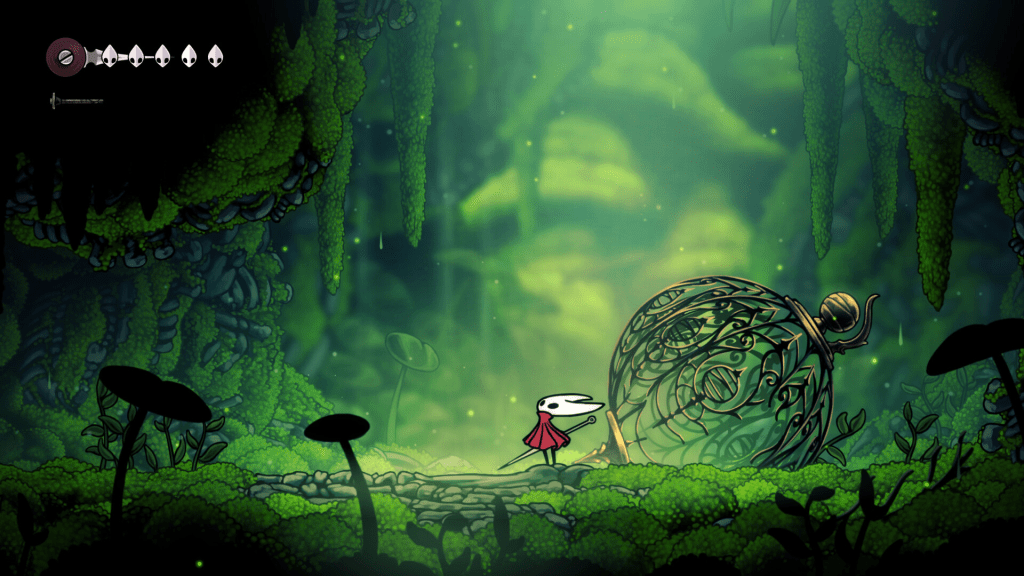
In 2017, a small Australian studio called Team Cherry released Hollow Knight. The game, an action adventure set in a world of insects, was well received by gamers and critics, and its reputation grew over the following years, as much for its challenging gameplay as for its melancholy world and atmosphere. Over time, Team Cherry aded to the game in various ways game – but the main expansion they originally promised, which was to feature Hornet, one of the game’s characters that starts off as an antagonist only to become an ally of the player character, proved too ambitious. As a result, Team Cherry announced in 2019 that Hornet’s adventures could not be contained in an add-on of the original Hollow Knight but instead required their own game: Hollow Knight: Silksong.

It would take another six years until Silksong came out.
Continue reading

They create worlds: This game belongs in a museum!

One of the things that video games can do magnificently is create worlds. These posts are an occasional exploration of games that I love because of where they take me.

There are a number of films that have been immensely influential on video games. Their thumbprints can be found all over gaming. An obvious example of this is Aliens; even beyond actual adaptations of the IP, you find the trope of space marines fighting insectoid xeno creepy-crawlies on hostile planets again and again – and sometimes, ironically, it’s the literal, licensed Aliens spin-offs that are among the games worst at replicating the Aliens playbook, more so than the games that are basically Aliens with the registration number filed off.

Another one of the clear inspirations for many games are the Indiana Jones films. It’s a perfect match, really: Indy makes for an appealing character type that gamers would want to play, there’s the appeal of mysterious legends and foreboding ruins, and the films are even structured in ways that lend themselves to being translated into the gaming medium: find artefact A, which opens door B, behind which there’s puzzle C, and so on, leading to legendary MacGuffin Z. Cue end credits.

Continue reading

They create worlds: Game over, man! Game over!

One of the things that video games can do magnificently is create worlds. These posts are an occasional exploration of games that I love because of where they take me.

In the 1980s and 1990s, video game adaptations of films and TV series were a staple of gaming – or, more precisely, they were a staple of bad gaming. Especially in the ’80s, a video game adaptation usually didn’t look, sound or play much like the movie it was adapting, other than a tinny, chiptune rendition of the main theme. (Sometimes we got lucky, as with Ghostbusters, which would shout a scratchy sampled “Ghostbusters!” and laugh maniacally at the player in the same scratchy voice.) And the gameplay? It’d just be a basic take on a genre that was easily imitated: the side-scrolling shoot’em up or the platformer. Those pixels looking faintly like a human being? They’re Arnold Schwarzenegger killing bad guys. That blocky car-looking thing? That’s your Ferrari Testarossa, you’re Sonny Crockett, and the other cars you’re pursuing in a crude top-down depiction of a city supposed to be Miami, they’re the drug dealers you’re trying to catch. ‘Drive’ your ‘car’ into their ‘cars’ and your score goes up. You’re living the life of a screen hero.

Continue reading

They create worlds: Walkabout Mini Golf

One of the things that video games can do magnificently is create worlds. These posts are an occasional exploration of games that I love because of where they take me.

When I started getting into Virtual Reality with the release of the first consumer-grade Oculus Rift in 2016, the kind of games I was expecting I’d eventually play in VR were ones where I’d sit in the cockpit of a spaceship, plane or racing car, or where I’d run around exploring mysteries and fighting or evading enemies. I expected games that were pretty much like what I’d been playing on PC for decades, just more immersive, more focused on the experience of being there, in the virtual world.

What I didn’t expect: that some of my favourite VR experiences by far would be hanging out with friends and trying to get a small ball to go in a smaller hole.

Continue reading

They create worlds: Still Wakes the Deep and the limits of realism

One of the things that video games can do magnificently is create worlds. These posts are an occasional exploration of games that I love because of where they take me.

Still Wakes the Deep is a recent horror game made by the developer The Chinese Room, who had previously released two games I’ve written about, Dear Esther and Everybody’s Gone to the Rapture (the latter of which I wrote an entry in this series about). While the staff turnover at The Chinese Room has resulted in a company that looks very different from the one that made these earlier games, Still Wakes the Deep nonetheless carries the DNA of earlier titles by the developer; perhaps many of the people working at The Chinese Room these days were inspired by the likes of Dear Esther and Everybody’s Gone to the Rapture to apply at the company.

Continue reading

They create worlds: Like a Thief in the night

One of the things that video games can do magnificently is create worlds. These posts are an occasional exploration of games that I love because of where they take me.

Like most people who’ve been playing video games for a long, long time, I like a good first-person shooter. I still remember the excitement of playing Wolfenstein 3D, and then later Doom and Quake. There were 3D environments before these, but they popularised them, while also driving the hardware evolution that, some 30-odd years later, would see graphics cards that do real-time raytracing. (If you have no idea what any of this means, don’t worry: it’s not what the post will be about.)

But while it’s fun to run around a 3D environment wielding a gun and shooting baddies, those aren’t my favourite first-person games. Give me a choice between running around, guns blazing, enemies falling left, right and centre, and sneaking around in shadows and biding my time, and it’s usually the latter that appeals most.

Continue reading

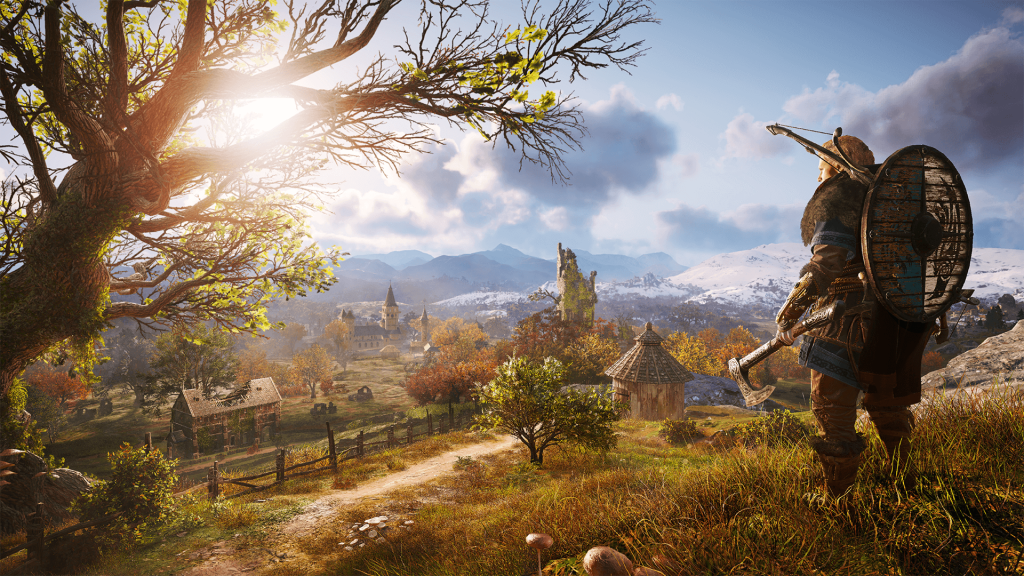
They create worlds: Assassin’s Creed Valhalla, or What I Did on My Viking Vacation

One of the things that video games can do magnificently is create worlds. These posts are an occasional exploration of games that I love because of where they take me.

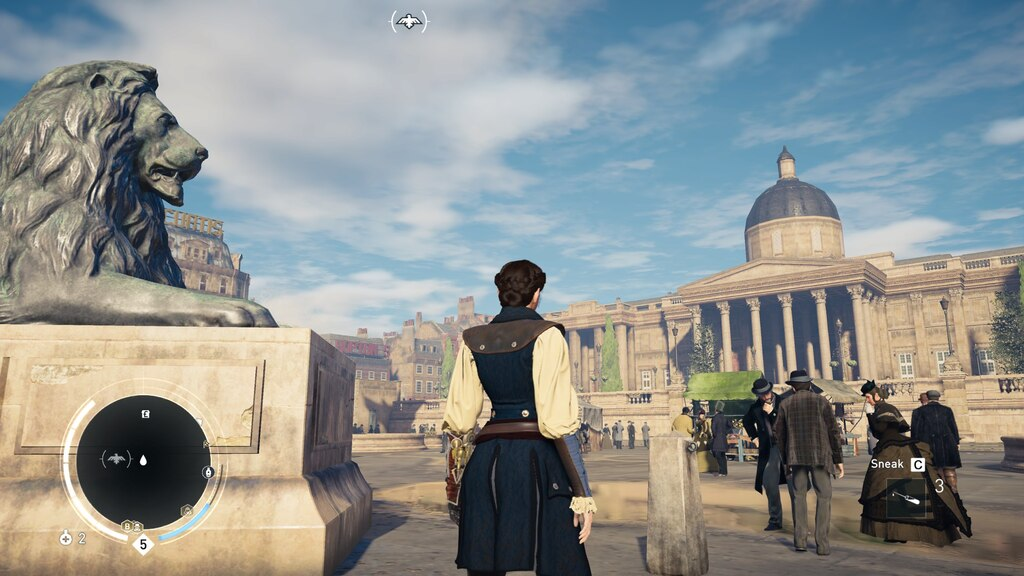
To be honest, I thought I’d burned out on the Assassin’s Creed games. For a long time, they were a staple in my gaming diet: a series of Dan Brownesque stores in which global conspiracies rub shoulders with ancient civilisations – and where you run around stabbing people. A lot. Mind you, while I kinda enjoy the ludicrousness of the setting, that’s not why I kept playing every single instalment in the series for the longest time. No, what kept bringing me back to the Assassin’s Creed well was that each game is mostly set at a specific place and time in history: I’ve climbed cathedrals in the Holy Land during the Third Crusade as well as in revolutionary Paris and late Victorian London. I’ve scaled Venetian palazzi and Egyptian pyramids. I’ve hobnobbed with the likes of Cleopatra, Blackbeard, the Marquis de Sade, half the Medici family, Dickens, Darwin and Marx. In short: I enjoyed the Assassin’s Creed games because they let me be a tourist, travelling less to distant countries than into the past.

Continue reading

They create worlds: Sable

One of the things that video games can do magnificently is create worlds. These posts are an occasional exploration of games that I love because of where they take me.

If I were to reduce the specific appeal that video games hold for me over any other medium, it wouldn’t be the predictable one. It wouldn’t be interactivity. Obviously it’s cool that games react to your actions, but let’s be honest: that interaction is often pretty limited – and, ironically, it tends to highlight the many ways in which the games aren’t actually particularly interactive. You can choose between option A and option B, or you choose whether to run left or shoot right. These actions can be fun, they can even be meaningful, but the freedom they offer isn’t exactly enormous.

No, the thing I’ve found that appeals to me most in games is exploration – and this is where I experience the freedom of games the most.

Continue reading

They create worlds: Imaginary gardens, real tourists

One of the things that video games can do magnificently is create worlds. These posts are an occasional exploration of games that I love because of where they take me.

I am currently replaying one of the Assassin’s Creed games, in which players are invited to go back in time and hobnob with the likes of Queen Victoria, Leonardo da Vinci and Cleopatra in 19th century London, renaissance Florence and Ptolemaic Egypt. They’re wonderful games for tourists – but they’re also shallow and repetitive, filled with busywork and ludicrous plots about ancient conspiracies and precursor civilisations. For a long time, I would buy each new Assassin’s Creed and play it excitedly, like the history nerd I am, but almost always I would get tired of them before I was even close to the ending.

Nonetheless, when I’ve got a phase where I’m tired from work in the evenings and don’t want anything that engages me too deeply, I often revisit an Assassin’s Creed game, because of the sightseeing. I don’t always need deep, engaging gameplay or storylines – sometimes what I want to do is climb the clocktower of the Palace of Westminster and look out over Dickensian London, smog, chimney sweeps’n’all.

Continue reading

They create worlds: Pentiment

One of the things that video games can do magnificently is create worlds. These posts are an occasional exploration of games that I love because of where they take me.

In the early years of video games, their aesthetics were limited mainly by technology: by the resolution of the graphics or the number of colours that a system could produce and display on the screen at the same time, or by CPU speed. The best programmers and artists could do wonderful things within those limitations, and you can enjoy great pixel art even today, when computers can produce real-time visuals that are vastly more complex.

These days, video game graphics are much less limited by the tech the games run on, so a lot of games – especially in the so-called AAA segment, i.e. the games with the biggest budgets and the largest teams of developers – aim for photorealism. At the same time, smaller developers who don’t necessarily have the resources to create virtual worlds that visually are getting less and less distinguishable from reality, have a vast range of possibilities to work with those very different limitations: they might create games that use different kinds of stylisation, that look like vintage animation or paper cutouts or jagged fever dreams. In modern games, we may find aesthetics that don’t harken back to the ’70s and ’80s, with their blocky pixels and four-frame animations, but to times when video games were entirely inconceivable.

Continue reading