Welcome to Six Damn Fine Degrees. These instalments will be inspired by the idea of six degrees of separation in the loosest sense. The only rule: it connects – in some way – to the previous instalment. So come join us on our weekly foray into interconnectedness!
I think it’s fair to say that, after Wes Anderson has directed 11 feature films (12 if you count The Wonderful Story of Henry Sugar and Three More, which Wikipedia does), I am something of a fan – and yet, I don’t really think of myself as such. Of his last eight films, starting with Fantastic Mr. Fox (check here for a typically wonderful Six Damn Fine Degrees by Julie about the film), I’ve loved several and enjoyed the others a lot. Admittedly, I have some issues with the early films of his I’ve seen – Rushmore, The Royal Tenenbaums, The Life Aquatic -, but after a streak of eight movies that I like or even love, shouldn’t I be able to say that I like the work of Wes Anderson? And, if not, why?
Join us every week for a trip into the weird and wonderful world of trailers. Whether it’s the first teaser for the latest instalment in your favourite franchise, an obscure preview for a strange indie darling, whether it’s good, bad, ugly or just plain weird – your favourite pop culture baristas are there to tell you what they think.
In this week’s Six Damn Fine Degrees: more books (Melanie wrote about making her way through Lois McMaster Bujold’s Vorkosigan Saga), so even less of an opportunity to post a fitting trailer! So, if it’s not too much of an insult to fans of the saga, here’s a trailer for the third season of a different sci-fi saga: Apple TV’s adaptation of Isaac Asimov’s Foundation. Obviously we need more adaptations of long-form sci-fi!
Our recent podcast episode on David Lynch, marking the start of our 2025 series Lost Summer, prompted us to pick up where that episode left of: for two of the films we discussed earlier this month, Blue Velvet and Twin Peaks: Fire Walk With Me, there are extensive sets of deleted scenes that, if they had not ended up on the cutting room floor, would have made both films into something very different. Sam and Matt watched these scenes – 51 minutes for Blue Velvet, a whopping 91 minutes for Fire Walk With Me – and talk about these and the notion of deleted scenes in general. Would Fire Walk With Me have been a better film if it had included all that material about the town of Twin Peaks, as fans and critics had hoped for when it was released? What can deleted scenes say about the virtues of leaving some things out? How do fan edits, a practice which has become highly accomplished in many cases, figure into this, and into the question of which version of a film is the real deal?
Join us every week for a trip into the weird and wonderful world of trailers. Whether it’s the first teaser for the latest instalment in your favourite franchise, an obscure preview for a strange indie darling, whether it’s good, bad, ugly or just plain weird – your favourite pop culture baristas are there to tell you what they think.
This week, Alan wrote about his childhood love for Greg Bear’s novel Blood Music – which makes for a great Six Damn Fine Degrees post, but sadly, it makes the whole issue of finding a trailer difficult, since Bear’s writings had never been turned into films or TV series. However, YouTube does have a reading of the original short story that Bear expanded into the novel, so if you need one hour of audio while you’re cooking or doing the dishes, why not check this out?
Over the last two years, I’ve been making my way through Criterion’s Essential Fellini box set. Starting with Variety Lights (1950 or 1951, depending on where you check) and ending with Intervista (1987), this beautiful set included most of Fellini’s films – though not all, skipping for instance the acerbic English-language Fellini’s Casanova (1976), in which a bewigged, increasingly ridiculous Donald Sutherland fornicates his way across Europe, getting further and further away from anything approaching happiness, or even pleasure, in the process.
Join us every week for a trip into the weird and wonderful world of trailers. Whether it’s the first teaser for the latest instalment in your favourite franchise, an obscure preview for a strange indie darling, whether it’s good, bad, ugly or just plain weird – your favourite pop culture baristas are there to tell you what they think.
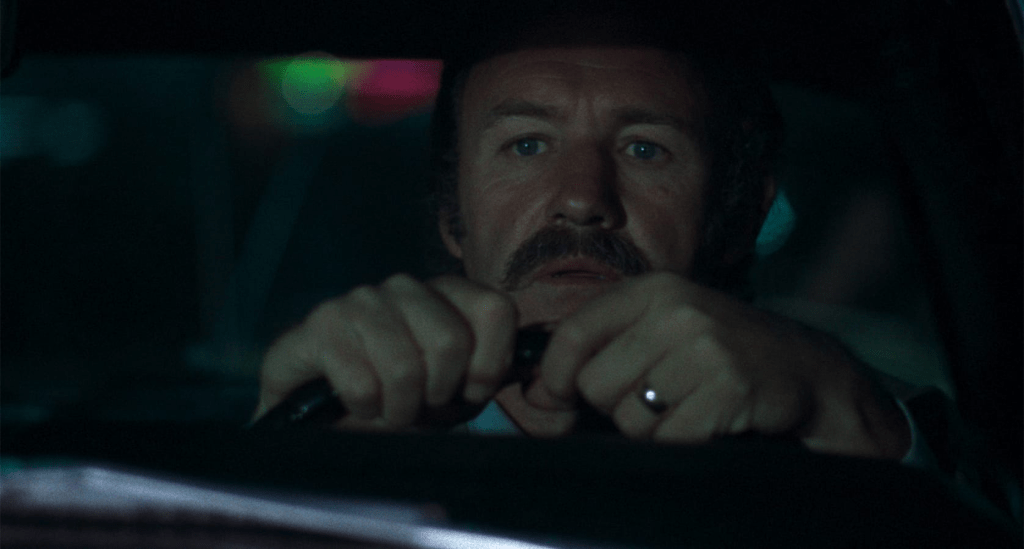
This year, we lost some of the greats – such as Gene Hackman, who starred in so many memorable films. One of the lesser known but equally deserving Hackman movies is the 1975 neo-noir Night Moves – a film all the more notable for how long it keeps its thriller plot on the back-burner, lulling its protagonist as much as its audience into a false sense of safety. Check out Matt’s thoughts on Night Moves here.
This month’s podcast kicks off our summer series for 2025: the Lost Summer is all about what we’ve lost – directors, actors, films – and what this means to us. We’re starting with one that is very close to our heart at A Damn Fine Cup of Culture: in January, David Lynch died at the age of 78, so we’re taking this opportunity to talk about some of the films of his that meant the most to us. Join Alan, Sam and Matt as they talk about neo-noir mystery Blue Velvet (1986), much-reviled prequel Twin Peaks: Fire Walk With Me (1992) and L.A. nightmare Mulholland Drive (2001). How did we discover Lynch’s work and these films in particular? What do they mean to us, and why? How do they fit into Lynch’s oeuvre? And what is the legacy that Lynch has left behind?
For more podcasts on David Lynch and Twin Peaks in particular, check out these classic episodes:
Welcome to Six Damn Fine Degrees. These instalments will be inspired by the idea of six degrees of separation in the loosest sense. The only rule: it connects – in some way – to the previous instalment. So come join us on our weekly foray into interconnectedness!
University reading lists as the one described in Matt’s latest post (and dare I mention I was one of his students to be on the receiving end of that particular list) can be a double-edged sword: There is a certain mechanical quality about ticking off titles one wouldn’t necessarily have chosen for personal reading, for sure. Yet gently forced exposure to such literature – if pre-selected well – can produce unexpected pleasures and open up new worlds and avenues for further reading. Starting out my English studies in the early 2000s as a slightly disoriented reader in the wide world of literature, the English department list (when diligently dealt with) certainly kept me busy, and struggling, for a while.
When you think of Gene Hackman and neo-noir, what comes to mind? For most people – including me -, the answer is simple: The Conversation. And obviously there’s absolutely nothing wrong with that choice: Francis Ford Coppola’s 1974 film is unarguably one of the best, most iconic paranoia thrillers of the 1970s and a great showcase of Hackman’s talents. But sometimes a film’s reputation can be so enormous, it eclipses other films that are also deserving of recognition.
Arguably, Night Moves (1975) is one of those films.