Join us every week for a trip into the weird and wonderful world of trailers. Whether it’s the first teaser for the latest installment in your favourite franchise, an obscure preview for a strange indie darling, whether it’s good, bad, ugly or just plain weird – your favourite pop culture baristas are there to tell you what they think.
Movies
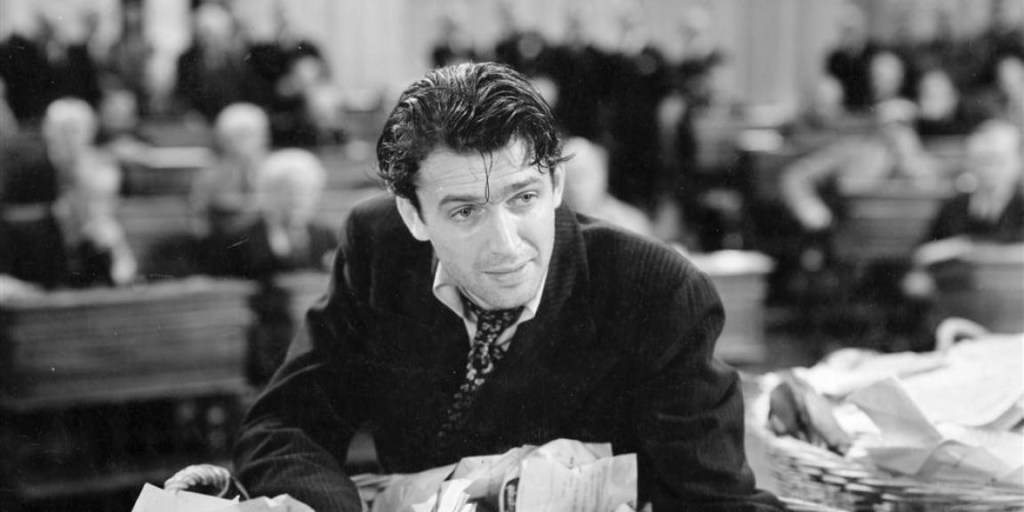
The Rear-View Mirror: James Stewart (1908)
Each Friday we travel back in time, one year at a time, for a look at some of the cultural goodies that may appear closer than they really are in The Rear-View Mirror. Join us on our weekly journey into the past!
When I think of James Stewart, I think of his everyman persona, not too dissimilar to that of, say, Tom Hanks. I think of him as the perennial regular Joe, the guy next door. A decent man. Exasperated, perhaps, but fundamentally good. So it always comes as something of a surprise when I watch one of his films – Vertigo, obviously, but even Frank Capra’s Christmas evergreen It’s a Wonderful Life – and find something more interesting, more complicated.
The Compleat Ingmar #15: Shame (1968)
The cliché of an Ingmar Bergman film seems to be that of a melancholy, existentialist treatise on the meaninglessness of life and of relationships, most likely in black and white. You know the kind of thing: people standing at the beach, being depressed. I’ve said so before, but that’s not the Bergman I’ve found, even in films such as The Seventh Seal, and most definitely not in Fanny and Alexander (both of these are yet to come in our journey through Criterion’s amazing box set Ingmar Bergman’s Cinema). Look at something like Scenes from a Marriage and alongside the acrimony, emotional cruelty and existential despair that doubtlessly fuel the conflict between Marianne and Johan, you’ll definitely also find warmth, humaneness and humour.

I rather wish there had been more of the latter in Shame, a film that, while recognisably Bergman in its concerns – and obviously in its cast -, reminded me of Michael Haneke in its relentless grimness. It is perhaps telling that one of the rare scenes where the film displays a sense of humour shows one of its characters to be such a bad shot that he fails to kill a chicken that’s barely half a metre in front of him.
By the end of the film, the chickens have lost their lives nonetheless and that character has become both able and more than willing to use his gun on a human being.
Continue readingI’ll be in my trailer… watching trailers: Love, crime and, obviously, brains
Join us every week for a trip into the weird and wonderful world of trailers. Whether it’s the first teaser for the latest installment in your favourite franchise, an obscure preview for a strange indie darling, whether it’s good, bad, ugly or just plain weird – your favourite pop culture baristas are there to tell you what they think.
A Damn Fine Cup of Culture Podcast #35: Soderbergh’s Schizopolis, Schizopolis’ Soderbergh
 For our August episode, we welcome special guest Daniel Thron (of Martini Giant) to talk about what may be the least-watched film of Steven Soderbergh’s directing career: Schizopolis. How does this surreal, experimentalist and often downright silly comedy about doppelgängers, lifestyle cults and failures to communicate fit in the director’s oeuvre? How does Schizopolis point the way to Soderbergh’s later career? And how do Netflix, COVID-19 and TikTok come into the conversation?
For our August episode, we welcome special guest Daniel Thron (of Martini Giant) to talk about what may be the least-watched film of Steven Soderbergh’s directing career: Schizopolis. How does this surreal, experimentalist and often downright silly comedy about doppelgängers, lifestyle cults and failures to communicate fit in the director’s oeuvre? How does Schizopolis point the way to Soderbergh’s later career? And how do Netflix, COVID-19 and TikTok come into the conversation?
The Rear-View Mirror: Clyde Barrow (1909)
Each Friday we travel back in time, one year at a time, for a look at some of the cultural goodies that may appear closer than they really are in The Rear-View Mirror. Join us on our weekly journey into the past!

Somehow, I’ve forgotten that Clyde Barrow was a real person. Born in 1909 and shot dead in a hail of bullets only 25 years later during the Great Depression, an era that is not short of gun-wielding criminals, he is one of the prototypes of the bad boys I’ve written about some time ago. Together with his partner and lover Bonnie Pointer, he robbed more than a hundred stores, banks and gas stations. Although most of the violence came from Barrow, who shot at police officers as well as innocent bystanders, Parker never wavered in her complicity.
Continue readingI’ll be in my trailer… watching trailers: Love, hate, furniture
Join us every week for a trip into the weird and wonderful world of trailers. Whether it’s the first teaser for the latest installment in your favourite franchise, an obscure preview for a strange indie darling, whether it’s good, bad, ugly or just plain weird – your favourite pop culture baristas are there to tell you what they think.
The Rear-View Mirror: Akira Kurosawa (1910)
Each Friday we travel back in time, one year at a time, for a look at some of the cultural goodies that may appear closer than they really are in The Rear-View Mirror. Join us on our weekly journey into the past!
Those of you who’ve been following this site for a while will know that when Criterion brought out a complete collection of Ingmar Bergman’s films, I was there pretty much immediately. I got the collection, a gorgeous collector’s item filled with existentialist Swedish goodness, and since then we’ve been watching an instalment in the ongoing Bergman saga on a more or less monthly basis. What better way to start your weekend than by watching a marriage crumble into acrimony and psychological cruelty? Criterion’s since announced another similar set – The Complete Films of Agnès Varda – and chances are I won’t be able to resist… but really, what I’ve been hoping for ever since the Big Box of Bergman is an announcement that Criterion is doing the equivalent for another one of the greats of world cinema. I am, of course, talking about Uwe Boll.

I’ll be in my trailer… watching trailers: Dystopia, revolution and bad, bad dubs
Join us every week for a trip into the weird and wonderful world of trailers. Whether it’s the first teaser for the latest installment in your favourite franchise, an obscure preview for a strange indie darling, whether it’s good, bad, ugly or just plain weird – your favourite pop culture baristas are there to tell you what they think.
The Rear-View Mirror: Bernard Herrmann (1911)
Each Friday we travel back in time, one year at a time, for a look at some of the cultural goodies that may appear closer than they really are in The Rear-View Mirror. Join us on our weekly journey into the past!
You don’t have to be into movies all that much to have been scared by Bernard Herrmann (1911-1975). He started composing when still a teenager and also worked as an orchestrator and conductor later on. One of his first notable contributions was for Orson Welles’ original 1938 broadcast of War of the Worlds. Hermann’s music must have had a hand in the fact that so many listeners thought that the Martians were really coming.
Continue reading A Damn Fine Cup of Culture