The Rear-View Mirror: Lone Star (1996)

Each Friday we travel back in time, one year at a time, for a look at some of the cultural goodies that may appear closer than they really are in The Rear-View Mirror. Join us on our weekly journey into the past!

What still gets me in John Sayles’ Lone Star is its simple device of showing you that time has passed. Let’s say there is a scene at the edge of a river in Texas, a woman and a man talking, set in the 1960ies, and then the scene comes to an end, and the camera slowly pans to the right, where there is another character in the here and now, the grown-up son of the man from long ago, watching the scene before his mind’s eye. Just by letting the camera move, the story is told in a flashback without a cut. Lone Star is not at all the first movie to do this, but to me, it was a simple but effective way to show that years, even decades, have gone by.

Continue reading
The Rear-View Mirror: Jackie Brown (1997)

Each Friday we travel back in time, one year at a time, for a look at some of the cultural goodies that may appear closer than they really are in The Rear-View Mirror. Join us on our weekly journey into the past!

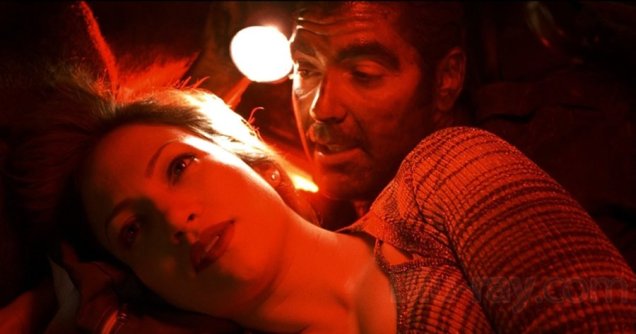
Car trunk shot, bare feet, vintage tunes, Samuel L. Jackson: Jackie Brown is clearly a Quentin Tarantino movie, there’s no doubt about that. At the same time, while all the telltale features are there, the film is an odd one out in Tarantino’s oeuvre. Where Tarantino’s movies often have a jittery, adolescent quality in their characters, language and use of violence, Jackie Brown feels like a more… is “mature” the word? … a more mellow film. Compared to the excesses of Reservoir Dogs, Kill Bill, Inglourious Basterds and Death Proof, there’s a grown-up quality (for lack of a better word) to Jackie Brown that is sadly underestimated by some of the director’s fans. At the same time, it would be a huge mistake to think that because of this Jackie Brown lacks the exuberance of Tarantino’s other films – and this is shown beautifully, in miniature, in the movie’s title sequence.

Jackie Brown
Continue reading

The Rear-View Mirror: Out of Sight (1998)

Each Friday we travel back in time, one year at a time, for a look at some of the cultural goodies that may appear closer than they really are in The Rear-View Mirror. Join us on our weekly journey into the past!

There is nothing that can date a movie like style for style’s sake. It’s one of the hallmarks that betrays a movie’s age, and while some stylistic choices can turn a movie into a classic, other styles might simply not age that well. Think about small things like lens flares. Or think about the dogma certificate. That doesn’t mean that they are bad movies; it’s just that sometimes, movies get stuck in the times they were made. Nostalgia isn’t the worst reason to re-visit a movie you haven’t seen in a long time.

Continue reading

The Rear-View Mirror: Spaced (1999)

Each Friday we travel back in time, one year at a time, for a look at some of the cultural goodies that may appear closer than they really are in The Rear-View Mirror. Join us on our weekly journey into the past!

Oh boy. How do you do justice to a year like 1999, wchich produced films such as The Matrix, Being John Malkovich and Magnolia? That gave us the HBO gateway drug The Sopranos as well as a The West Wing, whose idealism would be much needed these days? Let alone games such as System Shock 2 and Planescape: Torment, milestones of the immersive sim and of choice and consequence in video game storytelling? I can’t pick the film, series, book or game that was most meaningful, but I will pick one that has been wrongly overshadowed by its creators’ careers since.

Continue reading

The Rear-View Mirror: CSI Crime Scene Investigation (2000)

Each Friday we travel back in time, one year at a time, for a look at some of the cultural goodies that may appear closer than they really are in The Rear-View Mirror. Join us on our weekly journey into the past!

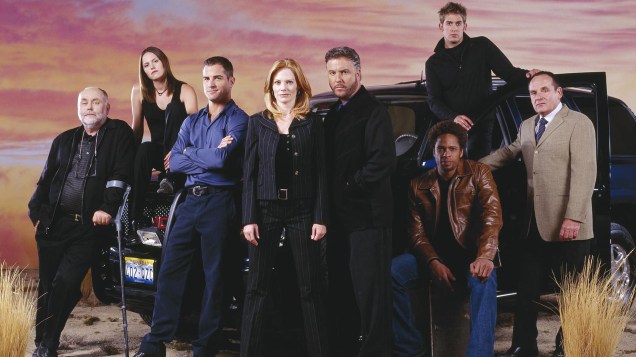
Today, my dearly beloveds, let’s talk about guilty pleasures. I know you have them because I have them. In a way, it’s the emotional continuation of reading under the covers when you’re a kid, flashlight in hand, way until after midnight. And already I’ve talked myself into a corner because now I have to reveal one of my guilty pleasures while you can keep silent about yours. Here goes, then: one of my guilty pleasures was, and still is, CSI: Crime Scene Investigation, the original one set in Las Vegas. Would you believe that it ran from 2000 to 2015? Its finale is only three years old. And yes, I watched every single sodding episode, until the bitter, bitter end. It wasn’t easy. I’m not proud of it. The guilt had outweighed the pleasure years ago.

Continue reading

The Rear-View Mirror: The Man Who Wasn’t There (2001)

Each Friday we travel back in time, one year at a time, for a look at some of the cultural goodies that may appear closer than they really are in The Rear-View Mirror. Join us on our weekly journey into the past!

There are few directors who can look back at as illustrious a filmography as the Coen Brothers. From the early neo-noir of Blood Simple, the gangster’s paradise of Miller’s Crossing, the surreal Hollywood of Barton Fink, via Fargo, The Big Lebowski and O Brother, Where Art Thou to more recent films such as No Country for Old Men, A Serious Man and Inside Llewyn Davis: though Joel and Ethan Coen clearly have a style, but they’ve never rested on their laurels. While they’ve had a couple of clunkers, I’m more interested in one of their films that hasn’t really received as much attention as I think it deserves.

The Man Who Wasn't There
Continue reading

The Rear-View Mirror: City of God (2002)

Each Friday we travel back in time, one year at a time, for a look at some of the cultural goodies that may appear closer than they really are in The Rear-View Mirror. Join us on our weekly journey into the past!

The first scene of Fernando Meirelles’ and Katia Lund’s City of God starts with a chicken trying to escape the frying pan, and it ends with the standoff between two warring drug gangs in Brazil’s Cidade de Deus, the poorest quarter of Rio, where the politicians put the lowest classes in the Sixties so the rich wouldn’t have to look at them. Cidade de Deus doesn’t have electricity nor water, and it’s almost impossible to get out, not geographically, but socially: if you are born there, you will most likely die there.

Six minutes into the movie, we already have to cope with three story strands. There is something of Melville in its structure: I want to tell you about Lil’ Zé, but in order to make you understand, I have to tell you about the Tender Trio, and so I have to start with how my brother… You get the idea. But City of God, based on a novel by Paulo Lins, sounds confusing, but it’s not. It’s fast-paced, but it’s never in a rush.

Continue reading

The Rear-View Mirror: Master and Commander (2003)

Each Friday we travel back in time, one year at a time, for a look at some of the cultural goodies that may appear closer than they really are in The Rear-View Mirror. Join us on our weekly journey into the past!

My enjoyment of the Marvel Cinematic Universe notwithstanding, I’m not the kind of moviegoer who regularly thinks, “When are they doing the sequel?” A film first and foremost has to be a world unto itself: before you can start to think about creating a universe, tell a good story. World building is fine, but as far as I’m concerned a movie is best served by being self-contained.

Master and Commander
Continue reading

The Rear-View Mirror: Primer (2004)

Each Friday we travel back in time, one year at a time, for a look at some of the cultural goodies that may appear closer than they really are in The Rear-View Mirror. Join us on our weekly journey into the past!

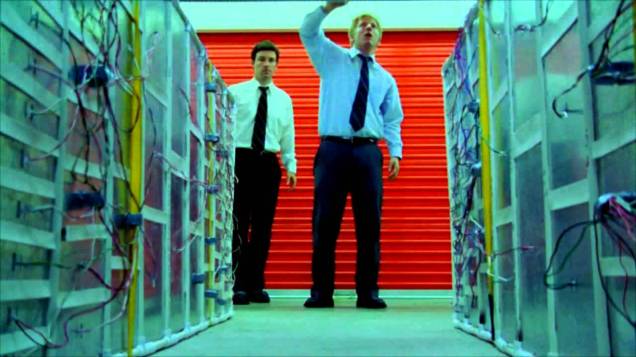
I had been sightseeing on foot all day, Nairn’s London in hand, my legs hurt, and I just wanted to sit down and get my bearings back. There was a small movie theatre off Leicester Square, showing a movie I had never heard of. The title was Primer, and the poster showed some kind of cube-shaped contraption with cables coming out, or going in. I couldn’t resist and bought a ticket. It was a very strange movie. There were three, four white-collar guys who had invented a machine that did something technical, and they were sending out free hardware parts in order to get their project financed. It was hard to follow the movie because they talked like real people talked, and there were no subtitles.

Continue reading

The Rear-View Mirror: Shadow of the Colossus and Psychonauts (2005)

Each Friday we travel back in time, one year at a time, for a look at some of the cultural goodies that may appear closer than they really are in The Rear-View Mirror. Join us on our weekly journey into the past!

Video games are the cosplayers of modern media. They like to dress up as other media, in particular movies and comic books. Look at the biggest-selling games of almost any year and you’re likely to see games dressed up as Michael Bay movies or as the latest Marvel extravaganza. In some ways early video games had more of a unique voice, not least aesthetically, because when you’ve got pixels the size of pomegranates and harsh bleeps and bloops it’s futile to try and look like a Jerry Bruckheimer action flick. There was an abstraction to the classics, the Space Invaders and Pac-Men of yore, that came with technical limitations. At least since the modern days of real-time 3D graphics, and especially in the last ten years, video games have come to look less and less like abstract art and more like what we see at the cinema, a big bucket of popcorn in our lap.

Space Invaders
Continue reading