Better than being hit over the head with a baseball bat

Quentin Tarantino loves cinema. If anyone ever doubted that, fifteen minutes of Inglourious Basterds should put that doubt to rest.Also, Quention Tarantino knows cinema. He knows its history, he knows films, he knows how to construct a scene, how to film it, how to make it work. As I’ve argued before, he is in control of his material like few other directors.

He may also just be the most radical of the big-name film makers working in Hollywood today.

Now, “radical” does not mean “independent” – or, more aptly, “indie”. The current indie film scene in the US, while gems keep coming out of it, is disappointingly generic, with quirky comedies about geeky weirdoes we’re supposed to love having become as predictable and stale as mainstream romantic comedies. What makes Quentin Tarantino radical is he doesn’t pander to his audiences. In the end, he makes films entirely for himself. If the audience enjoys them, all the better, if not, well, fuck them.

Which may go some way towards explaining why Tarantino is one of the filmmakers who is either loved or hated. If you don’t like what he’s doing, his films will grate like mad. There are no compromises for a broad audience. Tarantino is a lucky bastard (or “basterd”) who can be indifferent to what test audiences may say about his films. (Actually, I’d be curious as to what test audiences would make of his movies.)

Not a Basterd in sight...

One of the things that is most striking about Inglourious Basterds is how little the Basterds are actually in the movie, and how, in the end, they are not the heroes of the film. That honour goes to Shosanna Dreyfus, played to perfection by Mélanie Laurent. The Basterds themselves are pretty much a team of goons and thugs, a bunch of self-admitted terrorists, and they are only seen as the good guys because they go after Nazis (or “Nat-zees!”, as Brad Pitt insists with over-the-top relish), perhaps the easiest target in cinematic history.

And that’s where the second intriguing thing comes in: while the Basterds remain cartoony and one-dimensional, Tarantino takes a number of “Nat-zees” and humanises them. He doesn’t make them into the good Nazi, they’re not Germans with hearts of gold who happened to end up, against their will, wearing Wehrmacht uniforms – but they become human beings. While the surface of the film is all about Our Heroes wreaking terrible, deserved revenge on the Hun, the subtext – which may even be more prevalent than the text – is much more ambivalent.
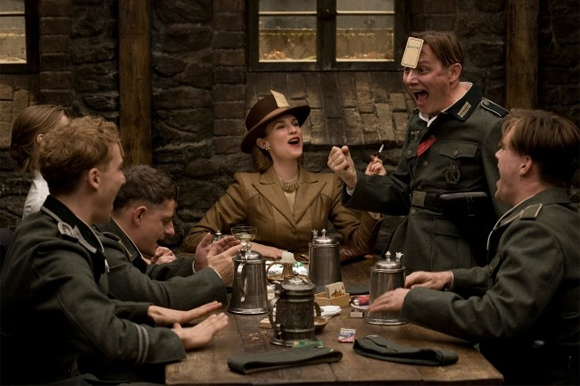
In occupied France, the Germans would get their kicks by sticking post-its on their foreheads. Silly foreigners...

And that’s what may be most radical about Tarantino: he’s managed to fool a large part of critics and audiences into thinking he’s a B-movie geek with an affinity for trash and violence, when his films are intricatedly crafted, wittily written, much more complex (and much less violent) than they’re given credit for. Many people have watched his films and seen only slickly made trash. He’s been hiding with incredible success that he’s that most elusive of cinematic beasts: an auteur. God bless his narcissistic, self-centred, infuriatingly post-modern little heart – and may he make many more films!

Would you kindly…?

My apologies for the posting delay – I was laid low the last two days with a stomach bug. I’m still home from work, but now I have no more excuse to dawdle… So here, without much further ado, the latest entry. I promise not to throw up while writing it.

I’ve been re-reading The Sandman from beginning to end. About a month ago I got the last of the Absolute Sandman volumes – gorgeous hardback large-format reprints of the original comics, with tons of extras such as additional stories in the Endless universe or scripts of some of the most important issues.

Yes, I know, I'm a book fetishist.

This is probably the fourth or fifth time time I’m reading the series in its entirety, and I still have the same favourites: A Game of You (vol. 5), Worlds’ End (vol. 8) and The Kindly Ones (vol. 9 – more on that later). However, Brief Lives (vol. 7) has grown on me, especially the last few chapters. I’m still not all that hot on its art, but the storytelling is fantastic – Gaiman at his finest – and it’s pretty much the volume when Delirium comes into her own.

I’m currently halfway through The Kindly Ones, and even at a fifth re-read, it still packs quite a punch. I love the art (which some found too cartoony – but I definitely prefer it to the more generic comic-book art of some of the other volumes, even though they all have their inspired moments), but even more, I love how Gaiman manages to bring together dozens of threads from the previous volumes in clever but not ostentatious ways. He makes it all feel natural and, as in all the best tragedies, inevitable.

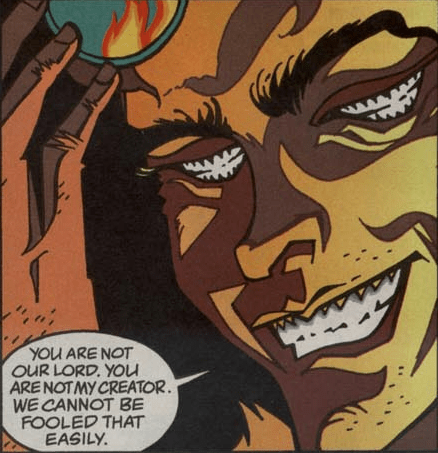
Imagine him brushing his teeth (and flossing) and he'll get a lot less creepy...

There are a number of things that in the hands of a lesser writer would feel like fan service, especially the return of the Corinthian, or indeed the extended scenes with Mervin Pumpkinhead. But what Gaiman pulls off is something that few series (in any medium) have managed so far: reading The Kindly Ones, you get the impression that he’s always known where he was going. And you want to follow him, even though you know it’ll all end in tears.

I haven’t been all that hot about most of Gaiman’s work since The Sandman. His recent short stories, and indeed his novels, have seemed too twee, too enamoured with their cleverness. There are always great bits, but in between those bits I feel I’m reading some Gaiman imitator who does an okay job but simply isn’t the same. Fragile Things was a shadow of Smoke and Mirrors (which contains some of my favourite short stories). Anansi Boys was fun but pretty forgettable. I liked Coraline a lot, though – perhaps Gaiman tries too hard to be clever and Gaimanesque when writing for adults, and when he writes for children he simply focuses on telling a good story. Which, in Coraline, he very much does.

Talking of Gaiman: this animated short reminded me of him – most of all because Nick Cave’s narration sounds exactly like some of Gaiman’s readings:

youtube=http://www.youtube.com/watch?v=Uj4RBmU-PIo]

You know what they say about no news… (Sometimes they’re wrong.)

I’m afraid I don’t have a proper update for this week, for a couple of reasons. To make sure that you didn’t come here for nothing, though, here’s the trailer for Michael Scorsese’s new film, Shutter Island, based on a novel by Dennis Lehane (of Mystic River and Gone Baby Gone fame). Looks like Scorsese’s love affair with Leo DiCaprio is still ongoing.

I likes me some scary asylum flick.

Growing pains

Remember when I wrote about my reactions to watching Before Sunrise for the first time at the age of thirty-something? Back when I got the film on DVD, there was a special offer for its nine-years-later sequel, Before Sunset, so I got that one too. After disliking the earlier film quite a bit (my reaction was pretty much that of constantly thinking, “Oh, grow up, you two!”, which didn’t make for an enjoyable experience), I’d decided that I wanted to get this over with: watch Before Sunset so I could pass the two DVDs on to someone. I don’t often get rid of DVDs I’ve bought, but shelf space is at a premium as it is. I knew I was unlikely to watch Before Sunrise again, unless I had some way of reverting to the age of 21 without illegal drugs.

Imagine my surprise when I enjoyed Before Sunset. Not just a bit. Not just in comparison with its predecessor. No, I enjoyed Linklater’s follow-up to his Viennese romance much more than any romantic film I’d seen in a long, long time. And what was even more unexpected: the later film has given me an appreciation for Before Sunset – not so much as a film in its own right, but as a chapter in the overall story.

Jesse and Céline, nine years later, are still the same people – but they’ve both left behind the self-involvement their earlier selves had. Yes, they’re still neurotic, yes, they still go on about the same topics, but differently from the earlier film they actually seem to have a life outside the present moment and a focus other than themselves. Céline’s had a string of unfulfilling relationships, Jesse’s got a son and is trapped in a marriage that has pretty much flatlined. Neither is all that original, but the characters and conversations ring true. Yes, they did in the earlier film, but just to the extent that I disliked the characters more for being credible self-centred twenty-somethings who barely see beyond the horizon of their own navels.

One thing I actually liked about the earlier film was the ending: as much as I didn’t particularly enjoy spending time with Jesse and Céline in their early twenties, there had obviously been something between them, so the moment where they have to leave one another – regardless of their promise to meet again, there, six months later – clicked. The way Before Sunset picks up on this is clever, but it tops it with an ending that in terms of tone and characterisation is perfect.

I’m curious whether I’d now see Before Sunrise with different eyes. I don’t think I’d suddenly like it – I still think it’s a difficult film to appreciate unless you respond to, or identify with, the self-involvement of the characters at least to some extent. But I’d find it easier to see the older characters waiting to emerge from their younger selves. And after this film, as perfect as it is as an ending, I wouldn’t mind catching up with the two again, some years into the future. I don’t actually want that to happen, mind you – but the thought that Céline and Jesse are somewhere out there, living their lives, is one that makes me feel strangely better.

So... Uma Thurman, huh?

If you’re gonna steal…

Okay, no most beautiful and wonderful things in the world in this entry. Instead I’m posting a quick, cheap link to Something Awful (with the usual warning that their humour can be rather off-colour and definitely NSFW). In a twist on their usual Photoshops veering from clever to tasteless to Eww! and beyond, they’ve got Real Books That Look Like Photoshops!

Here’s a sample:

That's just wrong, that is.

P.S.: The first entry on page 5 is wrong on so many levels that I may never be able to eat a flan caramel again. Ever.

Where is he now?

Okay, this won’t be a proper update. This is just me saying that yes, I’m still around, yes, I’ll still blog. This is just the busiest time in the year, work-wise.

But I’m hoping to write some updates soon, covering some or even all of the following:

  • The Wire Season 5
  • Sympathy for Lady Vengeance
  • Seven Samurai
  • Rock Band
  • The financial crisis and its repercussions on the mating habits of the North American dung beetle

Okay, one of those was probably a lie. Guess which one and you’ll get absolutely nothing. Other than my undying admiration and a day’s supply of minutes, free.

Damaged goods

Damages sounded so good. It’d had great reviews in the States. It had an interesting cast. It had won all these nominations and awards.

And it was one of the most disappointing series I’ve seen in a long time.

What confuses me is that so many critics and viewers seem to bend over backwards to praise this series. “Riveting”? “Simply extraordinary”? Sure, these are just soundbites, but the longer reviews and especially the nominations (Emmys: Best Dramatic Series)… I just don’t get them.

To begin with, there simply isn’t enough material for a full season. Had this been a six-episode miniseries, it may have been riveting, but as it was in progressed in fits and starts in between long periods of not going anywhere. I wouldn’t mind if the downtime had been used to develop the characters, but with most of them what you know at the end of episode 1 is pretty much what you know by the end of the season. The only difference is one of degree: we’re quickly aware that Patty Hewes (played competently by Glenn Close) is willing to have animals killed to get what she wants, so there simply isn’t that much of a surprise in learning that she’s willing to have people killed. The only characters that truly seem to develop are Ellie (although with her it takes until the last two to three episodes) and the defense attorney Ray Fiske, both of whom have actual character arcs.

The other thing, which is closely related is this: if a series over-relies on twists and turns they pretty much lose all their effectiveness. This happens fairly quickly in Damages; every so often, you’re asked to re-examine a character or a scene and ask yourself, “So, did this really happen as I believe it did?” Which is all fine and dandy, but the problem is that we quickly learn not to trust anything, and at that point I stop being involved. I don’t invest in the characters or in what I’ve seen because chances are things’ll be different one or two episodes down the line. And at that point, nothing that happens in the series matters. Why be surprised at a character turning out to be evil when you knew that you’d be naive to believe that character to be good? If everything twists and turns, everything becomes arbitrary.

Last but definitely not least: very few of the characters were interesting to begin with. Even a static character can be fun to watch, but almost everyone in the series felt generic. There simply wasn’t enough to Glenn Close’s Lady Macbeth-a-like Patty Hewes to make her different from similar manipulative characters. Same goes for Ted Danson’s Arthur Frobisher, one of the main bad guys in the series (although I found his uncanny, involuntary Christopher Walken impersonation at the beginning quite fascinating for an hour or so).

While I’m usually a fan of unconventional chronology in stories, it didn’t help or change much in Damages: it had the effect of making audiences wonder, “Okay, how do we get from point A to point B?” But sadly, the answer to that always seemed to be the same: Patty does something manipulative and underhand. Frobisher’s people do something manipulative and underhand. Ellie falls for it. Rinse and repeat.

So, since I don’t want to go on much longer about why I didn’t like (or didn’t get) Damages, I’ll just ask: is there anyone reading this who can tell me why I missed the point and that the series is actually clever/subversive/exciting in ways that I’ve failed to see? Because I do find it somewhat disconcerting that my opinion on Damages is shared by very few people out there, it seems.

It’s all work, work, work…

For those following this blog with baited breath (whoever you are, you are weird!), in case you want to know what I’m up to this week – i.e. the reason for my absenteeism – you may want to check out this page. Apart from doing other things, I’m the one editing the little films. Except for the one featuring a fairly famous Scotsman, which should go on later tonight. See you there (if you’re really, really bored and suffering from me withdrawal…).

My, my… aren’t we meta?

One of the things that I find nerdishly fascinating about having a blog is this: what sort of search terms do people use to find my blog? Here’s a quick selection of the ones that I found most baffling, amusing or worrying:

“coen brothers communists”: Who’d’ve thunk? I can imagine some rabid right-winger looking for Coen Brothers hate pages and landing on my site. If so, welcome, Aryan brother! Stay around! Did I mention I’m a pinko commie foreigner bastard myself?

“House M.D. board game”: There’s money to be made from this, I’d wager! “Your patient is too heavy for the CT scanner – lose one turn!” “It is not lupus! Go back three squares.”

 “not irony”: To which I say, “Hah! And double-hah!”

“rape games for kids”: I don’t even want to know… 

“under trampoline”: This one baffles me, I must admit. As does the last one:

“elder panty sniffing”

At least it now has some relevance if someone, heart pounding and palms sweaty, enters “elder panty sniffing” and ends up here…

The pic is called “grenadeboy”, apparently. Eep.

P.S.: If you google “coen brothers communists”, this is the first picture you get. Creepy, huh?