Bereavement: a game

What exactly makes video games different from other mediums? The go-to answer to that question is obviously interactivity – games require their audience (their ‘readers’, if we want to use the word in an extended sense) to interact. Now, clever-clogs will say, “Aren’t films and books interactive as well? After all, the reader is always engaged in co-creating meaning together with the text. Eh? Eh?” At which point you kick the clever-clogs in the nuts and send them back to the literature departments whence they came. (Please note that I myself was one of those clever-clogs for a long time, and I still have a fair amount of affinity with them. Doesn’t stop me from the whole nut-kicking thing.)

Granted, there is no such thing as an entirely passive audience. The interaction that games require, though, is of a different kind; it is not purely mechanical (like, say, flipping pages or working the DVD remote), nor is is purely a mental process (which covers anything from mere comprehension to interpretation to other forms of intellectual, psychological or emotional engagement with a text). It is tied in with the concept of agency: the player is more directly, more immediately involved in generating the actual text, although the freedom he has in this can be immense or minimal.

Where does this leave games such as the recent indie title Dear Esther, in which the player-reader-person holding the mouse (and wondering when he’ll find his first automatic weapon) is little more than a floating camera with ears? Playing Dear Esther, if “playing” is indeed the right term, means using the mouse to select where to look and the keys to move around. There’s no jumping, no shooting, no meaningful interaction with the environment – and more, there aren’t any goals, puzzles or challenges other than navigating the environment and looking for the spot where the next level or chapter begins. You walk around a foggy, damp island and look at things, and every now and then the narrator speaks his next monologue, about some guy called Donnelly, a long-dead shepherd called Jacobson, about Paul – and about Esther, the narrator’s wife. Over time, it becomes clear that Esther is dead, most likely killed in a car crash. Walking across the island, the narrator gives a voice and shape to his feelings of loss, sometimes through metaphor, sometimes through a simple retelling of events, sometimes through associative, allusive stream of consciousness.

Discussing whether this is a game risks being as pretentious as this short description of Dear Esther already sounds, most likely… and, truth to tell, I’m not particularly interested in finding a definition of what constitutes a game. On a very personal level, I wouldn’t say I “played” Dear Esther, I experienced it – and there I go again, skirting pretentiousness. Thing is, there’s no way around this. Dear Esther sets out to be artistic, from its themes (loss, mourning, life and death) to its visuals, to its writing, as this excerpt illustrates:

I collected all the letters I’d ever meant to send to you, if I’d have ever made it to the mainland but had instead collected at the bottom of my rucksack, and I spread them out along the lost beach. Then I took each and every one and I folded them into boats. I folded you into the creases and then, as the sun was setting, I set the fleet to sail. Shattered into twenty-one pieces, I consigned you to the Atlantic, and I sat here until I’d watched all of you sink.

Now, since the interactivity that Dear Esther offers is minimal, couldn’t the same be done in a short story or a film? Why make this a game (in the loosest sense of the word), other than in an attempt to help the still fairly young medium gain seriousness or credibility, to save it from the accusation that video games are reserved for adolescents looking for escapism or intent on enacting their power fantasies (save the princess, save the world, shoot turbaned bad guys, that sort of thing)? My own personal answer is no. Even if walking around the island and looking at ruined houses, painted symbols and snippets and texts, the lighthouse in the distance doesn’t constitute agency in the sense that you’re affecting the story or the characters in any way, you’re still experiencing it in a way that is inherently different from reading a story or watching a film. In fact, what Dear Esther (and similar games) remind me of most, perhaps, is theatre – and specifically the sort of theatre that says, “Screw the fourth wall” and requires its audience to experience what is going on in a more direct way. I remember reading a review of a play performed in a series of rooms, and the audience walks freely from room to room, witnessing scenes that exist separately from the audience’s journey; the sequence in which you see the performance, the points at which you enter or leave a scene, all affect your experience of the play.

Games like Dear Esther go further than this, in that they can create a theatrical space and experience involving elements that are difficult or even impossible in live performance: the voice you hear as you explore the island is disembodied, it isn’t the player’s, but nor is it a third-person narrator – it takes up a space in between. In some ways, games are that weird beast, the second-person narrative: you don’t become a first-person narrator, you put them on like a mask, and you’re always aware that there is a distinction between you and your character even while you perform this character. For me at least, when talking about a game, I usually slip into second person: “So, you’re this guy who’s lost his wife, and you explore this island that he’s withdrawn to. You walk up the hill to the ruined house, hoping to find… something. Some sign, something that will help you understand. Dunno… You play it, okay?”

Playing, reading, experiencing Dear Esther isn’t like being an audience, nor is it like being an actor. It is more like a lucid dream, and this dream-like state lends itself to experiences that none of the other mediums can provide in this exact way. Theatre can perhaps come closest, but traditional theatre, with its literal actors and spaces, cannot recreate that final, heartbreaking, soaring moment that Dear Esther delivers. The game isn’t its medium’s Citizen Kane, its The Dubliners or Starry Night, but it is unlike anything I’ve read or seen in the way it uses its means to make me think and feel. Doesn’t mean I want all my games to be like this – but I’m looking forward to others exploring the medium to see what it can do, what it can be. Others can call this pretentious all they want – I’m quite happy to soar with Esther.

P.S.: I very much like Eurogamer.net’s review of Dear Esther. Well worth reading, whether you’re generally interested in games or not.
Fool me once…

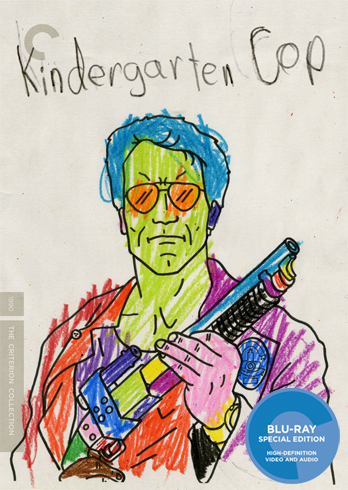
… and the award for Best April’s Fools Joke goes to – The Criterion Collection, who advertised that this masterpiece of modern cinema would soon join their ranks of superb DVD and Blu-ray editions:

And yes, they went the whole hog. Check out their synopsis of Reitman’s often underrated gem:

Historically, the policier and the family comedy were two distinct categories. Then, in 1990, Kindergarten Cop gave us all a lesson in genre revisionism. With muscular sensitivity, Hollywood’s last action hero Arnold Schwarzenegger embodies detective John Kimble, who is compelled to go undercover as a teacher of five-year-olds in order to catch a ponytailed drug dealer. Though it’s distinguished by pulse-pounding suspense, a Crayola-bright palette by cinematographer Michael Chapman (Taxi Driver), and trenchant observations about education in the Bush I era, the film’s emotional center is Schwarzenegger’s gruff yet good-tempered interaction with a class full of precocious scamps, including a tumor-forewarning death-obsessive and a genitalia expert. By leavening a children’s film with enough violence to please even the most cold-hearted bastard, director Ivan Reitman shows that he refuses to color inside the lines.

Which is only topped by some of the extras:

  • New high-definition digital restoration of the 1990 director’s cut, presented in 5.1 surround DTS-HD Master Audio on the Blu-ray edition
  • New audio commentary featuring Secretary of State Hillary Rodham Clinton, author of It Takes a Village: And Other Lessons Children Can Teach Us
  • Excerpts from the French television program Cinéastes de notre temps: “Ivan Reitman”
  • Kindergarten Cops Today, a new hour-long documentary featuring former New York City police detectives Frank Serpico and Robert Leuci, former San Francisco police inspector Dave Toschi, and New York City mayor Michael Bloomberg
  • From “Fingers” to Finger-Painting, an interview with cinematographer Michael Chapman
  • Archival video of Schwarzenegger’s acceptance speeches for the Favorite Movie Actor award at the 1989 and 1991 Kids’ Choice Awards
  • The Kids Aren’t All Right, an analysis of all the cuts made to ensure a PG-13 rating
  • More than six hundred minutes of rare behind-the-scenes and archival footage
  • Seven theatrical trailers
  • PLUS: A booklet featuring an essay by former police reporter and creator of The Wire David Simon and a reprint of James Agee’s original review of the film

I would so buy that in a heartbeat – even before checking out the Criterion “Three Reasons” video:


The Good Man of Albuquerque

It took me a while to warm to Breaking Bad – and the main reason for this is that it took me more than a season to understand what the series is doing. I’m fairly late to the game, only just having started watching season 3, and one of the main reasons for this is that I’d heard so much hyperbolic praise for the series: “Best thing currently on TV!” I’d heard that sort of thing before – but it rarely held up in any way. Seriously, Dexter? Heroes? Entertaining TV, perhaps, at least initially, but neither of those series was anywhere close to the Pantheon of The Sopranos, Deadwood, The Wire and their HBO brethren.

So anyway, Breaking Bad. The premise intrigued me – it’s one of those stories that appeals to my pinko liberal, borderline socialist self: only in America…! Healthcare, shmealthcare, right? If the healthcare system barely deserves that name, cooking meth is a perfectly sane alternative, isn’t it? To my mind, Walter White was a fundamentally decent human being driven to doing something downright insane because of The System, Man, and everything followed from that. Crime, murder, secrets and lies, matrimonial crisis.

Thing is: Walter White is not a fundamentally decent human being. Yes, life has screwed him over – lung cancer when he doesn’t even smoke? – and he doesn’t deserve the hand he’s been dealt. Yes, for much of the first season he doesn’t have time to stop and think about what he’s doing; he’s reacting to the fallout of his first, fateful decision. But once we see Walter make decisions that don’t happen under intense pressure, and we realise: it isn’t cruel fate that makes him do what he does. It’s his own self-pity, self-centredness, and his downright monstrous sense of pride. In fact, in the way he rationalises his increasingly dubious actions, he is a brother in spirit to that greatest of all TV villains believing themselves to be anti-heroes: Tony Soprano.

Note: If you haven’t seen the series at least to the end of the second season, this video won’t make much sense to you – but it will spoil a fairly big plot point. In other words, do not watch unless you know what I’m talking about!

Having said all this, the series does take roughly an entire season to become great. Much of the first season doesn’t exactly know what it wants to be: comedy, drama, bit of both? Are the characters realistic, caricatures or something else altogether? I’m also somewhat doubtful whether the series creators were right to have Walt commit a major crime (no, I’m not talking about some piddly meth cooking) within a couple of episodes of its beginning. Season 1 was entertaining and showed more promise already than, say, the Dexters and Heroes of TV Land, but it’s only in the series’ sophomore season that Breaking Bad fully comes into its own. And now I’m hooked, more so than on any current-gen HBO series – the series is my blue meth.

And as far as poor, decent, selfish, evil, monstrous Walter White is concerned, I’m sorry, Walt, you can’t blame the US healthcare system at this point. I believe Novalis said it best: Character is fate.

Oh, how the ghost of you clings…

Is there another medium as nostalgically in love with itself as film? You don’t really see many paintings about the painters of yesteryear, or novels about novelists from the 19th century. Hollywood, on the other hand, loves looking at itself back when it was younger, had fewer wrinkles, and Michael Bay wasn’t even a twinkle in ILM’s eye.

In the run-up to the last Oscars, there were two major examples of cinema yearning for its heydays: Martin Scorsese’s Hugo and The Artist, a French film whose point of reference is nevertheless the American movie scene of the early 20th century. Both received a fair share of accolades and both put a lot of emphasis on charming their audiences. Both movies are accomplished in many ways, but I’m somewhat torn on them: while I loved Hugo more, I have to say I appreciate The Artist more as a film.

Scorsese’s obviously one of the greats of cinema, and deservedly so. Taxi Driver, Raging Bull, Goodfellas, but also The Last Temptation of Christ, Kundun or the concert film Shine a Light – the man has a strong style, but he doesn’t remake the same film over and over again. Hugo is strange for him in some ways, as Scorsese’s never shied away from gritty, violent themes; trying his hand at a family movie is decidedly new for him. Having said that, there are definite stylistic links between some of his more recent period pieces, especially Gangs of New York and The Aviator, and Hugo, in that a lot of emphasis is put on creating a world. And what a world it is – the Paris of the film is not real in any way, but the train station in which most of Hugo takes place is a beautifully imagined, intricate world.

At the same time, Scorsese’s latest feels like it’s at least two different films, one for children who enjoy Little Rascals-style capers and broad characterisation, and one for people who love the cinema. Narratively these two are bridged by the sadness at the heart of the film, embodied by the titular character who has lost his father, but the result is a work that doesn’t always feel coherent. After seeing the film I walked out of the cinema feeling a warm glow for the love letter to the movies that I’d just seen, but I also sat in the dark feeling impatient for the slapstick, the scenes of Hugo running away from a panto-style villain and the “gosh, it’s an adventure, isn’t it?” enthusiasm of Chloë Grace Moretz’s character to end and for the film to get back to Méliès. The scenes that are primarily about the magic of movies are beautiful and poignant – much of the rest of the film first and foremost made me think that it’s been decades since I was twelve years old. Perhaps I’m not the ideal audience – but I honestly wonder whether a twelve-year old would be all that likely to respond to the scenes focused almost entirely on Méliès and on film history. How many twelve-year old film buffs are there?

While I share Hugo‘s love for cinema, I’m by and large indifferent to silent movies, to the extent where I don’t even remember if I’ve ever seen an entire one. (Yes, I do feel a bit guilty about never having seen Metropolis. Happy now?) I’m not sure The Artist‘s makers are nostalgic to the era where films were silent, either, or that they wanted to start a new wave of dialogue-free films. (Our cinema showed a Swiss short beforehand, also silent and fashioned as a pastiche of the original films of the ’20s. It was unbearable, smug and shallow, having nothing going for it other than wanting to emulate the style.) Take away the self-conscious, meta-cinematic elements and The Artist doesn’t work; but it’s this (dare we say postmodern?) playfulness that is as central to the film as the considerable charms of its two leads, Jean Dujardin and Bérénice Bejo. The film’s a meringue, as I would put it: sweet, delicious and so light the slightest puff of air could blow it away. It doesn’t have much substance in any conventional sense – but charm, style and wit can have a substance all of their own.

What The Artist finally does better than Hugo is this: it’s perfectly formed, it comes together into a whole. It is a complete film rather than two half-films patched together, with considerable skill that nevertheless cannot hide the join. And for all of Scorsese’s talent, The Artist works better because it has made a decision what sort of film it wants to be, and then it’s about the best such film it can be. As far as meringues go, it’s just about one of the best I’ve had.

March Variety Pack

Another month, another variety pack. I’m planning to write longer posts on Hugo and Breaking Bad – and possibly Being Human, depending on my mood – but in the meantime here are some shorter takes on a few of the films I’ve seen recently. Everything from teenage killing machines to Bostonian remakes of Heat and tragicomic Irish policemen – oh, the humanity!

Hanna

Joe Wright’s film about a teenage assassin and her odyssey is an odd ‘un. It’s definitely strikingly different from what you might expect reading the blurb on the back of the DVD, and it’s got a lot going for it – but in the end I don’t think it works all that well. Hanna, starring the unpronounceable Saoirse Ronan, is basically three different films: a gender-swapped Bourne Identity, a modernised L’Enfant Sauvage and a stylised, symbolist-bordering-on-the-surreal fairytale. It pulls off the first two, but it is both most interesting and least successful in the latter: there are elements reminiscent of Little Red Riding Hood, with the weirdest variation of the Big Bad Wolf ever (played by Tom Hollander as an artsy, flamingly camp psychopath, which should give you an idea), but these more stylised elements stand out like sore thumbs compared to the almost-realism of the more Bourne-inspired parts. It’s a shame – there’s a lot to admire about the film, from Ronan’s acting to the cinematography, but there are bits that feel half-baked or even outright ridiculous. And if Cate Blanchett’s accent even comes close to resembling the way any real human being talks, I’ll buy a 40-gallon hat and eat it.

The Guard

I am a big fan of Brendan Gleeson. I like black humour. Don Cheadle is one of the most criminally underused actors in Hollywood. And In Bruges was one of my favourite films the year it came out, making me laugh and cry in equal measure.

The Guard feels like like it’s trying to go for an In Bruges feeling in some ways, and Gleeson’s character has the same sort of laconic, melancholy humour going – but it doesn’t even come close to the earlier film’s… integrity, for want of a better word. The Guard is funny, undoubtedly, but its tentative attempts to be more than a pleasantly diverting, dark comedy don’t lead anywhere. Worse perhaps, The Guard is lazy in how it seems to think that it’s enough to have Gleeson play his usual part (or even a reduced version thereof) and have some jokes, and the rest will take care of itself. It isn’t, and especially if you’ve got Don Cheadle in the film it’s a massive waste to give him the most underwritten part in the film. If The Guard, whose author is the brother of In Bruges’ writer director Martin McDonagh, had come first, it might have been less of a disappointment – as it is, it’s difficult not to think that the time it takes to watch the film would be better spent on the earlier, better movie.

One thing, though: it’s great fun to watch the scenes shared by Liam Cunningham and Mark Strong. If there were ever a prequel spinoff focusing on their two characters, I’d watch it at the drop of a hat.

The Town

Talk about films that would play better if you hadn’t seen earlier film X… I’ve never been a big fan of Ben Affleck as an actor – I don’t dislike him, but I find him fairly bland, perhaps 0.47 McConaugheys – but I very much enjoyed his directorial debut, Gone Baby Gone (starring his kid brother Casey). The Town shows the former wasn’t a fluke – Affleck definitely has a talent for directing, and I was surprised to enjoy his acting in the film more than in most other things I’ve seen him in, even though I’m usually suspicious of actor-directors who put themselves in the main part. The film is also well written, acted and filmed – but it is practically impossible to watch it without thinking Heat… and more specifically, that Heat does everything better than Affleck’s film. There are too many echoes in The Town to Mann’s masterpiece, so that halfway into the movie it was difficult to focus fully on what was happening and not sit there thinking, “Yeah, this is just like that scene with Ashley Judd, and that’s very much like that bit with Tom Sizemore…” I liked The Town quite a bit – and am definitely planning to keep my eyes open for Rebecca Hall – but it brings too little to the table compared to Heat not to suffer from the comparison. In a world without Mann’s movie it might be different, but as it is I have to wonder: was there ever a moment when someone on the crew, the Director of Photography or one of the producers, said, “Listen guys, great work’n’all… but I’ve seen this film before, it was called Heat, and why exactly are we doing a Boston-based reskin of that movie?”

January Variety Pack (2)

A bit later than promised, but here’s the second January Variety Pack, containing all the snap, crackle and pop you could hope for, as well as Teutonic metaphysics and an ageless gnome who’s finally getting old.

Cave of Forgotten Dreams

Werner Herzog is one of those film makers I’ve been aware of for a long time but whose work I’d never seen. His name triggers childhood memories of zapping into Klaus Kinski films and being weirded out by the guy, and I definitely remember hearing about the epic, ongoing on-set battles between Kinski and Herzog – but I’d never seen more than a couple of seconds of the actual films. I’d heard good things about his earlier documentary, Grizzly Man – but again, if it was ever on I missed it. Cave of Forgotten Dreams hadn’t even been shown at cinemas here when I succumbed to the post-Christmas lure of Amazon.com and went ahead and ordered the film on Blu-ray. Hey, if people praise its amazing visuals, I want all the pixels I can get, right? (No 3D, though – it’s available on the disk, but my TV don’t do three-dimensionality.)

Herzog’s a weird one, at least on the basis of this film. Much of his slow, accented voice-over is heavy on the metaphysics, and while I wouldn’t necessarily say I like it, I cannot deny that I find it compelling – right down to the surreal epilogue featuring albino alligators. It becomes even weirder when Herzog cracks a joke, in the same slow, deliberate, strangely sad voice. (Imagine a voice with a heavy German accent that’s pretty much the aural equivalent of Tommy Lee Jones’ facial expression throughout The Three Burials of Melquiades Estrada.

As much as Herzog puts his stamp on the film, its real star is the cave itself and its amazing paintings dating back tens of thousands of years. Not all of the individual paintings are equally fascinating, but some show striking subtlety and artistry – and they look as if someone left them there just yesterday. Herzog’s film is highly successful at evoking both the age of the cave artworks and their immediacy – freaky amphibian reptiles with blood-red eyes are just an extra. The film is enjoyable even without smoking pot or drinking a bottle of cheap-but-nice red wine beforehand.

Mission Impossible – Ghost Protocol

… or MI:4, to its friends. In spite of my pretentious-yet-middle-of-the-road film geek credentials (with a few dozen Criterion editions on my shelves I cannot really deny it) I like a good action movie. I’ve enjoyed the Bourne series, Die Hard is one of my favourite Christmas flicks (right there with It’s A Wonderful Life and Nightmare Before Christmas) and I have fond memories of the Californian governor relieving Bill Paxton of his boots, clothes and motorbike.

In those terms, is Em-Aye Four a success? There are moments in the film that I’d consider among the most exciting action scenes of the last ten years. (It helps that we’ve arrived at a point where you can’t always tell a green-screen shot from stunt work.) I sat on the edge of the chair, I jumped, my pulse went up, my breath caught, just as the movie intended.

Apart from that, though, the film fails in one fundamental way: I didn’t care about any of the characters. Is the problem that Brad Bird’s first non-animated movie doesn’t know what to do with its human cast (nor, cheap joke alert!, with Tom Cruise)? Perhaps. It pays lip service to characterisation, but the motivations it provides for its protagonists are uninterestingly written and the actors don’t make them come to life. In fact, you care more about the characters when they’re not angsting about the partners they’ve lost to the job – they’re more relatable when they shut the hell up than when they open their mouths and pretend they’re real people.

For what it’s worth, MI:4 is better than John Woo’s MI:2 – but then, watching a burning dove fly past pooing itself in slow-motion fear is (marginally) better than that film. Is it on par with MI:3? I honestly couldn’t say, because for the most part J.J. Abrahams’ stab at the Missionary position self-destructed about five seconds after I exited the cinema… which is quite the achievement, admittedly, for a film featuring Phillip Seymour Hoffman.

Speaking of achievements, though, CGI has finally managed to conceal the fact that Thomas Cruise, Esq. does not age. The wrinkles that have begun to show on the Cruisester’s face look positively life-like. Will the Academy Award go to Make-Up or to Visual Effects? And is there any truth to the rumour that Cruise’s performance was motion-captured off Andy Serkis?

P.S.: For the record, I quite like Tom Cruise as an actor, when he’s got good material and is directed well – or when he shows that he’s got a sense of humour. (A bit of respecting this! and taming that! also seems to work quite well for him…)

January Variety Pack (1)

I know, it’s been a while. My apologies; my excuse is that I was lazy. Not a very good one, is it? In any case, I thought that rather than write one long update on a film I’d recently watched, I’d do some shorter ones. So without much further ado, here’s the first of my variety packs – the second is to follow very soon…

Four Lions

I have to say, when I heard about the film I was both intrigued and worried. It’s not that I think there are topics that can’t be treated by satire – but I also find the equal-opportunity-offender satire of, say, Trey Parker and Matt Stone neither particularly funny nor all that perceptive; in aiming at all targets, it rarely achieves more to my mind than a general, “Well, all positions can be a bit silly, can’t they?” Also, being offensive for its own sake is such a lazy way of satirising a subject. Which, let me hasten to say, Four Lions doesn’t do. In fact, for satire it is far from offensive in one important sense: as it opens its subjects to ridicule, it also evokes sympathy for them. It humanises its protagonists, the Muslim suicide bombers, as it shows them to be deeply flawed and silly in their motivations and reasoning. And it’s exactly this element that makes the film so funny and chilling in its strongest moments – rather than saying, “Those guys are our enemies and need to be destroyed” it asks us to see them as fellow human beings, albeit misguided ones… which may be much more subversive: love thy enemy.

But, apart from that, Four Lions is one of the funniest films I’ve seen in a while, asking the very important question: “Is a wookiee a bear, Control?”

P.S.: In terms of its darky humorous yet sympathetic tone, Four Lions reminded me of the Danish black comedy Adam’s Apples. Also highly recommended!

Never Let Me Go

Since I liked Kazuo Ishiguro’s novel a lot, I was curious about the film version by Mark Romanek of One Hour Photo semi-fame. I was also worried; would the novel’s delicate, moody tone survive the transition to the big screen, and more importantly, would it survive La Knightley? I’m not her biggest fan – I do think she’s talented, but more often than not film makers make the assumption on the part of the audience that we fancy her like mad, and they then become lazy when it comes to letting her act. Instead she ends up doing her portruding-chin shtik that signifies, “My character is feisty, passionate and won’t take crap from anyone!” All too often she doesn’t portray characters on screen so much as do a slight variation of what she’s done in other successful films. Since I don’t find her particularly sexy (I was definitely Team Parminder in Bend It Like Beckham) Keira being Keira just isn’t enough.

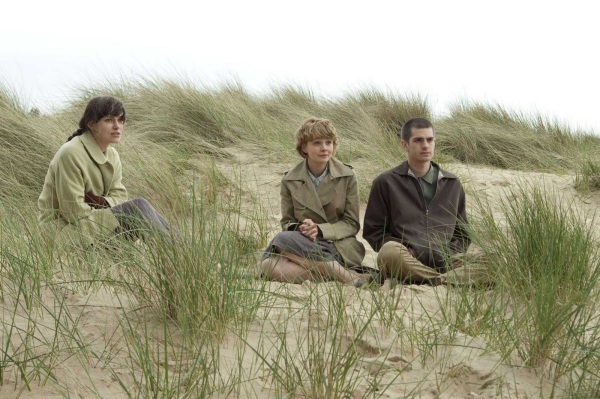
I wasn’t particularly fair in this fear, at least when it comes to Never Let Me Go. The adaptation isn’t perfect: it would need some more time for the implications of what’s going on to sink in and be as quietly devastating as in Ishiguro’s novel, and the writing (the script is by Alex Garland, whose work I tend to find compelling and frustrating in equal measure) is a little too on-the-nose at times, assuming that the audience is too thick to get it. But the casting, including Keira Knightley, works perfectly. Yes, both Andrew Garfield and Carey Mulligan aren’t miles from the parts they usually play, and it’s not as if Knightley is miles away from other parts she’s done, but the actors fit their parts to a T, with Garfield especially delivering a performance as poignant as that he gave in Boy A. I could imagine that my first criticism is less of an issue for those who haven’t read the novel – the film isn’t rushed by any means, it just doesn’t give its audience quite as much breathing space, which is what I missed a bit.

Consult this

Oh, Auntie. After a year of bigger and smaller disappointments and only one moderate success, you’ve shown me you can pull it off. And how… 2010’s Sherlock was a great treat: funny, exciting, smart. But it was also only three episodes, one of which was decidedly weaker than the others. Would a 1 1/2 year hiatus help? Judging from the New Year’s Day episode and season starter “A Scandal in Belgravia”, the answer to that is a definite, loud, positively orgasmic “Yes!” Honestly, has there been witty dialogue, chemistry between the characters and stylish execution like this in any UK production in the last couple of years?

No, “Scandal” wasn’t perfect; it did have a couple of very cheesy moments, two of which weakened the female guest star in ways that are perhaps a bit iffy (mind you, I wouldn’t agree with the extent to which Jane Clare Jones criticises the episode), and it was perhaps too self-consciously cute with its references, punning and otherwise, to Doyle’s original stories (I groaned at the “Speckled Blonde”, though I loved the hat bit). Regardless, the episode was pretty much perfect in terms of being wonderfully entertaining – and just when you thought the humour might become self-congratulatory, Sherlock throws a scene at you that works as drama, showing that for all his brilliance, the main character is deeply flawed. The series is a fan of Sherlock-as-genius, but it doesn’t make the mistake of becoming fanboyish – or -girlish, although I gather that Benedict Cumberbatch does make for rather yummy eye candy. Then again, the testosterone brigade can hardly complain after a guest starring spot by Lara Pulver that would have made Mary Whitehouse’s head explode.

Oh, and the dialogues! If you were wondering where the sparkling repartee of a The Thin Man had gone, look no further: the Beeb’s been stockpiling it, refining it and quite possibly enriching it with steroids. This exclusive trailer from The Guardian website may be a bit weird, but it has a fantastic exchange between Holmes and Watson:

So, BBC, bring it on. Give me what you’ve got. And I’ll be willing to forgive you for the wasted potential of Exile.