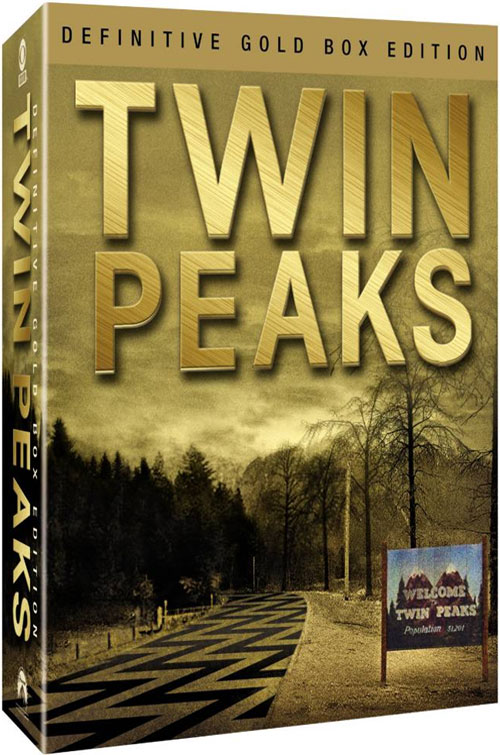
Today a big parcel arrived from Amazon.de. Of course I had a fairly clear idea of what I’d find inside, but I was still excited when I opened it. (Amazon – the 21st century replacement for Father Christmas…)
It’s been a while since I watched any Twin Peaks, but one of my fondest memories from my student days is a weekend of watching the series with a couple of friends, a coffee percolator (no fish – sorry, Pete), cherry pies and, yes, donuts.
Undoubtedly, much of Twin Peaks after Laura Palmer’s murder has been solved isn’t nearly as good as what went before it, and the final episode is pretty much David Lynch’s cryptic “!uoy kcuF” to the audience (to be said by a little guy in a red suit dancing to some slow jazzy tune). But I’m still looking forward to getting back to that foggy, creepy, underbelly of Mom’s apple pie-y place. And, of course, Albert Rosenfield.
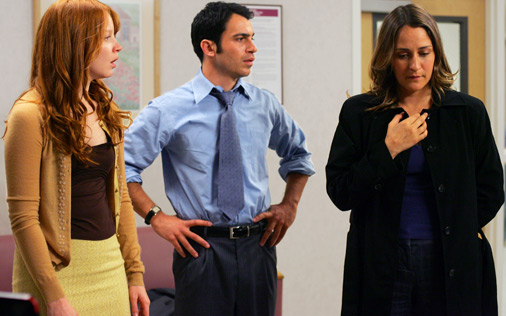
On Monday, Swiss television showed the season 3 finales of both House, M.D. and Lost. We haven’t seen the latter yet, but it probably says it all that the best moment of House, at least for me, was the Chase/Cameron kiss. That scene was sweet, but the actual medical case was too vague and the character interaction not very interesting. The House vs. God angle had also been done previously. All in all it felt like the series could do with a couple of months off. Seeing as season 4, cut short by striking writers, is just about over in the States, we might get it fairly soon…
… but first, we’ve got the grand return of Grey’s Anatomy (at a point where I sometimes feel that if I have to watch McDreamy be a self-righteous, self-infatuated git for another minute, I’ll find the actor and put his face through a meat grinder), doubled up with Private Practice, the Grey spin-off that got started in an atrociously written and at best adequately acted two-parter on its mother series.
How’s a man to cope – especially when this man knows that there are only six more episodes of Deadwood? Like, ever? Come to think of it, I’d like to see a cross-over where some select characters from Grey’s Anatomy and perhaps Desperate Housewives stop by the picturesque little town of Deadwood. Derek Shepherd could open a practice with Dan Doherty as opthalmologist. (If you have no idea what I’m talking about, click here, unless you’re still hoping to watch season 3 of Deadwood.)
Six Feet Under is also almost over – two more episodes. What next? We’ve got a fair choice of series: Rome, The Wire, Carnivàle, season 6 of The Sopranos. Then there’s more escapist or pulpy fare: Heroes, Veronica Mars, Joan of Arcadia, Dexter. I’ve heard very good things about the latter series, especially season 2 – which came as a bit of a surprise, as the second Dexter novel was quite a bit weaker than the first. I guess that sometimes film and TV can improve on books…
And to end this very meandering blog entry, here’s a YouTube clip – the very effective opening credits for Dexter, a show whose ‘hero’ is a serial killer… who is intent on only killing ‘bad guys’:
Yesterday evening we watched Kinky Boots, a film that tries too hard to be in the vein of recentish British comedies such as The Full Monty, Waking Ned or Saving Grace. It wasn’t exactly a bad film, it was simply deeply mediocre, which may be even worse… Even Chiwetel Ejiofor, playing the transvestite Lola, couldn’t save this film which clearly believed itself more charming that it actually was.
However, much worse were the trailers before the main attraction, all of them for films that proclaimed themselves to be “Based on a true story” in a deep, authoritative trailer voice. What worries me even more is that there’s obviously an audience for movies that make that claim for themselves. Are there really so many people who think that the seal of Factuality(tm) makes a movie better?
I’ve always thought that a story is elevated simply by itself, by the strength of the storytelling. A badly told, hackneyed story isn’t miraculously made less so by suggesting that it’s based on something that really happened – and let’s face it, realistically speaking there’s precious little left of the original facts by the time the film makes it to movie (or, in this case, television) screens. A great, well written and acted story, on the other hand, isn’t somehow worth less (or indeed worthless) because it is made up.
Perhaps this is just me being an arrogant ex-literary scholar, but I actively resent this attitude that there’s a clear cut division between fact and fiction. There’s truth in completely made up stories, especially emotional truth, if the storyteller knows what he’s doing; and there’s probably no genre that is as fictionalised as autobiography, which also tends to live off the claim that “This really happened, man!”
As it is, unless a film is written, directed and acted by talented people, the dreaded label “Based on a true story” is often reason enough for me to give it wide berth. If some pretend factuality is all a movie has has going for it, count me out.
But I would be a git if I just left you with this crabby, cranky monologue – so, as promised, here’s some more Tex Avery, supplemented by a Bill Plympton short. I love the malleability of the human, or lupine, body in the cartoons done by those two – and I love the absurdism and silliness. How needs stories based on real life if you can have cats in the shape of milk bottles and eyeballs literally popping out of a horny wolf’s head at some red hot riding hood?
Okay, actually it’s Davos I’m back from – although it does feel rather spacey during the WEF Annual Meeting. I mean, how often do you go to the men’s room and then wash your hands next to Henry Kissinger? (I didn’t, but I helped look after someone who did.)
Anyway, this entry isn’t about taking a leak with the high and mighty. It’s basically my way of saying, “Hello. I’m back. Miss me much? Hello? Anyone listening?” And then, tumbleweeds and the sound of crickets.
So, to ease myself back into this blogging business, I’m going to make it semi-easy on myself. And to give the title of this entry some minimal relevance, here’s a cartoon by Tex Avery. More will follow later – unless there’s a flood of comments telling me, “We hate Tex! Want more Miami Vice!” In which case I may just retire to some snowy peak in the Himalayas where I will dispense wisdom and computer game cheat codes from the ’80s to unwary yaks and passers-by.
Phew. He’s dead. And even though I knew it was going to happen – heck, I’d seen it before – it’s still amazing how much it got to me.
Rest in peace, Nathaniel Fisher Jr. You were often frightened, stupid, self-righteous, passive-aggressive (and lately just plain aggressive) and self-centred… but I’ll miss you.
We also watched another episode of Lost yesterday, namely “The Man Behind the Curtain”. It seems that the series makers have realised that you can’t just keep heaping mysteries onto the viewer without also revealing a thing or two, and the series definitely benefits from it. Also, I definitely like John Locke, Zealot more than the dithering Locke in the latter half of season 2. Hey, sometimes you just need to knock out a one-eyed Russian to make your point!
Also, note to all fathers reading this: Never, ever forget your son’s birthday every year – because otherwise he might just end up gassing you to death on some mysterious Hawaiian island. And some con-man from down South may just end up popping the skull off your dessicated remains to make the audience laugh.
My first David Cronenberg was The Fly, and I was probably 15 or 16 when I watched it. Like so many adolescents, I was into horror movies, although I was never a big fan of gore. The Fly was probably the goriest film I’d seen at that point, and it’s still one of the movies I’ve seen that is most disturbing in its graphic depiction of horrible things happening to human (and simian) bodies.
Yet Cronenberg’s use of violence is very different from the wave of torture porn we’ve had lately, the films that try to top one another with even more grotesque displays of sadism. I wouldn’t say that his films contain gratuitous violence (a strange term, because violence that is supposed to titillate the audience is used for a very clear reason – it’s the only raison d’etre of those films), because there’s nothing cool about it. There is a meticulous fascination with the human body as physical material. There are few directors who show what damage is done to the body when it is shot, stabbed or cut to the same gut-wrenching effect.
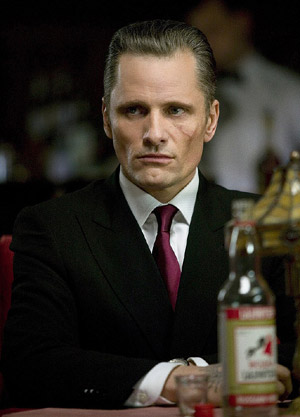
There are 3 1/2 brutal scenes in Eastern Promises: two cut throats (one of them a pretty amateurish job, the mere thought of which makes me flinch), a fight between a naked, vulnerable Viggo and two armed Chechens that hurts to watch (and probably hurt to film – where do you hide padding if you’re stark naked?). Oh, and a corpse gets a couple of fingers cut off – but he’s dead, so that hardly counts as violence. Unless, that is, you can’t bear to watch the annual dissection of the turkey at Christmas.
Are all of these scenes necessary to get the point across? I guess that depends on what you think the point is. If Cronenberg is preaching about the brutalising effects of violence, then there’s something about the film that is paradox at best and hypocritical at worst. However, I don’t think that’s what he’s doing. For me at least, he revitalises the sheer physical horror of doing damage to a human body. Violence in films is so often anodyne or aestheticised to the point where you shrug it off. Especially gun violence seems simple: point, click, blam, dead (or maimed… or at the very least shit scared, if you miss). Take a knife to someone and try to take his life, and apart from anything else it’s bloody hard work. Or hard, bloody work. It’s not just a concept, an idea or a theory: it’s a physical, tangible reality.
And strangely, Cronenberg’s films more than those of most other directors remind me just how precious and fragile the human body can be. It’s no coincidence that one of the first images we see in the film is a newly born baby with almost translucent skin, still wet with her mother’s fluids. And later in the movie Viggo, naked and slick with his blood, is just as vulnerable and easily damaged. Forget notions of morals, of good guys and bad guys, of right and wrong: bodies weren’t built to take such punishment, and they shouldn’t. But they do. And Cronenberg – and some of his characters – are strangely, horribly fascinated with this tension.
But enough pseudo-academic blabbering. If the previous few paragraphs make little to no sense, put it down to the fact that I should be in bed. So, good night and see you tomorrow.
P.S.: Don’t worry, I’ll get back to Uncle Alan and his merry band of gentlemen and -women, extraordinary and otherwise, tomorrow.
Sorry, guys… Not enough sleep and no coffee make this guy uncreative. I could write something about today’s episode of Six Feet Under (“The Silence”), but then, something about its ending made me feel all blue.
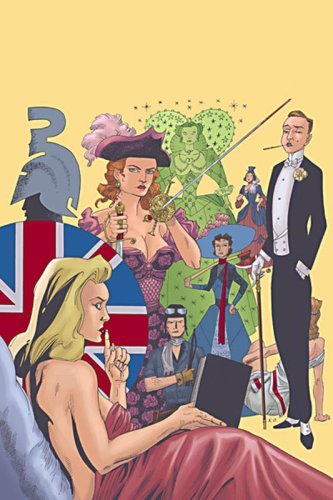
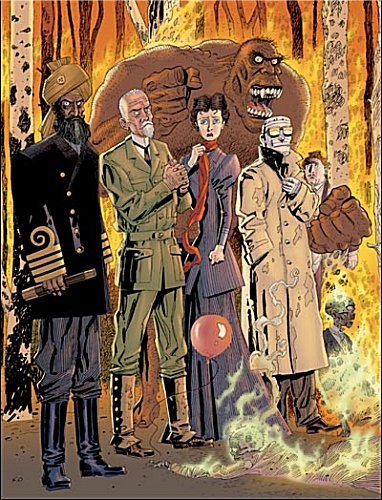
Or should I write about League of Extraordinary Gentlemen: The Black Dossier today? Well, considering that the annotations file on that one is more than 50’000 words long, I think that my review should wait until I’ve had more sleep.
So… should I write about Pulp Fiction, which I watched again yesterday, for the first time after years? Thing is, so much has already been written about Pulp Fiction, so I think I’ll just leave it at saying that the film is as fresh and as cool as it was back then (has Samuel L. Jackson ever been cooler?). And here’s a little something to keep you happy ’till the next blog entry:
… oh, but it is. It is. In subtle but essential ways.
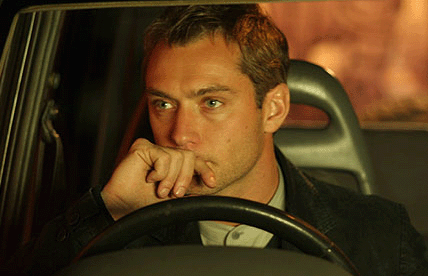
Okay, that’s probably way more cryptic than you would’ve hoped for – so let’s clarify things: Anthony Minghella’s latest, Breaking and Entering, a film that feels like it was made by Guardian readers for Guardian readers, gets some things very right. If you’re into urban decay, atmosphere, good acting, if you basically want to see a mood poem set in London, or indeed if you want to ogle Jude Law and enjoy his accent, this film is for you.
If you want a stringent story with credible character motivations and subtle writing… Meh. Not so much. It’s a shame, really, because the acting is there: I’m not usually a fan of Robin Wright Penn, but she makes her character’s pain credible, and the rest of the cast does a good, sometimes great job – but it doesn’t help that the film takes things that were already clear when they were only implied and makes them clumsily explicit. Also, one of the central two relationships seems to pop up out of nowhere in between scenes – and this, to me, almost crippled the film. (In fact, I felt like I’d fallen asleep for five minutes and had missed an important scene.)
What I really liked: the depiction of London; Martin Freeman’s character (oh so British!); Vera Farmiga’s character, miles away from her shrink in The Departed; Juliette Binoche (there are people, good friends of mine, who hate her – I’m sorry, guys, but I hope you forgive me for liking her acting a lot); the look and feel of the film. In some ways, I think I would have preferred Breaking and Entering if I’d seen it dubbed into some language I barely understand. If I could have watched the dialogues through some sound-proof window and taken in only the images and the soundtrack, I might have loved it.
P.S.: Minghella’s working on an anthology film called New York I Love You. Check out the list of directors, and give a good, hearty “What the…?”
It’s dangerous to go back to the things you enjoyed as a kid after decades, because chances are that you’ll want to tear out your eyes and lobotomise yourself rather than know that, boy, did you have crap taste when you were young!
Going back and watching the ’50s version of 20’000 Leagues Under the Sea isn’t nearly as bad as it could be. There’s still a lot in the film that works: many of the special effects, if not up to scratch nowadays, still have a certain realism, so that the film still looks pretty damn good. This is helped by the underwater scenes and the colour art direction which won an Academy Award. (Makes you wonder what other Academy Awards they gave back then – Best Racist Caricature in a Motion Picture? Best Gratuitous Use of a ‘Funny’ Seal Sidekick? Best Repeated Underwater Performance of Toccata & Fugue As Bach Never Wrote It?) The film’s atmosphere is still cool, and the kid in me still thinks it’d be fun to be on the Nautilus, at least if that Nemo guy stays off the organ playing for a few hours.
At the same time, I never noticed just how clunky the dialogues and much of the acting were. Not that I expect Dostoevsky from a Jules Vernes adventure movie, nor did I think, “This film could do with more Lee Strasberg-type performances…” But at times you wonder whether Richard Fleischer ever bothered to direct his cast. I know that Peter Lorre can do better, as can Kirk Douglas… and James Mason mainly works due to his eyebrows and his snobbish British accent, which makes lines like “I am not what is called a civilized man, Professor.” quite funny – you expect him to follow this with, “Now let us have a snifter of brandy and read some Shakespeare, shall we?”
And the trained seal and that insufferable “Whale of a Tale” song are evil, I tells ya! Eeevil!
P.S.: Speaking of Captain Nemo, perhaps I should take a day or two to write a blog entry on Alan Moore’s League of Extraordinary Gentlemen: Black Dossier. Very little Nemo in that one, though… Shame.
To be honest, I’m not completely up-to-date on what will be coming to cinemas near you (and me) in 2008. Right now, I can only think of a handful of films that I know of, and even fewer that I’m actively looking forward to. Two of these I’ve already mentioned, namely The Dark Knight and No Country for Old Men.
However, the film that I may just be looking forward to most is the latest movie by Paul Anderson. Nope, not the guy who did Event Horizon or Aliens vs. Predator. The man who directed Boogie Nights (the best Scorsese film by someone other than Scorsese), Magnolia (the best Altman movie not by Altman) and Punch Drunk Love (the best- sorry, I have no idea what to compare this film to… the best Adam Sandler film, perhaps?).
People have called Magnolia especially a self-indulgent piece of something or other, but to them I say, “Bosh! Flimshaw!” If art isn’t inherently self-indulgent, I don’t know what is. Punch Drunk Love mainly left me non-plussed, but the cast and trailer of There Will Be Blood (as well as the title, which is reminiscent of the Deadwood season 3 premiere, “Tell Your God to Ready for Blood”) definitely have me intrigued and excited.


 A Damn Fine Cup of Culture