Welcome to Six Damn Fine Degrees. These instalments will be inspired by the idea of six degrees of separation in the loosest sense. The only rule: it connects – in some way – to the previous instalment. So come join us on our weekly foray into interconnectedness!
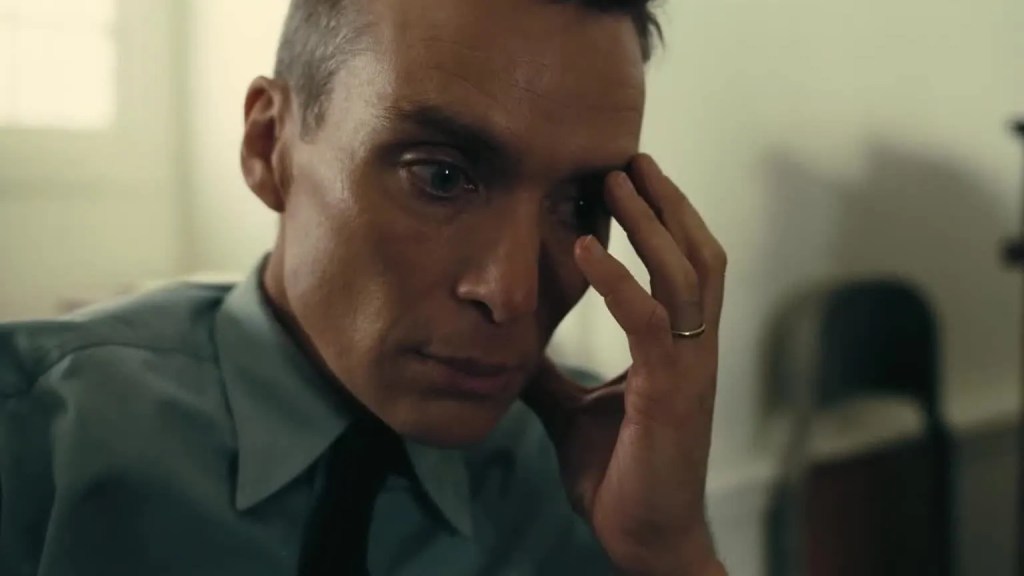
I didn’t like Oppenheimer. That’s largely because I didn’t understand the second half of the movie, wherein, somehow, Oppenheimer gets the upper hand over Strauss. I didn’t understand what was there for the getting, nor did I understand what the bone of contention was. To the very small extent that I got the situation between them, I didn’t much care. As I understood it, it took a smallish statement by the Rami Malek character during the hearing to push Strauss off his pedestal. And that was it. What had just happened?
Stop me if you’ve heard this one: Hollywood, the Dream Factory – it is actually quite silly, and none are more silly than Hollywood superstars. Drop them in the real world on their own, without their entourage, and they wouldn’t survive five minutes. They’re shallow, self-centred and vain, they barely have a personality of their own, which is probably why they choose acting in the first place. But then, they bring joy to all our lives, so all is forgiven. We love you, Hollywood superstar!
Andrei Tarkovsky’s Solaris (1972), an adaptation of Stanislaw Lem’s 1961 novel, is classic sci-fi cinema: as can be expected of a film by Tarkovsky, it is intriguing, hypnotic, at times sublime, but undoubtedly also confounding and even frustrating at times. It is a product of its time in some ways but timeless in others. Steven Soderbergh’s Solaris (2002) is unlikely to stand the test of time to the same extent – but is it still a worthwhile take on Lem’s novel? Is it indeed a remake – and, if so, is it a meaningful, worthwhile one, or is it an uncanny replica of the original material, much like the revenants that Lem’s mysterious planet produces, possibly in an attempt to communicate with humanity? Join Matt, Alan and Sam for the third episode in our Summer of Remakes, as they discuss these two films and their takes on both. How do they compare, in their approaches to Lem’s story, and in how successful those approaches are in creating a memorable film?
Welcome to Six Damn Fine Degrees. These instalments will be inspired by the idea of six degrees of separation in the loosest sense. The only rule: it connects – in some way – to the previous instalment. So come join us on our weekly foray into interconnectedness
Welcome to Six Damn Fine Degrees. These instalments will be inspired by the idea of six degrees of separation in the loosest sense. The only rule: it connects – in some way – to the previous instalment. So come join us on our weekly foray into interconnectedness!
So, apparently Alfred Hitchcock wasn’t a huge fan of Ivor Novello? One wonders what Novello thought of Hitchcock. It’s not exactly a secret that Hitch wasn’t always the easiest director to work with. He famously said that all actors should be treated like cattle, and when he said that he was correcting an allegation that he’d supposedly said that actors are cattle. Arguably, his correction didn’t exactly do much to make him look any better. Of course, being treated like cattle might still have been the better deal compared to other ways in which Hitchcock behaved towards his actors – and particularly his actresses. (It’s no accident that one of the sections in the Wikipedia entry on Tippi Hedren’s is titled “Allegations of sexual harrassment”.)
Welcome to Six Damn Fine Degrees. These instalments will be inspired by the idea of six degrees of separation in the loosest sense. The only rule: it connects – in some way – to the previous instalment. So come join us on our weekly foray into interconnectedness!
Pretty much from its infancy, cinema recognised the dramatic potential of crime.Whether we’re talking about whodunnits in the style of their literary ancestors, films in which the protagonists were sleuths and detectives, or their counterparts, the movies that told the stories of gangsters, thieves and murderers, crime pays – at the very least in ticket sales. Something else cinema exceeds at: showing us people who are very, very good at what they do. There’s a joy to watching consummate professionals at work. (There’s even a phrase for it, competence porn, and Breaking Bad‘s Mike Ehrmantraut is its laconic patron saint.) And, of course, there’s the place where the Venn diagram meets: many a highly entertaining film has been about criminals who are good at their particular genre of crime. The con men and women, the safe breakers and thieves, and yes, even the killers who are just so damn adept at killing that it’s delightful to watch them go about their gruesome business.
And at the heart of the intersection of those two sets is a particular brand of movie, about a particular brand of criminals who do a very specific kind of crime requiring the upmost professionalism: the heist movie.
Join us every week for a trip into the weird and wonderful world of trailers. Whether it’s the first teaser for the latest instalment in your favourite franchise, an obscure preview for a strange indie darling, whether it’s good, bad, ugly or just plain weird – your favourite pop culture baristas are there to tell you what they think.
There are a number of companies that still deliver great physical media for films – Arrow Films and Kino Lorber come to mind, for instance, companies that care about curation and quality. Here at A Damn Fine Cup of Culture, we’ve obviously entered the 21st century and we stream films and TV series, but we nonetheless like a good Blu-ray edition or boxset, and few do this as nicely as Criterion. Late this week, Matt announced a new feature that will have him working off his Criterion backlog – which should start next week with a Kubrick classic. So, while it’s not quite a trailer, here goes…
Welcome to Six Damn Fine Degrees. These instalments will be inspired by the idea of six degrees of separation in the loosest sense. The only rule: it connects – in some way – to the previous instalment. So come join us on our weekly foray into interconnectedness!
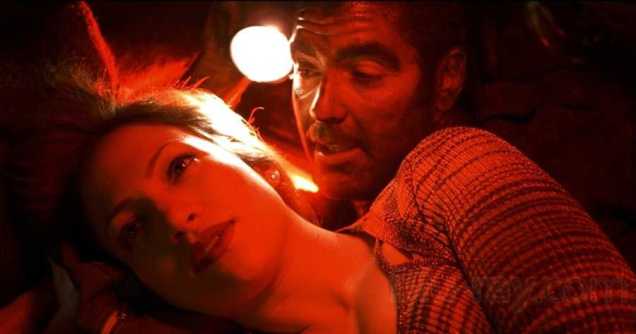
The first time I was exposed to Elmore Leonard (I make him sound a bit like a virus, don’t I?) was probably when Get Shorty came out in 1995 and was a big hit. I didn’t see it at the cinema, but I caught it on TV a while later. I have to admit that there’s pretty much nothing I remember about Get Shorty, so the first time I actually registered that this Elmore Leonard cat might be someone to look out for was when I went to see Out of Sight, in 1996, and fell for the film. I fell for the characters, the writing, the direction, the editing, the feel. And, obviously, I fell for Jack Foley (George Clooney), gentleman bank robber, for Marshall Karen Sisco (Jennifer Lopez), and most of all for their car trunk, whirlwind romance.
Each Friday we travel back in time, one year at a time, for a look at some of the cultural goodies that may appear closer than they really are in The Rear-View Mirror. Join us on our weekly journey into the past!
There is nothing that can date a movie like style for style’s sake. It’s one of the hallmarks that betrays a movie’s age, and while some stylistic choices can turn a movie into a classic, other styles might simply not age that well. Think about small things like lens flares. Or think about the dogma certificate. That doesn’t mean that they are bad movies; it’s just that sometimes, movies get stuck in the times they were made. Nostalgia isn’t the worst reason to re-visit a movie you haven’t seen in a long time.
What’s the best thing about an11-hour flight? It can’t be the dodgy movies on the in-flight entertainment system, can it? (I once failed to go to sleep on a flight that showed Marley & Me and Paul Blart: Mall Cop on all the screens. The lambs have barely stopped screaming on that one, Clarice.) Well, yes, it can, on one of those snazzy new planes where even down in Economy Class, with all the third class Oirish having a fun time before the plane hits the iceberg, you have a choice of oodles of films, music and games. And since Who Wants to be a Millionaire? loses its interest after a handful of games, especially when there’s no oily showmaster-wala with an Indian accent to foil your attempts to get the money and the girl, I decided to dedicate at least some of my flying time to watching first The Men Who Stare at Goats and then The Fantastic Mr. Fox.
Men, goats, intense stares… George Clooney, Jeff Bridges and Kevin Spacey – what could go wrong? Well, it’s not so much what went wrong; it’s more that way too little went right. The film is a brilliantly cast neat idea spun out over 1 1/2 hours, which makes for a great trailer (minus Ewan McGregor’s horrid American accent) and a decidedly mediocre film. It isn’t really worth saying all that much more about it, except to bleat mournfully.
The Fantastic Mr. Fox, though? I’m still surprised to say that I genuinely enjoyed it. I’ve had problems with the two Wes Anderson films I’d seen, The Royal Tenenbaums and The Life Aquatic. Anderson’s a great aesthete, but his style got in my way of enjoying both movies to a large extent. The problem is that the films and their characters are so stylised, in their looks, behaviour and neurotic quirks, that they feel wholly static – so when the plot contrives to make them tragic, I don’t buy it. The pathos turns into mawkishness, and when it kind of works in spite of the artifice, it’s largely due to the borrowed emotions of the songs Anderson chooses. To my mind, characters can only become tragic if there’s the illusion that they are free, or at least struggling to free themselves, from the master puppeteer that is Fate, the Script and/or the Director – Anderson’s characters have often struck me as being puppets at the mercy of a master stylist who doesn’t have freedom anywhere on his palette.
[https://www.youtube.com/watch?v=W460QxYQgh4]
I suspect that what makes Mr. Fox work for me is this: animated films are stylised to begin with. They are entirely created. And ironically that makes Mr. Fox feel less constricted by Anderson – whereas real people in a live-action film are made less unreal by the artifice that seems to be his favourite stylistic choice, the animated foxes, moles, possums and badgers, not to forget farmers Boggis, Bunce and Bean (one fat, one short and one lean), are infused with humanity, for want of a better word. The style becomes a part of the whole rather than being the whole and thereby threatening to suffocate both the actors and the characters.
The Fantastic Mr. Fox is very clearly a Wes Anderson film – the look, feel, costumes, even the character setup (father-son conflict anyone?) feel familiar… but by sidestepping live-action for once, Anderson’s made the first film that, being entirely artificial due to being animated, feels real to me.
And it’s got this lovely scene with Michael Gambon (as farmer Bean) and Petey, as played by Jarvis Cocker:



 A Damn Fine Cup of Culture