But is it what you would call ‘series acting’?

I like good acting. Not Oscar-winning acting, which I often think is mainly a case of “who’s best at manipulating the audience?”. That sort of acting tends to feel acutely self-aware, to the extent that I sit there, watching it, being painfully aware of the acting. (And I usually groan when someone says that this or that actor isn’t actually very good because he’s only got two facial expressions. Being able to produce a number of different grimaces doesn’t make for good acting. Watch Ulrich Mühe in The Lives of Others for a beautiful example of acting, based pretty much on the most subtle variations of one facial expression.) 

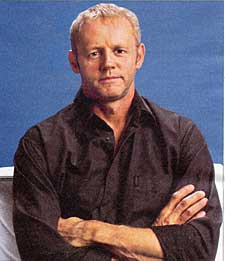
Ulrich Mühe

Strangely enough, TV series don’t necessarily need good acting to work. Of course, atrocious acting is as painful to watch in series as it is in movies, but limited actors can still work extremely well on television. The good thing about series in this respect is that after a season or so, deeply mediocre actors become the characters. Look at Jonathan Frakes who played Will Riker in Star Trek: The Next Generation. Definitely not a good actor by any standards, and most people would hesitate even to call him mediocre; but by season 3, he was Will Riker. Any wobbles in the performance could be attributed to the character – “Ah, it’s Riker being full of himself! It’s Riker being nervous at meeting the Axitraxian ambassador! It’s Riker having had too much cheese before going to bed!” And somehow, by season 5 or 6 good old Jonathan felt comfortable enough in the part to stretch himself and surprise me with an actual good performance (!) in an episode called “Frames of Mind”.

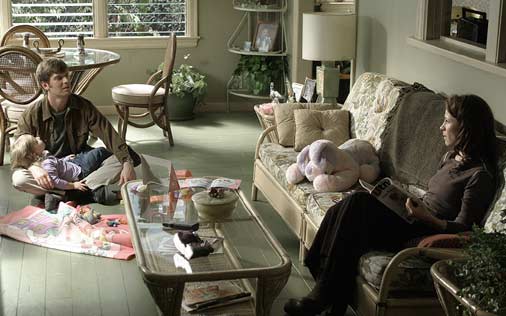
Watching those HBO series I keep harping on about – The Sopranos, Deadwood, Six Feet Under – I am constantly amazed at the high quality of acting. Thinking back to the series I watched, and loved, as a kid and as an adolescent, though… Most of them had fairly mediocre actors, for instance David Duchovny (although he does make for a great transvestite!). Yet somehow I never felt I was watching Duchovny being mediocre. I very quickly forgot about Duchovny and was simply watching Fox Mulder.

David “Nobody’s perfect” Duchovny

For me, Lost has that very same quality. Some of the acting in Lost is good – Terry O’Quinn comes to mind, for instance. But if you look at it critically, most of it is hackneyed character work. If the series is still remembered in ten, twenty years, it won’t be for the acting. And yet… Half an hour into the pilot, and I bought the characters. I don’t know whether that is a quality of the writing, or the directing, or simply a case of the actors being close enough to the characters not to have to act too much. Perhaps it’s also just chemistry between the cast members. I don’t know. But I know that it’s the characters I keep coming back for – even if Jack is a whiny bitch, Charlie is even more annoying than he was as a hobbit (Pippin at least had the benefit of a Scottish accent – here we’ve got Desmond for that), and Nikki and Paolo deserve a horrible death (preferably something out of E.A. Poe). (Note: We haven’t seen any episodes past “Every Man For Himself” in season 3.)

Two final comments for today: 1) Why is it that the Deadwood women keep ending up on the island? I’m waiting for Alma and Jewel to turn up… 2) Was it very noticeable this was a bit of a filler blog entry? If so, I apologise – and promise that tomorrow’s episode will be better. (In that respect, perhaps my blog is a bit like Lost: a long mid-season slump, but the “huh?!”-inducing revelations at the end of the season will keep all of you coming back. Mwhaha.)

By my troth, thou art a hooplehead

If anyone bemoans the state of TV in my presence, I tend to point them in the direction of HBO. At least if they’re not against watching series that may be very sexual or violent, or that may “contain language” (as opposed to all the Marcel Marceau-inspired television programming, of course). I’ll tell them to check out Six Feet Under, naturally, and The Sopranos. I myself haven’t checked out The Wire yet, but it’s definitely at the top of my list. From what I’ve seen so far, HBO series have a fairly consistently high level of quality, in terms of acting, writing, directing, cinematography.

I was rather surprised to find just how much I liked Deadwood. As a genre, the western doesn’t interest me that much. It took me two or three episodes to acclimatise to the language – not just to the incessant swearing, but to the elaborate quality of the dialogues. But then I was hooked.

One of the reasons is definitely the language. I know that the word “Shakespearean” is overused in criticism especially of TV and cinema, usually to give the younger, technological media a veneer of respectability that isn’t really needed anymore. But series creator David Milch’s writing does strike me as similar in quite a few respects to Shakespeare’s plays. Milch deftly mixes ‘high’ and ‘low’ language; he uses an impressive range of registers, styles and imagery to convey the characters. The difference is simply that with Shakespeare most people need to read the footnotes to see how filthy the language is at times. (I could imagine that it’s either frustrating as hell for the actors to speak the dialogues or greatly enjoyable. Or both.) The characters. Now, in a list of the best fictional characters on television, you couldn’t leave out an Al Swearengen. As a matter of fact, I’d say that you couldn’t leave him out of a list of the best fictional characters, period. (I imagine he might be joined there by Tony Soprano and his mother Livia. Now, I’d love to eavesdrop on a barroom conversation between Tony and Al.) I wouldn’t even consider it hyperbole to compare Al Swearengen to one of Shakespeare’s greatest creations, Falstaff. He’s just as rich, complex and ambivalent – and arguably as attractive – as the fat, vainglorious, cowardly and ultimately tragic knight of Shakespeare’s Henry IV. (Having said that, I would love to see Ian McShane in a Shakespearean role. Richard of Gloucester, for instance.) 

Ellsworth

While everyone loves Al, I must say that some of the more minor characters are my favourites. The first of these is Ellsworth. It’s difficult to write a fundamentally decent character and not make him boring, but they more than succeeded. And how can you not love a character who says the following, keeping a completely straight face?

Joanie Stubbs:   Will you keep a girl company?
Ellsworth:   I will, but I’m expensive.

Or indeed this?


Ellsworth:   Well, Ma’am, I’ve got myself a working gold claim.

Joanie Stubbs:   Well, sir, is that a damn fact?

Ellsworth:   A hell of a working gold claim, and if we knew each other better I’d throw “fucking” in there somewhere.

Joanie Stubbs:   If you did I’d try to catch it.

Ellsworth:   A working fucking gold claim, Joanie, and thank you for allowing me my full range of expression.

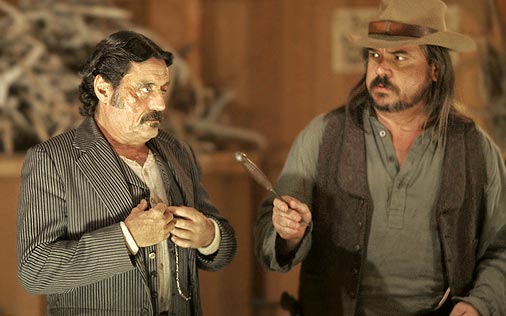
My second favourite character must be Dan Dority. He’s not the brightest, and he doesn’t exactly have great impulse control. But there’s something funny and sweet to his devotion to Al. His genuine distress when he thinks that Al prefers pretty boy Silas Adams to him, or when Al almost dies of a gleet. Again, like Shakespeare at his best, Milch mixes pathos and comedy perfectly in his best characters.

Dan Dority and Al Swearengen


It is to Dan and to Ellsworth, to Al, Sol, Seth, Trixie, Joanie, Charlie, Alma, Jane – and yes, even to E.B. – that I raise my glass of bourbon and say: “To your health, cocksuckers and hoopleheads! See you soon!”


P.S.: If you’re looking for a (Swiss-)German blog to read, especially if you’ve got a thing for outlandish international cuisine (and flame-baked Smurfs), check out Magenta’s Lucky Page. Highly recommended!

Loose baggy monsters. And they suck out your brain, too.

I used to love reading fantasy and science fiction literature. Or rather, I used to love the idea of sci-fi and fantasy. My parents never got that I enjoyed stories that were out of this world, so to speak. (One of my defining childhood moments: My uncle sends us Star Wars: A New Hope on Betamax tape, taped from Channel 4. We watch it, and I love it. My parents think it’s a waste of time and tape over it the next day. It’s a miracle I didn’t go Michael Myers on them. And by that I mean Halloween Michael Myers, not the “Groovy, baby!” kind.) I loved The Lord of the Rings, Madeleine L’Engle’s Wrinkle in Time and Diana Wynne Jones’ Chrestomanci books.

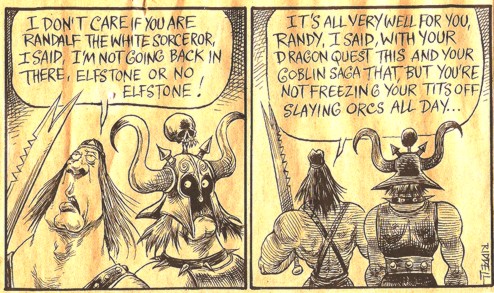
Randalf the First 

And then I read too much fantasy. I watched too much sci-fi. And so much of it is poorly written, derivative dribble, disposable junk. I was fed up with bearded, grumpy wizards trying very hard not to be Gandalf, I was sick and tired of chosen ones and ancient prophecies and evils sweeping the land. I had enough of names that looked like the deformed offspring of multiple apostrophes and the bottom of the bag of letters at the end of a game of Scrabble.

Randalf the Second

It was Joss Whedon’s Firefly that reinstated my belief in good science-fiction. Neil Gaiman largely did the same for fantasy, but I didn’t like his last couple of books that much – apart from which he tends to write metafiction rather than straight fantasy (whatever that may be). There’s always a self-aware, postmodern twinkle in his authorial eye, it seems.

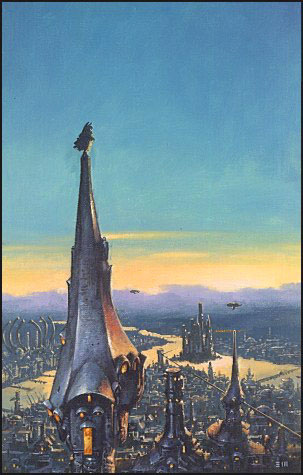
Yesterday I finished China Miéville’s Perdido Street Station. Arguably it’s fantasy, although it’s set in a universe that is closer to our world than to Middle-Earth or the books of Terry Brooks or Robert Jordan. There are no elves, dwarves or dragons (nor thinly veiled copies of them). Magic is a technology, essentially. And New Crobuzon, the monstrous city in which the story takes place, is reminiscent of Victorian London much more than of the pastoral fantasies or the hackneyed medieval towns of your common garden variety of fantasy.

What sets Perdido Street Station apart from those other fantasies is that it feels real. Not epic. Not mythological. Real. It’s fantastic enough to serve as escapist fare, but it’s not the sanitised, Disneyfied kingdom of Far, Far Away. What also sets it apart, and this may surprise some of those who have read it, is the economy of Miéville’s writing. Yes, the book is long – it’s over 800 pages long, in fact – but in the end I felt that no character, no scene, no piece of description didn’t serve a function. So often, bad or mediocre fantasy novels are filled with pages and pages of clumsily handled world creation, which feels like the author trying to show off his or her imagination, more often than not:

“Hey, look at this sentient bird-fish-dinosaur creature I’ve just come up with! And the deities it worships! And the weird, elaborate rituals in which the sentient bird-fish-dinosaur sacrifices his firstborn! And now we’ll never hear anything about them again. Because I’m so inventive, I don’t even have to use my bird-fish-dinosaur for anything else than showing off my imagination!”

Not so in Perdido Street Station. The book is wildly inventive, but everything is there for a reason. Yet the novel feels organic rather than constructed. And I never felt the sort of laziness you get in generic fantasy, namely that the author is simply ticking off all the things the readership wants: Old mentor figure: check. Orphaned hero-to-be: check. Evil lord, comes with his own minions: check. Instead, we have a novel that doesn’t have a clear-cut antagonist. The protagonists aren’t heroes, even if they end up being heroic, more as a way of staying alive than anything else. Some of the novel is genuinely unsettling. And it’s a deeply, densely political world – not the way George Lucas tried to bring in politics in his Star Wars prequels, but infinitely more believably and fascinatingly.

Perdido Street Station 

I don’t want to go on at great length (already having done so, of course), but my suggestion is this: if you used to love fantasy but then grew tired of it, or if you believe that you “outgrew” the genre – give Miéville a try. Check out Perdido Street Street Station. And if you don’t like it, write me… so I can tell you how and why you’re just, like, so wrong.

Dungeons and dragons (no bears) – oh my!

I used to love fantasy role-playing games. I’d devour all the Bard’s Tales, Ultimas and Baldur’s Gates I could get my Hands of Great Fingeritude +2 on. Some of my fondest geeky childhood memories are of drawing maps of enormous dungeons (back before the days of wimpy auto-mapping features) and adorning them with clumsy doodles of ringwraiths, dragons and beholders. I got a kick out of reading the rulesets for Dungeons & Dragons and imagining my own (predictably generic) fantasy world, although I never got a successful campaign off the ground – mainly because one of the players was quite mad and better at chewing up PET bottles, skulking off to a corner and rambling incoherently than at role-playing his dwarven fighter. (And no, I don’t think that sort of behaviour qualifies as valid role-playing for a dwarf.)

I still have a weak spot for the Ultima games, mainly because they got two things right: the world and the characters. If I had unlimited time, didn’t have to work and wasn’t worried about my girlfriend thinking I’m even more of a geek than I am, I would try to recreate the series’ Britannia as a huge mod for The Elder Scrolls: Oblivion. And then I’d get a kick out of walking from one end of the continent to the other, stopping every now and then to see the sunset over Brittany Bay or to watch a thunderstorm from some mountain peak. Sad, isn’t it?

  Britannia 

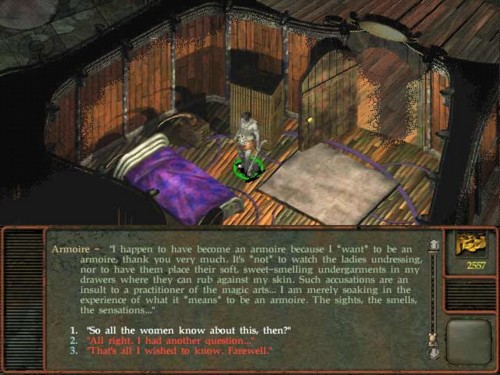
Anyway, to get back to the issue at hand: I bought Neverwinter Nights 2 last year, an RPG based on the Dungeons & Dragons ruleset. I’d heard good things about its story and writing. Somehow I never made it past the tutorial when I got started on it last year, but now I’ve started playing it again. And while it’s okay and competently executed, I realise I’m tired of what the 1UP review calls a “wonky fantasy geekfest”. I’m tired of the D&D ruleset. I’m tired of grumpy dwarfs, aloof elves, of slaughtering cheap orc knock-offs (doesn’t matter if they’re called “bladelings”). Yes, the writing is quite good, but not enough so to make the game much less generic. The characters seem fun – but not enough so to make me care much about the world or about what’s going on. Big evil threatening the Forgotten Realms, and only you can save the world? Please. Give me Planescape Torment instead any day, with its hyper-intelligent hive-mind rats, its puritanical succubus, floating skulls, and the best amnesia story this side of Memento. And its enchanted panty-sniffing armoires. Let’s not forget about the panty-sniffing armoires.

Planescape Torment

Anyway, enough of a rant about generic fantasy RPGs. More later, perhaps. And for those of you who tune in for the movie and TV musings, don’t worry – they’ll be back before long. It’s just that watching anything is more fun if my special someone is sitting beside me. And yes, that’s the kind of soppy, sentimental bastard that I am. Don’t say I didn’t warn you.

Morse code

Ah, to live in the early 21st century… To be able to sit in a little café, drinking fresh, good coffee, listening to Bach’s Goldberg Variations while reading China Miéville’s Perdido Street Station. And then to come to the office, start up the computer, and blog about it, to validate the experience.

(NB: If this was an e-mail or a message board post, I would have put a winking emoticon at the end of the paragraph, to indicate the subtle postmodern irony – there I go again, being less than perfectly serious! – but I try to do entirely without smileys in this blog. After all, Jane Austen, Randy Newman and Alanis Morissette managed entirely without…)

However, this blog entry is not about irony, or cafe latte or the Goldberg Variations (which I am proud to say I can listen to almost without thinking of Hannibal Lecter). It’s more of a dire warning.

For I have seen the face of evil. And it looks like this.

Looks innocuous enough, you think? Look again.

You may be wondering what it is that makes me think David Morse is evil. The reason is quite simple: he’s the one responsible for dooming the human race. He’s the one who released the virus that killed most of humanity, forcing us to live underground. He is evil.

And this may be where you go, “Huh?” And, if you know where I am currently located, you may even be calling the doctors to come and take me away. If you know Terry Gilliam’s 12 Monkeys, you might understand what I’m going on about, but it might still not make that much more sense to you.

Yes, I can distinguish between fiction and reality. Yes, I know that David Morse is an actor, hired to play characters, such as the apocalypse nut in 12 Monkeys. And yet. Every time he pops up on screen, I tense up. I take an immediate and intense dislike to him. Sometimes I’m proven right (Dancer in the Dark). Sometimes I’m proven wrong (The Green Mile). Sometimes the film and the scenes he’s in are so atrocious that it’s hard not to feel sorry for Morse (Contact, anyone? Daddy issues on tacky intergalactic beaches?). But I don’t trust the guy, and therefore I cheered on the inside at the thought of Greg House, M.D. and PhD in Misanthropy deciding to thwart the Morseman’s evil plans. Who will come out on top in the upcoming fight between House and his newly found nemesis? Only time will tell. Until then, it’s drawn thermometers at dawn.

It’s the freakiest show (not)

One of the series we’re currently watching is Life on Mars season 2. I enjoyed the first season – definitely fun TV – but so far season 2 has mostly failed to grab me. It felt too much like same old, same old. After all, we get it by now that the ’70s were sexist and racist. We get that Gene Hunt is a misogynist dick, albeit with occasional flashes of wit, who allows liberal viewers to vicariously enjoy their own reactionary urges. The first four episodes of the season were competently executed but not much more, and with most of them I felt that they would have been improved by being the length of your average US series episode rather than the usual BBC hour. After all, if your intrepid, flare-trousered heroes stumble around for ten, fifteen minutes trying to solve the case after the audience has figured out who dunnit, things get a bit boring.

Episode five, though, was a distinct improvement. Not only was the format changed slightly, with Sam Tyler out of the policing loop for most of the episode, and the writing cleverer, the episode also sported a gorgeous parody of “Camberwick Green” (which I’d never seen, but the sequence works nevertheless) at the beginning. If every episode were that much fun, I wouldn’t have spent the previous paragraph kvetching about the series.

However, I am doubtful that the planned ’80s spin-off, Ashes to Ashes, will be much good. It seems that they’re pretty much going for more of the same, just in ’80s neon aesthetic and with a woman police officer (played by Keeley Hawes) stuck in the past. It’s difficult not to go for heavy teen sarcasm and say, “Like, wow, how original!” And even though I enjoyed Hawes’ character Zoe in Spooks, she wasn’t exactly the strongest actor on that show. And I definitely don’t get enough of a kick out of Gene Hunt kicking nonces to be very excited about Ashes to Ashes.

Sunday morning stiff

To say that I like Six Feet Under would be an understatement. It is perhaps the best TV series I’ve seen. Its writing, acting, filming are among the best in the medium. But beyond its obvious craftsmanship, it has touched something inside me. It has made me think more about life and death, about family and relationships, than anything else.

And yet, I would be lying if I said that it was above criticism. As is any narrative that is, at least in part, made up in installments rather than planned from the beginning, it is uneven. There are storylines and characters that work less well, that sacrifice some complexity for overly facile satire or (less often) for melodrama. They still pull it off most of the time, but those bits stand out as not quite up to the usual standard.

We’re currently watching season 4 – our Sunday morning ritual consists of breakfast and an episode of Six Feet Under. Today we say the episode “The Dare”, and especially since I’m seeing it all for the second time, I feel that the storyline meanders somewhat. Claire’s art school hijinks aren’t that interesting, and I could do without Keith’s bodyguard duty anecdotes. Even those plotlines could work better if there was some more stringency (seasons 2,3 and 5 have this much more) and if it felt that the season is going somewhere, which it will, even if it doesn’t feel like it now. Nevertheless, even in these doldrums there are gems: Joe’s reaction to Brenda’s delicate confession, the way Claire handles her proposal to Edie so matter-of-factly, the return of Kathy Bates’ wonderful, wonderful Bettina.

And the late Lisa Fisher (Lili Taylor) dressed up as a human-sized Petunia, throwing things at Nate: “It’s pain. Get used to it.” Hurls another onion at Nate’s noggin. Bless her.

(Unfortunately I couldn’t find a picture or video of Lisa the Amazing Petunia. Sorry.)

It’s opera, doc! With guns! And harmonicas!

Just a quick post to complement my “Hello world!” entry. Me and my ladylove just watched Sergio Leone’s Once Upon a Time in the West. I’d forgotten just how much Leone indulges in the sheer, unapologetic over-the-top grandiosity of his movie. The style’s so easily recognisable and even more easily parodied, it shouldn’t work… but it does. Boy, does it work. It’s archetypical, operatic, and oh-so-watchable. If you have time (and have seen the film before – I wouldn’t want to spoil the ending for you otherwise), check out this video, containing the entire showdown:

Leone’s way of building up tension until it’s almost unbearable, and then releasing it in short bursts of violence, is masterful. I’ll definitely have to get my girl to watch The Good, the Bad and the Ugly with me one of those days…

(Having said all this, though, I must say that Leone’s sexual politics, in this film but even more in Once Upon a Time in America, are pretty hard to swallow these days. I mean, check out this quote: “You know what? If I was you, I’d go down there and give those boys a drink. Can’t imagine how happy it makes a man to see a woman like you. Just to look at her. And if one of them should pat your behind, just make believe it’s nothing. They earned it.” Yeah, right. The guys out there in the sand have worked hard, so they’ve earned the right to paw you. Sure, no prob…)

One is the loneliest number…

Yes, I’m afraid it’s finally happened. I’ve created a monster… or rather, a blog.

 Why? Or, for that matter: Why?!

Well, two reasons, really. 1) I’ve been looking up blog software and free blog hosts for this project I’m managing at work – and suddenly there was this little voice in my head saying, “Join us…!” (Note: I don’t often get little voices talking in my head, and even when I do, I don’t usually go out and do exactly what they tell me to do. That one time with Jody Foster was an exception.) 2) I’m an opinionated bastard who loves having a say about books, films, TV series, comics, games and the world. More or less in that order.

 So, this is the raison d’être for this blog. If you check back in, say, two months, will there be more than this measly first post? Only time will tell…