I’m afraid I don’t have a proper update for this week, for a couple of reasons. To make sure that you didn’t come here for nothing, though, here’s the trailer for Michael Scorsese’s new film, Shutter Island, based on a novel by Dennis Lehane (of Mystic River and Gone Baby Gone fame). Looks like Scorsese’s love affair with Leo DiCaprio is still ongoing.
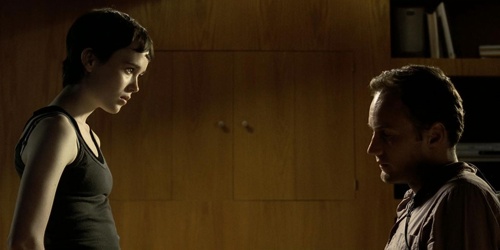
Hard Candy is one of the most uncomfortable films I’ve seen lately. Is it a good film? I don’t know. It’s an interesting film, and it’s definitely well acted. It’s a courageous film for the most part because it doesn’t go for an easy judgment of its characters, but neither does it go for an equally easy moral relativism. And then, in the last twenty minutes or so, it commits a couple of serious blunders that take away from its ability to disturb.
Like some of the most disappointing films, its first quarter of an hour is probably the strongest part of the film. The way it establishes the relationship between its two main characters – photographer Jeff and precocious 14-year old Hayley – and then turns this relationship upside down is very well done. Jeff isn’t an out-and-out creep, yet he is way too keen to play along with the teenage girl’s flirtation. He deserves it when she turns the tables on him… at first, but does he deserve the emotional and physical torture she puts him through? How far does his guilt go, and what puts her in a place where she can take it upon herself to be judge, jury and quite possibly executioner?
Jeff is too much interested in teenage girls, and he lets his interest go too far. He is guilty – but so far his desires are only different in degree from those who check out porn that advertises itself with “Hot Teen Sluts” or “Barely Legal”. You don’t have to go to the pornographic industry to see how teenage female sexuality is used to sell, well, just about anything, and how the line that delineates legal desires from illegal ones is blurred. Does this lessen Jeff’s guilt? No, but it puts it in context, and it makes it less easy to draw a line between him and they guy you work with who has the hots for the Olsen Twins or early Britney Spears or any number of nymph used by the marketing industry. If Jeff deserves castration, what do guys deserve who count down the days until some teen starlet becomes legal, or who fantasise about the high school cheerleader dressed up to be a sexual fantasy?
All of this only works so far, though. Throughout Hard Candy the question of a teenage girl who’s disappeared comes up, and Hayley insinuates that Jeff was somehow involved in this disappearance. A (chaste) photo of the vanished girl serves as incriminating evidence. Unfortunately the film comes out at the end and says that Jeff was either there when the girl was killed (by another pedophile) or that he killed her himself. Does it matter which of the two is true? Not really. He is culpable in either case, and his culpability is different in kind from the many, many men who have a hard-on for teenage girls. At this point we can easily draw the line, and Jeff is on the other side of the line. He’s a murderer or an accessory to murder. And at that point it becomes much easier to watch Hayley drive him to commit suicide. Most of the ambiguity of the film falls away, and with it the discomfort. And the movie’s previous courage to let its ambiguity stand gives way to a much more conventional moral simplicity, leaving us with just the window dressing of ambiguity.
Just when my frustration at Firefly‘s premature cancellation was starting to abate:
Yesterday evening we watched the last episode of Veronica Mars. The series definitely went out on a very strong episode – but why did it have to go out to begin with? Okay, the answer is simple: not enough people were watching it. Don’t ask me what they were watching instead; probably some reality TV crap with barely one percent of the wit of Veronica Mars, not to mention the wonderful acting by the lead and the great supporting characters. I’ve said it before (somewhere) and I’ll say it again: the relationship between Veronica and Keith Mars is the best father-daughter relationship I’ve ever seen on TV.
Yes, there were weaker episodes, one of the banes of series that require 20+ episodes per season. Yes, season 2 was a muddled mess in terms of its overarching plot. And yes, Duncan Kane was largely a boring waste of space. But the main character was one of the funniest, strongest female characters this side of Joss Whedon’s work. And I don’t see anyone much having replaced her.
Talking of strong women: one of the games I’ve been playing lately, Mirror’s Edge, is one of the few A-list titles whose protagonist Faith is a woman – and, more unusually, the game is played from first-person perspective, so the mostly male players aren’t even invited to ogle Faith’s assets. (No Lara Croft, her.) The game takes the trendy sport Parkour as its main inspiration, but it’s much more than a gimmick – in fact, it’s perhaps the most exhilarating first-person game I’ve played. Mirror’s Edge is flawed, mainly in its humdrum plot and storytelling, but when it works, it works amazingly well. I’ll let the visuals speak for the game:

 A Damn Fine Cup of Culture