Swan on Swan

So, tonight’s the night. Stars all gussied up, waiting to hear those coveted words: “And the winner is…” A show that is best enjoyed with vast amounts of alcohol and decadent nibbles. (A couple of years ago, my girlfriend and I pulled out the sofa in front of the TV and made it into a bed, slept until early in the morning and then had toast and salmon while watching the Oscars. Good times. Much better than the one where we tried to do a Vacherin fondue and the cheese both smelled and tasted putrescent.)

I haven’t seen all of the nominees, far from it. Colin Firth hasn’t stuttered his way into my heart yet (aww…), an ageing Dude hasn’t yet shown us what True Grit is, and I have no idea whether The Kids Are All Right or not. In the last two weeks I’ve watched two of the multiple nominees, though: 127 Hours and Black Swan. I enjoyed both films, but I wouldn’t necessarily call both of them ‘good’ films. They both are showcases for their directors, full of stylistic flourishes – but I found 127 Hours exhilarating, thrilling and moving, and I was able to take the film seriously throughout. Black Swan, for all its technical accomplishment, struck me as silly to the point of becoming laughable.

It’s an eminently well made, well acted, well shot, well edited film – but it’s a B movie dressed up to be Oscar bait. It’s a Brian De Palma thriller pretending to be a relevant statement about the artist’s responsibility to destroy herself in order to produce true art. And it’s cheesy as hell – but like a good cheeseburger, it is a yummy treat and should be acknowledged as such.

My main problem is this: if you’re going to make a film about someone going mad, with scenes that signal at every edit, “Is this real or is this only happening in her poor, psychotic imagination?”, you need to have a certain base reality. Natalie Portman’s Nina, though, is a few feathers short of a cygnet from the beginning, and even the scenes that are supposedly real are turned up to 11, producing a hyper-reality that is only halfway removed from the all out insanity that eventually grips Nina’s mind. And the turny-twisty revelation at the end might be believable (I’m not talking about realism but about what is credible in the world established by the film) in opera, but decidedly less so in this movie.

What doesn’t do the film any favours is the spectre of better films that haunts it: All About Eve and obviously Powell’s The Red Shoes. And no hot (though imaginary – oops, did I give it away? The film already does a good job of doing so…) bedroom scene straight out of Lesbian Spank Inferno III: The Birds can banish these ghosts completely. There’s even a hint of Buffy‘s Faith, although that is one ghost that makes Black Swan look good by comparison – Mila Kunis is both hotter and a more convincing actress than poor Eliza Dushku.

So what about that much praised performance by Natalie Portman? She definitely does a very good job, but she’s not always helped by the script, which keeps the character samey for the first half, varying between forte and fortissimo, and then escalates it for too short a time. Portman finally makes for a magnificent black swan, but it’s difficult to say how much the performance is bolstered by make-up, costume and CGI effects.

So, who will win? Hmm… From the films I’ve seen, I can’t really say much about the nominated actors, having seen too few of them in these specific performances. I also don’t think all that much of a “Best Picture” category, since the best films in different genres can hardly be compared. (Is Chinatown a better film than Raiders of the Lost Ark? Does it matter?)

I am rooting for L’Illusioniste, though, because its doomed, beautiful magic has given me one of the most enchanting cinematic experiences, not only this year, but ever. Pixar’s got enough of those little golden men on their mantlepiece, after all.

Exit Ghost (Writer)

Roman Polanski’s The Ghost Writer (or The Ghost, if you’re in the UK) is one handsome looking piece of celluloid. It is clearly made by a director who knows his craft.

It is also a film rendered trite, silly and questionable by a woefully inadequate plot.

I remember the reviews at the time of the film’s release being fairly positive. No one called this a Chinatown or The Pianist, but critics described it as a smart political thriller. The problem with such a description is that The Ghost (I’m going to stay with the UK title, since that’s what it says on my DVD case) isn’t particularly smart and ends on a downright imbecile note, and it isn’t much of a political thriller. It gives the appearance of one, at least for its first half; dealing with a ghost writer called in to complete the memoirs of the British ex-Prime Minister after the former author and aide of the PM ends up with a lungful of salt water, it exudes Tony-Blair-Iraq-War-“Special Relationship” vibes all over. The cast is as handsome as the cinematography, with Pierce Brosnan a flattering doppelgänger of Phony Tony and Olivia Williams offering a take on Cherie Blair.

Thing is, though, and this is where people averse to spoilers should get the hell outta Dodge, Robert Harris pulls the same trick he did in Enigma: when it comes to resolving his thriller, the political takes the backseat to the private, in an ultimately cheap twist. Throughout the film, Ewan McGregor’s writer finds more and more evidence that former Prime Minister Adam Lang was pretty much acting on behalf of the CIA when he got his country into a problematic war in the Middle East. (Sound familiar?) However, the twist – delivered in an immensely hackneyed fashion, in a sentence formed by putting the first words of the memoir’s chapters together – reveals that it wasn’t Lang acting on behalf of the CIA, it was his wife.

Wow. That changes everything, doesn’t it? Scenario A: a British Prime Minister acts on behalf of the USA’s interests and gets his country involved in a dubious war because he’s employed by the CIA. Scenario B, post-twist: a British Prime Minister acts on behalf of the USA’s interests and gets his country involved in a dubious war because he’s manipulated by his wife who is employed by the CIA. All the difference in the world.

What doesn’t help the twist is that it’s delivered in a cod-Hitchcockian scene: very well shot, but utterly nonsensical, and ending with the author killed and the mystery a secret yet again. Except the ghost writer’s actions suggest that he’d already died of a massive stroke, because his last action (before getting run over off screen by Them) suggests that the character was already braindead. I have a fairly high tolerance for characters doing things that are less than bright, because I can believe that someone scared out of their wits may not be at their best intellect-wise, but Ewan McGregor’s character’s final action is that of a retarded cucumber. And what we’re left with is a film that I wouldn’t mind framing and hanging on my wall – as long as we can consign its plot to a government vault whence it will never re-emerge again.

Vale of Tears, HBO style

My tastes probably tend towards the dark and tragic somewhat. For a while David Fincher’s Seven was my feelgood film (and I’m only exaggerating slightly). I’m not particularly into comedies, mainly because I don’t tend to find them funny – but I think that Shakespeare’s Richard III and John Webster’s The Duchess of Malfi are both rich in humour, though of the blackest sort. I tend to label things as “bittersweet” that my Significant Other would call “depressing as hell”.

Imagine my surprise when we finished watching season 2 of Oz… and my reaction was pretty much this: Whoa. This series may be too negative, too pessimistic, too “everything is going to shit” for me. By comparison, the last two seasons of Six Feet Under were light tragicomedy, The Sopranos is Analyse This! and Deadwood is Paint My Wagon. In the season 2 finale, Oz gives us a pedophile ex-priest getting crucified by Arians, a Latino guard’s eyes getting stabbed (with disturbing visuals of the damage) and one inmate’s arms and legs being broken. (I can still hear the snapping sounds…) When an old Nigerian gets stabbed to death, it almost feels like a relief: Thank god, they could have put his arm down the garbage disposal and then fed him his own kidneys!

Oz is open to allegations of being gratuitous in its use of violence, at least in this episode – but then, I can think of scenes of Deadwood, Rome and indeed Six Feet Under (elevator bisection!) that are as visceral and gory. So what is it, if not the gruesome depiction of violence? Is it that the characters are by and large doing evil things? Hey, Al Swearengen could pull off as many as six evil things before breakfast, without breaking into a sweat. The Soprano mob was no bit more angelic than the inmates of Oswald Penitentiary. So, again: what is it that makes Oz less bearable?

I think it’s this: Oz is about a world where hope is mostly dead, and what hope is left is killed over and over again. All these other series, for the pain, suffering and evil acts they depict, they haven’t killed off hope. Goodness can exist and survive and sometimes even thrive. In Oz, the only way that goodness can avoid being trampled is by hiding away, making itself smaller. There are sparse moments of light, but they are so exceptional and all the characters seem to know it that you almost dismiss them as a mere distraction from the doom and gloom. And yes, there is humour, but most of the time it’s grim as hell. Even the world of The Wire is more hopeful. Consider that: The Wire is more hopeful than Oz.

Arguably, that’s the world the series depicts: its version of the American penal system is Hell, an institutional hell where goodness is weakness, and the weak get their arms and legs broken. But if a series is that relentlessly negative and nine out of ten times something good happening is just occasion for the characters to fall from a greater height, it becomes wearying. And it’s the first HBO series where I’m not exactly eager to get started on the next season as soon as possible.

Perhaps I need to recover with something lighter.

Time keeps on rippin’

There’s one big problem with Red Riding – and for once I’m not talking about the absence of English subtitles. No, the problem is much more basic, and it’s this: the trilogy starts on the strongest film (1974), continues with what is basically a structural retreat (1980) and ends on a disappointment (1983). Since I haven’t read the novels the series is based on, I cannot tell whether this is a problem with the original material or to what extent the individual directors are to blame – in technical terms, the filmmaking and acting are strong throughout, but they’re put to increasingly lesser use.

I’ve read internauts describe Red Riding as Zodiac meets The Wire. The first part of that description, while limited, is relatively apt: the atmosphere of fear, the trip back to the ’70s and early ’80s, the way the protagonists – journalists, policemen – go mad trying to bring about justice. I can see where the comparison to The Wire comes from, just about; both series deal heavily with corruption. But that’s where the comparison ends, or rather, falls flat on its face. Corruption in The Wire is a cause and symptom of systemic rot, but it’s the system that’s fucked up. In Red Riding, corruption is basically due to Evil, Greed and Villainy(tm). And unlike in HBO’s Baltimore, the Channel 4 Yorkshire’s brand of corruption could conceivably be killed, literally, by putting a bullet in the heads of its proponents, who are vile, horrible figures that are barely human at all. Yes, there may be evil of this metaphysical sort, but in that case it’s doubtful that a shotgun blast to the cranium will make a difference in the long run.

1974 has the best understanding of its noir roots, telling the moody, dark tragedy of a deeply flawed man who, in the end, signs his own death warrant not because of right or wrong, or even because of petty ambition, but because of love – a love he barely understands himself, since he’s so used to getting laid just because of his youthful good looks. 1980, for all its strengths – especially its cast -, makes the mistake of telling almost exactly the same story. Flawed protagonist digs too deep into a conspiracy, ignores warnings and threats, finds out too much and gets killed. There are elements that are different, from protagonist Peter Hunter’s dogged belief in justice (where journalist Eddie Dunford in the first film was a romantic, Hunter is an idealist) to the theme of betrayal, but basically we get a very similar story, told with somewhat less conviction.

The problem with 1983 is that it doesn’t know which story to tell, so it half-heartedly starts three stories but is mostly busy tieing up loose threads. Thing is, when your story is about corruption, there is no such thing as loose threads. The system cannot be healed, not fully, the kindly but creepily ingratiating older man (whether it’s Chinatown‘s Noah Cross or Red Riding‘s Reverend Laws) is only symbolic for the deeply rooted rot, so blowing off his head doesn’t suddenly make everything all right – nor does the cheesy, slow-motion scene of one of our protagonists emerging with the cute-as-a-button blonde abductee girl from the Wolf’s underground lair. We’ve been watching a series of films that at least claimed to be about corruption, and the corrupt men in power are still where they were before… so yes, rescuing the girl is obviously not to be scoffed at (nor, if we admit to our reactionary urges, repeatedly shooting Reverend Laws with a shotgun), but what about the police force? What about the men toasting their crimes while they’re supposed to work for justice? You can provide an ending that is ambivalent – but 1983 isn’t ambivalent so much as amnesiac, forgetting completely what the red thread was going through these three films.

If anyone’s reading this and wondering whether they should check out the series, I would say: absolutely… as long as you stop after the first film, or lower your expectations and forget about thematic consistency. For all its Yorkshire accents and grey weather, 1983 is too Hollywood at heart to live up to the promise of the first film. And there’s no need to see 1980, since you’ve already seen that story, just better. If anything, watch the second and third film for the filmmaking craft that went into both – but accept that you’ve already seen the best, and from here on it’s all downwards.

P.S.: Admittedly, some of my liking of 1974 is due to the plaintive, moving music by Adrian Johnston (of Jude fame):

Johnston could be accused of having one theme only for the film, slightly varied again and again… but hey, it works for me!

Le retour du sous titre

You know what’s almost as bad as not having any subtitles in a series of films filled by mumbling Yorkshiremen? (Note that in the meantime a friend’s lent me the German edition of Red Riding, which features subtitles along with the English audio track. Blessings upon their Teutonic heads!) Buying a DVD that advertises, right on the back, subtitles in every language under the sun, or at least in English, German, French, Russian and a fair number of other languages – but then the actual DVD bears little resemblance with what’s promised on the box.

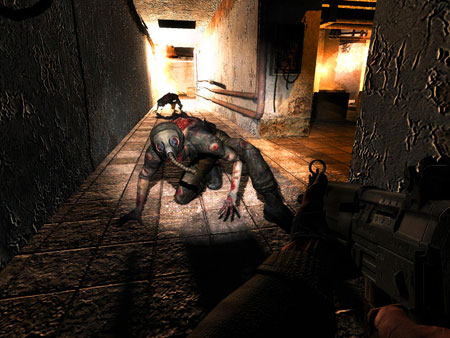
Other than featuring Andrei Tarkovsky’s enigmatic Stalker, that is. I’ve been interested in the film for, oh, about 15 years now, ever since a friend mentioned to me that it’s one of his favourite movies. My interest was piqued even more when I played the Stalker games, although they’re based less on the movie than on the novel Roadside Picnic (and ironically, while the games are relatively thoughtful, they still look like an ’80s action movie next to Tarkovsky’s film). I ordered the DVD on Amazon.fr ages ago – precisely because the edition promised subtitles in lots of different languages – but only got around to seeing the film now.

First impression: man, my French sucks. I was never very good at it, but after letting what ability I had rust for 15 years I understood perhaps 40% of what was being said. (Or rather, 40% of the subtitles; I understood even less of the Russian dialogue, although I did understand “бутерброд”!)

Second impression: even if I understand fairly little and the film is extremely slow – there’s something eminently compelling to Tarkovsky’s style. Even more than Solaris (which suffered somewhat from being set in an outdated future, the fate of so much sci-fi) Stalker is hypnotic… and gorgeous to look at. It is atmospheric without going for any of the predictable tools of atmospheric film makers. The world of Stalker is ominous and eerie, yet at the same time naturalistic, creating an effect I haven’t seen in any other film. There’s something almost documentary in its visuals, yet there’s a dream-like quality – and it’s this seeming contradiction, this tension, that is utterly fascinating.

More than that, perhaps it helps to see the film in a language I don’t fully understand. Films that are put in the ‘art film’ box tend to have a certain portentous, somewhat affectated quality to them; as much as I like Bergman, for instance, a number of his films have a certain self-aware heaviness that can be more alienating than is necessary. Perhaps Tarkovsky’s work has this same quality if the viewer understands the dialogues enough to realise that they’re unintelligible – but my impression was that while the world and themes of the film are portentous, the characters feel real. Not 100% and not all the time, but they’re more than just vehicles for themes.

In the end, though, I can really only judge Stalker as a visual experience until I’ve rewatched it (after a French refresher, perhaps), and on those terms alone it’s well worth seeing. Even if there’s a relative scarcity of Ukranian mercenaries, radioactive mutants and frantic gunfights.

But if I get my hands on the people responsible for that mendacious DVD edition, je m’occupe de vos miches à la médiévale!