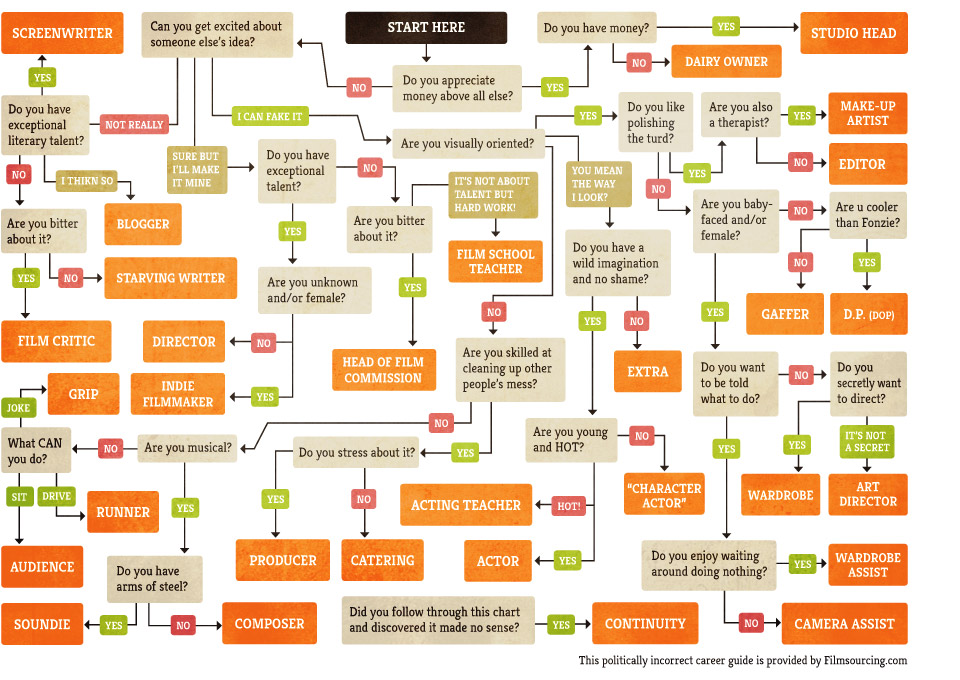
A third January Variety Pack should be coming soon (here’s hoping I’ll still make January), but for now, here’s a nice flowchart for anyone who’s dreaming of a career in the movies.
A bit later than promised, but here’s the second January Variety Pack, containing all the snap, crackle and pop you could hope for, as well as Teutonic metaphysics and an ageless gnome who’s finally getting old.
Cave of Forgotten Dreams
Werner Herzog is one of those film makers I’ve been aware of for a long time but whose work I’d never seen. His name triggers childhood memories of zapping into Klaus Kinski films and being weirded out by the guy, and I definitely remember hearing about the epic, ongoing on-set battles between Kinski and Herzog – but I’d never seen more than a couple of seconds of the actual films. I’d heard good things about his earlier documentary, Grizzly Man – but again, if it was ever on I missed it. Cave of Forgotten Dreams hadn’t even been shown at cinemas here when I succumbed to the post-Christmas lure of Amazon.com and went ahead and ordered the film on Blu-ray. Hey, if people praise its amazing visuals, I want all the pixels I can get, right? (No 3D, though – it’s available on the disk, but my TV don’t do three-dimensionality.)
Herzog’s a weird one, at least on the basis of this film. Much of his slow, accented voice-over is heavy on the metaphysics, and while I wouldn’t necessarily say I like it, I cannot deny that I find it compelling – right down to the surreal epilogue featuring albino alligators. It becomes even weirder when Herzog cracks a joke, in the same slow, deliberate, strangely sad voice. (Imagine a voice with a heavy German accent that’s pretty much the aural equivalent of Tommy Lee Jones’ facial expression throughout The Three Burials of Melquiades Estrada.
As much as Herzog puts his stamp on the film, its real star is the cave itself and its amazing paintings dating back tens of thousands of years. Not all of the individual paintings are equally fascinating, but some show striking subtlety and artistry – and they look as if someone left them there just yesterday. Herzog’s film is highly successful at evoking both the age of the cave artworks and their immediacy – freaky amphibian reptiles with blood-red eyes are just an extra. The film is enjoyable even without smoking pot or drinking a bottle of cheap-but-nice red wine beforehand.
Mission Impossible – Ghost Protocol
… or MI:4, to its friends. In spite of my pretentious-yet-middle-of-the-road film geek credentials (with a few dozen Criterion editions on my shelves I cannot really deny it) I like a good action movie. I’ve enjoyed the Bourne series, Die Hard is one of my favourite Christmas flicks (right there with It’s A Wonderful Life and Nightmare Before Christmas) and I have fond memories of the Californian governor relieving Bill Paxton of his boots, clothes and motorbike.
In those terms, is Em-Aye Four a success? There are moments in the film that I’d consider among the most exciting action scenes of the last ten years. (It helps that we’ve arrived at a point where you can’t always tell a green-screen shot from stunt work.) I sat on the edge of the chair, I jumped, my pulse went up, my breath caught, just as the movie intended.
Apart from that, though, the film fails in one fundamental way: I didn’t care about any of the characters. Is the problem that Brad Bird’s first non-animated movie doesn’t know what to do with its human cast (nor, cheap joke alert!, with Tom Cruise)? Perhaps. It pays lip service to characterisation, but the motivations it provides for its protagonists are uninterestingly written and the actors don’t make them come to life. In fact, you care more about the characters when they’re not angsting about the partners they’ve lost to the job – they’re more relatable when they shut the hell up than when they open their mouths and pretend they’re real people.
For what it’s worth, MI:4 is better than John Woo’s MI:2 – but then, watching a burning dove fly past pooing itself in slow-motion fear is (marginally) better than that film. Is it on par with MI:3? I honestly couldn’t say, because for the most part J.J. Abrahams’ stab at the Missionary position self-destructed about five seconds after I exited the cinema… which is quite the achievement, admittedly, for a film featuring Phillip Seymour Hoffman.
Speaking of achievements, though, CGI has finally managed to conceal the fact that Thomas Cruise, Esq. does not age. The wrinkles that have begun to show on the Cruisester’s face look positively life-like. Will the Academy Award go to Make-Up or to Visual Effects? And is there any truth to the rumour that Cruise’s performance was motion-captured off Andy Serkis?
P.S.: For the record, I quite like Tom Cruise as an actor, when he’s got good material and is directed well – or when he shows that he’s got a sense of humour. (A bit of respecting this! and taming that! also seems to work quite well for him…)
And the second instalment of the January Variety Pack is to follow later this week, featuring semi-crazed German filmmakers, Paleolithic graffiti artists and impossible missions, should you choose to accept them. See you soon!
I know, it’s been a while. My apologies; my excuse is that I was lazy. Not a very good one, is it? In any case, I thought that rather than write one long update on a film I’d recently watched, I’d do some shorter ones. So without much further ado, here’s the first of my variety packs – the second is to follow very soon…
Four Lions
I have to say, when I heard about the film I was both intrigued and worried. It’s not that I think there are topics that can’t be treated by satire – but I also find the equal-opportunity-offender satire of, say, Trey Parker and Matt Stone neither particularly funny nor all that perceptive; in aiming at all targets, it rarely achieves more to my mind than a general, “Well, all positions can be a bit silly, can’t they?” Also, being offensive for its own sake is such a lazy way of satirising a subject. Which, let me hasten to say, Four Lions doesn’t do. In fact, for satire it is far from offensive in one important sense: as it opens its subjects to ridicule, it also evokes sympathy for them. It humanises its protagonists, the Muslim suicide bombers, as it shows them to be deeply flawed and silly in their motivations and reasoning. And it’s exactly this element that makes the film so funny and chilling in its strongest moments – rather than saying, “Those guys are our enemies and need to be destroyed” it asks us to see them as fellow human beings, albeit misguided ones… which may be much more subversive: love thy enemy.
But, apart from that, Four Lions is one of the funniest films I’ve seen in a while, asking the very important question: “Is a wookiee a bear, Control?”
P.S.: In terms of its darky humorous yet sympathetic tone, Four Lions reminded me of the Danish black comedy Adam’s Apples. Also highly recommended!
Never Let Me Go
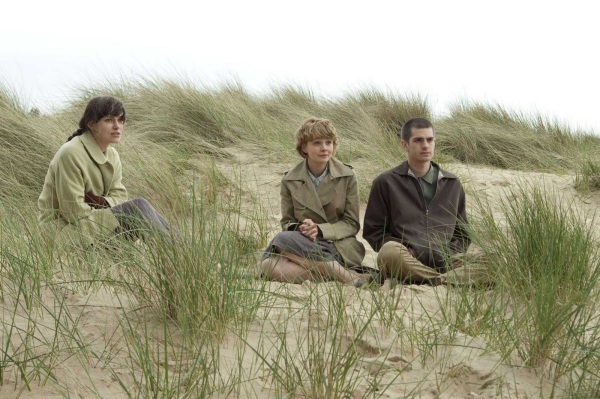
Since I liked Kazuo Ishiguro’s novel a lot, I was curious about the film version by Mark Romanek of One Hour Photo semi-fame. I was also worried; would the novel’s delicate, moody tone survive the transition to the big screen, and more importantly, would it survive La Knightley? I’m not her biggest fan – I do think she’s talented, but more often than not film makers make the assumption on the part of the audience that we fancy her like mad, and they then become lazy when it comes to letting her act. Instead she ends up doing her portruding-chin shtik that signifies, “My character is feisty, passionate and won’t take crap from anyone!” All too often she doesn’t portray characters on screen so much as do a slight variation of what she’s done in other successful films. Since I don’t find her particularly sexy (I was definitely Team Parminder in Bend It Like Beckham) Keira being Keira just isn’t enough.
I wasn’t particularly fair in this fear, at least when it comes to Never Let Me Go. The adaptation isn’t perfect: it would need some more time for the implications of what’s going on to sink in and be as quietly devastating as in Ishiguro’s novel, and the writing (the script is by Alex Garland, whose work I tend to find compelling and frustrating in equal measure) is a little too on-the-nose at times, assuming that the audience is too thick to get it. But the casting, including Keira Knightley, works perfectly. Yes, both Andrew Garfield and Carey Mulligan aren’t miles from the parts they usually play, and it’s not as if Knightley is miles away from other parts she’s done, but the actors fit their parts to a T, with Garfield especially delivering a performance as poignant as that he gave in Boy A. I could imagine that my first criticism is less of an issue for those who haven’t read the novel – the film isn’t rushed by any means, it just doesn’t give its audience quite as much breathing space, which is what I missed a bit.
This one doesn’t need any comment – other than this: viewers should know John Carpenter’s The Thing. Otherwise you’ll just be flummoxed. Oh, and don’t let your Pingu-loving kids watch this!
Oh, Auntie. After a year of bigger and smaller disappointments and only one moderate success, you’ve shown me you can pull it off. And how… 2010’s Sherlock was a great treat: funny, exciting, smart. But it was also only three episodes, one of which was decidedly weaker than the others. Would a 1 1/2 year hiatus help? Judging from the New Year’s Day episode and season starter “A Scandal in Belgravia”, the answer to that is a definite, loud, positively orgasmic “Yes!” Honestly, has there been witty dialogue, chemistry between the characters and stylish execution like this in any UK production in the last couple of years?
No, “Scandal” wasn’t perfect; it did have a couple of very cheesy moments, two of which weakened the female guest star in ways that are perhaps a bit iffy (mind you, I wouldn’t agree with the extent to which Jane Clare Jones criticises the episode), and it was perhaps too self-consciously cute with its references, punning and otherwise, to Doyle’s original stories (I groaned at the “Speckled Blonde”, though I loved the hat bit). Regardless, the episode was pretty much perfect in terms of being wonderfully entertaining – and just when you thought the humour might become self-congratulatory, Sherlock throws a scene at you that works as drama, showing that for all his brilliance, the main character is deeply flawed. The series is a fan of Sherlock-as-genius, but it doesn’t make the mistake of becoming fanboyish – or -girlish, although I gather that Benedict Cumberbatch does make for rather yummy eye candy. Then again, the testosterone brigade can hardly complain after a guest starring spot by Lara Pulver that would have made Mary Whitehouse’s head explode.
Oh, and the dialogues! If you were wondering where the sparkling repartee of a The Thin Man had gone, look no further: the Beeb’s been stockpiling it, refining it and quite possibly enriching it with steroids. This exclusive trailer from The Guardian website may be a bit weird, but it has a fantastic exchange between Holmes and Watson:
So, BBC, bring it on. Give me what you’ve got. And I’ll be willing to forgive you for the wasted potential of Exile.
 A Damn Fine Cup of Culture