Yes, I like my Quentin Tarantinos and my Martin Scorseses. I enjoy TV series about New Jersey mobsters doing mobsterish things (like breaking kneecaps) or Ancient Romans doing Ancient Roman things (like slicing through kneecaps – remember the Thirteenth!). I don’t mind watching films and TV that walk the dark, cruel side.
But sometimes I think that gentleness is more difficult to pull off and pull off well, at least for an entire movie. Think about it: how many films do you know that you’d consider good and that you’d describe first and foremost as gentle? The problem is that “gentle” sounds milquetoast and boring, but it shouldn’t be mistaken for its blander distant cousins, “timid” and “nice”.
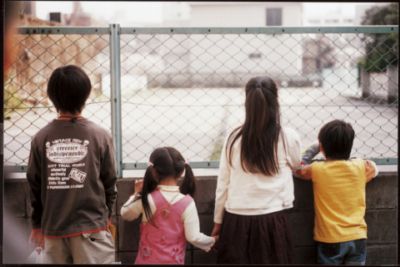
The Japanese director Hirokazu Koreeda is one of the best directors when it comes to gentle films. His work is by no means harmless in its themes, even if it’s decidedly low on kneecapping – his characters deal with painful issues, which is never more apparent than in Nobody Knows, in which a disturbed young mother leaves her four children to fend for themselves. While tragedy is increasingly likely to strike as the film proceeds, Koreeda is not interested in making a domestic disaster movie where we sit on the edge of our seats waiting for the worst to happen. His guiding feeling towards the people he depicts seems to be compassion, as he bears witness to the fact that living, let alone being good, is hard, people are often prone to weakness, fear and pettiness – but we all deserve compassion.
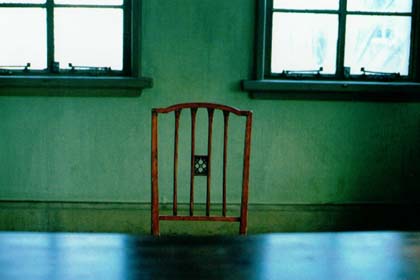
Still Walking, a film in which disaster has already struck, years ago, permanently damaging a family, is similarly suffused with empathy. It’s not happy-clappy, sappy “we’re all human beings so let’s group hug!” empathy – Koreeda’s film does not shy away from the characters’ selfishness and cruelty in any way, but he urges us to look closer, not to condone but to understand, which in the end may be much harder and more uncomfortable than sitting in judgment.
For all the enjoyment I get out of films and TV series that wouldn’t know ‘gentle’ if it held them and stroked their hair, there is something soothing, even healing about Koreeda’s films. While I love visiting the more brutal worlds of many of his fellow directors, it is his world that I would want to live in. (And even be dead in – his After Life, my first experience of Koreeda’s films, is a wonderful, witty and, yes, gentle take on death and memory.)
After last week’s instalment turned out quite a bit longer than expected (a bit like the wait for Max Payne 3, in fact), here is a shorter tidbit – which, apparently, should be spelled “titbit”, but that sounds too much like a snack or breakfast cereal for sex-obsessed psychopaths to me. I’ll be on holiday next week, so I’ve got a good excuse for the next post to be a couple of weeks away, but in the meantime…
I used to consider myself a Tim Burton fan. Around the time when the man made Edward Scissorhands and Batman Returns, his goth-romantic style clicked with me, so much so that I considered his second Batman instalment one of my favourite films. (I still have a great fondness for the movie, but I’m more aware of its flaws at this point.) Then came Mars Attacks!, a perfectly okay half-hour comedy stretched into a feature film, and Sleepy Hollow, which looked like the most gorgeous Tim Burton film ever but felt, well, hollow. Planet of the Apes didn’t have much going for it beyond the make-up and Big Fish angers me with its twee, needy sentimentalism that would give Steven Spielberg a toothache.
Fast-forward to Sweeney Todd. I am not all that much into musicals and had heard of Sondheim but didn’t know him at all. The trailer and stills for Sweeney Todd looked like Sleepy Hollow all over – more so, in fact, with the film’s production design being so Tim Burton, it felt like someone had taken his earlier films, boiled them into a thick, black ooze and used this to paint the sets. When I saw the film at the cinema, mostly for old time’s sake, I was surprised that despite the ultra-Burton look the direction felt… more adult, I’d have to call it. Less of the cartoon exaggeration that Burton had fallen to (and would return to in later films). Even Johnny Depp looked like he was acting rather than simply doing his Depp/Burton spiel.
I’ve just recently rewatched Sweeney Todd, after catching it on stage at the Edinburgh Fringe, and I still consider it to be one of the better of Burton’s recent films, perhaps even the best – yet it is held back by the director’s visual style. Sondheim’s play, for want of a better word, has a certain meatiness. There is a charnelhouse vitality to it, yet in spite of the gallons of gore Burton’s visuals are bloodless. They are designed within an inch of their life. More than that, they make Todd and his accomplice-paramour Mrs. Lovett one of a kind, a sort of Goth His’n’Hers, which hurts especially the pie maker’s characterisation. It’s a shame, really: while I think that Sweeney Todd is proof that Burton still has talent and doesn’t just imitate himself, he also keeps the film from being as good as it could be. And, frankly, while I used to love the typical Burton look, by now it feels less like a style and more like a brand. Predictable, safe, and not a little boring.
P.S.: You know who’d make a very effective Sweeney Todd? Mark Strong. Unfortunately the poor man is typecast and only plays sweet, loveable good guys.
P.P.S.: YouTube is acting up, so instead I went to Vimeo, not expecting to find anything much… except it looks like someone uploaded the entirety of Tim Burton’s film, with Spanish subtitles. Weird, huh? And probably more than just a little legally iffy… Still, while it’s up it’s up, eh?
While I am not an outright fan of explicit violence in modern media, I’m not particularly squeamish either. I have no interest whatsoever in the gore extravaganza of much modern horror, but neither am I put off by the viscera of some of Tarantino’s more recent offerings, and some of the TV series (e.g. Rome or Game of Thrones) I’ve enjoyed most over the last couple of years don’t skimp on the red gushing stuff.
And yet, Max Payne 3 almost made me switch off the game, not just once but twice, due to the brutality it depicts.
And this is in no way an indictment of the game.
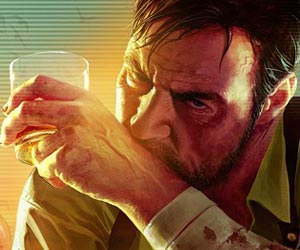
Max Payne 3 is a brutal game – and more than any shooter I’ve played it does a remarkably horrid job of showing what bullets do to bodies. Does the game revel in showing exit wounds? I think I’d be lying if I said it wasn’t – MP3 does not present its violence with the frat boy, fist-pump glee of other games, but it has a fascination for showing the damage done, both to people and to interior (and exterior) decorating, in slow motion. So much so that checking out some of the videos on YouTube makes me queasy – less with the game than with the Beavis and Butthead-ish tone of the video description and comments.
But it’s not so much seeing the carnage I’m authoring that made me wince, at least not after the first ten minutes or so. (There is definitely something numbing to seeing henchman after henchman dying horribly at the business end of my gun – and it’s this repetitiveness that’s a major flaw of the game in my opinion.) It’s two key scenes: in one, I finally find the beaten, bleeding trophy wife of a São Paolo business man earlier abducted by a favela gang, only to see one of the gangbangers put a bullet through her head. In another, the business man’s brother is covered with petrol and burnt alive. The game has previously shown the man as shallow, narcissistic and rather pathetic – but the way the game depicts his death got to me, and quite possibly more so than a similar scene would have in a film.
I don’t want to get into the question here of whether games are becoming too violent or whether people are desensitised to real-life violence and cruelty due to watching brutal films or playing violent games. That question is much bigger and deserves a longer discussion in a wider forum. What I’m interested in is this: why did these two scenes get to me to the extent where I wasn’t sure I wanted to continue playing (keeping in mind, as I’ve said, that I’m not all that squeamish)?
I think it’s this: games make a big thing of player agency – as gamers it’s our finger on the trigger, we decide who lives and who dies, it’s, like, interactive! – yet in practice our agency is always limited, it’s circumscribed in a hundred ways: by a game’s design, its user interface, our character’s abilities and, often frustratingly, by the story a game tells. You’re Superman while playing the game, you’re John McClane, you’re Neo – and then comes a pre-rendered sequence, and what’s pre-rendered as well is your impotence in the face of the great god, Plot. The villain jumps from the shadows and skewers your love interest with his great big sword. (I’ve never played Final Fantasy VII, but apparently this is one of the primal scenes of so many gamers into Japanese role-playing games… and I wonder whether the cod-Freudian subtext is as heavy when you’re actually playing.)
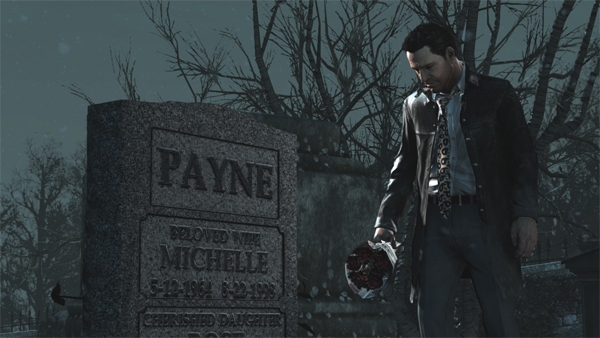
Many games use this in a frustrating way that feels like the program is cheating, in revenge for decades of players using hidden cheats and God modes to become invulnerable. Think you’re all-powerful, gamer? Take that! Ooh, that must’ve hurt! The two scenes in Max Payne 3 thatI mentioned earlier (and there are others, although none as pointed) may have an element of this, but I think the game is being cleverer than that: Max Payne, from the first game onward, told a story about revenge and redemption. I’m not sure to what extent it manages the latter all that well, although there’s a lot of quasi-Noirish verbiage in the game about it – but especially Max Payne 3 never lets you forget that the revenge you’re effecting is finally hollow. Yes, you might get to kill hundreds of bad guys in bloody, bone-crunching ways, but Max’ loss is the constant foil through which the player views this revenge. For every henchman killed, for every villain stopped, Max’ wife and child is not a single bullet closer to being alive. For a game that’s entirely about revenge and redemption, it’s bleakly ironic that revenge is shown to be pointless and redemption all but impossible. Max Payne’s extended trauerarbeit (and I don’t think this is wankerish pseudo-analysis imposed on the game – every second line of dialogue is about Max’ ongoing, futile quest to find some sort of meaning in a life that’s had all meaning shot to hell), like the hundreds of painkillers he keeps popping, only serves to dull his pain momentarily.
I’m not saying that Max Payne 3 is a deep, philosophical treatment of mourning, revenge and the futility of redemption – but it does address these issues within the rules it has set up for itself… and, like Rockstar’s earlier Red Dead Redemption (although my vote still goes to RDR for doing more interesting, complex things with the theme) it goes a long way to disabuse the player of this crazy idea that just because he’s got his finger on the trigger he can make everything all right.


 A Damn Fine Cup of Culture