The Leftovers, S1E4 – B.J. and the A.C.

Episode 3 raised the stakes for Fater Jamison losing his church to the GR, didn’t it? I was almost sure that whatever would come after that episode wouldn’t match the clerical odyssey, but even judged on its own, this episode was a qualified disappointment.

HS-speech-300x195

It’s December, and someone steals the little plastic baby Jesus from the nativity display. I felt slightly sorry for Kevin Garvey because it looked like it was his turn for an odyssey. He has to find the doll or buy a new one with cash from Mayor Warburton while making sure the GR don’t cause any ruckus during the local Christmas dance. His car goes dead on him (an electrical malfunction that could well be from Lost), and he has to use Dean the dog-shooter’s truck still parked in the Garvey driveway. Kevin, in desperate need of some success, wants to find the original doll. Whodunnit?

The usual suspects must include the Guilty Remnant. Garvey tries to come to an agreement with a mute Patti because the holidays are the time when people want to blow off steam and be with their families. Patti, smirking, cruelly stabs back by writing that “there are no families.” Wow. The GR come across as seemingly peaceful, but relentless in their presence. Here, Patti is downright cruel to Garvey, and such cruelty is new. If it is the new M-O. for the GR, watch out Mapleton, you have a problem.

bodies

Tommy and Christine are definitely not suspects, trying to find their way past the authorities and eventually back to Mapleton. We see them again in what looks like a hospital admissions room or cafeteria, where an all too naked guy throws a tantrum in front of Christine, yelling about why she appears in his dreams: “You walk over the dead. They are all in white.” I half feared that this referred to the GR being dead and walking among the living. Bad flashback to the ending of Lost – remember? This is what lazy writing will do. The twist was cheap then, and it would be cheap now. It’s only in the second hospital that we learn that – damn you, Wayne – Christine is pregnant. Does he feel that the world owes him a child? Without appearing in this episode, Wayne has become even more despicable. (And no, I won’t let him off by mentioning immaculate conception.)

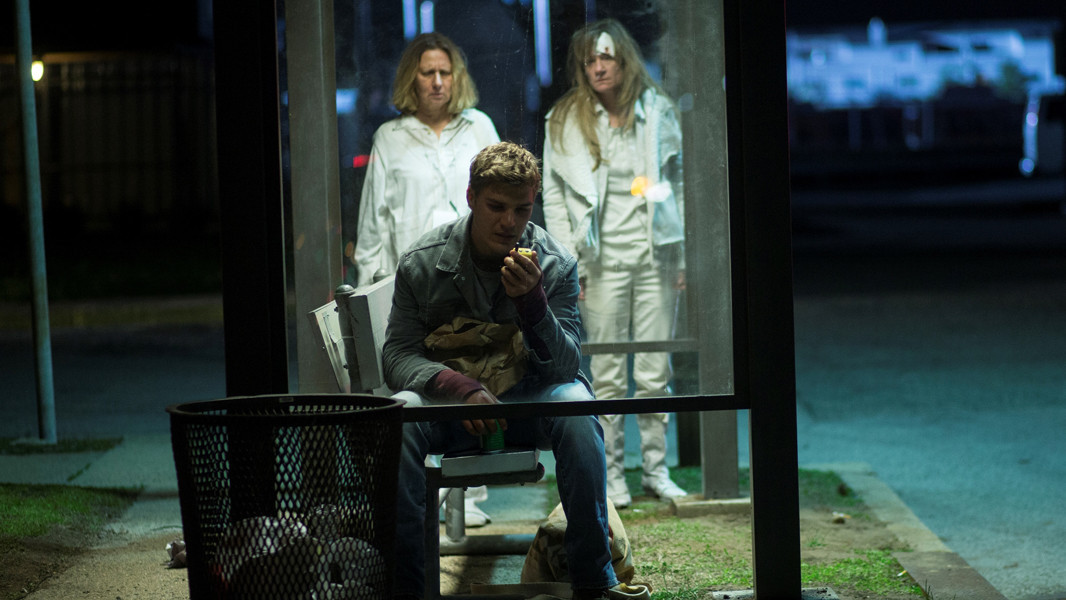
Tommy thinks about running away, leaving Christine on her own. While he waits for the bus home, there is a random visit from two GR members who hand him a leaflet that says: “Everything that matters about you is inside.” He opens the leaflet and stares at a white page. That scene is raw and well-played, but it ends in a technically unclean way: Tommy sees the bus pull up, but wishes that Wayne would call for instructions. The phone rings, and it’s a taped ad, asking if you have lost someone. It’s unclear if that is from the GR or maybe even the insurance company Nora Durst works for. Shame, because it’s such a tense moment. I felt for Tommy, which is a first, but I also wanted to know who was behind the ad.
zap-the-leftovers-season-1-photos-20140710-025

Tommy returns to Christine, shoeless and with a bull’s eye on his forehead. It’s weird enough that he seems to start his own cult, but it’s superweird that he makes an underage pregnant girl walk barefoot through the snow. The next scene with them should be a punch in the stomach, but it’s merely puzzling and slightly eerie: The bus that Tommy and Christine are on jolts to a halt because a blue shipping container is blocking the road, its doors burst open, and shrouded human bodies scattered all over the street. It’s here that Christine walks among the dead who are all in white. I should have felt jolted by that scene because it’s the first hint at where some of the disappeared might have disappeared to: They are dead, but at least their mortal coils are still around and can be examined, buried, and said goodbye to. Instead, that scene felt like put there for lack of anything else to do with the storyline. It was out of rhythm with anything else in this episode and lacked any serious build-up.

Jill Garvey is a suspect. Christmas prank from the troubled teenage fraction – why not? When her dad flat out asks her if she took the doll, we get the impression that she is innocent. We even pity her a little later. The scene starts when Garvey comes home and finds Laurie and Meg on his front porch. I guessed immediately why Laurie was there – Kevin must have thought this was some attempt at smoothing things over. Poor fool. Megan reads Laurie’s letter, and you immediately know she is asking for a divorce. Jill looks and listens until they see her. That scene is well-played, but it’s so darned hackneyed. A divorce? Is that supposed the emotional twist of the episode? Didn’t work for me. Its a weak plot-point, and although Amy Brenneman’s face is a marvel, she cannot save that scene. It gets worse: Jill gives Mom her Christmas present – a zippo lighter. It’s so utterly forseeable: divorce, pregnancy, a zippo lighter. Even the scene where Laurie retrieves the lighter from a storm drain is so unimaginative is deeply mediocre afternoon drama TV.

baby-belt-648x336

Turns out Jill stole the baby, and you probably guessed that as well. That she refuses to give it a mock sea burial does not make her the smartest teenagers, just the least silly. Jill, please smarten up. It’s okay to have Aimee as a goofy friend, but if you are dumb enough to make the twins deliver the baby to your doorstep when your dad is still home, you also need smarter friends.

Ah, almost forgot the dance. Garvey can finally present the found-again baby to the community, if only to luke-warm applause. Out in the hallway, he meets Nora Durst taking a break from dancing. It’s an intriguing scene between two strong characters who haven’t met before. Nora somehow feels compelled to tell Garvey that her husband cheated on her. Garvey retaliates by admitting that he cheated on his wife. In-between the need for confession and the subconscious flirtation, there is something happening here, but these two are not yet sure what to do with their mutual frankness.

vlcsnap-2014-07-21-15h19m30s49

Outside the town hall, the GR line up on the edge of the town hall grounds so as not to trespass. Garvey has some of them arrested anyway, but when he sees Patti’s smirk again, he realises that Laurie and a lot of the other GR are not even here, so the real stuff is happening elsewhere: They break into people’s homes and take all the photographs they can find, leaving behind empty frames and fridge magnets. Breaking and entering is bad enough, but they steal people’s memories, their keepsakes, their mementos. The memory of the disappeared among them will fade. That, to my mind, is unforgivable. Talk about Patti being cruel.

This episode could have ended well at least for Garvey, but he finds Father Jamison at the nativity with a spare baby Jesus, so on the way home, Garvey throws the doll out of the car window. That’s symptomatic for a lot of what happened in this episode: no-one is really at a new point of the storyline, and even the scenes themselves weren’t interesting. With the exception of the Garvey-Durst flirt, evey supposed highlight lacked impact. Shoddy writing, bad editing, no pace, no rhythm, no build-up, no payoff. Next episode can only get better.

Round and round, underground

I don’t go out of my way to watch films about the Second World War, and this is even more the case with respect to Holocaust-related movies. That’s little to do with the subject matter and a lot with the way such films often turn out to be samey in terms of form and content. Especially when it comes to the Holocaust, there’s a certain iconography, at least in Western films, that is rarely escaped or at least varied. The topic is an important one, undoubtedly, but important topics don’t automatically make for good films.

When Agnieszka Holland’s In Darkness was shown on TV recently, I was nevertheless interested. On the surface it sounded like a story we’d seen before, of how a simple, flawed man finds his own humanity to save a group of Jews at risk of being killed by the Nazis and their helpers. Holland, though, is an interesting director. I’d greatly enjoyed the episodes of The Wire and Treme she’d directed, and I’d heard very good things about Burning Bush, the miniseries she’d done about Jan Palach, the student who immolated himself in 1969 Prague to protest the Soviet occupation. While she’s worked in America, In Darkness is a Polish film, and the film is told from a perspective we don’t often see, without excusing or minimising Polish anti-semitism.

In Darkness

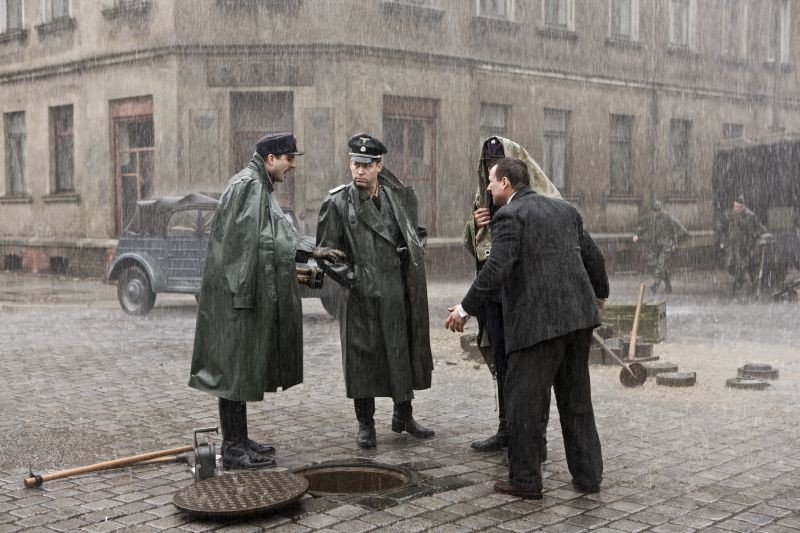
The story of a sewer worker protecting a dozen Polish Jews fleeing the massacre of their families and friends in Lvov and looking after them in the sewer system, first for money but later because he comes to see it as the right thing to do, is interesting in itself, but apart from the details it’s not altogether new. What makes the film effective even when it follows fairly well-trodden ground is what Holland gets out of her actors and how she portrays all of them as essentially human – though not in a sentimental way. The characters she shows us are flawed, petty, jealous, shallow, selfish, craven, and this is as true for the Jewish refugees in the sewers as for Leopold Socha, the Polish sewer worker. There’s often a tendency, not only in films, to idealise the persecuted and the victims, and while the impulse is understandable, such idealisation can be dehumanising. Holland never loses sight of the humanity of all her characters, the good and the bad, and the film benefits greatly from it.

In Darkness is not perfect, and its story, while closely based on the real events, doesn’t always ring true; a near-disaster late in the film may have happened the way it is shown, yet it doesn’t feel altogether believable as part of the film. Yet more than any film about WW2 and the murder of European Jews I remember watching since, well, The Pianist, I found it affecting. Holland’s film doesn’t come across like it wants to communicate a message, but in refraining from doing so, at least up until the very end, it succeeds all the more.

In Darkness

P.S.: There is a message in the title cards that close the film: after the war, Socha died saving his daughter from a runaway army truck. At his funeral, the screen text relates, someone said that perhaps this was God punishing Socha for protecting the Jews during the war. Holland ends on an angry, sad and bluntly timely note: “As if we need  God to punish each other.”

The Leftovers, S1E3 – Two Boats and a Helicopter

First of all, I thank my fellow blogger and altogether excellent friend who explained this episode’s title to me. This title and the one from last episode remind me of Lost with its polar bears and planes and boats and other means of transportation, and I am sure a helicopter is in there somewhere. It’s my own personal joke that some of the disappeared have boarded an Oceanic flight and have crash-landed on a strange island. Which is not a complete coincidence, because Lost as well as this series are master-minded by Damon Lindelof. Lost was co-created by him, whereas Leftovers has its origins in Tom Perrotta’s book of the same name.

the-leftovers-matt-jamison

Perrotta is also the novelist behind Little Children and Election, so he might know how to combine the personal with the political, two aspects of existence that keep on crashing into each other in The Leftovers. (This is a good place to tell you that I haven’t read Perrotta’s novel and will only talk about the TV series episode for episode. I don’t know more than you. There are spoilers, but fewer than in other blogs.)

Fans of Christopher Eccleston have reason to rejoice, because this episode is mainly about his character Matt Jamison. We’ve already seen him handing out leaflets at Heroes Day, and he and Nora Durst seem to be friends.

My impression that he is a man of the cloth are confirmed in this episode. He is a dedicated Episcopalian priest, his wife Mary got severely hurt in the car crash from the pilot episode and is now in a waking coma. The pews in his church are far from full. His take on the disappearance is that it was not a rapture: some of the disappeared were bad people, and he feels he must distinguish the sinners from the good people by printing leaflets about the crimes of the former, and people need to know. Some of them feel compelled to punch him, and some will. Observe the pit boss at the casino – he has Matt’s whole appearance figured out in two seconds.

leftoversjamisonflyer

Matt is broke personally, and his church is threatened with foreclosure. To him, that might be the same thing. Nora Durst is willing to help him on condition that he stop printing his leaflets. He replies by telling her that her husband Doug had an affair. Some people are better off not knowing everything about their loved ones, but there you go. Nora seems… relieved.

Matt lies down to sleep beside his unresponsive wife when he has an idea from above how to get money to save his church. He drives to Kevin Garvey’s house, where Garvey Sr. has buried a jar some time ago with a wad of money for Matt (which hints at another, older story). It’s interesting that he sees Laurie sitting on a swing in the backyard of the place she once called home; apparently she’s there for old times’ sake, but asks Matt to not tell anyone. That might work because Matt is not supposed to be there either. He takes the cash to the casino, where he keeps winning. I could go on about the plot, but that’s a thing that I will leave to the viewer to discover. Let me just say that it is a terrible thing to see a man’s dedication turn into hate.

leftoversintro

If I remember correctly, Lost often dedicated one whole episode to one of the main characters. This third episode works the same. I have to say I quite like it, if only because I don’t have to remember at which point we’ve left this or that character. There are a few characters who can carry the series on their own, and I hope we get to see a whole episode about Nora Durst or about Laurie Garvey. My guess is that there will be a point at which we get to know more about what happened on that fateful October 14 – a metaphorical hatch buried in the ground, if you like. But not yet. Let the characters evolve. For now, following Father Jamison on his odyssey has been the series’ highlight. I’d like more of that, please.

Mad about the boy

Most of what I’ve read about Richard Linklater’s Boyhood has been complimentary to the point of gushing. Recently, though, I read a forum post that compared the film to a dancing bear – it’s not such much what it does than the sheer fact that it does what it does that makes it remarkable. The post concluded that people should go and see Boyhood, but it still came across as somewhere between condescending and dismissive. Go and see the dancing bear, because you won’t see another one any time soon!

Growing up in front of our eyes

Yet, while I don’t want to be dismissive of a film that obviously resonates with many people, part of me sees what the poster was saying. Boyhood is a good film by a talented filmmaker – though one that is rather hit-and-miss for me – but take away its most defining feature, and what remains? The movie’s biggest asset is that it was filmed over more than ten years using the same actors, so we literally see the people on screen growing up before our eyes. Gone is that often distracting effect of a shift in time being indicated by a change in actors who, at best, look kinda similar to their younger or older selves. Gone is that even more embarrassing effect of changing age being indicated by uneven makeup, clothes and wigs or bald caps, which is convincing one out of 99 times and laughable and sad the rest of the time.

It’s not altogether fair to ask what is left of a film if you take away its defining feature – but few films have one single defining feature. Boyhood is well crafted and serviceable throughout, with some elements standing out (for a film that’s as long as this one, it flows remarkably well) and others falling short (some actors who may or may not be related to the director may not always be altogether convincing in their parts). It’s enjoyable, engaging and altogether likeable, and it is too smart and self-aware to fall for the faux-depth that coming-of-age films focused on thoughtful, artistic young people can have.

Still, none of these are altogether exceptional – the one exceptional thing that Boyhood undoubtedly has is its sheer verisimilitude. The actors become the characters, not so much by dint of their acting but because they do one of the things that is always, and usually not particularly well, faked in films. The effect is engaging and intriguing – yet is verisimilitude what I look for in films? It works for Boyhood, but it does most of the heavy lifting. The ghost of Goddard’s “The cinema is truth 24 frames per second” (though I doubt he meant it all that literally) haunts the film, but if truth and reality become the same the medium leaves me behind. The logical development of the film would seem to be documentaries along the lines of the Up series, yet cinema can never be a complete, unadorned reproduction of reality – if indeed it should aim for this to begin with. Does verisimilitude come closer to truth, or even to a more partial, incomplete though still relevant truth? Other than the stylistic effect of one element of reality, what do we get out of watching Ellar Coltrane – rather than Ellar Coltrane as well as two or three actors looking somewhat like him – grow up?

It looks like I’ve ended up being similarly condescending towards Linklater’s latest. Ironically, I would still say I very much enjoyed Boyhood; I just don’t think I am particularly interested in what it does. Like Mason, Boyhood is likeable and engaging – but in the end I don’t think its standout feature is all that far from being a gimmick. If it is used again, I hope it’s put to the service of a more ambitious film.