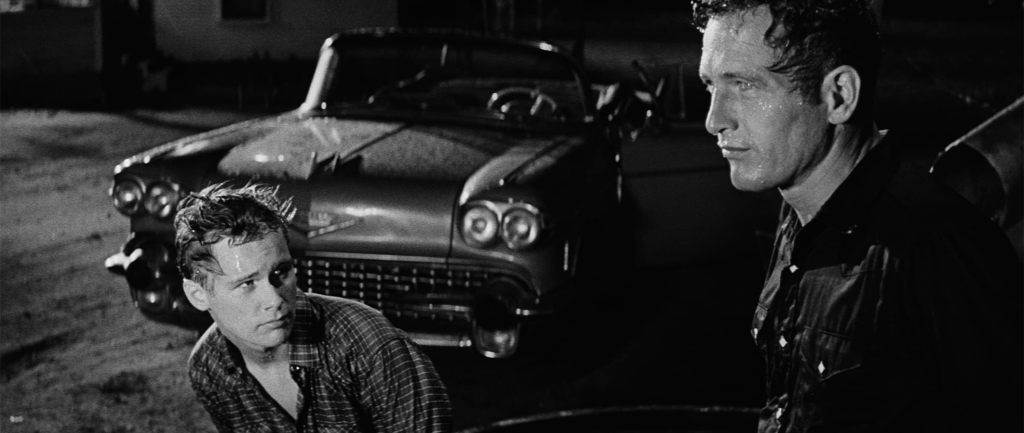
There is a certain thrill to seeing a movie star of tremendous charisma, a leading-man type we’re drawn to, play a character that is offputting. Certain stars we got to know as villains: Willem Dafoe, for instance, or Ralph Fiennes, Alan Rickman or Mads Mikkelsen. The beloved Gary Oldman arguably rose to stardom playing mostly bad guys, even if some of them were tortured and romantic. But there’s a difference when a leading man with leading-man looks appears on the screen – and does something horrible. Remember Henry Fonda’s introduction in Once Upon a Time in the West? Part of what makes that scene so effective is that the sadistic man we see murder a boy in cold blood is portrayed by the actor who played iconic paragons of integrity such as My Darling Clementine‘s Wyatt Earp or 12 Angry Men‘s Juror #8.
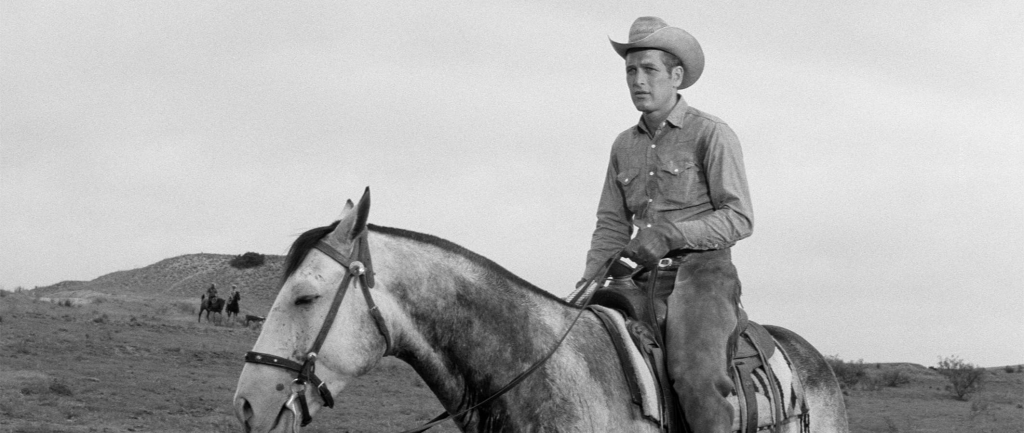
Paul Newman’s protagonist in Hud isn’t a nice man. Perhaps the best that can be said for him is that he is an antihero – but there are moments in the film where it isn’t much of a stretch to call him an out-and-out villain. He’s a bully and at the very least an attempted rapist. And yet, part of the character’s fascination is the fact that there is an attractiveness there, even if it is one that the character has weaponised into an essential part of his cruelty. Hud is self-serving, and he carries an enormous chip on his shoulder His father has largely given up on him, blaming him for the death of Hud’s brother, while his nephew is caught between wanting to reject his uncle and yearning to emulate him: in his eyes, Hud is the kind of man who gets what, and who, he wants. And for a young man who’s little more than a kid himself, this is dangerously alluring
And we buy it: after all, even at his most cruel, Hud does look and sound and carry himself like Paul Newman. In order for the film to work, we have to see how people might want to be like Hud, even while we recognise him as that iconic figure of the Old West – the rugged individual willing to do what it takes to succeed – curdled into its true final form: a selfish, lonely man who rejects any kind of community for dominance, because he thinks that coming out on top is the best and only thing he can hope for.
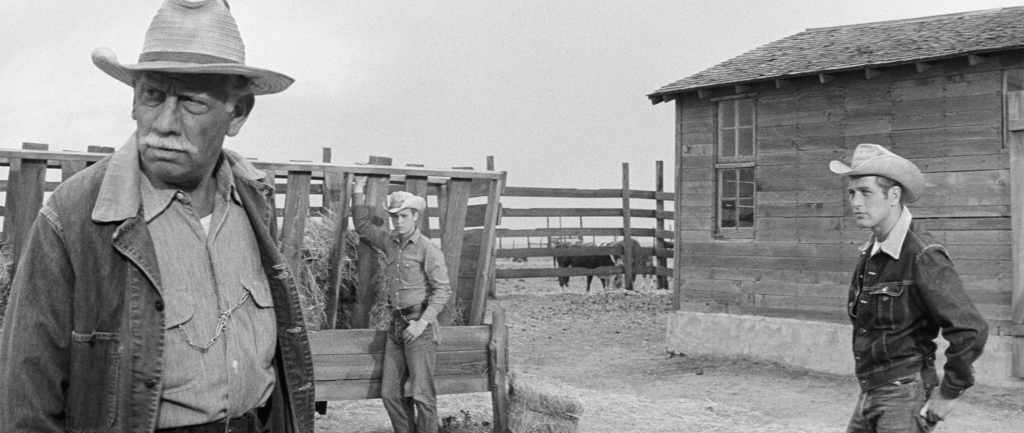
Earlier this year, during our Summer of Genre, we dedicated an episode to the Western, discussing how the genre was commonly used to let America tell stories about itself. Hud can certainly be described as a revisionist Western, taking the tropes and iconography of the genre to tell a darker story about a country built on the myth (or lie?) of rugged individualism. Its male protagonists are a family of cattlemen, but their business is threatened by something that cannot be done away with by means of a gun and six bullets: one of their cows dies, most likely from foot-and-mouth disease, and a positive test for the disease could mean that the entire herd has to be destroyed.
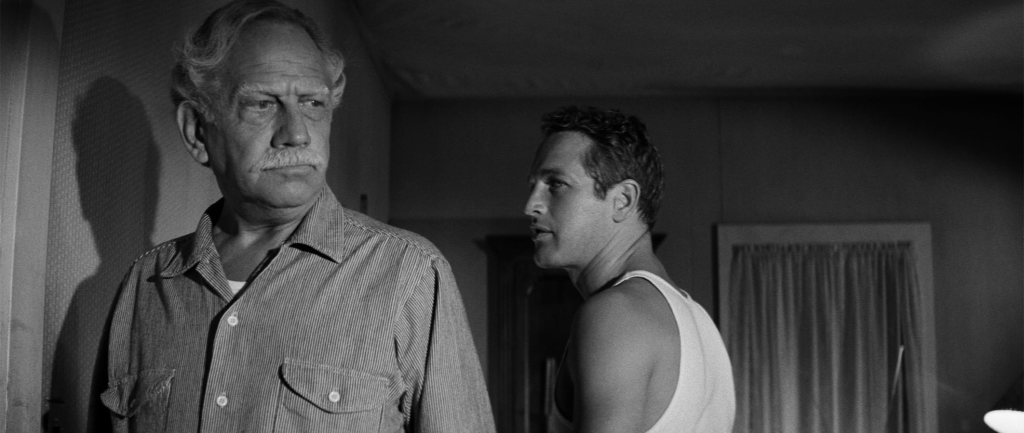
The Bannon household – Hud, his father Homer (Melvyn Douglas) and his nephew Lonnie (Brandon deWilde, the kid from Shane!) – are reminiscent of so much of American literature of the mid-20th century, in particular its stage drama. The character constellation is a familiar one: Homer is morally upstanding, but he is also a relic. Lonny, meanwhile, finds himself caught between the two men, trying to decide which ideal to follow. His choices are that of a well-meaning but moribund moral rectitude that belies an inability to change with the times, or Hud’s hyper-masculine urge to dominate at all costs, even if coming out on top means losing everything. And then there’s housekeeper Alma (played to perfection by Patricia Neal), the object of the younger men’s desires, but she is also stronger than any of them and the only one willing and able to look at what’s happening and draw the right conclusions for herself.
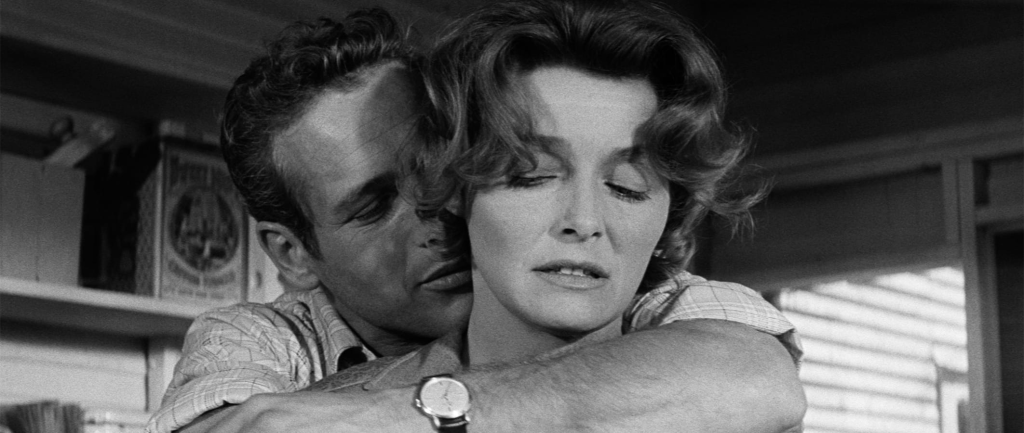
Verdict: Hud is Greek tragedy through the filter of Americana, as effective as the works of the great American dramatists. Its scenes, between Hud and his father, or Lonny who looks up to him, or Alma who does not deny her own attraction to Hud but who perhaps sees him best for what he is and understands how his cruelty stems from weakness: many of these have the force of scenes written by the likes of Eugene O’Neill and Tennessee Williams. The film is also starkly beautiful to look at: it comes as no surprise that James Wong Howe won the Oscar for Best Cinematography in Black and White in 1963, though the images are often as grim as they are beautiful. (One scene in particular will remain etched into my mind, for its visuals as much as for its sound design: the eventual fate of the Bannons’ cattle.)
All the various elements that make up Hud – the writing, direction, cinematography, editing, acting – are strong, but it is Newman who pulls them together into a whole. It is hard to imagine the film working this well without Paul Newman in the lead part. He never holds back in playing the title character: his Hud is hateful when he needs to be, and that’s most of the film. He is as monstrous as Streetcar‘s Stanley, though finally he turns out to be more pathetic. Newman plays the character so that he works brilliantly as a symbol for the ugly reality of the Western hero: a man who may win but only at the cost of destroying everything. At the same time, he never loses sight of Hud as a human being, finding pathos without diminishing his ugliness.
P.S.: Hud‘s director Martin Ritt is an interesting one: while he wasn’t outright blacklisted by the House Un-American Activities Committee, he was accused of Communist ties, and the television industry did indeed blacklist him; in 1976 he directed the blacklist drama The Front. He collaborated with Paul Newman frequently, for the last time in 1967 on the Elmore Leonard adaptation Hombre. He was also at the helm for The Spy Who Came In from the Cold (1965), adapted from John Le Carré’s classic Cold War spy tragedy – which was the subject of an earlier Criterion Corner. (That film’s protagonist, Alec Leamas as portrayed by Richard Burton, is another fascinating entry into the canon of anti-heroes.) Ritt doesn’t come up all that often in discussions of the great directors of the mid- and late 20th century, but on the strength of these films I suspect he might be one to look out for more than I have to date.