Welcome to Six Damn Fine Degrees. These instalments will be inspired by the idea of six degrees of separation in the loosest sense. The only rule: it connects – in some way – to the previous instalment. So come join us on our weekly foray into interconnectedness!
Just like Alan described in last week’s post, there are movies I first saw long ago that I could swear turn out differently than on recent rewatches. At times, no matter how much research you do, the misremembered version cannot be unearthed: no Director’s Cut has since been released, nor have deleted scenes been found, nor is there footage of such scenes to be found in any image galleries. Nevertheless, I’m certain I’ve seen the scene. Or was it just in my head after all?
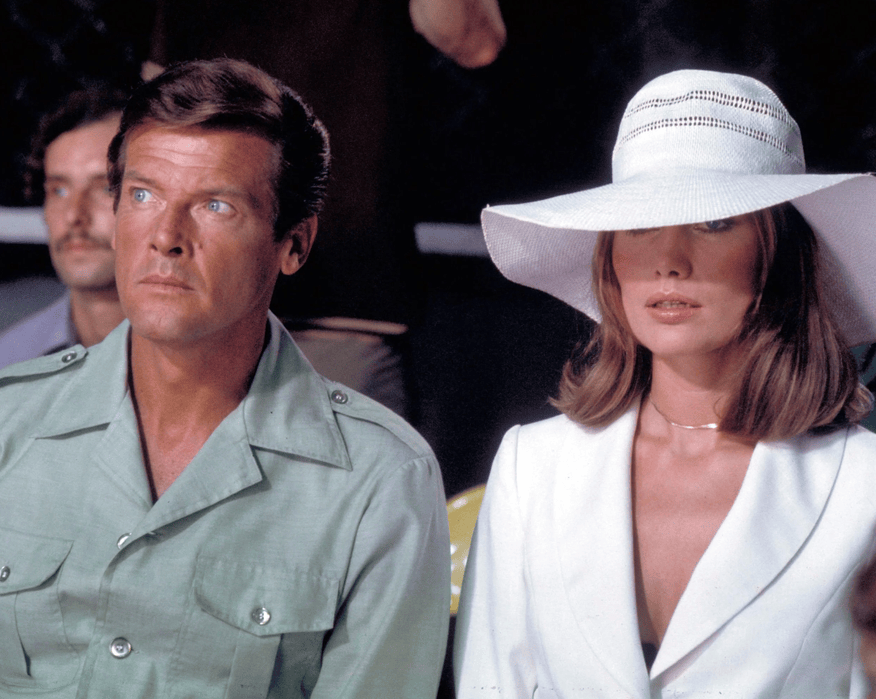
As an ardent Bond enthusiast, there’s one particular scene I specifically remember seeing as a teenager: in 1974’s The Man With the Golden Gun, Bond (Roger Moore) is supposed to get a vital piece of hardware from villain Scaramanga’s girlfriend Andrea (Maud Adams) in the middle of a Thai boxing match in Bangkok. When he sits down beside her, however, he discovers she has already been shot clear through the heart, from a distance, by Scaramanga’s golden bullet. Like a waxen doll with a small wound down her cleavage, she sits and stares blankly while a disquieted Bond discovers he has already been surrounded by the villain and his henchman.
So far so good, but the odd thing is that I distinctly remember Andrea being shot, Scaramanga (Christopher Lee) aiming at her and the wound being inflicted just as Bond is making his way to meet her. I see Maud Adams in her cream-white dress strolling into the stadium, finding her seat and nestling in her handbag for the desired Solex agitator, the McGuffin of the film that supposedly solves the ’70s energy crisis. And I remember how henchman Nick Nack (Hervé Villechaize) approaches her while his boss gets ready for the kill from the wings of the stadium.
In reality, such a scene apparently was never shot, and there isn’t a single indication on fan blogs or production stills galleries that shows such a moment being captured. What I must remember is a conglomerate of different but similar moments when the assassin shoots other victims, and maybe the horror of the waxen Bond girl inspired me to believe that I had actually seen her demise in more gruesome detail.
To this day, with all the other deleted scenes that have been released, I still can’t put my finger exactly on what had happened in my head. Which, of course, is a fascinating phenomenon: do each of us remember films not only differently in tone and emotional impact, but does everyone actually add and subtract scenes to films we see, so that if we talked about it and compared, this would make for a whole library of imagined cinema?
German technically has a good term for this: Kopfkino – the cinema in your head. Even though this often refers to the assembly of personal events, scenarios and memories that together feel like one’s own movie, I’m going to slightly appropriate it for the way we often remember films and are then baffled to find that we filled in our own bits, interpretations and feelings since to create a movie that maybe never existed.
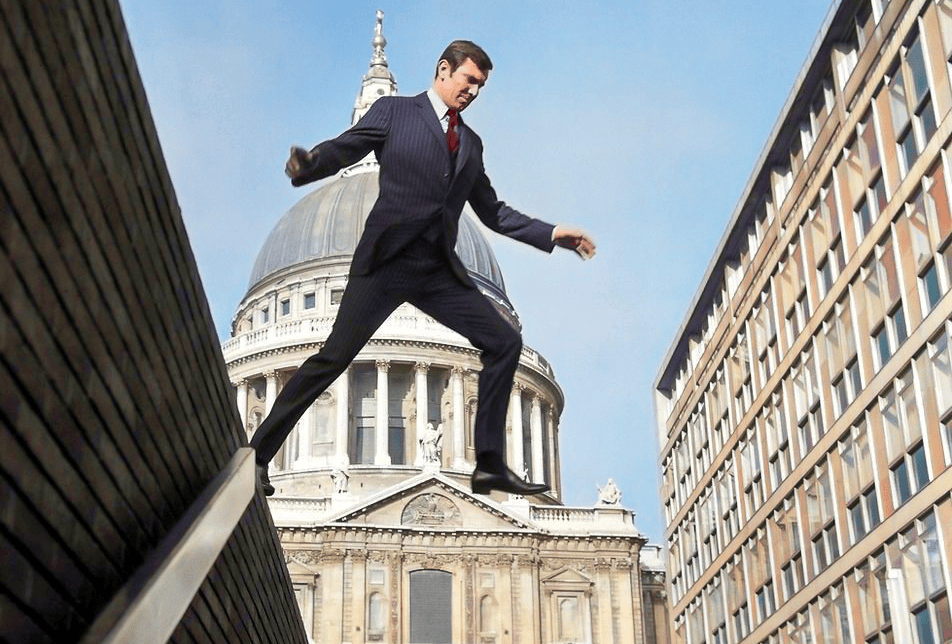
Other instances of this are more easily discarded by readily available facts ever since the advent of fan pages and film databases: why, for example, had I remembered different edits of my Bond favourite, On Her Majesty’s Secret Service with Bond breaking into a Bern office (the scene was censored from some versions due to Switzerland’s neutrality!), Bond chasing after a villain over the London rooftops (cut for length) or, just before the end, henchwoman Irma Bunt (Ilse Steppat) reflected in the shop window where Bond and his future wife buy their wedding bands (it was filmed but never included in the final cut, even if apparently it popped up in a 1970s TV airing)?
Some confusion in audiences’ minds might also have been spread by the odd and rather brief habit of studios expanding their theatrical releases for television in aforementioned ’70s fashion. Universal in particular discovered that extending a movie’s runtime for TV could significantly increase commercial breaks and spread the (often already thin) plots to the maximum.
Two examples I am very familiar with are among the recently talked-about disaster films so typical of the era: 1974’s Earthquake saw additional scenes with (admittedly more minor) characters flying over L.A. before and during the quake. A shoddy airplane set (repurposed from Airport ’75, most likely) and some cheap supporting cast on the Universal payroll were an easy fix and would stretch the film to 2½ hours or more. The scenes from Earthquake (filmed two years after the original release and totalling 35 minutes) have recently been reinstated in an excellent Blu-ray release, with options to add them to your viewing experience — not an earth-shaking one, I must admit and apparently hated by director Mark Robson, who was not involved in their production.
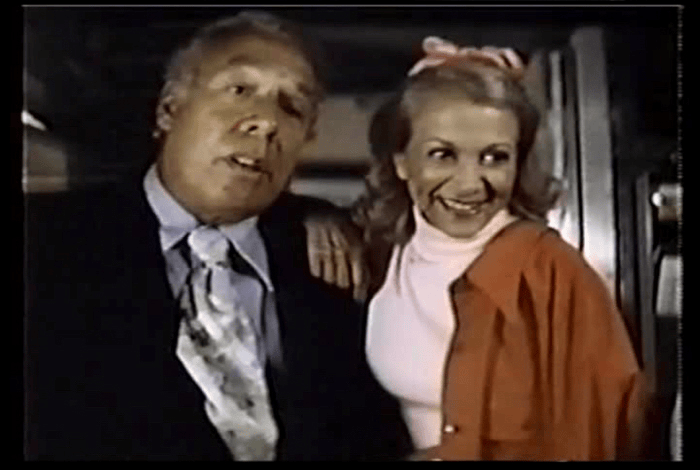
Another example was the next disaster in a highly successful series: When Airport ’77 aired, the practice of expanding on a theatrical film was extended to a full additional hour of material. Besides many additional dialogue scenes, an alternative opening was included, and there were numerous flashbacks where even major characters (played by Jack Lemmon, Lee Grant, George Kennedy or Christopher Lee) were shown before they had boarded the ill-fated plane.
It must have been the heyday of network television and a new strategy for major studios still making a profit from their blockbusters (especially the disaster flicks), yet at the same time already struggling with the competition of New Hollywood successes. Milking their most priced cows for expanded material done on the cheap was a short-lived but clever ploy just before video and DVD offered even more lucrative fan service with Director’s Cuts and Extended Editions. However, for fans familiar with such alternative versions, seeing the originals must have been very confusing to their movie memories: hadn’t there been that flashback just prior to the crash? Wasn’t there that exchange where that character had admitted this terrible thing?
Again, thanks to the saving graces of the Internet Movie Database (IMDb), making-of documentaries and ardent fan work especially on social media these days, we are able to sort the imagined from the edited or the censored. This blissfully confusing era before is (mostly thankfully) gone but of course, the fact remains that we sometimes best remember films in our heads as they don’t always live up to the quality of our Kopfkino. Just like Alan described so accurately based on his love for Alien (1979): some films are both brilliant each time we rewatch them and might offer us new highlights and insights each time, and they can expand on the way we remember them in between watching them.
So as I’m protecting myself against certain revisits of, for example, favourite childhood memories, I might easily rerun some of my favourite films at any point. I have such fond and possibly mostly misremembered recollections (what a good word, by the way, to recollect pieces but never the whole) of shows like The Secret World of Polly Flint (1987) or The Return of the Antelope (1986-88) but I don’t dare watching them again for fear of bursting my happy memories and Kopfkino versions. At the same time, show me Vertigo, O.H.M.S.S., Once Upon a Time in the West or The Empire Strikes Back any day!