Join us every week for a trip into the weird and wonderful world of trailers. Whether it’s the first teaser for the latest instalment in your favourite franchise, an obscure preview for a strange indie darling, whether it’s good, bad, ugly or just plain weird – your favourite pop culture baristas are there to tell you what they think.
We look back at the week that straddles two years, which for us here at A Damn Fine Cup of Culture began with Matt’s retrospective of 2024, bookended by Hirokazu Kore-eda’s wonderful Monster and the wondrous Flow.
Ever since the pandemic, time feels like it’s been broken. Looking back at the films and TV series I’ve watched this year, the games I’ve played, and whatever else I did over the last 12 months, my most frequent reaction is “That happened this year?!” The temporal shape of things has been out of whack for a while, and it sometimes feels like this is getting worse – like we’re all stuck in one of the trippier episodes of Star Trek. Though I think it’s time to be honest about this: in part that’s also because I am approaching the big Five-Oh (and no, I’m not talking about Hawaii). This is my last New Year’s post before finishing my half-century, and that is a pretty freaky thought.
Join us every week for a trip into the weird and wonderful world of trailers. Whether it’s the first teaser for the latest instalment in your favourite franchise, an obscure preview for a strange indie darling, whether it’s good, bad, ugly or just plain weird – your favourite pop culture baristas are there to tell you what they think.
It’s the last trailer post of the year, and we feel… apprehensive? Not so much about the trailers but definitely about the year to come – but until then, let’s enjoy some trailers, shall we? And we’ll begin with a collection of trailers coming out of this year’s Christmas Special podcast episode, ranging from Howard Hawks, Alfred Hitchcock to Billy Wilder and Mary Harron. Enjoy!
Join us every week for a trip into the weird and wonderful world of trailers. Whether it’s the first teaser for the latest instalment in your favourite franchise, an obscure preview for a strange indie darling, whether it’s good, bad, ugly or just plain weird – your favourite pop culture baristas are there to tell you what they think.
I admit: knowing many of those old, black-and-white monster movies only from short snippets or animated GIFs, I tend to go in assuming that they’re kinda silly, and while you might enjoy them, it’ll be the kind of enjoyment that comes with an ironic distance. You enjoy them for their silliness, their camp aspects. You enjoy them because it’s so obviously a guy in a rubber suit stomping on toy cars.
Sometimes that may be true, or you might enjoy the historical aspect, or the craftsmanship of a time when the effects guys were literally making up a new industry. Sometimes, though, you can watch one of these films and realise that they still work as what they were meant to me: earnest works of horror. Perhaps not in their entirety – but there’s an earnestness and filmmaking skill on display that can’t be dismissed with any amount of jaded irony.
Half an hour into the film, I began to feel off. It started with a wave of nausea. I was worried that I might have to throw up, but then the nausea was first complemented and then supplanted by something else: tunnel vision. My field of vision began to fade around the edges, becoming more and more narrow. I tried to focus on something other than the screen, but by then it was too late. The sounds I was hearing became muffled. Next thing, though I still registered the low, muted noises of the film, I felt I was somewhere else, somewhere far away.
Join us every week for a trip into the weird and wonderful world of trailers. Whether it’s the first teaser for the latest instalment in your favourite franchise, an obscure preview for a strange indie darling, whether it’s good, bad, ugly or just plain weird – your favourite pop culture baristas are there to tell you what they think.
Welcome to Six Damn Fine Degrees. These instalments will be inspired by the idea of six degrees of separation in the loosest sense. The only rule: it connects – in some way – to the previous instalment. So come join us on our weekly foray into interconnectedness!
Like Sam, I was a big fan of The Little Vampire as a kid – though, unlike him, I was a Book Firster. I loved the books by Angela Sommer-Bodenburg (at least as far as I read them, stopping somewhere around the fourth or fifth volume), and I think I may have had something of a kid crush on the vampire girl the main character fell in love with, but I couldn’t abide what I saw of the TV series. I’d been looking forward to watching the adaptation, but to me at the age of 10 or 11 it felt deeply silly. To be fair to the series, though, perhaps it was simply that I was growing out of the books at the time, and maybe I minded what I saw as the series’ silliness because it highlighted to me the ways in which The Little Vampire was, first and foremost, a series of children’s books. Not YA, not “for all ages”, but kids’ books. Which doesn’t mean that you’re magically too old for such fare at the age of 10, nor that such books cannot be enjoyable as you get older – but, for me, The Little Vampire stopped being as enjoyable as it had been originally. And, having loved the books dearly until then, perhaps that’s why I pretty much stopped reading them from one day to the next.
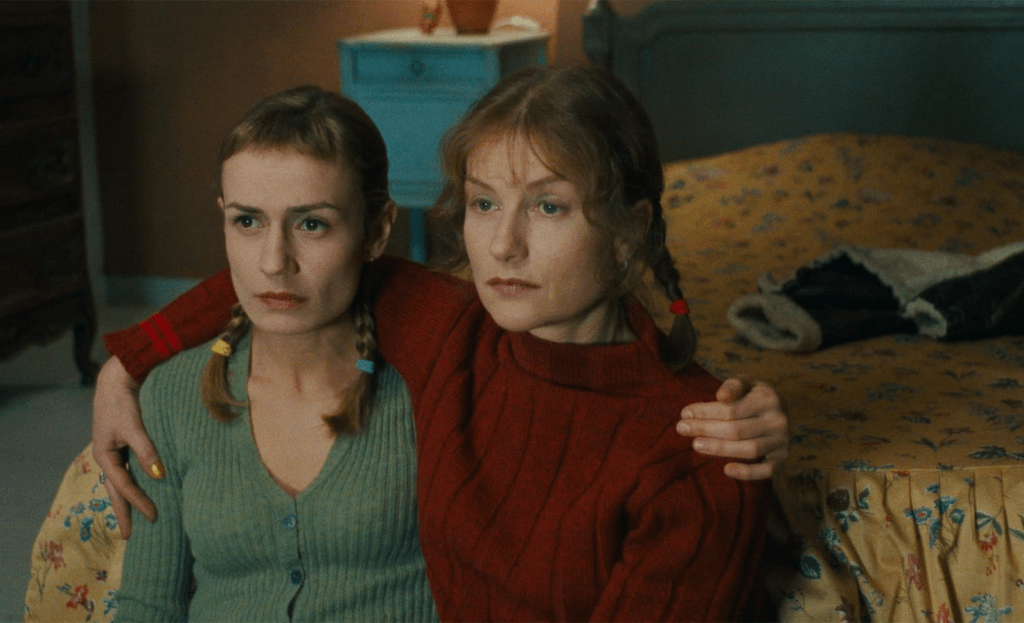
There are so many iconic directors that came out of the Nouvelle Vague, the French New Wave. Obviously there’s François Truffaut and Jean-Luc Godard, and even if you don’t like either or both, there’s no getting past them. Then there are the likes of Rohmer and Rivette, and others associated with (but not always counted as part of) the Nouvelle Vague, such as Resnais, Demy or Varda.
And then there is Claude Chabrol, who stands out for his dedication to genre cinema, something that is rare in the movement. He is one of the directors I’ve been aware of for a long time, but I had only seen a couple of films: The Colour of Lies (original title: Au coeur du mensonge, translated more accurately as At the Heart of the Lie), a thriller that I enjoyed at the time but that didn’t leave all that much of a trace, and the Highsmith adaptation The Cry of the Owl (Le cri du hibou), which I absolutely hated. Highsmith should be a good fit for Chabrol, but this particular adaptation didn’t work for me, leaving some characters utterly vague, others grotesquely one-note, and all of them annoying. (I later saw the more recent English-language version with Paddy Considine, which was almost aggressively mediocre but nonetheless felt like an improvement on Chabrol’s take.)
Because of this, I went into La Ceremonie with some trepidation: would I bounce off as much as I had with The Cry of the Owl? Does Chabrol just not do it for me all that much? Should I go back to the less genre-minded members of the French New Wave?
I’ll cut it short: even if I’d not seen any other Chabrol films at all – hell, even if I’d only seen, and hated, The Cry of the Owl -, La Ceremonie‘s strength would be enough to make me a fan. This is a definite keeper – that is, if you’re okay with thrillers that leave you feeling deeply uneasy for days.
Join us every week for a trip into the weird and wonderful world of trailers. Whether it’s the first teaser for the latest instalment in your favourite franchise, an obscure preview for a strange indie darling, whether it’s good, bad, ugly or just plain weird – your favourite pop culture baristas are there to tell you what they think.


 A Damn Fine Cup of Culture