Six Damn Fine Degrees #136: Some like it cult

Welcome to Six Damn Fine Degrees. These instalments will be inspired by the idea of six degrees of separation in the loosest sense. The only rule: it connects – in some way – to the previous instalment. So come join us on our weekly foray into interconnectedness!

The classic series The Avengers has frequently popped up on my radar, and it’s usually mentioned in positive terms. And yet, I’ve never bothered to seek it out. Too much to watch already, too many things that come first on my TV bucket list – and that’s before I even get into the favourites I’d like to revisit – if the streaming services of my choice haven’t taken them off their catalogue and erased out of existence, that is. Same with, say, Miami Vice, or Absolutely Fabulous or (don’t tell Alan) Randall and Hopkins (Deceased). And, to be honest, one main reason is that people talked about them with a great sense of reverence – or they don’t talk about them at all. They’re cult TV – and that’s something that tends to make me hesitate.

Continue reading

Criterion Corner: Le silence de la mer (#755)

There are many kinds of resistance. The one that’s perhaps most familiar to us – more so from the cinema screen than from personal experience, most likely – is that of taking up arms against the oppressor. The French filmmaker Jean-Pierre Melville made a number of films in which the French Résistance and its fight against the occupying German army featured, most famously perhaps Army of Shadows (which may come up more prominently in a future post), and as one might expect, the film depicts a heroic (if bleak) armed struggle.

While the setting is a similar one – the Second World War, occupied France -, the resistance of Le silence de la mer (The Silence of the Sea) is of a very different kind; as is, arguably, the characters’ struggle with each other and with themselves.

Continue reading

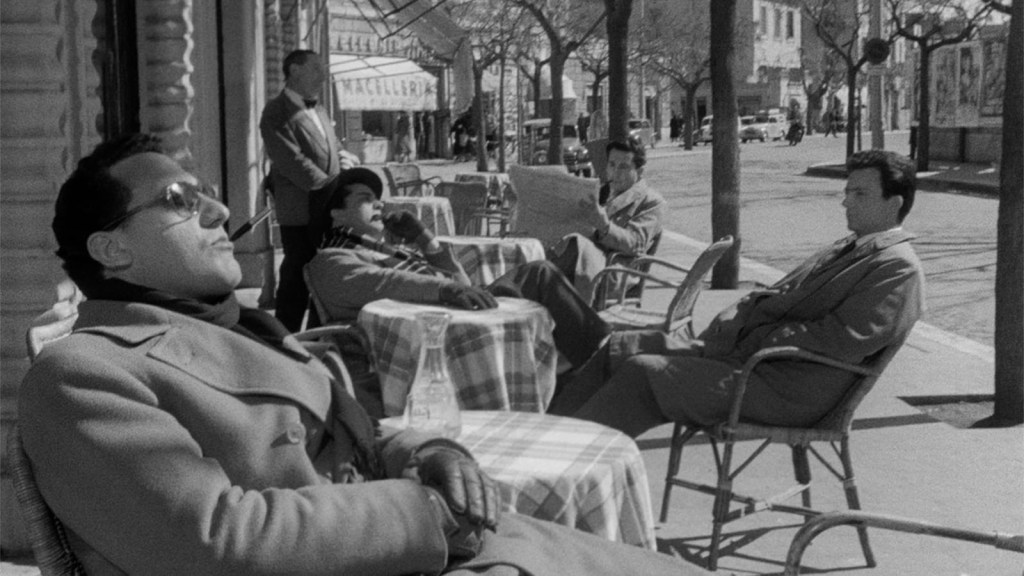
In France, they call it le Fleabag: Léon Morin, Priest (1961)

She’s in her 30s. She’s smart, savvy – and perhaps a little too proud of her critical abilities. She’s an atheist, and when she enters a church and sees the confessionals, what she thinks of isn’t faith or confession, she thinks of how she can challenge the curates. So she talks to the young, sexy priest, seeing if she can shake his faith – and the conversation that develops with them, over several meetings, is as much about belief and ethics as it is an extended flirtation. She is drawn to him, and while he doesn’t say so, his actions suggest that the attraction isn’t one-sided. What exactly is he trying to convert her to – and what is she trying to convert him to? And where can this ongoing, and increasingly erotic, duel of wits lead?

The young woman is Barny (played by Emmanuelle Riva, icon of French arthouse cinema), and the sexy priest (Jean-Paul Belmondo, just one year after Breathless) is the title character Léon Morin. But even considering how much of a cliché the constellation is – a sexy priest, an attractive young woman -, it is difficult not to think of Phoebe Waller-Bridge’s modern classic Fleabag.

Continue reading

Criterion Corner: Midnight Cowboy (#925)

In my head, John Schlesinger’s 1969 classic Midnight Cowboy is intertwined with Miloš Forman’s 1979 adaptation of Hair for some reason, to such an extent that I tend to mix up Jon Voight and John Savage. I have no convincing explanation why this is the case, but I suspect it may be that I watched at least the beginning of Midnight Cowboy at an age when I was too young to really take in what the film was about, so all that stuck with me was a young hick from one of the more rural states taking a bus ride to New York to begin a new life and, once there, falling in with a very different crowd than what he was previously used to. Perhaps Harry Nilsson’s melancholy hit “Everybody’s Talkin'”, playing over the Greyhound ride Joe Buck (played by Voight) takes to the Big Apple, added to that mostly inaccurate memory.

Those similarities are there, but they’re entirely superficial. Where Hair‘s Claude Hooper Bukowski goes to New York City after being drafted into the Army to go to Vietnam, Joe Buck has drafted himself into a very different kind of service: he wants to put his carnal talents, and his cowboy outfit, to good use to make the women and men of New York happy. And there’s no idealised, singing hippie tribe waiting to take Joe under their wings, but a fidgety, coughing con man named Rico “Ratso” Rizzo (Dustin Hoffman), who at first is eager to trick the naive Texas hick out of twenty dollars – but then, for a while, becomes the midnight cowboy’s only friend and companion.

Continue reading

Six Damn Fine Degrees #131: Men with hats, boys with tapes

Welcome to Six Damn Fine Degrees. These instalments will be inspired by the idea of six degrees of separation in the loosest sense. The only rule: it connects – in some way – to the previous instalment. So come join us on our weekly foray into interconnectedness!

It’s been too long now for me to know for sure: was Raiders of the Lost Ark the first Indiana Jones film I ever watched? Or was it Indiana Jones and the Last Crusade? What I can say for sure is this: I watched The Last Crusade at the cinema, but Raiders I saw on VHS, because it was the first official video release of a film that I ever owned.

Continue reading

Through a mirror polluted: Extrapolations

Remember when Don’t Look Up came out, the 2021 satire by Adam McKay about climate change and the way humanity deals with the crisis? Climate change activists generally praised it, conservatives of all stripes berated it for being propaganda, and film critics by and large disliked it as a film. I was largely in the third of these camps: while I agreed with the underlying sentiments, I found too much of the film smug and happy to preach to the choir, and I simply didn’t see much reason to be smug about a film designed to get those people nodding who were already nodding, while being pretty much guaranteed to put those off who weren’t already among those nodding. To my mind, Don’t Look Up was best where it dropped its lazy, easy-target satire (no matter how deserving that satire might be) and went for anger instead of smugness. (Which isn’t to say that I can’t imagine a better, more successful climate change satire than Don’t Look Up, but that’s a different topic.)

Extrapolations, an anthology series by Apple TV+ mostly forgoes the satire, but like Don’t Look Up I am largely in agreement with the thinking behind it. More than Don’t Look Up, though, it fails as activism as well as storytelling – sometimes disastrously so.

Continue reading

It’s already gone: revisiting Six Feet Under

Around the time that my father received his cancer diagnosis in 2021, I started rewatching HBO’s Six Feet Under, a five-season series about the lives of the Fisher family who run a funeral home in Los Angeles. I’d watched the entire series before, twice, the last time finishing in 2008. At the time, I wasn’t married yet (though I was already living with my now-wife), and my parents were both still alive, as were my partner’s. My mother was the first of our parents who died, in 2009. On this day a year ago, my dad died, not of the cancer he’d been diagnosed with but of complications in connection with the illness or the treatment or perhaps simply his age, and this morning I watched “Everyone’s Waiting”, Six Feet Under‘s final episode.

Continue reading

Criterion Corner: Rififi (#115)

Perhaps my experience of watching Jules Dassin’s Rififi for the first time would have been different, or at least more smooth, if I’d remembered its original French title: Du rififi chez les hommes. The English title, especially if you (like me) don’t know what the word ‘rififi’ means. The film is kind enough to provide something of an explanation, in the form of a song performed in a nightclub to an audience of gangsters, hoodlums and molls: rififi is brouhaha, trouble, especially the kind that goes on between gangsters over money, women, the size of their guns. But without that knowledge, the title Rififi sounded like a cocktail, a musical style that makes you snap your fingers, or a Mediterranean resort town. This together with the film often being described as the quintessential heist movie made me expect something jazzy, breezy, stylish. Something fun.

So when fifteen minutes into Rififi the main character makes his former girlfriend strip and then brutally beats her with a belt because she’d gone off with another man while he was serving five years in prison, I was taken aback – especially when the film in the scenes following the violence seemed to shrug and go, “Well, that’s what men are like, that’s what women are like, and that’s how everyone likes it.” I was ready to press STOP, eject the disk from the Blu-ray player, put it away and never think of Rififi again.

Continue reading

Six Damn Fine Degrees #127: You never forget your first time

Welcome to Six Damn Fine Degrees. These instalments will be inspired by the idea of six degrees of separation in the loosest sense. The only rule: it connects – in some way – to the previous instalment. So come join us on our weekly foray into interconnectedness!

You probably remember that scene from Poltergeist (the 1982 original, not the 2015 remake): Marty, one of the parapsychologists investigating the Freeling home, goes to the kitchen at night, grabs some food from the fridge – and finds that what he’s taken seems possessed and infested with maggots and evil. Understandably taken aback, he runs to a nearby utility room, he splashes water on his face… and then watches himself in the mirror as slits and cracks open in his face. Blood drips in the sink. And as we’re watching, a horrified Marty pulls off his face chunk by chunk, revealing blood, flesh and bone. A flash of light! – and Marty’s face is where it belongs, where it’s always been. It’s all been in his head… or has it?

Warning: Some graphic albeit cheesy ’80s gore to follow.

Continue reading

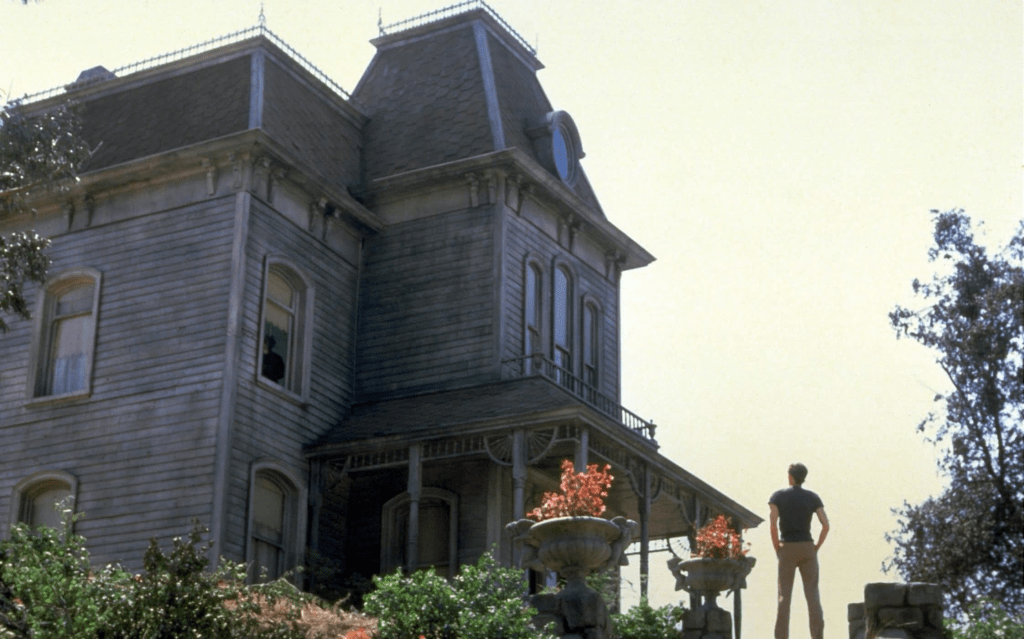
Fear the birds

You’d think this film shouldn’t work, not in 2023. The special effects aren’t outright hilarious at this stage, but they’re definitely ropey. Much of the time you can see that the swarm doesn’t actually exist in the same plane as the people running away from them. Your brain tells you: this is tricks, effects, it’s movie magic. And, more than that, it’s birds! There’s no way they can be this much of a threat, can they?

Continue reading