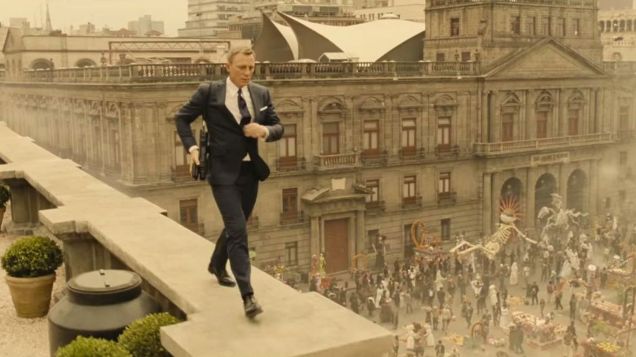
How long is long enough to shake the unfairly high expectations created by everyone loving a new series? I never watched Mad Men back when it first aired, but now that the series has come to an end I finally decided to dust off my Season 1 box set and acquaint myself with Don Draper and company. The result: I don’t dislike it, I find it intriguing, it’s beautifully made, and yes, Don is an attractive figure – but I have to admit that I don’t find myself caring all that much.
Author: Matt
Jus Sauli
Saul Goodman is one of TV’s greatest supporting characters. He’s definitely one of the funniest, with Breaking Bad‘s writing and Bob Odenkirk’s acting working together to create comedy magic. At the same time, the humour is never at the expense of the character, which is a rare thing – each wisecrack, each lopsided bit of legal advice adds to the character, an amoral cynic with the surprising occasional flash of a moral compass underneath all the quips and jadedness. However, supporting characters do not necessarily make good leads. Is Saul a Walter White – or, better, is he a character entirely of his own that can support his own series?
No strings on her
Can a machine ever be truly intelligent? Can it have feelings? If a machine fakes these things convincingly enough, at what point does the appearance become the real thing? Whatever the answer, Hollywood tends to remind us that it’s a bad idea to fall for robots and AIs, however seductive they look and however much they sound like Scarlett Johansson. Ex Machina is not alone in dramatising the Turing Test, but Alex Garland’s first film as a director is definitely a striking addition to the genre.

It’s showtime!
I almost managed to live to the age of 40 thinking that Bob Fosse’s All that Jazz would be a film I’d hate. High camp, stage dancers from the days when disco was just about still alive but definitely already starting to smell funny funny and the like aren’t exactly on my list of favourite things; I’m more of a whiskers on kittens and David Fincher’s Seven kinda guy. It was only when Criterion brought the film out on Blu-ray and Matt Zoller Seitz did his video essay on the film (embedded at the bottom of this post) that I thought I should perhaps try to get over my Fear of a Leotard Planet.
In short, I was transfixed. A couple of years ago I wrote about artifice and authenticity in films, and already while watching All that Jazz I was startled how well the former was used to evoke the latter. The film is often highly stylised, it eschews the surface markers of realism, it embraces camp and staginess like so few films do, and even fewer do successfully. The style of All that Jazz is showy, but it’s never insecure or needy: there’s an almost staggering confidence at play in the film. It’s rare to find a film that has learnt the right lessons from theatre, and that understands how limiting cinema’s obsession with realism is.
That’s perhaps the main thing I took away from All that Jazz: it’s exciting to see a film that isn’t beholden to a narrowly defined and all too often shallow representational realism. While it wouldn’t fit all kinds of films and stories, the kind of illusion that’s more common to the stage is something I wish film would embrace more often. Filmmakers try to make things look more real, but we know that what we see isn’t real: the dinosaurs and flying superheroes are pixels, that tower with a big flaming eye on top is a miniature, and that guy running with a gun is Tom Cruise. There’s a certain demented futility to the extent to which cinema is often at cross-purposes with itself: movies want you to get excited about the extravagant illusions they create, yet they want to hide the fact that they are illusions. There’s a fetish of the seamless – and it isn’t limited to CGI orgies: in a way, what Linklater was aiming for with Boyhood was also the seamless appearance of reality. There’s definitely a place for that, but realism isn’t inherently more valuable than other modes of representation. To my mind the most powerful illusion is often not the one that is seamless: it’s the one where the audience sees the illusion for what it is, a mirage, and fully buys into it nevertheless.
On the stage, we can watch an actor slip from one role into another, yet make them all real. There’s no need for Academy Award-winning makeup to hide the fact that we’re still looking at, say, Meryl Streep. A different hat, changed body language, all of these change an actor from a young man into an old woman, and both can touch our heart. The audience doesn’t just watch the illusion, it becomes complicit in it, intensifying the effect. I’ve seen a modern actor playing an Elizabethan player playing Thisbe, making us laugh at the incongruity one moment and cry the next as Thisbe’s pain and death feel utterly real. When it works, that reality is in no way diminished by the obvious artifice of it all. To make the audience see both the trick and the reality of what the trick presents at the same time, that’s magic. As Tony Kushner wrote in his stage directions to Angels in America: “It’s OK if the wires show, and maybe it’s good that they do.”
Obviously, film isn’t theatre, and what works in one medium has to be adapted for another. I wouldn’t want all movies to resort to the Brechtian strategies Lars von Trier resorted to in Dogville. I do want film to be less fixated on the invisibility of its illusions, though: the more magic happens entirely on the screen, the less it happens in my mind. All that Jazz‘ magic isn’t entirely that of the stage and its visible wires, but it rejects a superficial realism. It invites the audience into a much larger and more exciting space. Its reality is emotional first and foremost, its razzle and dazzle is artificial and has no qualms about this – artifice can heighten reality much more than a seamless illusion can. It opens up space and time, showing what a tiny stage realism is. How many leotarded angels can dance on the head of the pin that is realism? Many times fewer than Fosse was able to imagine, I’ll wager.
The fact of the meta
François Ozon’s Dans la Maison (In the House) makes for an interesting companion piece to his Swimming Pool. Both films are highly meta, both are about the process of storytelling, and both highlight the tenuous relationship between what makes a good story and What Really Happened. Based on these films, and on Ozon’s career as a filmmaker, his loyalties lie with the former – which is an attitude I very happily endorse.
Dans la Maison is a cheeky variation on the tale of Sheherazade: Germain Germain (Fabrice Luchini), a jaded teacher in late middle age finds himself becoming first intrigued and then well and truly hooked on the essays of the one student of his that shows promise as a writer, in a sea of bored, uninterested pupils that would give even mediocrity a bad name. Claude (Ernst Umhauer), who appears to come from a less privileged background, recounts in a waspish tone how he insinuates himself into the decidedly middle-class home of a classmate, eyeing the seemingly happy family – and especially the attractive though fading mother – like an underage Tom Ripley. The very first of these essays ends in a teasing, even flirtatious “A suivre…” – To Be Continued.
Surely, it is no accident that the teacher’s name echoes that of another fictional middle-aged man who enters decidedly murky ethical waters in an ongoing affair-of-sorts with a teenager – but Germain is no Humbert and his student is no precocious twelve-year-old. The seduction we witness is done by means of storytelling, and while Germain says, and may even believe, that he’s letting Claude continue his story and his infiltration of the titular house only to help him become a better writer, it is only in part the intimate but controlling act of teaching that motivates him. Germain is hooked on the illicit voyeurism of observing this middle-class family through the eyes of a transgressing young man whose attitude is partly desire, partly envy and partly disdain of what he sees.
In writing what he observes, Claude shapes both his material and his audience, and as the film proceeds it becomes increasingly less clear to what extent his story swerves from what he actually sees and hears towards pure fabulation. Germain prompts these changes by criticising the story Claude tells – too ironic, too predictable, too melodramatic – but it remains ambiguous whether these critical notes are indeed genuine feedback or the desperate attempts of a captive audience to maintain at least the illusion of control. Claude seems to defer to his teacher’s criticism, but he may just be giving the man what he’s asking for so he can snare him all the better. Germain wants the story to meet his standards of good fiction, yet he also wants it to be true, and the more the former is the case, the more he believes what he reads.
It’s a shame that while Ozon gets the relationship between Claude and Germain precisely right, he falters when it comes to the teacher and his wife Jeanne (Kristin Scott Thomas). No doubt, there are interesting elements there: Germain is a snob who patronises his wife with respect to her fear that she may lose her job as an art gallerist, and he is oblivious of the growing rift between the two of them as he clearly favours his pupil’s fiction over the art she works with, showing off the former to her while dismissing the latter. Late in the film, Claude insinuates himself into Germain’s life, apartment and marriage, much as he inserted himself into his classmate’s family, and again it is not clear where fiction ends and reality begins – but in these elements Dans la Maison remains underdeveloped. While there is a coda that is strangely serene, reconciliatory and sad in equal measure, a fitting end for the characters and the story, what precedes it feels like a first draft, something that hints at ideas and themes but fails to develop them fully. Claude’s final story, about him and Jeanne, feels too sketchy and rushed to warrant Germain’s extreme reaction, and the teacher’s final confrontation with his wife falls uneasily between the stools of relationship drama and French bedroom farce. It’s a shame: the film falters especially because what surrounds its resolution is sharp, smart and has the necessary lightness of touch. In this, too, it makes for a good companion piece to Swimming Pool. Regardless of the film’s third-act problems, Dans la Maison shows that Ozon still has the wit for playful meta, and I’ll gladly consider myself a willing audience to this particular Sheherazade.
The past is a black-and-white cartoon
My first impression is this: Alois Nebel wants nothing so much as to evoke the animated documentary Waltz with Bashir, with its ligne claire images and its story and themes – in both movies an imperfectly remembered historical event is key to modern-day goings-on. Unfortunately, the ambitions of the recent Czech film very much outstrip its actual achievements, in spite of winning the European Film Award for Best Animated Movie in 2012. It’s a shame, because visually Alois Nebel is moody and sometimes arresting, but too much of it ends up feeling half-baked and derivative.
It starts with the film’s look: Alois Nebel isn’t a carbon copy of Waltz with Bashir, using rotoscopy rather than the combination of Flash and more traditional animation of the latter, but it is close enough to serve as a constant reminder of a stronger film that makes better use of the medium. Bashir reflected on the gap between memory and history, using animation as a more overtly subjective mode of representation. The Czech film, however, doesn’t seem to have much of a reason why it is animated, doubly so since the actual actors, surroundings and objects are clearly visible in the rotoscoped lines. Other than the choice of black and white, there’s little obvious stylisation; form and function seem to be uninterested in one another rather than serving a common purpose. In the end, Alois Nebel mainly seem to be an animated black and white film because this gives it a more unique look, but as such the visuals come across as a vaguely motivated Unique Selling Point, not a purposeful directorial choice.
Similarly, Alois Nebel is content to leave too many things unclear. Now, I like the effects that elliptic storytelling can have, but there’s a distinction between elliptic and vague, and the film tends distinctly towards the latter. Early in the story, the titular protagonist, a quiet-to-the-point-of-sullen train dispatcher is taken to a mental institution during the last months of Czechoslovakia as a Soviet satellite state – ostensibly because he has hallucinations about an event from his childhood, but the way the film represents it the one, sole hallucination he has, and in the privacy of his privy at that, could as well be a memory, a dream or simply a flashback. Why exactly is Nebel committed? Why is he released? What difference does either make to him? If it doesn’t matter to any of the characters we see, why should it matter to us?
After he is allowed to leave the institution, Nebel returns to this troubling memory several times, each time revealing a bit more about what happened, but the eventual moment of clarity comes as an anti-climax: it tells us little more than the original incomplete memory did, and it doesn’t flesh out Nebel. It does provide a motive for a secondary character looking for retribution, but that character’s story equally doesn’t add much to Alois Nebel – or indeed Alois Nebel. All of it feels like first draft material in need of being elaborated on; in order to pull off elliptic storytelling successfully, the author needs to have a strong grasp of the story, to know what to leave out and why, but this one seems to have been designed around pre-designated gaps to begin with. If the mystery comes before the story, it’d better be a damn good mystery, yet in this film the mystery is too perfunctory to matter much.
The film comes into its own most during its middle, when Nebel is released from the psychiatric hospital, finds that he has been ousted from his job in the village of Bílý Potok and goes to freshly post-Soviet Prague looking for work. While this episode of the taciturn, middle-aged railway man finding companionship, momentary happiness and later disappointment may not be original, it works better at telling a story than the overall film, which includes too many elements while doing full justice to none of them. It’s in the Prague section that the film focuses on one thing rather than a shopping list of ideas, and it does so well (if somewhat predictably). Its mood does not come across as atmosphere for its own sake, as a repeated moody railway station vignette does in the early movie, and it is the better for it.
Unfortunately the filmmakers were too intent on telling their story about past crimes and present retribution, axe murder and all. It’s as if the film forgets its title character, or quite simply isn’t interested enough in him. There’s potential poignancy in a story that sidetracks its title character (I’m wondering what the Coens would do with such a story) – but sadly, Alois Nebel’s poignancy lies mostly in how most of the time it reminds you of a film that is better because it has a clear understanding of what it wants to be.
Flight or fight
I guess it had to happen sooner or later: if Miyazaki’s word is to be trusted on this, The Wind Rises is the director’s final film. While it’s not his best work, Miyazaki’s fictionalised biography of the aeronautical engineer Jiro Horikoshi is a fitting swan song for an artist whose fascination with flight is evident throughout his films (with Princess Mononoke being a notable exception). The Wind Rises is much less overtly fanciful than most of the director’s works, and its depiction of pre-WW2 Japan is striking in its prosaicness, but the film frequently soars with Jiro’s imagination. Flight is the dream that both the movie’s protagonist and its director share.
However, while the depiction of flight is often exuberant in Miyazaki, in some cases there’s a dark undercurrent to it, and this is definitely true of The Wind Rises. In his dreams, Jiro talks to the Italian engineer Count Giovanni Caproni, who tells him that “airplanes are beautiful, cursed dreams”, and that curse is the weaponisation of flight. In several of Miyazaki’s films flight and warfare are in close proximity to each other, and even the innocence of Laputa‘s air pirates’ ship or Porco Rosso‘s scarlet biplane and its whimsical pilot already hint at the violence of aerial combat. Although The Wind Rises doesn’t come out and say so explicitly, Jiro’s work will lead directly to the Zeros bombing Pearl Harbour and those piloted by kamikaze pilots. Even when the film is at its most elated, it is streaked through with sadness that man’s dream of flight so often serves only to come up with new and better means of inflicting death and destruction.
Except for a couple of scenes, the film keeps this as subtext rather than making it overt; if it had presented a more blatant pacifist message, The Wind Rises could easily have become preachy. Instead, Miyazaki weaves the theme throughout the film without forcing it onto the audience. However, it’s not clear to me to what extent the director wanted his protagonist, who can easily be read as something of a surrogate figure for the director, to come across as naive at best, and blithely self-centred at worst. The film wants us to like Jiro, clearly, but his actions and decisions come at a price that he never quite acknowledges. He is aware that his airplanes will be used for battle, yet he makes himself ignore this. Miyazaki’s depiction also seems to absolve Jiro too readily: he creates dreams, yet it is faceless others that pervert these dreams into killing machines. There is another, equally troubling instance of the film appearing to absolve Jiro’s actions, after he falls in love with and marries a Nahoko, a young woman who has tuberculosis. She leaves the sanatorium where she is supposed to get better to be with and support her husband, knowing that this is likely to worsen her condition, and while Jiro’s sister (a fictional addition to Horikoshi’s real biography, like Nahoko) blames her brother for allowing Nahoko to endanger her health even more, Miyazaki’s depiction of the couple’s love for each other suggests that everything is as it should be: Nahoko’s needs come second to Jiro’s dreams, just like these dreams come before any moral qualms that the airplanes he designs will be used as weapons. In his final imaginary encouter with Count Caproni, Jiro sees Nahoko again, smiling and waving, having fully become the beautiful ideal rather than a real, flesh-and-blood partner, but even here she subsumes her own needs to Jiro’s obsession:she conveniently dissipates in the wind so Jiro can continue talking shop with his idol.
It’s intriguing: The Wind Rises presents its protagonist as a good guy, but you don’t need to scratch the surface much to see that for all his charm and passion Jiro serves his own dreams before anything else. The film doesn’t present this as its preferred reading of the character, to my mind, but it definitely gives its audience enough space to interpret Jiro as increasingly self-absorbed. This tension between the presentation of Jiro as a Miyazaki stand-in and the now-you-see-it-now-you-don’t subtext of his more questionable qualities is interesting but also somewhat troubling; it’s still not clear to me whether The Wind Rises seeks this tension or whether it is at cross-purposes with itself. Miyazaki’s films usually don’t shy away from ambivalent characters, but I’m not sure this is what is going on in what is likely to be his final work.
Regardless of this, though, The Wind Rises is a beautiful, poignant work, and while I’ve only seen the English dub so far, I’d say that it is one of the better Miyazaki dubs, with one surprise voice actor especially that almost made me clap my hands in delight at how perfect the choice was. While I have the exuberant flights of fancy of Porco Rosso, Spirited Away and My Neighbor Totoro to return to, if Miyazaki makes good on his announced retirement I will miss seeing his imagination soar on the screen.
March Variety Pack
It’s been a while since I’ve done one of these, especially since being joined at Eagles on Pogo Sticks by my assiduous co-blogger, but due to an attack of what the Germans call ‘spring tiredness’ (in the German-speaking world spring makes us tired, not horny) I don’t have entire full-length posts on each of these in me right now. So, without much further ado, here are some thoughts on Japanese child-swapping, Cumberbatch cryptography and teens with superpowers.
Like Father Like Son
I’ve written about Koreeda before; Like Father Like Son is another worthy addition to his filmography. The film’s premise – two families find out that their six-year-old sons were swapped at birth – has been criticised for being too movie-of-the-week, but then, other than his inventive version of what happens after death in After Life, Koreeda’s films are rarely driven by premises as much as by characters. His strengths lie in his talent for quiet observation and his empathy for his protagonists. Ryota, one of the two fathers in Like Father Like Son, a young, ambitious salaryman who finds it easier to push his son to excel than to relate to him emotionally, could easily have been the villain of the piece, and Ryota is often arrogant and disapproving, but in Koreeda’s subtle direction and writing he never loses his humanity or becomes a stereotype. Similarly, while the film admittedly is more interested in fatherhood, the scenes that concentrate on the two mothers give them the necessary space to stand out as complex, interesting individuals. As is often the case in Koreeda’s films, though, it’s especially the child actors that amaze: they are thoroughly believable and real, with none of the preciousness or precocious quality that even good child actors display all too often.
The Imitation Game
I haven’t seen all the recent Academy Award favourites, but of the ones I’ve seen this is the one that brought to mind a word that I find nearly as dismissive and annoying as “pretentious”: Oscar bait. (I haven’t seen The Theory of Everything, which by all accounts is a worse offender in this respect.) There’s a lot to like about The Imitation Game, but it tries so damn hard to be worthy and meaningful. In spite of capable and even strong performances, the film is failed especially by its direction and writing. The former is pedestrian and predictable, exactly what one would expect of a respectable British historical drama; the latter is painfully hamfisted. Its central idea could be straight from a motivational poster and is repeated until it becomes a mantra, becoming more cringe-inducing with each repetition: “Sometimes it is the people who no one imagines anything of who do the things that no one can imagine.” There’s interesting material there, both in terms of the historical background and the character of Alan Turing, but the film never rises above the quality of its writing, which feels like the work of a B- student in Scriptwriting 101. Also, it is difficult to like a film that has a low esteem of its audience’s intelligence, as this one seems to have: The Imitation Game tends to make the same points repeatedly, as if to make sure that everyone watching it gets it.
One additional note on The Imitation Game: the film has been criticised both for overplaying Turing’s homosexuality and for giving it short shrift. I honestly don’t think that either applies; Turing’s orientation is one aspect of his personality, and it is an important one, yet it is not singled out as his most defining feature. The film doesn’t contain any sex scenes, gay or otherwise, but this fits in with its general polite bloodlessness, rather than speaking to anything more problematic, to my mind. The Imitation Game‘s crime isn’t homophobia so much as its banality and an almost complete lack of subtlety.
Chronicle
On paper, Josh Trank’s film about three teenagers who, after a close encounter with a McGuffinesque glowing rock, find themselves able to move things with their minds reads like a high concept too far: superpowers, teenage pranks, found footage. The movie could easily have ended up straight-to-DVD (or VOD? Not sure what the most fitting term is these days) garbage, but it works due to believable characters, a plot that is simple but effective and strong leads. Michael B. Jordan is no longer the meek Wallace from the first season of The Wire; while he gets less screen time than the other leads, it is clear he is a performer of immense charisma. Meanwhile, Dane DeHaan find the right balance between sympathetic underdog and simmering rage, making him a gender-swapped Carrie for this millennium. Unfortunately, the found-footage-but-not-quite cinematography is both a boon and a bane; it gives Chronicle an immediacy that is very effective, especially when coupled with the characters’ initial uses of their powers that are far from the special effects excesses of most superhero movies, but some of the time it simply doesn’t make much sense that we’d be seeing this footage, so what’s the reasoning behind the format? Nevertheless, Trank’s movie is a smart, interesting genre piece that, together with some of the casting, makes me more interested in his Fantastic Four reboot than that premise – a Fantastic Four reboot, of all things! – ought to be.
The Music Men
Are there any movie genres that are more, well, generic than films about young, struggling musicians (and perhaps sports films)? Even the best films about musicians tend to follow the same story beats: a talented young person’s struggle against all odds, personal sacrifice to reach the top, stern but well-meaning teachers, following your dreams, making it at the big competition, that sort of thing. Whiplash was admirable for how it avoided the clichés in some ways and reinterpreted them in others, eschewing the feel-good ending for something considerably more ambiguous, but it’s a rarity in the genre.
Miloš Forman’s Amadeus, a movie that doesn’t receive anything near the recognition it deserves these days, is even more of a rarity. Here is a film that at a superficial glance would seem to fit three of the genres most prone to cliché and lazy filmmaking: the music film, the period drama and the biopic. However, while it may flirt with these genres, it is beholden to none of them. It doesn’t purport to be Mozart: A Life: The Film, nor does it tell a straightforward, inspirational story of artistic triumph, and while it isn’t immune to the attraction of period detail, it’s decidedly not about giving the audience a touristic trip to picturesque 18th century Europe.
In fact, Mozart isn’t even the film’s lead; that honour falls to Antonio Salieri, in a performance by F. Murray Abraham that is still breathtaking. Quite literally, Amadeus begins and ends with him, a man who chooses to defy God out of a heady mix of spite, envy and spiritual crisis. The movie’s Salieri is a second-rate musician and composer at best, yet he has the ear to understand that this new kid on the block, Wolfgang Amadeus Mozart, is an immense talent. For Salieri, God speaks through Mozart’s music – yet Wolferl himself is a vulgar brat. What kind of God chooses not the diligent, devout (if more than a little vain) Salieri as his instrument but a manchild giggling madly at toilet humour? It is this metaphysical insult to his ego that fuels Salieri’s wish to destroy the musical genius – like a petty child that would rather destroy that which he cannot have entirely for himself.
How much further could this be from the variation on the dreary hero’s journey that is the common-or-garden-variety music film? Salieri isn’t the antagonist standing in the hero’s way: he is the protagonist, and we watch as he successfully destroys a man whose only crime is that he’s better at what he does than the bitter, self-centred main character. And what makes this more tragic is that Salieri, for all his poisonous pettiness, has enough self-awareness to understand what he is doing. As his plot progresses and as he fuels Mozart’s own self-destructive side, he begins to feel unexpected pangs of conscience. His destruction of the young genius birthes an amazing work of art, Mozart’s Requiem, yet it also destroys the conduit for this art, in an unhealthy relationship that isn’t entirely different from the sadomasochistic teacher-student dynamic of Whiplash. In destroying Mozart the man, Salieri becomes midwife to Mozart the legend.
And therein lies the razor-sharp irony of Amadeus. Salieri is a man painfully aware of his own mediocrity, and in his sacrilegious envy he destroys Mozart, being the only one at the time to recognise his genius for it he is – yet in death, the composer becomes the iconic genius, while Salieri is all but forgotten. Just as it begins, the film ends with a forgotten old man who, after a fashion, killed his beloved nemesis but who cannot even kill himself; he is spirited away to an insane asylum, where we see him relating his blasphemous tale to an idealistic young priest and preaching to the insane, the self-styled patron saint of mediocrity.
In terms of its plot, and in comparison to the conventional music film, Amadeus is pretty far from inspirational – yet as an example of cinematic art, it’s joyous. It looks beautiful without succumbing to the superficial prettiness of so much period drama. The writing is witty and powerful, delivered by the actors with the right blend of naturalism and stylisation. Abraham is a sublime Salieri, moving from sly irony through self-pity to toxic hatred with an ease that is gorgeous – but the other performances, while mostly requiring less of a range, are just as impressive. Hulce’s Mozart is infuriating, oblivious and heartbreaking in equal measure, and the smaller roles are spot-on, especially Jeffrey Jones’ hilarious performance as Emperor Joseph II. All in all, Amadeus is a classic of a kind that is rarely made these days and that deserves to be better remembered than it is – not least because, like Whiplash, it is a fantastic corrective to the generic, utterly conventional music films out there.
Il suono e il furore
Toby Jones is something of an unacknowledged gem. While his parts are rarely showy, he usually brings a beautifully earnest, genuine quality to them, whether as Truman Capote or as a computer-generated house elf with a heart much bigger than his diminuitive size suggests. It’s difficult to imagine Berberian Sound Studio with someone other than Jones in the part of the British sound engineer Gilderoy who seems to wish to shrink even more in the face of an intimidating job in an equally intimidating environment. Having worked primarily on bucolic British nature documentaries and recording the domestic sounds of rural England, he looks and feels out of place working in Italy on a bloody supernatural thriller – but don’t call it a horror movie, or the unctuous director will give you an earful about the film’s artistic ambitions! Gilderoy is visibly ill at ease, having traded the birdsong and ticking grandfather clocks of the recordings that remind him of home for the sounds that evoke medieval torture and putrid corpses.
Aside from Jones, whose performance transcends the stereotype it’s written as (a repressed middle-class Brit intimidated by loud, garish and macho Italianness), the film’s main strength is its atmosphere and the way it is created: apart from its expressionist titles, we never see a single scene of The Equestrian Vortex, the film Gilderoy is working on, but as we are told about the horrific goings-ons on screen, we see and hear how the sound is created. Water melons are stabbed, overripe marrows smashed on the floor, and various other innocent vegetables tortured to evoke murder, torture and gratuitous deaths. Similarly, we don’t see beautiful young women falling victim to the vengeful witches’ curse, but we see actresses screaming in sound booths. Berberian Sound Studio demands our complicity in piecing together the film within a film from what we hear, and for audiences that buy into what the movie is trying to do it works exceedingly well: like a good sound engineer, Berberian Sound Studio creates an ominous, uncanny world in our heads by appealing to our ears.
There are distinct Lynchian overtones (no pun intended) to the film, suggesting especially Lost Highway’s games with identity, but Berberian Sound Studio is equally indebted to Kafka: while Gilderoy never wakes up to find himself turned into an enormous beetle, a puzzling sequence late in the film makes him undergo a transformation befitting its themes. Where Gilderoy was initially unable to speak Italian, entirely at the mercy of others who would choose when to understand him and when not, and when to exclude him from their conversations, suddenly the words coming out of Jones’ mouth are in the language of Mario Bava and Dario Argento – yet it’s a dub. Gilderoy’s own, English voice is gone. Where before he was working on a film, albeit hesitantly, his agency and selfhood are gone as he becomes subject to film. He is a character reduced to the bare minimum, a body, hollowed out and filled with someone else’s voice. The words may be the same, just in a different language, but the Gilderoy we watch as Berberian Sound Studio comes to a close comes across a doppelgänger. The man who from the first looked like he wanted nothing so much as to make himself vanish has been dubbed over.
However, while Berberian Sound Studio is intriguing, it is also flawed. It excels in terms of atmosphere and evocativeness, and Jones is very strong, but at times the film feels like it’s trying too hard to become a cinephile’s cult movie. While I haven’t yet watched the short film that it grew out of, Berberian Sound Studio is too long for what it does. Scenes often repeat the same motifs and effects without reinforcing or varying them, and initially strong formal ideas wear themselves out. Moreover, while I like elliptic narratives, there are several moments where I felt the film was simply trying too hard to make itself worthy of cult. There’s a preciousness to its last half hour especially that would have worked better in a shorter film (though at 94 minutes, Berberian Sound Studio is by no means epic); as it is, the movie ends up being rather too self-consciously cryptic for its own good. It’s a perfect starting point for movie-geek discussions in part because it offers enough of a blank canvas. Nevertheless, the atmosphere and especially Jones’ performance hold it together, even if the film is somewhat too keen in aiming for cult classic, and it’s the kind of movie that lingers long after its final image has gone dark. Se non è perfetto, è ben doppiato.