And another quick link, this time copied and pasted directly to avoid embarrassing typos (thanks to my better half/editor!): The Best Picture Nominees, As Infographics. Just to tide you over until my confounding and sadly non-Oscar-nominated post on Tinker Tailor Soldier Spy.
Star Wars humour can be extremely lazy, but I really enjoyed this beautifully deadpan article from McSweeney’s: “On the Implausibility of the Death Star’s Trash Compactor”. Enjoy this slice of well-executed geek humour – and give me a couple of days to collect my thoughts before I post my take on Tinker Tailor Soldier Spy. (It may feature the word ‘elliptic’ prominently.)
Sometimes I am just a tad embarrassed to be a gamer. Make that more specific: sometimes I’m embarrassed to be a male gamer. Apart from superhero comics, is there any medium whose depiction of women tends to be this much on the adolescent fetish fuel side of things? Seriously, the average depiction of women in games makes Michael Bay’s female characters and their depiction look positively mature.
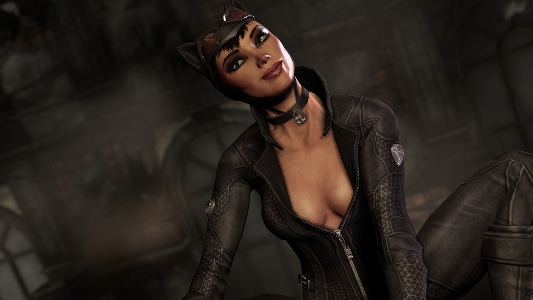
One of the games I played recently, the sequelific Batman: Arkham City, is a good case in point, being the offspring of both of those media… and boy, does it ever meet the stereotype. Witness Exhibit A:
Possibly an argument could be made that Catwoman’s open-hearted display of her, ahem, cuddly kittens is there to distract the various henchmen she faces – but no, seriously. We all know why Ms. Kyle is presented in this way, and it has little to nothing to do with tactical advantages fighting testosterone-riddled thugs.
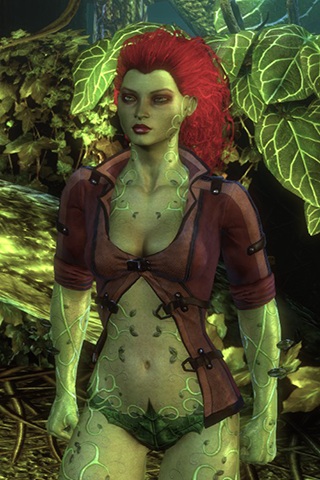
In comparison, Poison Ivy is almost demure, right? Wrong.
The sad thing is this: in terms of writing, Arkham City isn’t bad, and this includes its female characters. Sure, it’s no Ibsen, it’s pulpy as hell, but within the over-the-top, Grand Guignol genre they inhabit, the characters, their motivations and their actions make sense. And, what’s more, they become surprisingly compelling. I’m not a big fan of comic-book superheroics as such – I like some select examples of the genre,* but I don’t feel any specific attachment or nostalgic yearning for the various Adjective Men and Single Defining Attribute Women bursting out of phone booths in gaudy costumes (and in half the cases practically bursting out of gaudy costumes in phone booths). But over the 20+ hours of playing the Caped Crusader (AKA World’s Greatest Detective – I bet you thought it was Sherlock Holmes, didn’t you? – AKA The Man Who Manages To Remain Po-Faced When People Call Him Silly Names) it’s difficult not to become engaged in the story and in the silly, silly characters.
A large part of this is the voice-acting. Again, we’re not talking about masterclass material – this isn’t Ian McKellen at the Old Vic – but the cast manage to infuse the often pathos-laden, convoluted storyline with wit, humour and, yes, a sense that these freaks in costumes are real. At least for the duration of the game, I found myself wanting to know what happens to the Joker, Rhas Al Ghul, Mr. Freeze and the whole menagerie. Admittedly, I’d still feel a burst of shame if my girlfriend had walked into the room while I was playing with Catwoman (anyone who even thinks of making jokes about joysticks will get a kick in the Johnny Szazs…), but the game almost, almost made me see the appeal of these eternal schoolyard fights that are half semi-mythological epic, half soap opera.
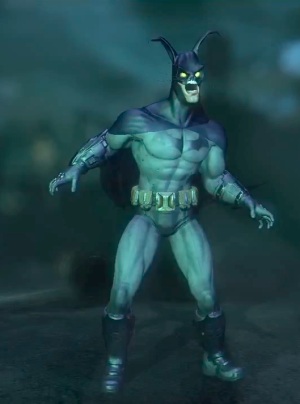
Also: how can you not love a game that features this Donnie Darko-meets-March Hare version of the Batster?
But seriously, folks – this is what Catwoman looks like! Not like two melons pressed into a zip-up leather overall – this is the one, true Catwoman:
*Okay, I’ll come clean. While I wouldn’t call myself a fan of superhero comics per se, I have enjoyed Watchmen, Mark Millar’s Red Son, Joss Whedon’s run on X-Men, Hellboy (does he count as a superhero?), Brian K. Vaughn’s Runaways and Ex Machina,several of Moore’s other ‘science hero’ works, Chris Nolan’s Batman films, and I will want to see the new Spiderman at the cinema, although that’s entirely because of Andrew Garfield. And, hey, good old Jed Bartlett is in it too!
When we were watching HBO’s Rome, I heard whispers and rumours of one that was greater: I, Claudius, these voices hinted, and then (sounding ever so slighly like histrionic Nazgul) BBC… Derek Jacobi! “Pshaw,” I said, with an emphasis on the “Psh”, but since when had I ever been able to resist the lure of cheap boxsets on Amazon?
Anyway, as so often happens, that boxset had been sitting on the shelf for years, while we watched Rome and many other series… but then, a few weeks ago, I thought it was finally time to check out a good old BBC classic. After all: Derek Jacobi, but also Patrick Stewart! John Hurt! Brian “GPS” Blessed!
The first episode of I, Claudius came as a bit of a shock. After Rome, a series whose production values were clearly visible on the screen, the ’70s series looked decidedly drab and dowdy, its colours faded. Worse perhaps, the acting felt extremely mannered, as if enunciation was supposed to do double duty for characterisation as well. (I remember seeing the RSC Macbeth from around the same time on video and thinking that the likes of Ian McKellen and Judi Dench had never seemed this fake.) I was positively yearning for the likes of Titus Pullo and Lucius Vorenus, for the glories of Cinecittà.
But then, we thought, it’s only 12 episodes. Surely there will be at least some historical interest, or we might spot someone who’d later turn up as a bent copper on Prime Suspect or that aging but handsome doctor on Casualty. Hey, we’d seen Steven Spielberg’s Taken, and after that a bit of over-enunciation and fruity British thespianism can’t beat us, can it?
I’m glad we stuck with the series; yes, it does take some getting used to, especially for modern audiences, and yes, you cannot expect the production values of HBO at its most extravagant. The acting is clearly not what we’re used to – but I wonder sometimes how seemingly naturalistic acting of the 21st century will seem to audiences in thirty, fourty years. Most likely, Rome is still my favourite of the two series, although that may at least partly be because it came first: in terms of acting, I, Claudius definitely catches up – and where it beats its nipple-happy great-grandchild is in terms of its overarching story. Rome‘s great weakness is its story and how it fails to be paced well in season 2. Obviously the early cancellation of the series is to be blamed, but regardless of that the HBO series fails to bring a compelling story arch to what history more or less dictated to its makers. Caesar’s rise and eventual assassination is compelling to watch, but once that story has been told Rome becomes a series of “And then…” Things happen because they happen, not because they make for a strong plot.
In comparison, I, Claudius has an overall arch. It has themes. It feels like something that is both historical and a story written by a writer who knows where he’s going and what he wants to achieve along the way. And while I love Pullo and Vorenus to bits as characters, they are a bit like Rosencrantz and Guildenstern: fun to be with, but essentially peripheral to the larger story. I’m not sure that Rome, especially in its second season, really managed to get the most out of its Upstairs, Downstairs parallel storylines; I, Claudius doesn’t feature the commoner’s perspective, but it is more of one piece as a result. And the acting, once you become acclimatised to the style, is very strong. Hell (Dis?), you even get that rarest of beasts: a subtle performance by Brian Blessed that consists of more than fruity bellows. Even when it comes to sex on screen, one of Rome‘s trademarks, its ancestor isn’t all that coy: it’s difficult not to think that I, Claudius must have driven Mary Whitehouse to righteous frenzies back in the day.
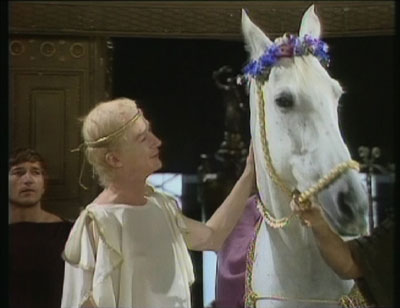
Oh, and then there’s John Hurt’s Caligula. Trust me, after this you’ll never be able to look at him with the same eyes.
Yeah, I know… That subject header is both corny and a bad joke. Sorry. Anyway, Sherlock. While I loved how the BBC series started its second season, I found the following episode – “The Hounds of Baskerville” – a bit of a disappointment. Entertaining, yes, but also not nearly as clever or charming as “A Scandal in Belgravia” had been. (Preferring naked yet tastefully presented Irene Adler over a hoary CGI hound? Perish the thought!) In that respect, season 2 shaped up to reflect the pattern set by the first three episodes: one good, one weak… one brilliant?
In hindsight, season 2 did mirror the first season – inverting the episodic quality as a mirror would. “The Reichenbach Fall” was definitely a good episode, but it was no “Scandal”… and it showed that a little Moriarty goes a long way. Sherlock‘s flamboyant take on the Napoleon of Crime was perhaps its most controversial take on Arthur Conan Doyle. Was he effective or annoying? While I haven’t read many reviews praising Andrew Scott’s camp Irish master villain, I was a big fan of his in “The Great Game”. His Moriarty’s over-the-top flamboyance struck me as an overt performance covering a ruthless, utterly amoral and frighteningly insane nemesis for everyone’s favourite be-cheekboned sociopath. (Check out his “If you don’t stop prying, I’ll burn you. I’ll burn the heart out of you. ” at 5:45 in the following clip.)
Thing is, there are so many scenes featuring Moriarty in “The Reichenbach Fall”, it frankly becomes a bit boring… and yes, his shtick does begin to grate. He still has many effective moments and a highly surprising exit from the episode, but there was a scene about halfway into the episode that I was hoping to end sooner rather than later.
The second issue I have with “The Reichenbach Fall” is this: set up an ending that signals this clearly that there’s some sort of trick involved and it’s very difficult to become involved in the character’s emotional journey. I’m sure it comes as no major spoiler that at the end of the episode, as in the Sherlock Holmes story it’s based on, our consulting detective seems to fall to his death… but the great sleuth manages to trick death somehow. Thing is, Martin Freeman’s wonderful take on Everyman John Watson makes him an obvious identification figure for the audience, but in the final moments of “Fall” we’re not empathising with him: we’re wondering how Holmes pulled it off. Freeman’s emotionally truthful scene at his friend’s grave is wasted because the previous five minutes were so clearly signalled to be some sort of sleight-of-hand trick. Which, incidentally, also means that the series’ writers will have a hell of a job with the payoff: they won’t get away without an explanation, but chances are that the explanation will be too elaborate to feel satisfying to the audience – the most amazing magic trick is rendered clumsy and inelegant by an “Oh, so that is how they did it… Hmm. Blimey. Cor… And we’ve waited a year for that?”
Having said all of that, the episode was entertaining and, at least to my mind, better than “Hounds” – and it did one thing exactly right: when the whole world turns against Holmes, they don’t go for the tired old “Even his best friend doesn’t trust him…” Watson, the sort of friend Holmes may not deserve and quite possibly isn’t smart enough to wish for, never gives up, never buys Moriarty’s fabrication. And that’s what I’ll be tuning in for when Sherlock returns: not the reveal, not the cases. Holmes and Watson.
Damn… I’m turning into the modern-day equivalent of a Mulder/Scully ‘shipper, aren’t I?
I’m not a psychopath, Anderson, I’m a high-functioning sociopath. Do your research. (Sherlock Holmes, Sherlock)
Admittedly, it may be due as much to what I’d read about Drive as to the actual film, but ten minutes into Refn’s much acclaimed film, these two quotes popped up in my head. The Driver, played by Ryan Gosling in such an internalised way it could almost be mistaken for no acting at all, is very much in line with several Michael Mann characters, most of all McCauley as played by Robert De Niro (in one of his last great roles – whatever happened to that guy’s talent, at least for choosing good parts?); in fact, he’s almost a distilled version of all of those strong, quiet men living according to their very own moral code. And in the process of distillation, he’s lost something: when it comes to interacting with others, there is something almost autistic to the guy. He’s 99% blank, though is it because there’s nothing there on the inside or because he’s so much defined himself through his role?
In spite of distracting, extremely loud and though not incredibly close munching (I barely heard my girlfriend eating popcorn right next to me, but there was a person several rows back who sounded like her chewing was amplified through the cinema’s sound system, which must’ve included a crunchwoofer), I was sucked into the film almost immediately, as its first sequences introduces the Driver as a virtuoso professional, and there’s a giddy joy to watching a film present that sort of perfection in similarly perfect cinematic craft. As soon as we see the protagonist in scenes with human beings, though, there’s something lacking, and we start to suspect that this strong, silent type is silent because speaking would reveal his weakness: he doesn’t do the whole human interaction thing. In fact, as we see later in the film, the Driver may be so lacking in these things, he may be downright sociopathic; at least his skill for detached, unflinching, professional violence (he’s definitely not an amateur in the literal sense, he doesn’t seem to enjoy stomping a would-be killer’s head to mush) suggests this.
Until the woman enters his life. And while I like Drive a lot, I see where the criticism of its female characters comes from: Carey Mulligan’s character Irene works well enough for me, but that’s because I reacted to her vulnerability much in the same way the Driver does, but as a character she’s underwritten – again, similarly to the female characters in, say, Heat. (I love Diane Venora’s performance in Mann’s film to bits – “You prefer the normal routine. We fuck, then you lose the power of speech.” – but she, like Irene, is primarily there as a foil for the male characters.)
Then again, Drive isn’t interested in presenting a full range of deep characters with complex motivations – and while I’d definitely say that it’s a smart critique of the near-mythological Strong, Silent Type, I also think that an overly academic discussion may do the film a disservice. (And I’m saying this as someone who’s always up for a pretentious, get-out-our-rulers-and-measure-the-size-of-our-brains academic discussion.) What I reacted to most strongly was the film’s underlying sadness, the protagonist’s inarticulate loneliness. Over-intellectualising the film, while it’d stand up to such analysis, ignores the feelings it evokes strongly and successfully. Like Neil McCauley, the Driver may say he’s alone, not lonely, but if he did he’d be lying to himself. But perhaps it’s these lies that allow his kind to ride off into the sunset, solitary, unencumbered and definitively alone.
And, just in time, here’s the third and last variety pack for this month. We’ve been to the cinema a couple of times already this year, and while I wasn’t completely bowled over by any of the movies, it’s still nice to get the whole ritual: getting popcorn, sitting down, the lights dim, the curtain opens, trailers… It helps that none of the shows had a predominantly teenaged audience. (I’m slowly getting to the age where I get a warm and fuzzy feeling if I can still honestly say I’m one of the younger people in the audience.) So, what did we watch?
Sherlock Holmes: A Game of Shadows
Oh, Sherlock. Sherlock, Sherlock, Sherlock. You’ve got a lot to answer for. My near-constant thought during the first hour of the Guy Ritchie/Robert Downey Jr. sequel was this: “Sherlock does it better.” I sat there missing the smartness and the wit of the BBC series. Was the first Sherlock movie as much of a dumb actioner? I remember thinking at the time that for all of the rollicking action, the first film didn’t make me feel like I should have handed in my brains at the entrance. It wasn’t Proust, obviously, but it had a smart script and great chemistry between the leads. By comparison, Sherlock 2 felt for a long time like its subtitle should be Mr Downey Jr. Pays His Rent. The action sequences were long and overstayed their welcome. The plot took forever to get going.
A Game of Shadows fares better in its second half, and it does feature a few very nice scenes – I especially enjoyed the final confrontation between Holmes and Moriarty, and Stephen Fry’s Mycroft Holmes is fun throughout the film – but it still fails on one crucial point: not only do I think I would have enjoyed most episodes of BBC’s Sherlock better, I don’t think I would have enjoyed rewatching the first film any less. And that’s rather sad, I think. Whatever works in the film (Mycroft, Moriarty, one or two of the setpiece scenes), it’s put to the service of a sequel that doesn’t for one second justify its existence.
The Ides of March
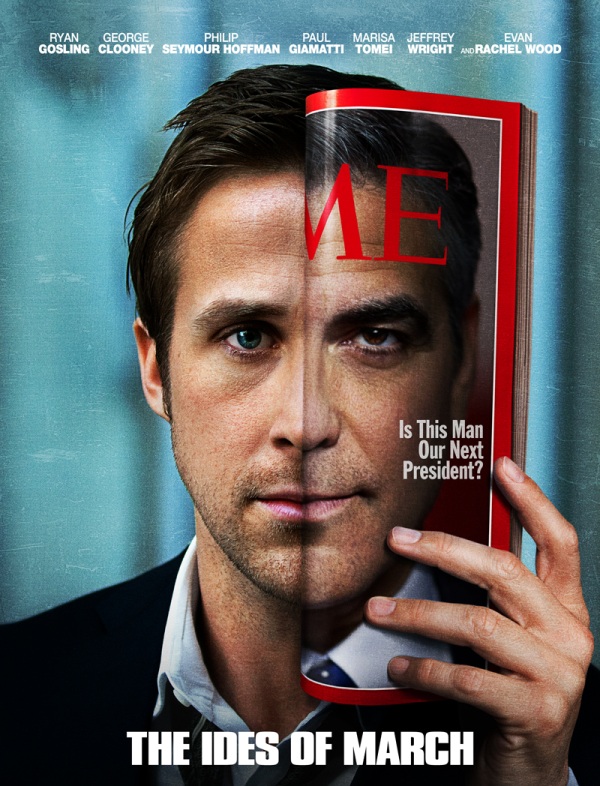
So, how to make myself feel smarter again? Shouldn’t a political thriller/drama directed by George Clooney, starring the current golden boy Ryan Gosling and based on a stage play do the trick? It should, but somehow it doesn’t. The Ides of March isn’t a bad film; in fact, it’s a handsomely made, nicely acted, reasonably smart film – the problem is that with those actors it should be so much better. Instead it is adequate. It is lukewarm. I enjoyed it well enough while watching it, but the film doesn’t add up to much other than yet another statement that politics corrupt. That idealism cannot survive in politics. Well, bugger me with a fish fork, who’d have thunk?
It would be unfair to say that all of the film is merely satisfactory. Phillip Seymour Hoffman’s performance is strong, as always (but it’s such a monumental waste to have him in a film with Paul Giamatti and not give the two of them a good, juicy scene together), and Ryan Gosling’s character is interestingly ambiguous. Is he an idealist or is he smug, self-righteous and the most corrupt of the bunch? Is he changed by what happens, or does what happens reveal the rotten core underneath? Still, the film rarely becomes more than a finger exercise, Clooney showing that he knows his craft – and after I loved his first, Confessions of a Dangerous Mind, I would have expected something more than that.
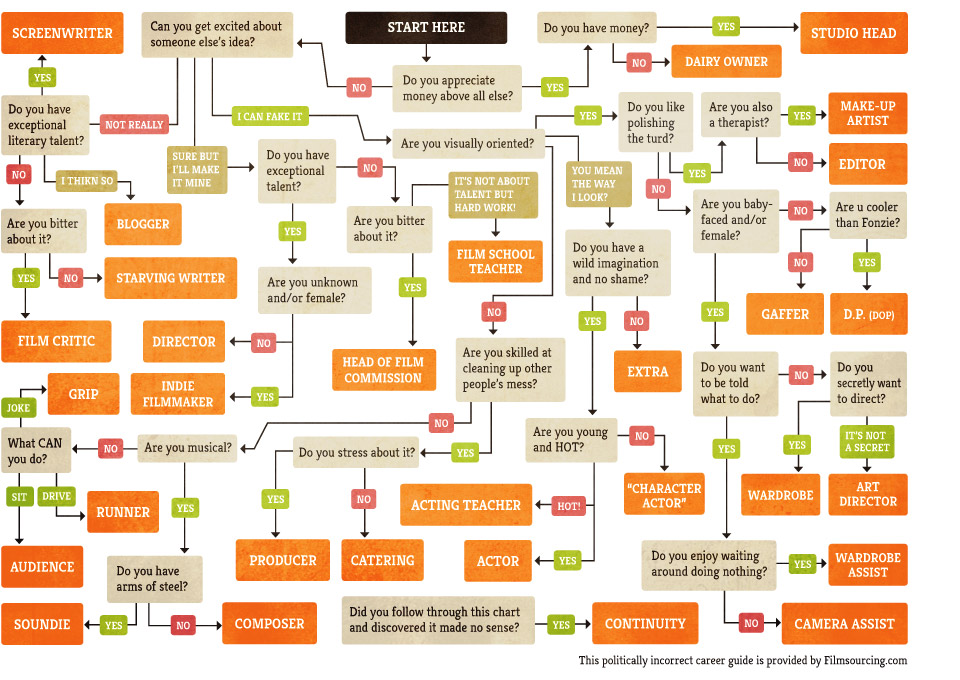
A third January Variety Pack should be coming soon (here’s hoping I’ll still make January), but for now, here’s a nice flowchart for anyone who’s dreaming of a career in the movies.
A bit later than promised, but here’s the second January Variety Pack, containing all the snap, crackle and pop you could hope for, as well as Teutonic metaphysics and an ageless gnome who’s finally getting old.
Cave of Forgotten Dreams
Werner Herzog is one of those film makers I’ve been aware of for a long time but whose work I’d never seen. His name triggers childhood memories of zapping into Klaus Kinski films and being weirded out by the guy, and I definitely remember hearing about the epic, ongoing on-set battles between Kinski and Herzog – but I’d never seen more than a couple of seconds of the actual films. I’d heard good things about his earlier documentary, Grizzly Man – but again, if it was ever on I missed it. Cave of Forgotten Dreams hadn’t even been shown at cinemas here when I succumbed to the post-Christmas lure of Amazon.com and went ahead and ordered the film on Blu-ray. Hey, if people praise its amazing visuals, I want all the pixels I can get, right? (No 3D, though – it’s available on the disk, but my TV don’t do three-dimensionality.)
Herzog’s a weird one, at least on the basis of this film. Much of his slow, accented voice-over is heavy on the metaphysics, and while I wouldn’t necessarily say I like it, I cannot deny that I find it compelling – right down to the surreal epilogue featuring albino alligators. It becomes even weirder when Herzog cracks a joke, in the same slow, deliberate, strangely sad voice. (Imagine a voice with a heavy German accent that’s pretty much the aural equivalent of Tommy Lee Jones’ facial expression throughout The Three Burials of Melquiades Estrada.
As much as Herzog puts his stamp on the film, its real star is the cave itself and its amazing paintings dating back tens of thousands of years. Not all of the individual paintings are equally fascinating, but some show striking subtlety and artistry – and they look as if someone left them there just yesterday. Herzog’s film is highly successful at evoking both the age of the cave artworks and their immediacy – freaky amphibian reptiles with blood-red eyes are just an extra. The film is enjoyable even without smoking pot or drinking a bottle of cheap-but-nice red wine beforehand.
Mission Impossible – Ghost Protocol
… or MI:4, to its friends. In spite of my pretentious-yet-middle-of-the-road film geek credentials (with a few dozen Criterion editions on my shelves I cannot really deny it) I like a good action movie. I’ve enjoyed the Bourne series, Die Hard is one of my favourite Christmas flicks (right there with It’s A Wonderful Life and Nightmare Before Christmas) and I have fond memories of the Californian governor relieving Bill Paxton of his boots, clothes and motorbike.
In those terms, is Em-Aye Four a success? There are moments in the film that I’d consider among the most exciting action scenes of the last ten years. (It helps that we’ve arrived at a point where you can’t always tell a green-screen shot from stunt work.) I sat on the edge of the chair, I jumped, my pulse went up, my breath caught, just as the movie intended.
Apart from that, though, the film fails in one fundamental way: I didn’t care about any of the characters. Is the problem that Brad Bird’s first non-animated movie doesn’t know what to do with its human cast (nor, cheap joke alert!, with Tom Cruise)? Perhaps. It pays lip service to characterisation, but the motivations it provides for its protagonists are uninterestingly written and the actors don’t make them come to life. In fact, you care more about the characters when they’re not angsting about the partners they’ve lost to the job – they’re more relatable when they shut the hell up than when they open their mouths and pretend they’re real people.
For what it’s worth, MI:4 is better than John Woo’s MI:2 – but then, watching a burning dove fly past pooing itself in slow-motion fear is (marginally) better than that film. Is it on par with MI:3? I honestly couldn’t say, because for the most part J.J. Abrahams’ stab at the Missionary position self-destructed about five seconds after I exited the cinema… which is quite the achievement, admittedly, for a film featuring Phillip Seymour Hoffman.
Speaking of achievements, though, CGI has finally managed to conceal the fact that Thomas Cruise, Esq. does not age. The wrinkles that have begun to show on the Cruisester’s face look positively life-like. Will the Academy Award go to Make-Up or to Visual Effects? And is there any truth to the rumour that Cruise’s performance was motion-captured off Andy Serkis?
P.S.: For the record, I quite like Tom Cruise as an actor, when he’s got good material and is directed well – or when he shows that he’s got a sense of humour. (A bit of respecting this! and taming that! also seems to work quite well for him…)





 A Damn Fine Cup of Culture