And the second instalment of the January Variety Pack is to follow later this week, featuring semi-crazed German filmmakers, Paleolithic graffiti artists and impossible missions, should you choose to accept them. See you soon!
I know, it’s been a while. My apologies; my excuse is that I was lazy. Not a very good one, is it? In any case, I thought that rather than write one long update on a film I’d recently watched, I’d do some shorter ones. So without much further ado, here’s the first of my variety packs – the second is to follow very soon…
Four Lions
I have to say, when I heard about the film I was both intrigued and worried. It’s not that I think there are topics that can’t be treated by satire – but I also find the equal-opportunity-offender satire of, say, Trey Parker and Matt Stone neither particularly funny nor all that perceptive; in aiming at all targets, it rarely achieves more to my mind than a general, “Well, all positions can be a bit silly, can’t they?” Also, being offensive for its own sake is such a lazy way of satirising a subject. Which, let me hasten to say, Four Lions doesn’t do. In fact, for satire it is far from offensive in one important sense: as it opens its subjects to ridicule, it also evokes sympathy for them. It humanises its protagonists, the Muslim suicide bombers, as it shows them to be deeply flawed and silly in their motivations and reasoning. And it’s exactly this element that makes the film so funny and chilling in its strongest moments – rather than saying, “Those guys are our enemies and need to be destroyed” it asks us to see them as fellow human beings, albeit misguided ones… which may be much more subversive: love thy enemy.
But, apart from that, Four Lions is one of the funniest films I’ve seen in a while, asking the very important question: “Is a wookiee a bear, Control?”
P.S.: In terms of its darky humorous yet sympathetic tone, Four Lions reminded me of the Danish black comedy Adam’s Apples. Also highly recommended!
Never Let Me Go
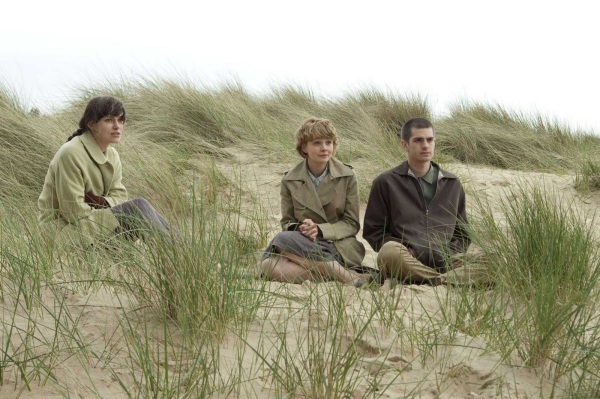
Since I liked Kazuo Ishiguro’s novel a lot, I was curious about the film version by Mark Romanek of One Hour Photo semi-fame. I was also worried; would the novel’s delicate, moody tone survive the transition to the big screen, and more importantly, would it survive La Knightley? I’m not her biggest fan – I do think she’s talented, but more often than not film makers make the assumption on the part of the audience that we fancy her like mad, and they then become lazy when it comes to letting her act. Instead she ends up doing her portruding-chin shtik that signifies, “My character is feisty, passionate and won’t take crap from anyone!” All too often she doesn’t portray characters on screen so much as do a slight variation of what she’s done in other successful films. Since I don’t find her particularly sexy (I was definitely Team Parminder in Bend It Like Beckham) Keira being Keira just isn’t enough.
I wasn’t particularly fair in this fear, at least when it comes to Never Let Me Go. The adaptation isn’t perfect: it would need some more time for the implications of what’s going on to sink in and be as quietly devastating as in Ishiguro’s novel, and the writing (the script is by Alex Garland, whose work I tend to find compelling and frustrating in equal measure) is a little too on-the-nose at times, assuming that the audience is too thick to get it. But the casting, including Keira Knightley, works perfectly. Yes, both Andrew Garfield and Carey Mulligan aren’t miles from the parts they usually play, and it’s not as if Knightley is miles away from other parts she’s done, but the actors fit their parts to a T, with Garfield especially delivering a performance as poignant as that he gave in Boy A. I could imagine that my first criticism is less of an issue for those who haven’t read the novel – the film isn’t rushed by any means, it just doesn’t give its audience quite as much breathing space, which is what I missed a bit.
This one doesn’t need any comment – other than this: viewers should know John Carpenter’s The Thing. Otherwise you’ll just be flummoxed. Oh, and don’t let your Pingu-loving kids watch this!
Oh, Auntie. After a year of bigger and smaller disappointments and only one moderate success, you’ve shown me you can pull it off. And how… 2010’s Sherlock was a great treat: funny, exciting, smart. But it was also only three episodes, one of which was decidedly weaker than the others. Would a 1 1/2 year hiatus help? Judging from the New Year’s Day episode and season starter “A Scandal in Belgravia”, the answer to that is a definite, loud, positively orgasmic “Yes!” Honestly, has there been witty dialogue, chemistry between the characters and stylish execution like this in any UK production in the last couple of years?
No, “Scandal” wasn’t perfect; it did have a couple of very cheesy moments, two of which weakened the female guest star in ways that are perhaps a bit iffy (mind you, I wouldn’t agree with the extent to which Jane Clare Jones criticises the episode), and it was perhaps too self-consciously cute with its references, punning and otherwise, to Doyle’s original stories (I groaned at the “Speckled Blonde”, though I loved the hat bit). Regardless, the episode was pretty much perfect in terms of being wonderfully entertaining – and just when you thought the humour might become self-congratulatory, Sherlock throws a scene at you that works as drama, showing that for all his brilliance, the main character is deeply flawed. The series is a fan of Sherlock-as-genius, but it doesn’t make the mistake of becoming fanboyish – or -girlish, although I gather that Benedict Cumberbatch does make for rather yummy eye candy. Then again, the testosterone brigade can hardly complain after a guest starring spot by Lara Pulver that would have made Mary Whitehouse’s head explode.
Oh, and the dialogues! If you were wondering where the sparkling repartee of a The Thin Man had gone, look no further: the Beeb’s been stockpiling it, refining it and quite possibly enriching it with steroids. This exclusive trailer from The Guardian website may be a bit weird, but it has a fantastic exchange between Holmes and Watson:
So, BBC, bring it on. Give me what you’ve got. And I’ll be willing to forgive you for the wasted potential of Exile.
Something’s odd with WordPress today (no dashboard), so I’ll make this quick’n’easy. More proper updates to follow in the new year (2012 – bring on the apocalypse!), but for now here’s what Michel Gondry gets up to when he’s bored:
For those who don’t get it, check out the plot synopsis for Gondry’s Be Kind Rewindand especially this. If you still don’t get it, well, the French are weird, y’know?
There’s something ironic about watching three one-hour films about the influence of modern technology on our lives, recorded via digital TV, and then that old technology they call “Teletext” goes on the fritz, giving us one line of subtitles every 5-10 minutes… Where are modern TVs that use the YouTube algorithm to subtitle programmes on the fly?
Anyway, Charlie Brooker’s Black Mirror. We already had the one where the pig, ahem, and the prime minister, erm, you know. The second episode was broader in choosing its satirical targets: gamification, avatars, Nintendo WiiFit and Miis, micro-transactions, casting shows, all of those were in there. There wasn’t anything terribly original about any of the individual elements – but Brooker and his co-writer and wife Konnie Huq turned “Fifteen Million Merits” into a strangely moving, discomfiting romance with a final twist that, though again not exactly new, worked very well… and Rupert Everett makes a wonderfully hateful mirror-universe Simon Cowell.
I was very much looking forward to the third and final episode, “The Entire History of You”, as I’d been surprised to enjoy the first two as much as I did. The episode was beautifully shot and edited, and the acting was strong as well, but in the end it disappointed, more so than any of the previous ones. My biggest quibble with it is that the central conceit – in the not-too-distant future, almost everyone has an implant, the Grain, that records what people experience and allows for instant playback on any AV setup, complete with zooms and, I’d imagine, instant uploads to YouTube for all of those cute-cat/fat-kid-making-an-arse-of-himself/America’s-funniest-maulings type experiences. So far, so okay… but the entire story, centred on an insecure husband who (rightly) suspects his wife had an affair, does not really depend on the Grain. While the tech, which Black Mirror purportedly is about, may change the exact expression of the protagonist’s anxieties, the story would not have differed in any major way without it. “The National Anthem” (now with more pig!) and “Fifteen Million Merits” were about human foibles, but they depended on technology to highlight how our understanding of public vs. private, self-image, entertainment etc. are shaped by the media we use to express them. Perhaps “History”‘s point was that technology doesn’t screw up people, people screw themselves up, but after the previous episodes had made a strong point that the tech, the media, the platforms do matter, that they do shape us, that would have been a strange point to make.
Still, having watched all of Black Mirror, I’m definitely curious now about Brooker’s Big Brother-inspired, zombie-infested satire Dead Set. Apparently Davina McCall gets munched on by the undead… not that I’d wish that on any TV personality. Except perhaps Ann Coulter, but let’s face it, those brains would be a tad on the nouvelle cuisine side.
In Swiss cinemas, there’s almost always an intermission roughly halfway during the film. Doesn’t matter if it’s a three-hour epic or a blink-and-it’s-over chit of a comedy. Doesn’t even matter if it’s the remastered 2001: A Space Odyssey and five minutes after the cinema’s intermission (2001 – now there’s a true popcorn flick!) there’s the roadshow version’s actual intermission.
Even though I would consider myself a cinephile, I don’t hate intermissions with a vengeance. Sometimes I like having a moment to pause and think about what I’ve just seen; sometimes my bladder is grateful for them.
And sometimes they break a movie’s back, much like this:
I greatly enjoyed the first 50-60 minutes of Roman Polanski’s Carnage. The film was expertly paced, the casting near perfect (although I would’ve loved to see James Gandolfini in it), the performances strong, with just the right lightness of touch. I’m notoriously tricky when it comes to comedy, but I was laughing along with the escalating situation. And then came the break.
For all I know, without the forced interruption I would have stayed in the film. I would have enjoyed it to the end. As it was, the impetus was gone, and what remained felt clichéd, trite, predictable. Oh ho, neuroses and hypocrisy under a thin veneer of civilisation! Tee hee, the lawyer collapses when his mobile phone ends up in the vase! Giggle, snort, the wife breaks down in a sobbing wreck when her beloved handbag is thrown across the room, spilling its innards all over the floor.
Thing is, all of this – the clichés, the lack of any depth – was there in the first half… but as the film built up momentum, it felt like all of this was exactly to the point. Having had five minutes of ice cream ad projected at the screen and then to pick up where we’d left, as if nothing had happened? Carnage had turned from witty, sharp, light-of-touch comedy to leaden sitcom. The remaining 25 minutes felt longer than the almost-hour we’d already seen. Yes, it was still expertly acted, but to such obvious, hackneyed effect. Perhaps an earlier break would’ve been better, giving the film more of a chance to build up momentum again. I don’t know, but as it was I had seen two thirds of a smart, funny film, only to turn against it in the remaining half hour.
It’s difficult not to think of this piece of Zen wisdom:
P.S.: It’s difficult not to love Christoph Waltz’ performance in this, though, while disagreeing with him 99.9%.
So… Glad that’s over. I’m not going to spout overused terms such as Jumping the Shark, but if I hadn’t known that House M.D. was waaaaay past its prime before, I definitely would know after having watched the season 7 finale. One of the advantages of being 6-12 months behind the English speaking world due to watching series on Swiss TV is that I’d already heard all the clamouring, wailing, gnashing of teeth and general lamentations concerning the season ending, so I had lowered my expectations accordingly. Not quite enough, mind you – it’s painful watching the actors trying to make the material work. Lazy writing is one thing; lazy writing that spells all the show’s facile pop psychology out is just insulting to the intelligence of the audience.
From everything I’ve heard about the eighth (and final, right? Promise?) season, it sounds like the show remains moderately, patchily watchable, but at this point it’s difficult not to wish for the actors involved to find something better that isn’t written by an infinite number of computers programmed by monkeys (and shit-flinging ones at that) and possibly IT supported by outsourced Indian monkeys. (For the record: the computers work flawlessly, even if their output is dross.)
How do you follow up a depressingly shoddy episode of House? Why, with a Channel Four satire about the UK Prime Minister coerced into having sexual intercourse with a pig, that’s how! The first episode of Charlie Brooker’s Black Mirror sounded like crass satire in a one-sentence synopsis, and the reviews I’d read were tepid at best – so I was surprised to find “The National Anthem” well written, well acted and quite thought-provoking. While the premise is satirical, the episode plays it straight and with remarkable conviction at that – which made “The National Anthem” quite a bit more unsettling than a more leering, in-your-face approach would’ve achieved.
Though the entire media satire-meets-inappropriate sexual content thing did put me in mind of one of my favourite Monty Python sketches. So, to end this post on a more amusing note:
Phew… A while ago we finished The West Wing. Seven seasons worth of politics, drama, screwball comedy, quickfire dialogue. Is it up there with Six Feet Under or The Wire in my appreciation? Not quite, but I definitely felt sad when it was over – 150+ episodes is quite the commitment, both on the part of the audience and the series’ cast and crew, and The West Wing managed remarkably well to remain relevant throughout its run, with the exception of its lowest period after the departure of Aaron Sorkin.
I wonder what it was like for Americans to follow the series as it was first aired. As much as I liked it, it’s difficult to fully relate to The West Wing‘s patriotism, its belief in the ongoing project that is America. As a European of reasonably left-wing persuasion, and with a bi-national background to boot, I find nationalism of any ilk utterly alien, yet these characters I’ve enjoyed watching and have been rooting for – right down to Toby Ziegler, possibly the one closest to me in his political outlook on things – have a fierce pride of their nation and, more importantly, what it can be that I cannot help but find fascinating.
Apart from this almost anthropological interest in the series, though, I defy anyone to watch The West Wing and not enjoy the series’ regular cast. There were a few missteps along the way, often when it came to characters on the other side of the political spectrum – until the last two seasons, The West Wing struggled to portray realistic, credible Republicans who weren’t moustache-twirling villains or vague concessions to alternative political persuasions – but the central cast was pitch-perfect pretty much from day 1. And anyone who doesn’t enjoy Allison Janney’s CJ Cregg is no friend of mine, simple as that.
What’s next for us, series-wise? Well, we’ve got started on a rather shorter presidential show, John Adams, and it’s a joy to watch Paul Giamatti and Laura Linney (whom I used to dislike intensely, mainly due to her character in The Truman Show – she was pretty much my female David Morse), but since we’re close to the end of House M.D. season 7 (and not a moment too soon!), it’s probably time to get started on another long ‘un. Mad Men? Or should we mop up some mini-series or one-season wonders, such as I Claudius (which, in this day and age, probably should be rebooted as iClaudius) or The Prisoner? And then there’s The Killing and Five Days and, and, and… Too many series, not enough evenings and weekends. Early retirement due to too many things to watch sounds just fine to me!
If it weren’t for that meddling Hugh Laurie… Seriously, I find few things in TV land as annoying as writerly laziness – and House, M.D. has become one of the laziest shows in that respect. We’re now almost at the end of season 7 in Switzerland, and when they’re not paying attention I’m sure I keep catching the series regulars avoid each others’ looks in embarrassment. Laurie still does a good (though no longer great) job, as does Robert Sean Leonard, but you have to feel sorry for the likes of Chase, Foreman, Taub and the other hapless sidekicks.
House has rarely been a terribly original show, and part of its appeal was its utterly formulaic structure. Once you’ve seen half a dozen of episodes, you know what expects you: weird symptoms manifest themselves, the team makes a first diagnosis and starts treatment, the patient gets worse, more treatment, more escalation, the apparent solution followed by a major crisis, then House – usually while talking to Wilson – has an epiphany based on some more or less feeble pun or metaphor emerging from the conversation he’s just had and solves the case. Patient saved, in 49 out of 50 cases, otherwise cue patient’s poignant death accompanied by some melancholy singer-songwriter droning on about love and loss and dead puppies.
It’s not that the show is samey; it’s that the bits where the show could at least be somewhat different from week to week, the soap opera/comedy bits, have become really, really inept. I’ve stopped counting the moments where House says something offensive, inappropriate or weird and we get reaction shots from the other characters that could be out of a cheapo ’80s sitcom. It doesn’t help that the episode “Bombshells”, which tries (though not all that successfully) to mix up the format, does a scene parodying sitcom clichés when the actual show in business-as-usual mode delivers lazy versions of those same clichés.
At this point, as much as it pains me to say it, I am seriously thinking that House, M.D. should’ve been put down like an old, sick dog. Let Laurie move on to something where he can make better use of his talents. I’m happy if Leonard tags along. But now, giving us Olivia Wilde to look at simply isn’t enough to keep things very interesting. Sorry, Gregory – I’m just not that into you anymore.
P.S.: Is it just me, or is this music video quite possibly one of the weirdest things to result from the series?



 A Damn Fine Cup of Culture