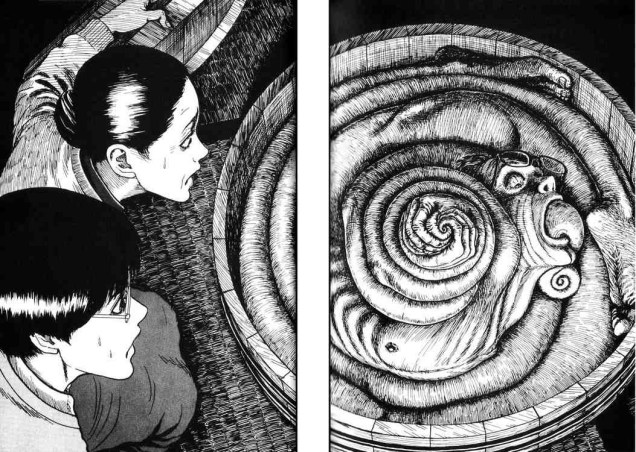
Och fasa, och fasa…

… or whatever the Swedish use for “The horror, the horror”.

I missed Let the Right One In at the cinema, but I made sure to catch up with this well-received Swedish horror movie (that old chestnut!) as soon as possible. And I’m glad I did. It’s one of the most poignant, disturbing films I’ve seen in a long time.

In many ways Let the Right One In felt familiar: the look of the film – the faces, the clothes, the haircuts – was that of an urban Astrid Lindgren without the nostalgia. Critics with a thing for Freudian theory could probably have a field day talking about heimlich and the uncanny and the like; for the purpose of this blog, suffice it to say that Tomas Alfredson’s movie uses the familiarity and banality of the setting to great effect.

And it’s always great to see a film where the main characters are kids that are both well written and well acted, something that only a handful of directors can do. (Danny Boyle comes to mind.) The two protagonists, Oscar and Eli, are two of the most credible children I’ve seen in a movie, which is saying something considering that one of them is a vampire. Let the Right One In especially gets one thing right: its young protagonists are not idealised. Oscar’s reaction to being bullied viciously is a set of violent revenge fantasies not at all uncommon to boys of his age; I know that at times I was one good bullying away from going all Travis Bickle on some of the kids at my elementary school. Eli, the trickier character of the two because there’s no real template (there aren’t too many eleven-year-old-but-they’ve-been-eleven-for-a-long-time vampire girls-who-might-actually-be-castrated-boys that could have acted as consultants for this film), but the writing, the direction and the acting make her work. She’s both utterly believable as a girl (and it’s clear why someone like Eli would fall for her, possibly his first real love) and immensely unsettling as a vampire.

What I appreciate most about the film is how bravely it maintains its ambiguity. The relationship between Oscar and Eli is touching, and the feelings between them seem genuine, but there are enough hints suggesting that the old man Hakan that Eli travels with was once an Oscar. How much of Eli’s actions is actual love, and how much is her manipulating the boy into becoming what she needs him to become? In fact, with her forever stuck at eleven, how much of their continued fate together is inevitable, as long as they stay together? There are hints of Interview with a Vampire‘s Claudia in this thematic strand, but Let the Right One In arguably does something deeper, more poignant with it.

While we’re on the subject of horror: after League of Extraordinary Gentlemen: Century: 1910, I decided to give in to my Alan Moore cravings and got myself the first three volumes of his run of Swamp Thing. It’s fascinating to read these, because you can pick out themes and motifs that Moore later used, usually to better effect. At the same time, while Moore’s Swamp Thing (both the comic and the character) are complex, with richly metaphysical overtones, I have similar problems with it as I have with much of the first volume of Neil Gaiman’s Sandman. Both take the old staple of the horror comic and infuse it with mythology, deeper characterisation than you’d expect from the genre, and a degree of relevance, moving away from pure escapism, but they’re still both caught in the confines of the genre. The end result, at least for me, is a comic that tries to be more than just horror but just about not succeeding.

Still, it’s bound to be better than Wes Craven’s Swamp Thing movie. When all a film has going for it is Adrienne Barbeau’s breasts, well, then…

Swamp Thing (duh duh, duh duh!), you make my heart sing!

You can’t always go back

Before Sunrise seems to be one of those films that ‘people of my generation’ (the moment you use that phrase unironically, you’re getting old, man!) tend to like. Somehow many of them seem to feel that it captures their attitude towards romance and what they wish their EuroRail adventures had been.

Some films should be seen for the first time at a certain age. If you don’t see them when you’re ten or sixteen or twenty-two, you’ve forever missed your chance, and unlike your peers you won’t be able to watch them with a healthy dollop of nostalgia that makes them bearable to begin with. The Goonies is probably one of those films, with its ’80s cod-Spielbergian cast of kids. Having seen Before Sunrise for the first time less than a week before I turn 34 makes me think that this is another one of those films.

Gosh, aren't we all, like, cute and stuff?

It’s quite obvious that the movie itself is enamoured with its leads and their conversations – because that’s all there is. My thoughts, for most of the film’s running time, were, “Yes, I remember those kind of conversations, when I was an undergrad student, at 2am after lots of red wine.” In that situation, those wannabe deep talks are enough – but now? I sat there thinking, “Oh, grow up!” and making fun of the characters’ self-infatuation. Which worked for about ten, fifteen minutes… and then it got boring.

You can capture the feel of a certain age or a certain type of situation. You can do so with lots of affection. But the moment you give up on any semblance of critical distance, you’re likely to end up with something narcissistic – something you can only love if you identify 100%. But especially Julie Delpy’s Céline is way too serious about her ramblings, giving the impression of a second-year Philosophy student (with a minor in Gender Studies) thinking that she’s discovered The Meaning of Life. Personally I found Ethan Hawke’s Jesse somewhat more bearable, because I thought that he doesn’t have this po-faced seriousness, whereas my girlfriend found him way more annoying. Read into that what thou wilt.

On a somewhat more positive note: I received Alan Moore’s new comic this week, the cumbersomely titled League of Extraordinary Gentlemen, Volume III: Century: 1910 (if we want to be exact, we’d have to add the intriguing, Brecht-inspired subtitle, “What Keeps Mankind Alive”). It’s very clearly the first part only of a longer story (parts 2 and 3 are to follow in 2010 and 2011, alas), but differently from Moore’s Black Dossier, he’s actually telling a story in this one. And he’s up to his usual clever intertextual games, his major inspiration for this one being Berthold Brecht’s Threepenny Opera.

And yes, Moore and O’Neill still like a good bit of nudity, although there’s less of the actual sex. Regardless of whether you like that sort of thing or not, Kevin O’Neill’s compositions are gorgeous:

league-of-extraordinary-gentlemen-century-4

And to finish on a slightly less voyeuristic note – checking out the Threepenny Opera before reading Century: 1910 seems to be a requirement:

Second chances: The Claim

Michael Winterbottom’s an odd one for me. I appreciate his talent, and his films clearly don’t compare to anyone else’s – they’re always very clearly Michael Winterbottom films. I like that he doesn’t tell me how to feel about his characters and their actions. At the same time, though,  I sometimes end up not feeling anything much; I watch his films feeling remote and strangely indifferent. It’s as if I have to take a conscious decision to care about his characters.

I first watched The Claim, his loose adaptation of Thomas Hardy’s The Mayor of Casterbridge, years ago. I didn’t dislike it, but the film felt cold and distancing – which wasn’t what I’d been expecting after reading Hardy’s novel. Winterbottom’s earlier film based on Hardy, Jude (wisely leaving out the Obscure part in its title), pretty much came across as an exact translation of one of English literature’s most depressing books into celluloid. (The very ending of the book was gone, but that only meant the film was depressing rather than suicidally depressing.) The original novel came through so strongly, I couldn’t see a director’s handwriting in the film, nor did I need to.

The Claim was perhaps the second or third film by the director that I’d seen, and to some extent it felt like I didn’t fully understand Winterbottom’s idiom. I only got the coldness that crept out of almost every single shot of the film, muting the emotions. Then, some years later, I saw the director’s Wonderland, and while it didn’t turn me into a Michael Winterbottom fan, it helped me see things in his approach and style that I hadn’t been able to see before.

Having rewatched The Claim, I’d say that the film has rewarded my renewed attention. The film is no longer Hardy’s Mayor, but it is a worthwhile take on the original, evoking its own flavour. The casting is pretty much pitch-perfect, especially with Peter Mullan, the go-to man for stubborn, self-destructive men who should know better but who eventually don’t have the strength to act on this knowledge. And the muted, remote style keep the story from becoming melodramatic; instead we’re invited to observe and eventually mourn from a distance. It’s pretty much the opposite of the easy emotions of a Spielberg or a Ron Howard – the film isn’t conventionally touching or moving, it gives you a choice and asks you to act on this choice: will you become involved, or will you remain cold and distant? Do you want to be touched by this? Because, if you do, you need to know that it may hurt. It may get close, closer than is comfortable. That is the proposition the film makes, like Wonderland, and that I’ve come to find not just puzzling but, in equal measures, beguiling.

And if those feet in ancient times

There is much that is cheesy and dated about Chariots of Fire. The Oscar bait heavy inspirationalism. The frequent slo-mo sequences that suggest the film’s director, Hugh Hudson, was a sort of pacifist late 20th century Zack Snyder. More than anything else, that icon of ’80s cheese, the Vangelis soundtrack.

And yet, the film works. Even as I was watching it, thinking how its brand of male bonding would make Freudian critics and queer theorists giggle with glee, how it was manipulative and tear-jerky, I couldn’t escape the pull of its pathos and earnestness, nor its nationalist nostalgia. The latter is easiest to accept, perhaps, as the film’s idealisation of the Britain of Yore nevertheless permits a critical note or two: the anti-semitism of the Cambridge deans, the echoes of a recent war defying patriotic re-interpretation, or the way that one character’s beliefs trump the pride of the British empire even in the face of its future king.

The film even pulls off the Vangelis, although just about (and you have to be willing to accept it as a product of its time), because its synth strains add an intriguingly anachronistic note to the movie’s nostalgia for a better, nobler time – filtered, by now, through our own ambivalent, ironic nostalgia for the ’80s. The movie’s editing, too, helps with its Nicholas Roeg-like fragmenting touches, adding a touch of strangeness to what might otherwise be too reassuringly – and boringly – familiar.

Chariots of Fireworks as a one-off thing: if there was another film like it (and there very well might be – can’t say I’m too versed in sports movies), even if that film was equally well-made, it would feel like too much: too much pathos, too much British nostalgia, too much Inspiration with a Capital I. In itself, the film holds up. At least if you have a touch of yearning for that silly, gentle, noble Englishness that never really existed except in the minds of writers, poets and the people who made the Hovis bread ads.

P.S.: After my long hiatus from this blog, I’ve decided this: I’ll aim for one entry per week. No more, no less. It’d be cool if you stick around to find out together with me whether I’ll manage.

Sick squid? Not bloody likely!

Squid we can believe in!

The short version: I liked Zack Snyder’s Watchmen. It was by no means perfect and there are a couple of pretty bad flaws – mostly to do with the film’s interpretation of Adrian Veidt and the massive cuts in Laurie/Silk Spectre II’s backstory (to the point where there is almost nothing left of the crystalline glory of chapter IX, “The Darkness of Mere Being”) – but it’s the first film version of an Alan Moore comic that takes the source material seriously, even if it doesn’t always completely trust its audience.

One problem that Snyder seems to have, though, is that he’s too much in love with his talents and his cleverness. The use of music was one aspect of this, with too many jokes being used in a winking “Get it? We’re being clever as well as showing reverence to Moore’s original!” And whenever there was something semi-clever, Snyder had the tendency to linger on it for much too long, making these moments smug rather than witty and subtle. The cheesy soft porn scene on Archie? Prime example of that sort of smugness. Moore wasn’t above the occasional broad joke in the original, but they didn’t last for five minutes.

The other thing is Snyder’s propensity for over-the-top violence. Some fit okay, even though I didn’t particularly feel I needed to see a man’s arms being sawn off (not that the original scene with its throat-cutting was that much more harmless – I’ve got a thing about throat-slicing scenes…), but the first fight scene with Dan and Laurie didn’t make any sense story-wise. These two haven’t been wearing their costumes for years, they haven’t been out to beat up street ganes in a long, long time. Their first fight should be clumsy and exhilarating, not choreographed to a T.

My problems with the ending? No, they have nothing to do with Snyder’s re-interpreting the squid into S.Q.U.I.D. I agree that audiences wouldn’t have bought the comic’s finale – hell, I’m not sure I fully bought it, at least not the means by which Adrian executes his plans. What didn’t work was how clean everything was: in the original we’re treated to page after page of the apocalyptic, horrific results of Veidt’s plan. There’s nothing clean about it. Similarly, in the film Ozymandias more or less receives absolution from Dr. Manhattan – and in an utterly inexplicable move, the “Nothing ever ends” line that is so essential to the ending and to Adrian’s character ark is spoken, after her return from Antarctica, by Laurie in a conversation with Dan. As a wise man once said: Huh?!

Final quibble: why, oh why, did they feel the need to change the beautiful simplicity of “I did it 35 minutes ago”?

But still, as I said: I liked it… unlike a certain mustachioed madman.

Who watches the… ah, sod it!

I can’t come up with a clever title for this Watchmen-based blog entry, so I’ll leave the cleverness to others – such as the evil, evil people who created this internet parody:

Okay, after that has seared your synapses, here’s something from the actual film – the very cool title sequence. Enjoy!

If you’re gonna steal…

Okay, no most beautiful and wonderful things in the world in this entry. Instead I’m posting a quick, cheap link to Something Awful (with the usual warning that their humour can be rather off-colour and definitely NSFW). In a twist on their usual Photoshops veering from clever to tasteless to Eww! and beyond, they’ve got Real Books That Look Like Photoshops!

Here’s a sample:

That's just wrong, that is.

P.S.: The first entry on page 5 is wrong on so many levels that I may never be able to eat a flan caramel again. Ever.

Smell disfunctional marriages, can ya?

It’s good to see Leonardo Di Caprio and Kate Winslet in something that wasn’t written by an author whose ideas of romance (and class) are those of a 16-year old. Revolutionary Road is a beautifully, if at times somewhat archly, acted study of a marriage stifled by society and by individual cowardice.

The film could easily have gone wrong – the script isn’t particularly strong, with a number of oddities (e.g. where are the Wheelers’ children? they seem to exist only when it’s deemed necessary, whereas the rest of the time they seem to be locked away in a stasis chamber), clunky lines (“You’re the most beautiful and wonderful thing in the world. You’re a man!” Excuse me, but WTF?!) and hackneyed characters. The mathematician son of a friend of Frank and April’s is basically that old chestnut, the wise fool – but the acting makes him into something more real than the script would warrant.

It takes the film a while to spin on all cylinders and move beyond its conventional story of societal pressures and marriage as an exercise in mutual resentment, but once it does it’s gripping and moving, thanks mainly to Di Caprio and Winslet’s acting. And the ending is effectively devastating as Frank Wheeler surrenders to the quiet dispair, the “hopeless emptiness” of his life.

I was less taken with last night’s episode of Grey’s Anatomy. The series has never been particularly good at introducing new characters, and it’s even worse at giving a send-off to regulars. Dr Erica Hahn’s leaving was handled especially badly, coming across very much as a spur-of-the-moment decision by the producers to axe her and the budding lesbian relationship she’d started with Callie Torres. Similarly, the two new characters weren’t given any lead-in – they were just there suddenly. Especially with Sadie this was done quite insultingly badly; obviously we were supposed to think, “Eh, she really comes out of the blue, which doesn’t make sense if she’s supposedly Meredith’s former BFF, but she’s hot, so whatever…”

And her character Virginia Dixon, a heart surgeon who has Asperger’s Syndrome, highlighted one of the things I’ve come to hate about the series: its manipulative use of music. It’s okay if it’s earned, and they often have a good hand at choosing songs to underline sad moments – but the jaunty comedy music is annoying, especially when what we’re seeing simply isn’t very funny. It’s just a step away from canned laughter. And when the series invites us to laugh at the weird new doctor (after all, the music tells us that this is a comedic scene) to then turn around and have her say that she doesn’t particularly like being made fun of, chiding us for what the episode suggested was the intended reaction? Well, that strikes me as more than just a tad hypocritical.

Skeletor is not a crook (and our little Brad’s finally gone and grown up)

Sorry for that post title. I was going for something clever and intertextual, but after staying up for the Academy Awards I simply don’t have the brains for it.

Did anyone else see them? I was doubtful that I’d enjoy them – but I did, not least for the huge grin on Danny Boyle’s face that grew with every one of his mates winning an Oscar. And his Tigger impression was sweet. I always knew that the man who directed 28 Days Later had to have a genuinely sweet side to him.

Incidentally, the last two films I’d seen at the cinema were among the most nominated titles: Frost/Nixon and The Curious Case of Benjamin Button. A lot has already been said and written about how the latter is practically a remake of Forrest Gump; my only comment on that is that yes, in terms of plot this allegation is absolutely true. But David Fincher, thank the celluloid gods, is no Robert Zemeckis. It’s not his best film, not by a long shot, but it’s a poetic, not a little surreal story about the things and the people we leave behind. As such I found it very effective and another illustration of Brad Pitt growing as an actor with every year.

All things considered, though, I was more taken with Frost/Nixon, perhaps more so because I didn’t expect to be. The first film I’d seen Michael Sheen in was Underworld, which ranks high in my list of worst films ever. (No, Kate Beckinsale in tight leather doesn’t stir my, ahem, imagination any. Sorry, Kate.) I wasn’t prepared for his strong, nuanced performance as David Frost – but I was doubly not prepared for Frank Langella’s sad, pathetic, tragic Richard M. Nixon. Who’d have thought that the guy who played Skeletor in the film version of Masters of the Universe would be this good? I should probably go back and watch those early Deep Space Nine episodes he was in.

What next? Well, I definitely want to see Revolutionary Road and quite possibly Milk and The Reader. And at some point I should check out The Visitor, which garnered Richard Jenkins (yes, that’s right – Nate the Elder from Six Feet Under) a nomination. Ah… something isn’t right if you don’t get to go to the cinema at least once a week!

Cold off the press

Yes, I’m afraid I have to admit that I have been somewhat amiss in updating the blog. My boring, sad excuse? Work. Work, work, work. (I could write an entire scene just using variations of the word, but I think we can all do without that one.

But there are a number of things on my list of Things to Blog About. Even if some of them go back months, they’re definitely not forgotten.

Now, if only I could remember what they are…

The Wire, season 5. Most of the reviews I read were almost a bit embarrassed – yes, the final is good but it’s widely agreed to be the weakest of the series. If it had come earlier it would have been less of a disappointment, but after the potent tragedy, the incisive satire, the sheer all-round greatness of the earlier seasons – well, it felt like The Wire light.

This was perhaps clearest in how the season may just be the funniest of the five, but it lacks a strong tragic counterpoint. Yes, there’s sadness in what happens, even in McNulty’s harebrained scheme, but not to the level of Frank Sobotka’s tragedy, or Bunny Colvin’s, or that of the kids in season 4. And what tragedy there was felt like more of the same, not the deepending of previous seasons. Michael, Dukie, Prop Joe, Omar – they didn’t really bring anything new to the table. As such, season 5 felt less like the last chapter and more like an epilogue. Arguably, the only truly new aspect – the media – lacked the complexity of the series’ earlier depictions of deep flaws in the system grinding up people who try their hardest to get by.

Nevertheless, season 5 worked well as a sendoff to the series and its characters, not least due to its final episode and its uncharacteristic hopefulness. Yes, the system still sucks but – suprisingly optimistic for The Wire – our heroes, the McNultys, Danielses, Michaels, Bubbles, have a chance of surviving, of getting out. Which, in hindsight, may be a touch sentimental… but damn, if it didn’t bring a tear to my eye as I watched it.