Bleh…

Well, guys… I was going to write a blog entry about this:

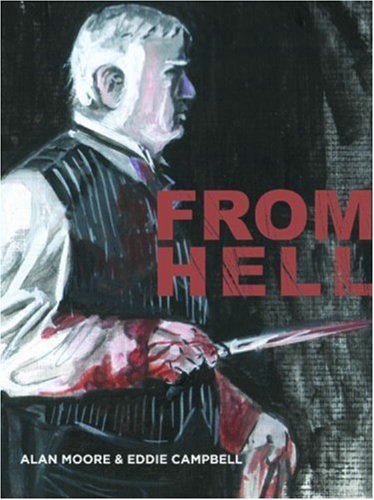
A Family Tragicomic

Instead, the redesign of the WordPress dashboard (the page where you can write blog entries, among other things) has sorta, kinda screwed things up for me. Looks like I have to go and post a couple of pissed off messages on the forums. The really cool thing is that I can upload images quite easily, but when I try to insert them, the “Insert image” button is located below the taskbar – and I can’t move the window so it’s actually on screen.

(“If I can’t insert images, how come I’ve got the book cover up there?” I hear you ask. Well, there’s an explanation for that, but it’s technical and boring. If you really want to know, write a comment and I’ll tell you… what a sad person you are, that is. And then I’ll explain, showing what a sad person I am. Sad but helpful, and rude to boot.)

But here’s a little something so you’re not completely disappointed. And once I’ve figured out how to make things work properly again, I’ve got lots of things to post: the end of Buffy, rewatching Firefly, and the family tragicomic whose cover you can see above. So, without further ado, here’s some nostalgic madness:

Preaching the law of diminishing returns

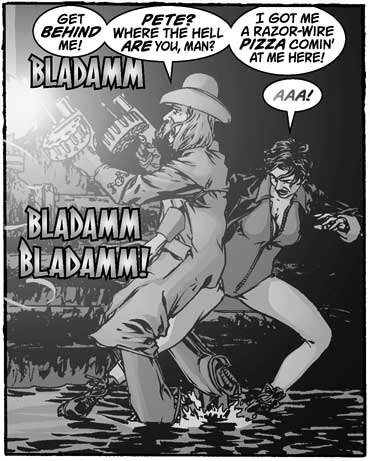
Don’t you just hate it when you get started on a series, and you like it? Quite a bit, even if there are things about it that you’re not quite sure about? So you get the next in the series, and the next – and they’re still good, but not quite as good? And by the time you’re on episode/book/season 6 out of a total of 8, you realise that the series is actually not very good any more, in fact, it pisses you off – but you’re so far into it, you want to know how it ends? Of course you could just find out from Wikipedia, but it wouldn’t be the same. So you get the last one or two parts of the series and hate yourself for it when you read them.

It looks like this is pretty much what is happening with me and Preacher, the comic by Garth Ennis. I enjoyed the first one or two books quite a bit; yes, there was a deeply adolescent streak about the humour, but I liked the ambivalence of the plot and characters, and I liked the mythical/religious background. I liked that it asked many of the right questions.

But then, as the series went on, it dropped much of the ambivalence, became more interested in cheap shots, facile ultra-brutality, trying to shock those that are easily shocked, and trying way too hard at that. Book by book, the characters became less interesting, the morality more cloying and more reactionary. This was one Preacher who was getting decidedly self-righteous.

And now I’ve got the first eight books – of nine, that is. Of course I’m going to get the ninth book, but not primarily because I need to know how it all ends.

Nope. I’m making sure that I’ve got all nine… so then I can sell it better on eBay. At the very least, I can get some of my money back. Yee-hah!

P.S.: In case this entry bored you, feast your eyes and ears on this:

League of Extraordinary Literary Self-Indulgence, part III

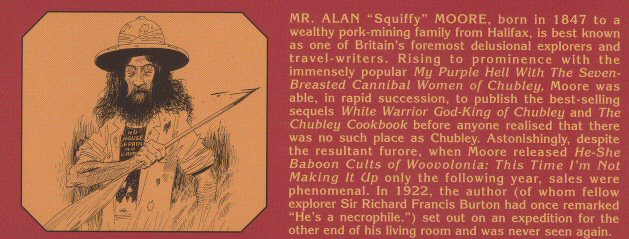
Alan Moore’s latest, League of Extraordinary Gentlemen: Black Dossier (formerly Dark Dossier) has been in the making for a while. It was delayed a number of times, but there was enough information to get any self-respecting Alan Moore fan salivating. Here’s what the Hairy One himself said about the project: it’s

not my best comic ever, not the best comic ever, but the best thing ever. Better than the Roman civilisation, penicillin, […] the human nervous system. Better than creation. Better than the big bang. It’s quite good.

(Gotta love the understatement in that quote…)

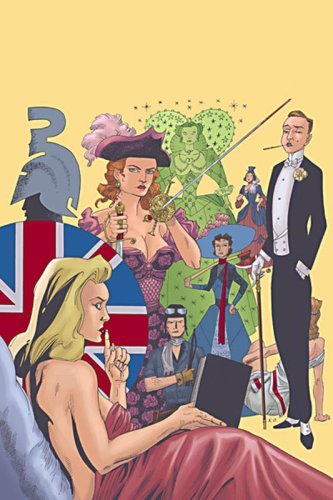
Black Dossier

Now, as I wrote before, what I liked most about the previous League books was that beyond the cleverness and the erudition, Moore told a good tale and he gave us fascinating, ambivalent characters. Those qualities are much less prominent in Black Dossier, which is perhaps less a new League adventure than a companion piece to the other books. (This is probably also the reason why the book isn’t Volume 3 – that one is coming out this or next year, in three installments.) Much of the book is rather an exercise in literary pastiche: there are a number of texts telling of earlier incarnations of the League: for instance the first two scenes of Faerie’s Fortunes Founded, purporting to be a lost history play by Shakespeare  and a prequel to The Tempest, describing the creation of the very first League; the quite hilarious “What Ho, Gods of the Abyss!”, a memoir conflating the Wooster & Jeeves stories by P.G. Wodehouse and the Cthulhu mythos (with the League saving the day); or The Crazy Wild Forever by Sal Paradyse, in the style of Kerouac’s On the Road. There’s also a cutaway drawing of the Nautilus, an illustrated erotic history of a previous League written by none other than Fanny Hill, and Sexjane, a “Tijuana Bible” insert published by Pornsec, the pornography division of Big Brother’s government.

All of this is very witty and very well executed, but without a strong story to connect the pieces, it feels unsatisfying, at least to me. Moore is good at pastiche, but he’s shown this before; and frankly, sometimes reading Black Dossier felt more like hard work. Faerie’s Fortunes Founded especially isn’t one of Shakespeare’s more gripping pieces, and I managed perhaps three or four lines of the Kerouac parody before giving up. Again, if I’d given a damn about the story connecting these pieces (or if I had known not to expect much story at all), I might have enjoyed these pieces more – but it felt at times like Moore added the story without caring that much about it.

Faerie’s Fortunes Founded

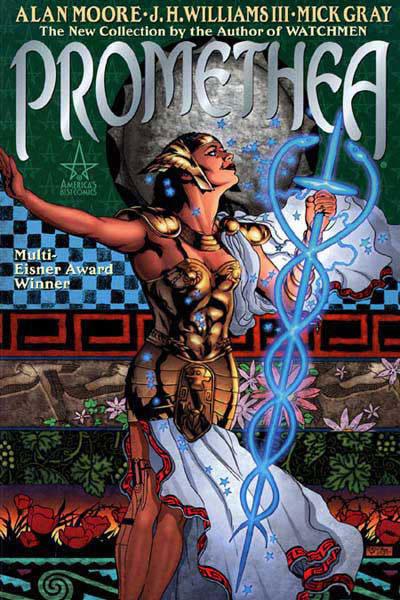
What grated more than that, though, was Moore’s tendency to preach towards the end. In many ways, the last section of Black Dossier (a magnificently executed 3D sequence – tinted glasses are included in the book) is a retread of the last volume of Promethea. Moore’s credo seems to have become something like this: Language equals magic or godhood, because via language we create, out of thin air, things, beings and whole worlds that didn’t exist before. Fiction and imagination, via signs (such as language and images – hence the comic genre being Moore’s chosen form of expression in the League and Promethea), signify freedom from narrow material reality and from those who purport to define what is real. Via language and fiction we ourselves become Creators, challenging those who define reality for us as a means of exercising power.

All of this is nice and good, and I agree with it to some extent. (I think Moore himself is aware of the limitations of this sort of ‘magic’,  where the magic we wield with words can still be vanquished, at least in the present, by the ‘magic’ of those in power, such as force, laws and norms.) What I don’t like is being preached to – especially if I basically agree in many ways with the one doing the preaching. Moore’s writing and his works may be technical tours de force, but increasingly my reaction goes along the following lines: “Yes, I know. And yes, you’re very clever. Can we get on with it now?”

Perhaps it’s also that I think storytelling is a more convincingly, more successfully form of “magic” if it doesn’t preach. Philip Pullman’s His Dark Materials trilogy is a case in point: in the second and third book of the trilogy, the story takes a backseat to Pullman’s soapbox proselytising for atheism. I agree with so much of his criticism of organised religion, and he shows time and again that he is a good writer – but even the best writers are brought down by polemics, above all if they’re the writers’ own polemics.

Volume III

For the third volume of the League’s adventures, I do hope that Moore lays off the heavy-handed preaching for a while. I don’t want to read a third version of Promethea‘s apocalyptic finale. I don’t need to be more convinced of Moore’s beliefs and ideologies. I want him to show that he can still tell a good, clever story with fascinating characters and depth that needn’t be signaled in big flashing letters.

Or otherwise I’ll send Mister Hyde to break his writing pen. (Ouch!)

P.S.: I’ll be travelling for work during the next two weeks, so I can’t guarantee regular updates. I’ll see what I can do, though.

P.P.S.: Miami Vice has now garnered me more than twice as many hits as the next highest search term. What is it with all those people Googling  “miami vice”? Pastel has a lot to answer for…

League of Extraordinary Literary Self-Indulgence, part II

While I think that From Hell and Watchmen (and, to a lesser extent, V for Vendetta – it’s rougher around the edges in terms of tone and style, and its inconsistencies can be a bit jarring) are amazing, rich and exciting works, I have a lot of fondness for some of the comics that are sometimes considered ‘minor Moore’. In many ways, the Moore titles that I’ve enjoyed most are Top 10 and League of Extraordinary Gentlemen.

On paper, Top 10 especially didn’t sound like my cup of tea. I’m not that much into superheroes, so the idea of a whole city of superheroes didn’t exactly appeal to me. Except, of course, if everyone has superpowers, they’re no longer variations on the Nietzschean übermensch. There’s something very humane to the shlubs of Neopolis, where every Joe Shmoe wears a cape and blue-collar shapeshifters rub shoulders with telepaths heading for a boring day at the office.

Top 10

It’s the characters of Top 10, together with its Where’s Waldo? appeal (there’s riches of funny little allusions and throwaway gags on every single page, the little iMac-bot building a snowman being one of my favourites), that make the series come to life. And while much of it is ‘just good fun’ (as if that were in some way less important than deep, large volumes about serial killers and our fascination with evil), there are vignettes in there that are surprisingly touching, such as the aftermath of a teleporter accident in volume 2.

I also enjoyed Promethea, although less so. In it, Moore started to go off on his post-structuralist New Age tangent. And he started to become too infatuated with his cleverness and wealth of erudition, I sometimes feel. The effect is, at least to me, that some of Promethea reads less like a good story with fascinating themes and hidden depths (which it starts out as) and more like an educational comic on magic, tarot, religion and myth with a lot of input from Peter “Prospero’s Books” Greenaway.

Promethea

League of Extraordinary Gentlemen was more in the vein of Top 10, and accordingly I enjoyed it more than Promethea. Again, the characters made it into more than it seemed to be at first (which was a witty, exciting pastiche of Victorian ‘superheroes’ and monsters, deconstructing the cultural politics of the era) – especially the Invisible Man and Mr Hyde turned out to be quite disturbing and brilliantly ambivalent in their depiction.

More than that, though, Moore told a rollicking tale in his League books, perfectly complemented by Kevin O’Neill’s art: the mock-Victorian counterpart to the ’50s sci-fi world of Top 10. It’s ironic that the god-awful League of Extraordinary Gentlemen film is so much less cinematic and exciting than the book… In the first two volumes of the League’s adventures, Moore managed an almost perfect balance between cleverness and erudition on the one side and fun on the other.

Next: League of Extraordinary Gentlemen: Black Dossier.

’s all true!

Best thing since sliced throats

My first David Cronenberg was The Fly, and I was probably 15 or 16 when I watched it. Like so many adolescents, I was into horror movies, although I was never a big fan of gore. The Fly was probably the goriest film I’d seen at that point, and it’s still one of the movies I’ve seen that is most disturbing in its graphic depiction of horrible things happening to human (and simian) bodies.

Yet Cronenberg’s use of violence is very different from the wave of torture porn we’ve had lately, the films that try to top one another with even more grotesque displays of sadism. I wouldn’t say that his films contain gratuitous violence (a strange term, because violence that is supposed to titillate the audience is used for a very clear reason – it’s the only raison d’etre of those films), because there’s nothing cool about it. There is a meticulous fascination with the human body as physical material. There are few directors who show what damage is done to the body when it is shot, stabbed or cut to the same gut-wrenching effect.

Take the hobbit outside and shoot him in the head. Then cut off his fingers and bring me the ring.

There are 3 1/2 brutal scenes in Eastern Promises: two cut throats (one of them a pretty amateurish job, the mere thought of which makes me flinch), a fight between a naked, vulnerable Viggo and two armed Chechens that hurts to watch (and probably hurt to film – where do you hide padding if you’re stark naked?). Oh, and a corpse gets a couple of fingers cut off – but he’s dead, so that hardly counts as violence. Unless, that is, you can’t bear to watch the annual dissection of the turkey at Christmas.

Are all of these scenes necessary to get the point across? I guess that depends on what you think the point is. If Cronenberg is preaching about the brutalising effects of violence, then there’s something about the film that is paradox at best and hypocritical at worst. However, I don’t think that’s what he’s doing. For me at least, he revitalises the sheer physical horror of doing damage to a human body. Violence in films is so often anodyne or aestheticised to the point where you shrug it off. Especially gun violence seems simple: point, click, blam, dead (or maimed… or at the very least shit scared, if you miss). Take a knife to someone and try to take his life, and apart from anything else it’s bloody hard work. Or hard, bloody work. It’s not just a concept, an idea or a theory: it’s a physical, tangible reality.

And strangely, Cronenberg’s films more than those of most other directors remind me just how precious and fragile the human body can be. It’s no coincidence that one of the first images we see in the film is a newly born baby with almost translucent skin, still wet with her mother’s fluids. And later in the movie Viggo, naked and slick with his blood, is just as vulnerable and easily damaged. Forget notions of morals, of good guys and bad guys, of right and wrong: bodies weren’t built to take such punishment, and they shouldn’t. But they do. And Cronenberg – and some of his characters – are strangely, horribly fascinated with this tension.

But enough pseudo-academic blabbering. If the previous few paragraphs make little to no sense, put it down to the fact that I should be in bed. So, good night and see you tomorrow.

P.S.: Don’t worry, I’ll get back to Uncle Alan and his merry band of gentlemen and -women, extraordinary and otherwise, tomorrow.

League of Extraordinary Literary Self-Indulgence, part I

I came to comics fairly late. Of course I read the odd Asterix, Tintin and Disney comicbook when I was a kid, but I never really read those adolescent fantasies with guys in tights and big-breasted caped beauties fighting dastardly villains when not moping about their lovelives.

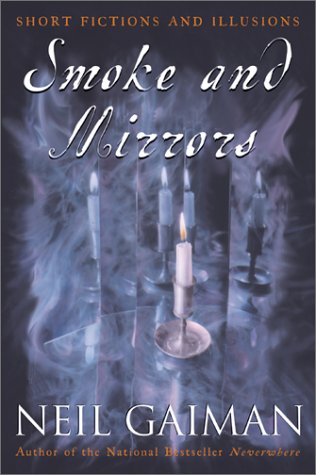
When I was 26, I went to Glasgow for a few months. Being a literature nerd, one of my favourite pastimes was to go to Waterstone’s (or, on my most nerdy days, Forbidden Planet), grab a book or five, sit down on one of the couches and read. That’s when I came across Neil Gaiman’s Sandman. I’d heard of it before, and I’d read Gaiman’s Smoke & Mirrors and Good Omens, the novel he’d written with Terry Pratchett. I’d always wanted to check out Sandman, but since I wasn’t into comics… I didn’t. Until Glasgow.

Smoke & Mirrors

And there, within the space of one or two days, I got hooked on Gaiman’s mythopoetic world. (Yes, I’ve always wanted to use the word “mythopoetic”. Now I have. Life suddenly feels empty.) And I started to think, “Hmm. Maybe there’s something about them there comics after all.”

Shortly after I started looking for other comic book authors of similar renown as Gaiman. Names like Mike Mignola came up, or Daniel Clowes, or (of course) Will Eisner. But the name that came up most insistently was Alan Moore. And the titles that were mentioned were Swamp Thing, From Hell, V for Vendetta and Watchmen. So I got started on From Hell, not knowing what to expect – and got hooked. Yup, the book grabbed me pretty much like a sharp hook to my belly, pulling my insides out. But metaphorically. And in a good way.

Ahem. Anyway, after reading V for Vendetta and then Watchmen (rather unsettling, as I read it just after 9/11), I knew that Moore was my kind of writer.

From Hell

 Next: Top 10, Promethea… and the League.

P.S.: Here’s a little bonus, at no additional charge, for the Neil Gaiman fans among you:

Blue, extraordinary and oh so pulpy

Sorry, guys… Not enough sleep and no coffee make this guy uncreative. I could write something about today’s episode of Six Feet Under (“The Silence”), but then, something about its ending made me feel all blue.

Nate and Maggie

Or should I write about League of Extraordinary Gentlemen: The Black Dossier today? Well, considering that the annotations file on that one is more than 50’000 words long, I think that my review should wait until I’ve had more sleep.

The Black Dossier

So… should I write about Pulp Fiction, which I watched again yesterday, for the first time after years? Thing is, so much has already been written about Pulp Fiction, so I think I’ll just leave it at saying that the film is as fresh and as cool as it was back then (has Samuel L. Jackson ever been cooler?). And here’s a little something to keep you happy ’till the next blog entry:

Look at the size of those eyebrows!

It’s dangerous to go back to the things you enjoyed as a kid after decades, because chances are that you’ll want to tear out your eyes and lobotomise yourself rather than know that, boy, did you have crap taste when you were young!

Going back and watching the ’50s version of 20’000 Leagues Under the Sea isn’t nearly as bad as it could be. There’s still a lot in the film that works: many of the special effects, if not up to scratch nowadays, still have a certain realism, so that the film still looks pretty damn good. This is helped by the underwater scenes and the colour art direction which won an Academy Award. (Makes you wonder what other Academy Awards they gave back then – Best Racist Caricature in a Motion Picture? Best Gratuitous Use of a ‘Funny’ Seal Sidekick? Best Repeated Underwater Performance of Toccata & Fugue As Bach Never Wrote It?) The film’s atmosphere is still cool, and the kid in me still thinks it’d be fun to be on the Nautilus, at least if that Nemo guy stays off the organ playing for a few hours.

At the same time, I never noticed just how clunky the dialogues and much of the acting were. Not that I expect Dostoevsky from a Jules Vernes adventure movie, nor did I think, “This film could do with more Lee Strasberg-type performances…” But at times you wonder whether Richard Fleischer ever bothered  to direct his cast. I know that Peter Lorre can do better, as can Kirk Douglas… and James Mason mainly works due to his eyebrows and his snobbish British accent, which makes lines like “I am not what is called a civilized man, Professor.” quite funny – you expect him to follow this with, “Now let us have a snifter of brandy and read some Shakespeare, shall we?”

And the trained seal and that insufferable “Whale of a Tale” song are evil, I tells ya! Eeevil!

P.S.: Speaking of Captain Nemo, perhaps I should take a day or two to write a blog entry on Alan Moore’s League of Extraordinary Gentlemen: Black Dossier. Very little Nemo in that one, though… Shame.

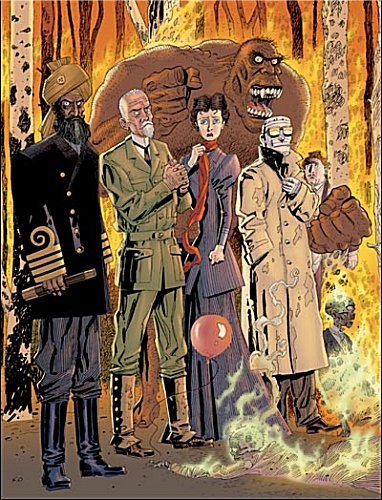
The League, back when things were happy (in a dysfunctional way)

Hellboy is other people

Pamcakes

I like Mike Mignola’s Hellboy – both the comic and the character. I like the audacity of having a character called “Hellboy”, because most people wouldn’t dare… They’d be afraid of looking silly. Mignola doesn’t seem to be afraid of that. In fact, he embraces the silliness that is in the concept, and he turns it into an asset – by making Hellboy a fascinatingly human character. One that struggles with the knowledge that he’s the key to the Apocalypse, but by and large Hellboy is more concerned with things like pancakes.

More pamcakes

Mignola loves his mythology, folklore and the supernatural – but he’s not infatuated with it, to the point where he can laugh about it. To Hellboy, agent of the Bureau for Paranormal Research and Defense, the supernatural is mainly an annoyance: daemons with ancient grudges, monstrous creatures, insane immortal monks and hags in huts on chicken legs are all in a day’s work for the guy, and one gets the feeling that he’d rather sit down and have a beer with most of the goblins and ghouls he encounters… but no, they choose to misbehave, so it’s clobberin’ time. Because if you sit around twiddling your thumbs, before you know it, some wolf decides it’s about time to gobble down the moon, and all that jazz.

Even more pamcakes

Yesterday I got the latest Hellboy collection, The Troll Witch and other stories. It’s entertaining, but like all of the short story collections it lacks the punch of a sustained narrative. It doesn’t show us any new sides of the big red guy with the filed-down horns. Instead, it sometimes feels a bit like an indulgence by Mignola. It’s like he’s recently read about this cool character from Malay folklore, so he does a little vignette: Hellboy meets (and fights) the Penanggalan. However, even if the story was just about Hellboy sitting around, reading the funny pages and watching TV, I’d read it – because I’ve fallen in love with Mignola’s expressionistic, woodcut-like drawings. They may take some getting used to, but I find they add both to the humour and to the ominous and eerie elements. But enough talk – more pamcakes!

Yum!

The first rule of Fight Club

So, I’ve been rewatching Fight Club. (Best way to listen to commentary tracks? Work out while you’re listening to them. You’ll feel like a fit couch potato.) I still think it’s a very funny, very clever and extremely well made movie. But one thing about it tends to annoy me… and that’s many of its male fans.

So many guys I know who like the film buy into Tyler Durden’s fashionable nihilism and reactionary chic. They see the film as a critique of a society that brings forth the silly, ridiculous “Let’s all grouphug and cry into each other’s t-shirts!” self-help groups and subscribe to the “You are not beautiful, unique snowflakes” existentialism that Tyler preaches.

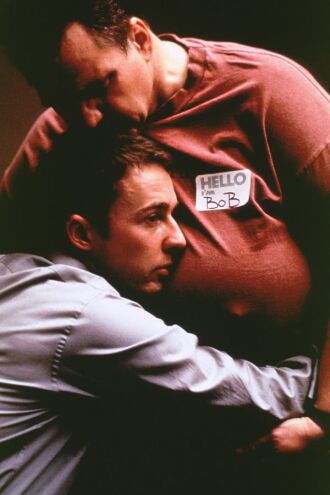
Bob. Bob had bitch tits.

But, essentially, is there much of a difference between the fight clubs and the self-help groups? Aren’t both basically places where people come together, feel sorry for themselves and their lot in life (perhaps even with justification) and then make each other feel better by either hugging each other or beating each other? Aren’t both simply schemes to make you think “Yeah, there’s others out there who feel like me?” The guys who join Tyler’s clubs are losers, and they think that beating each other up and being about as nihilist as a Nine Inch Nails t-shirt turns them into men.

“We’re still men.”

“Yes. Men is what we are.”

The only real difference (apart from the blood and snot vs. tears and snot, depending which brand of self-help group you prefer), it would seem to me, lies in the ideological veneer that covers either. But those guys who think, “Yeah, that Tyler is cool, we’re not beautiful and unique snowflakes, consumerism sucks, and I’d quite like to beat someone’s face into a pulp, because that’ll make me a man” – I’d say that a lot of Tyler Durden’s joke is on them. If you have to beat someone up, or be beaten up, to feel like a man, if you have to demolish coffee shops in order to feel you’ve got a sizeable penis, then good luck finding new teeth.

Rock bottom, and lovin’ it!