When in Arkham…

Sometimes I am just a tad embarrassed to be a gamer. Make that more specific: sometimes I’m embarrassed to be a male gamer. Apart from superhero comics, is there any medium whose depiction of women tends to be this much on the adolescent fetish fuel side of things? Seriously, the average depiction of women in games makes Michael Bay’s female characters and their depiction look positively mature.

One of the games I played recently, the sequelific Batman: Arkham City, is a good case in point, being the offspring of both of those media… and boy, does it ever meet the stereotype. Witness Exhibit A:
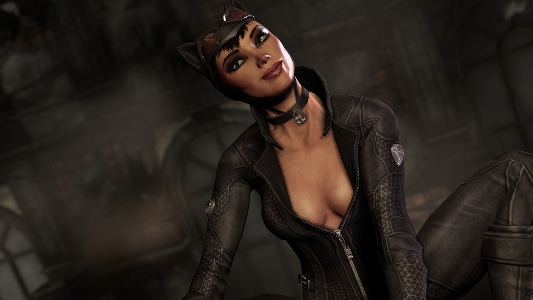
Possibly an argument could be made that Catwoman’s open-hearted display of her, ahem, cuddly kittens is there to distract the various henchmen she faces – but no, seriously. We all know why Ms. Kyle is presented in this way, and it has little to nothing to do with tactical advantages fighting testosterone-riddled thugs.

In comparison, Poison Ivy is almost demure, right? Wrong.
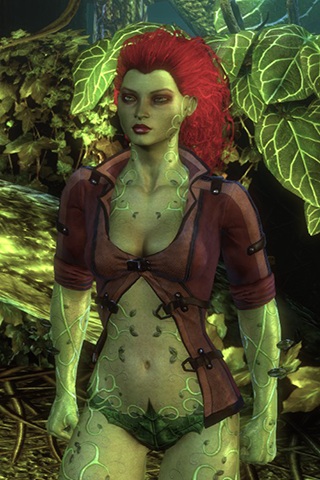
The sad thing is this: in terms of writing, Arkham City isn’t bad, and this includes its female characters. Sure, it’s no Ibsen, it’s pulpy as hell, but within the over-the-top, Grand Guignol genre they inhabit, the characters, their motivations and their actions make sense. And, what’s more, they become surprisingly compelling. I’m not a big fan of comic-book superheroics as such – I like some select examples of the genre,* but I don’t feel any specific attachment or nostalgic yearning for the various Adjective Men and Single Defining Attribute Women bursting out of phone booths in gaudy costumes (and in half the cases practically bursting out of gaudy costumes in phone booths). But over the 20+ hours of playing the Caped Crusader (AKA World’s Greatest Detective – I bet you thought it was Sherlock Holmes, didn’t you? – AKA The Man Who Manages To Remain Po-Faced When People Call Him Silly Names) it’s difficult not to become engaged in the story and in the silly, silly characters.

A large part of this is the voice-acting. Again, we’re not talking about masterclass material – this isn’t Ian McKellen at the Old Vic – but the cast manage to infuse the often pathos-laden, convoluted storyline with wit, humour and, yes, a sense that these freaks in costumes are real. At least for the duration of the game, I found myself wanting to know what happens to the Joker, Rhas Al Ghul, Mr. Freeze and the whole menagerie. Admittedly, I’d still feel a burst of shame if my girlfriend had walked into the room while I was playing with Catwoman (anyone who even thinks of making jokes about joysticks will get a kick in the Johnny Szazs…), but the game almost, almost made me see the appeal of these eternal schoolyard fights that are half semi-mythological epic, half soap opera.

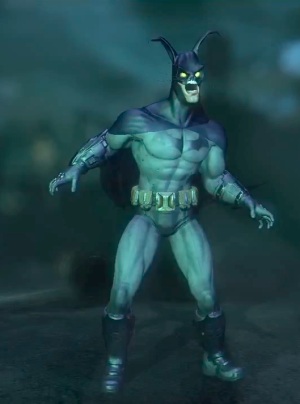
Also: how can you not love a game that features this Donnie Darko-meets-March Hare version of the Batster?
But seriously, folks – this is what Catwoman looks like! Not like two melons pressed into a zip-up leather overall – this is the one, true Catwoman:

*Okay, I’ll come clean. While I wouldn’t call myself a fan of superhero comics per se, I have enjoyed Watchmen, Mark Millar’s Red Son, Joss Whedon’s run on X-Men, Hellboy (does he count as a superhero?), Brian K. Vaughn’s Runaways and Ex Machina, several of Moore’s other ‘science hero’ works, Chris Nolan’s Batman films, and I will want to see the new Spiderman at the cinema, although that’s entirely because of Andrew Garfield. And, hey, good old Jed Bartlett is in it too!
The times, they are a-changin’…

… and the League of Extraordinary Gentlemen is changing with them – but it seems that time is catching up with the League.

When I first read it I wasn’t terribly fond of Alan Moore’s Black Dossier, a source book-cum-smorgasboard of literary pastiche continuing the ongoing tales of some of literature’s strangest, least likely heroes. What I liked best about the first two volumes of the League’s adventures was how Moore combined exciting tales with fascinating characterisation, bringing to the fore the undercurrents of Victorian genre fiction in smart ways: the sexism, the racism, the sense that an Empire was slowly rotting from the inside. I enjoyed how Moore could bring out humanity in his monsters and vice versa. While I appreciated the achievement of Black Dossier a lot more when re-reading it, it’s still mainly a show of Moore’s considerable skills at parody and pastiche. What it isn’t is a strong story.

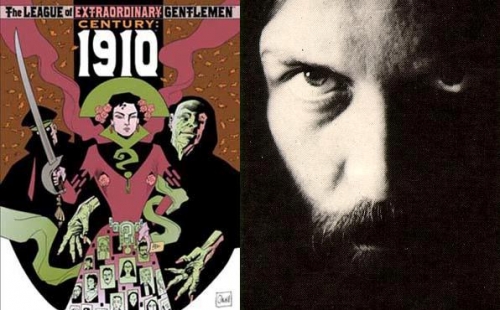
The first issue of League of Extraordinary Gentlemen, Volume III: Century was a lot more centred on telling a story, but it was clearly a first part. Having been a Moore fan since my first trip into his mindscape (From Hell was my starting point, and what a wild ride it was) I trusted that the grand old man of Northampton knew what he was doing, but it was difficult to discern where this was going: the issue was self-contained, but in terms of story it was relatively thin, being more interested in doing a retelling of Brecht and Weill’s Three Penny Opera in the world of the League than in giving us a plot to care about – which was most likely exactly that Moore had intended, in homage to Brecht’s literary politics (or should that be political literariness?).

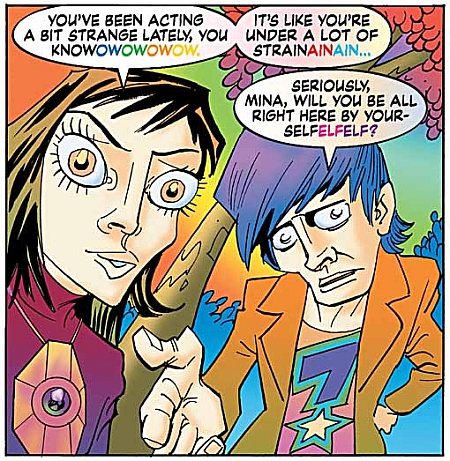
Moore and his League artist Kevin O’Neill are notoriously late with their work; the second issue, 1969 (AKA “Paint It Black”, although I haven’t actually seen that title anywhere in the comic itself) was originally scheduled for spring 2010 but finally came out in August 2011. And while it’s as much of a middle part as 1910 (or “What Keeps Mankind Alive”) was a beginning, it’s easier to discern where the writer is taking this storyline. Arguably, this is the Empire Strikes Back of Century, and it ends with Moore’s dark equivalent (darker even if you take in the appendix) of Han frozen in Carbonite. It’s quite surprising how an artist who in an interview boiled down his Lost Girls to “Make love, not war!” (I’m sure Moore was fully aware this was an oversimplification) presents such an ominous version of the Age of Aquarius. This is not the Summer of Love so much as a wicked, clever Nicolas Roeg-inspired romp that spirals out of control and ends in madness, mayhem – and a certain unexpected character vanishing into a wall at Kings Cross Station. That’s right, Moore brings a certain someone from a much beloved franchise into his storyline and gives him a prominence that proves surprisingly effective.

What’s next for the League? 1969‘s epilogue, set in a punk club in the ’70s, with Mina out of sight and literally out of mind, Alan Quatermain back on the drugs that almost killed him and Orlando (female once again, although far from feminine) giving up on his erstwhile friend and lover, suggests that the third issue – to come out next year, if Moore, O’Neill and the gods of publishing prove kind – won’t start in a happy place. The issue’s title, “Let It Come Down”, doesn’t exactly sound optimistic, does it?

And now, guys and gals, make sure to pray to your 2nd century imaginary sock-puppet hoax of a snake god that the book comes out while we still remember what happened before, okay?

Funny how? What’s funny about it?

I like Ian McEwan. Atonement is one of my favourite novels of the last ten years. Enduring Love has stayed with me, as has On Chesil Beach. I even enjoyed Saturday, which was given not so much a panning as a resounding “Hmm” after Atonement was loved by pretty much all the critics.

I just don’t think he’s a particularly funny guy.

Back when his Amsterdam received the Booker Prize in 1998, I remember many people saying that they were making up for not giving him the year before, for Enduring Love. Obviously Arundhati Roy’s God of Small Things was more than deserving, but there was definitely something that felt off about giving McEwan the Booker for Amsterdam – a book both slight (more a novella than a novel) and, at least in my opinion, not particularly good.

Amsterdam feels a bit like one of those Roald Dahl stories for adults – people who aren’t particularly nice getting themselves into shitty situations and digging themselves in further the more they try to extricate themselves, doing damage to themselves and to those around them who are usually as unpleasant as they are. There was even a nasty twist in the tale that felt very Dahlish. The thing was, though: Dahl’s stories, while nasty, are also funny. McEwan’s attempt at a joke felt too elaborate, overwritten, and simply not particularly amusing. It felt snide, smug and not a little self-satisfied… and essentially forgettable.

Fast forward twelve years, and it feels like McEwan’s pulled another Amsterdam – though one that dresses itself in topicality. Solar is about a physicist, ageing, fattening, roundly unpleasant but with enough of the hypocritical charm that Brits of a certain class seem to have to bed a number of fairly attractive women. For better or for worse, he ends up occupying himself with climate change and trying to make his name in the growing eco-business. Oh yes, he also frames an innocent man for murder, goes on an Arctic expedition, steals a dead man’s research and generally makes the reader – well, at least this reader – wish that he’d get eaten by a polar bear.

I’ve read articles that described Solar as “laugh-out loud funny”. A friend at work read and loved the novel. And, as I mentioned above, I generally like McEwan a lot. He’s a smart, usually subtle writer – not necessarily original, but great at his craft. But again: when McEwan aims for satirical humour, his writing falls flat for me. Solar displays his craft – McEwan can turn an elegant phrase – but it feels as smug as Amsterdam. The targets of his satire are obvious, his humour considerably less clever than it seems to consider itself; there’s an unpleasant feeling of the novel going, “Did you see that? Wasn’t that funny? Wasn’t that clever?” Solar is neither sharp and nasty enough to be good satire, to my mind, nor does it have an interesting plot or characters to keep me going. I finished it, of course, since a novel almost has to throw up all over my Criterion DVDs to make me put it aside without finishing it, but this overlong, heavy-handed, one-note joke of a novel overstayed its welcome roughly 20 pages in. Perhaps I don’t have enough of a sense of humour, or perhaps I should avoid Mr McEwan’s humoristic writing like the plague, but one Amsterdam was enough for me… and at least that one was only about a third of Solar‘s length.

On the more positive side, though: I recently re-read Kazuo Ishiguro’s The Unconsoled and didn’t like it any more the second time around – but I’m warming a lot more to his Never Let Me Go. Part of me wishes I’d been able to read it unspoiled, but even knowing what I do about the novel’s plot I’m enjoying it a lot, much more than either some of Ishiguro’s earlier work or McEwan’s attempts at amusing me. Here’s hoping that this doesn’t mean my next read afterwards has to be another failure!

P.S.: I wasn’t amused to find the old, worn out crisp/biscuit-eating anecdote in Solar, but I did like the meta-absurdity in which it’s developed in the novel – and I was happy to see Douglas Adams (R.I.P.) referenced.

One for the road…

No, this isn’t another post on The Road. (I’ve written interminable entries about one Nick Cave-scored film, I don’t need to add another one at this time.) It’s about the book I’ve just finished reading: Must You Go?, a memoir by Antonia Fraser about her life with Harold Pinter. I’m usually not much into memoirs and biographies – I’m very much a fiction reader – but this one was a present from a friend, and a fitting one; I’d directed that friend in a student production of Pinter’s The Dumb Waiter 13 years ago.

Fraser’s book is eminently readable, even if during the middle third or so it feels like it consists primarily of encounters with famous people and praises of Pinter’s writing – though obviously one wouldn’t go to a widow’s memoir for an in-depth appraisal of an author’s literary output. Must You Go? is also a sad book, as its final 100 pages lead up to the death that answers its titular question in the depressingly affirmative. But throughout the book there are passages that made me smile, grin and every now and then even laugh out loud. And there’s something so wonderfully British about the diary entry that describes what happened after Antonia Fraser told her husband at the time, Hugh Fraser, about her affair with Harold Pinter:

In the end I summoned Harold round. He drank whisky, Hugh drank brandy. I sat. In a surreal scene, Hugh and Harold discussed cricket at length, then the West Indies, then Proust. I started to go to sleep on the sofa. Harold politely went home. (p. 23)

On serendipitous finds

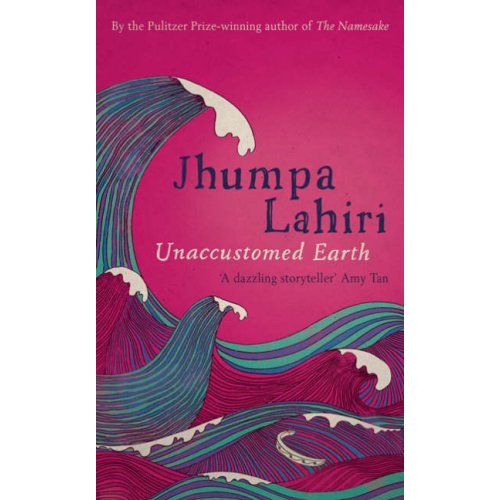
So there was the book, on top of my “to read” pile. An uninviting purplish-pink (dare I say ‘magenta’?), with some turquois waves, looking a bit as if it had been designed on an old CGA screen. The title was a bit more intriguing: Unaccustomed Earth, by Jhumpa Lahiri. I’d read some Lahiri years ago when preparing for an exam, or at least I thought so, but I couldn’t remember the first thing about it. For all I knew, I’d put the book on my reading list and then forgot all about it. Just as I’d forgotten why I had this book. Did I buy it, and if so, why? Had it been given to me as a present? (… perhaps by someone reading this blog, in which case I will be duly embarrassed?)

I picked it up and started to read it, more due to a vague sense of obligation than anything else. My bleeding heart pinko liberal Spidey senses were telling me that it’d be good for me to read this, as it’s good for me to eat spinach and the like.

Unaccustomed Earth, I’m confident to say after having read it, is one of the best books I have read in the last ten years. Lahiri’s use of language is economical but never stingy, precise but not fussily so. Her characters feel real, but not because of the accumulated weight of details that you get with other writers; she deftly sketches their personalities with an elegance that is humbling. And her plots, while deceivingly simple, often carry a sting that is quite devastating.

I have an ambivalent relationship with short story collections. They’re often moreish, like a pack of Toffifee – one is so short and light that you’re sure another one won’t hurt… and then another, and another. And then you’ve had too much and feel faintly sick. There was no such moment with Lahiri’s stories – also because, unlike some other collections, it doesn’t feel like she’s belabouring a theme. There are motifs that are touched upon in all the stories, mainly because the majority of characters are the children of Indian migrants, but the book is definitely not dully monothematic.

Most of her stories are sad. They’re not grand tragedies (except, perhaps, for “Hema and Kaushik”, the final three-part story that almost qualifies as a novella), but loss runs through all of them, and more than once did I find my breath taken away by the feelings Lahiri evoked.

If you haven’t read any Jhumpa Lahiri, or if – like me – you’ve read her before but simply can’t remember whether you like her or not, give yourself a gift. Buy Unaccustomed Earth. Put it somewhere on your “to read” pile, preferably towards the bottom. Forget that you ever got the book and come upon it as if by accident. Give it a chance. I’m willing to bet you won’t regret it.

P.S.: If I did get this book as a present from someone reading this blog: thank you, thank you, thank you!

P.P.S.: After this one, I will definitely have to revisit The Interpreter of Maladies, if only to find out whether I did indeed read it. If so and I found it forgettable, the pre-exam pressure of “Gotta read x books by the weekend! No time to enjoy!” may have been to blame.

Insert guest blog here: David Nicholls

The following blog entry was written by that most elusive of creatures, mege1, whom you may remember from blog entries such as this one. Unfortunately, tech gremlins prevented him from posting the entry himself, so I’m doing it for him, in between holidays. I’ll be back for good in a little over a week, at which point I’m hoping to post something witty, insightful and not at all redundant about Seven Samurai and The Magnificent Seven. The Goofy Beast – Always Ahead Of The Curve When It Comes To Being Behind.

Let’s get one thing out of the way first: Yes, David Nicholls’ books all have the same basic plot: Boy and girl seem to meet and to start liking each other, but there are obstacles and pitfalls. Hackneyed, you say? So what? You see, there’s that book about a mad captain who goes after a white whale. Oh, and another one tells us about a guy on who is stranded on an island. Boring, isn’t it? On the other hand, do you really read books for their plot? If you dismiss each and every book on the grounds of it being another love story, then an angry mob consisting of irate live readers, dead writers and led by Will Shakespeare and Jane Austen wants to seriously haunt you.

It is also blindingly obvious that David Nicholls and Nick Hornby are perfectly comparable: Both borrow heavily from contemporary music, film, and pop culture trivia; both know how to bring in a joke whenever they feel like it. Both are not likely to end up on any serious reading list, but what of that? They don’t aspire to be, I imagine.

Nicholls’ debut, Starter for Ten, is about a teenager leaving home and going to University and falling for a rather posh and glib beauty. They both end up on the hopeless team for that game show, University Challenge, and it’s clear from early on that his clumsy courtship will go unanswered. But man, can Nicholls tell you a story. The whole book is full of comedy, but at the same time, all the characters are believable and right there on the page. My main delight is the scene during that night when the teenage lover-boy is invited to the girl’s parents’ holiday cottage, gets stoned and goes for a glass of milk in the middle of the night. For reasons better left explained by the novel itself, mum and dad turn up naked in the kitchen. It could have been raucous, it could have been clumsy and slapstick-y and awkward, but Nicholls handles that moment with wit and grace – as much as there can possibly be, anyway.

The Understudy uses a lot of Nicholls’ first-hand experience as an actor. (Nicholls has pretty much given up on acting and has switched to writing screenplays – and novels, obviously). The man from the title plays extras like corpses and bystanders and is also the understudy of a conceited movie superstar who plays Lord Byron in a London stage play. The understudy falls in love with the star’s wife while keeping quiet about the star’s flings. Again, the plot may not prompt you to pick up that book; it’s in the telling. Nicholls gets a lot of the backstage atmosphere of a theatre right, at least as far as I can tell. He is not afraid to show wayward or obnoxious traits of a protagonist you are supposed to like for most of the time. The understudy starts lying, not because he’s selfish, but he wants to protect someone else and so digs himself deeper into the Pit of Failed Actors. And that, as we all know, is a deep pit indeed.

Nicholls’ latest novel, One Day, seems to be all the rage. Nicholls himself has taken on the noble task to turn it into a Hollywood screenplay, a situation he has rendered with all the acerbic wit necessary in his previous novel. One Day, again, is about a girl and a boy who almost sleep together on the night after their graduation; the novel goes on to tell us about what happens every 15th of July for twenty years. That’s quite a good concept to avoid lengthy bits, and it also allows the author to bring in all kinds of pop trivia. This novel here is more serious in tone, although there are enough comic elements left. While the first two novels can be read during a longish train ride, One Day has the good instinct to delve into the two protagonists’ psyches. All three novels are great reads, by themselves, but also if you’ve come out of some serious reading of Literature with a capital L, like I have. Go on now, have some fun. Any day now, David Nicholls’ novels will be part of pop culture. You’ll know when his name or the name of one of his novels are the answer to some question on some televised game show.

You know, for kids!

Alice in Wonderland (and its sort-of-sequel, Through the Looking Glass) is an odd book, and my memory of it is just as odd. I can remember liking it, but when I try to remember the book, what comes to mind is John Tenniel’s illustrations, images from the Disney movie, scenes from Jan Svankmajer’s surrealist dream/nightmare – or, more recently, American McGee’s Alice with its twisted, dark Wonderland and music by Chris Vrenna.

Anything, but not the actual Alice in Wonderland. The original has become a sort of collection of memes: the Mad Hatter, the Cheshire Cat, the Jabberwocky. It’s a hypotext whose influence throughout literature, cinema, comic books, video games etc. is strong, but Alice itself has become distorted and murky behind all the copies, pastiches and parodies.

Tim Burton’s most recent film is called Alice in Wonderland, but it’s less of a direct adaptation than a hodgepodge of half-digested ideas and images from over 100 years of Aliceology. Like most of Burton’s films, it looks gorgeous, but like too many of his recent movies it feels like warmed-over Burton, down to the Danny Elfman score. The visuals are admittedly cool (and I have to admit that I watched the film on a BA transatlantic flight – small, fuzzy screens aren’t the best way to appreciate a Tim Burton film), with some fantastic character design, but the plot is predictable, the dialogues leaden and most of the acting vanishes behind the CGI. It’s as if Burton was given a beautifully surreal world but basically decided to tell Generic Fantasy Story X in this world. Despotic ruler, check. Chosen one, check. Needs to discover her powers and believe in herself, check. Special blade, check.

It’s a shame that such a creative, talented cast and crew could have come up with something that combines Lewis Carroll’s original story and Tim Burton’s sensitivities in weird and wonderful ways – but Burton’s sensitivities at this point seem to be a pale shadow of his earlier creativity. Worst of all, the man seems to have gotten old the way that Steven Spielberg has gotten old, meaning that in creating something that should burst with childlike energy and wonder, he’s come up with something that feels like a director in a midlife-crisis trying to pander to what he thinks is youthful and energetic. The worst example of this is the dreadful dance the Mad Hatter does towards the end of the film: even Johnny Depp with his considerable talent and charm can’t make it into anything other than an awkward attempt by the film to be ‘cool’ and contemporary.

Anyway, enough about Alice in Wonderland. I may get back to my 12 hours of blurry free films at a later date, but for now I want to leave you with this strange, strange video telling the Complete History of the Soviet Union through the lens of Tetris:

Fool me once…

Yup, I know… For one thing, it’s been ages since I last posted an entry. Shame on me. For another, April 1 has been and gone, so this is pretty late. Still, it bears reposting for the sheer geeky awesomeness: comic book publisher Top Shelf posted the following update on Alan Moore’s League of Extraordinary Gentlemen last Thursday. Shame it’s a joke.

Here’s the blurb they came up with:

When war-hero-turned-handyman Kesuke Miyagi is found drained of blood, it becomes clear that the occult gang known as the Lost Boys are targeting the only individuals that can stop them from complete domination of America. It’s the perfect case for the League of Extraordinary Gentlemen–except that their government contact, Oscar Goldman, disbanded the team in 1979 after they defeated Mr. Han’s army of the living dead.

Now, disgraced scientist Emmet Brown has to put together a new team to combat the growing threat of the Lost Boys and their leader, a newly resurrected vampire kingpin Tony Montana: Transportation specialist Jack Burton, ex-commando B.A. Baracus, tech wizard Angus MacGyver and the mysteriously powerful femme fatale known only as “Lisa.” But will Brown be able to stop the Lost Boys before time runs out?

On a somewhat less fun note, apparently the next real chapter of LOEG has been delayed until 2011. Bother.

Love, death, life and the silly sublime

To be fair: watching The Fountain recorded from digital TV, the compression turning any dark scene into black (“none more black”) with a handful of flecks of light, isn’t really the best way to see the film for the first time. Darren Aronofsky’s follow-up to his much-lauded Requiem for a Dream, the kind of film even I can’t describe as bitter-sweet, is intensely visual, and if the first five minutes turn into a frantic game of “It’s a… it’s an elephant, I think. A black elephant. At night. No, it’s a spaceship. At night. And it’s black. Is the TV on?”, the film suffers. (Or, depending on how you look at things, the audience suffers.)

The rare moments when I could not only see what was going on on-screen but actually saw enough of the image to appreciate it, the film definitely proved to be a feast for the eyes. And it wasn’t just pretty – much of what Aronofsky shows us is evocative and beautiful. (Pretty is to Beautiful as Liv Tyler is to Cate Blanchett, if you ask me.) There’s one image in particular, Queen Isabella’s chamber lit by hundreds of tiny lamps hung from the ceiling, that I found quite stunning.

Kitschy or sublime? You decide.

But while some of the imagery is sublime, some – especially in the last half hour of the film – are plain silly. I don’t mind the latent (or not so latent) ‘New Ageyness’ of The Fountain, because as a visual poem on love, death and a man’s inability to let go the film works for me. But then you got bald yoga master Hugh Jackman in the lotus position, floating towards some cosmic birth canal, and awe is replaced by incredulous giggles. Same goes for the scene where Jackman, as a Spanish conquistador, is consumed by flowers sprouting from his torso as if he was the world’s sexiest, silliest Paul Daniels magic trick. I get what the scene’s trying to do, but it just looks… well, naff. Combine that with the film’s po-faced tone and the film doesn’t do itself any favours.

At some point I hope to watch the film again, with subtitles (so I can figure out what those Spaniards are shouting in the rain) and adequate visual quality. I expect that it’ll pull me in more, which in turn might make me forget (or at least forgive) the unintentional humour of scenes that would have had Dr Manhattan raise one implacable, blue eyebrow. Clint Mansell’s lyrical score will definitely help – it did the first time, to the extent that I was more captivated by the end credits than by what had been going on ten minutes before.

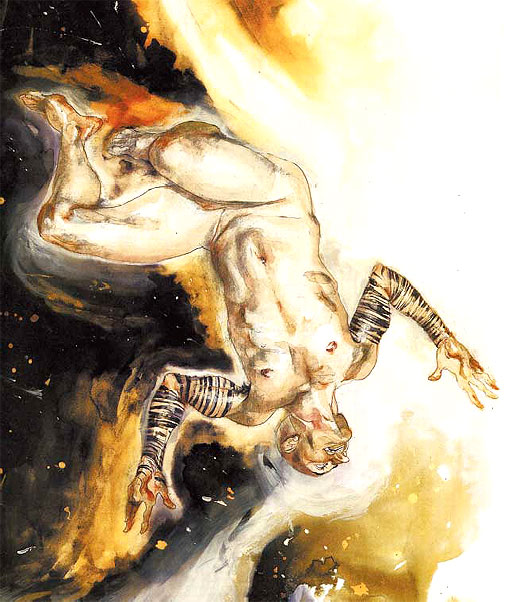
Right now, though, I think that The Fountain works much, much better as the comic book version, which the script was turned into after a first attempt to film it failed. It has all the elements of Aronofsky’s movie, but what looks silly in the film works much better in the stylised drawings (somewhat reminiscent of Dave McKean’s work on Arkham Asylum, although less abstract). It still borders on New Age kitsch, but as far as I’m concerned it pulls it off. Perhaps the best thing would be to read the comic while listening to Mansell’s soundtrack. And, if that’s your cup of tea, fantasising about Hugh Jackman.

Naked dude floating in space. Trippy.

P.S.: Much more nudity in the comic. (Both Rachel Weisz and Hugh Jackman remain chastely dressed throughout the film.) But it’s artistic nudity (“and in the end, isn’t that the real truth?”). And not even close to the full-on pornography of a Lost Girls.

Spiraling down towards madness

I don’t really know much manga. Yes, I’ve read Akira, and I quite enjoyed Osamu Tezuka’s Buddha, but other than that I simply haven’t read much. In addition, other than the original Dark Water I’m pretty ignorant about Japanese horror (other than having read reviews, and reviews of the American remakes – I don’t know anything, basically, I just meta-know!).

When I read about Junji Ito, though, I was intrigued. I don’t know what it was – the chills that his works evoked among the people who had read him, the single panel someone had posted? Perhaps it was just that I had time on my hands.

So I checked out Uzumaki. And I’m glad I did. But yes, some of it will haunt me.

Differently from the Western horror I’ve watched or read, Uzumaki doesn’t go for full-on naturalism that is then invaded by some uncanny creature of the beyond. From the first, there’s something weird and uncanny about his stories. Is it that the people who become obsessed with spirals in the story are going mad, or is there something more to it? There is something obsessive in the storytelling itself, as each chapter takes us further down the spiral.

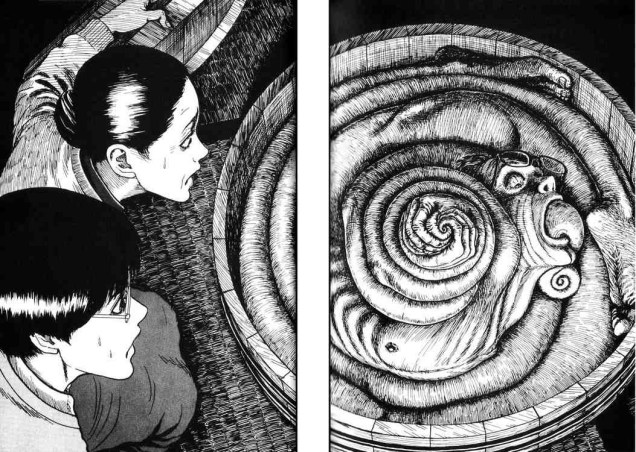
There are bits that are gruesome and gory (in moderation), but those aren’t really what had most of an effect on me. It’s the surreal that somehow becomes frighteningly compelling as it invades every aspect of the manga – there are overtones of Kafka, as people turn into giant snails, but there’s also something creepily funny about some of the chapters. It’s unsettling, to say the least.

So, if you’ve got time on your hands, you may want to check out Uzumaki. Beware, though – it is addictive, it is unsettling, and it may just burrow into your mind and leave little, spirally holes, as if someone had taken a corkscrew to your frontal lobes.

I made that last bit up...

Or did I?