They create worlds: Alien: Isolation

One of the things that video games can do magnificently is create worlds. These posts are an occasional exploration of games that I love because of where they take me.

When I was a kid playing pirated games on my beloved “breadbox”, the C64, games based on movie licences tended to be ubiquitous, largely interchangeable and mostly dire affairs. Whether they were mediocre shooters or bad action adventures, if it wasn’t for the title screen and (if we were lucky) a bit tune rendition of the movie’s theme, it’d be well-nigh impossible to know that what you were playing was supposedly an adaptation of Licence to Kill (yes, those two dozen huge pixels represented Timothy Dalton) or Platoon (a surprisingly enjoyable action game, albeit one that dropped the film’s anti-war angle in favour of some more mass market-friendly Vietcong shootery). Whatever connection there was to the films that purportedly inspired the games ended up being mostly imaginary.

Alien: Isolation Continue reading

I’m Walkin’, Yes Indeed

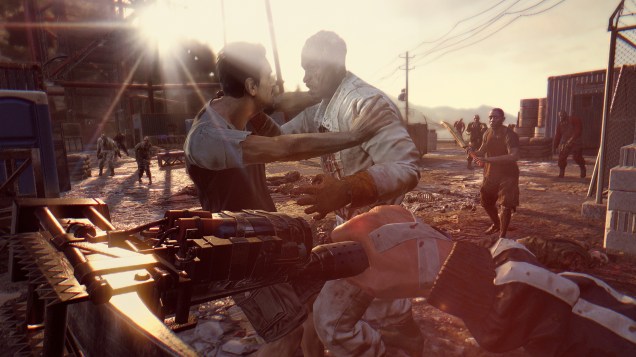
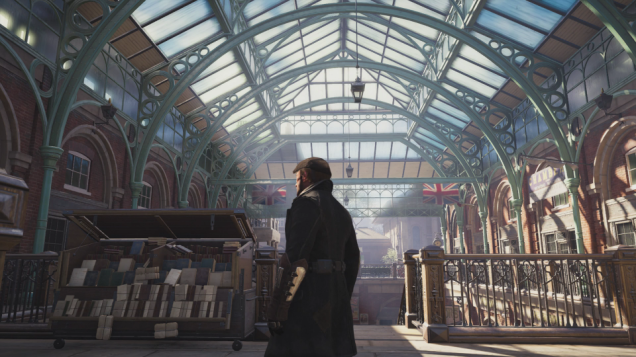
In video games, you’re usually in a hurry. You’re saving the world, trying to save the president’s daughter – or, on the other side of the spectrum, you’re running away from the cops after robbing the First Bank of Los Santos or, if you’re less criminally inclined, a horde of infected intent on tearing out your throat. Under these circumstances, it makes sense that the player’s first instinct is to look for the run button or sprint command. More than that, though, so many games are about getting from A to B. This kind of behaviour is reinforced by secondary objectives like “Get to da choppa in less than 2:00” or by rewards inversely proportional to the time you took to do what you were supposed to.

Assassin's Creed Syndicate Continue reading

Making for a Happy Medium

While it should be self-evident that different media allow for different kinds of storytelling and different forms of expression, it’s good to be reminded of this in enjoyable ways in this Age of Adaptation, where so many films, TV series, games are adaptations of material in other media. Last week I saw the London production of Gypsy, which was brilliant, startling – and a great example of a story that works best on stage. We’d previously seen the ’60s film version of Gypsy, which works well in its own right, but it’s on the stage that the story came truly alive.

Gypsy Continue reading

War games

I was predisposed towards liking Valiant Hearts: The Great War. I mean, here’s a game about a war that is rarely seen in video games (the First World War), there’s no shooter gameplay in it, it is not about winning, the game has a distinct anti-war streak, the overall tone is melancholy, and Valiant Hearts even does a good job of educating its players about WW1 without turning into a moralising lecture. Whereas the vast majority of games set in wartime put you behind a gun or inside some vehicle equipped with guns, Valiant Hearts is largely pacifist in its leanings. Its protagonists are French, German, Belgian – and canine, since I hesitate to assign a nationality to a dog… as does the game, to its credit.

Valiant Hearts Continue reading

They create worlds: Assassin’s Creed

One of the things that video games can do magnificently is create worlds. These posts are an occasional exploration of games that I love because of where they take me.

I’ve walked the Holy Land at the time of the Third Crusade. I’ve explored Renaissance Florence, Venice and Rome. I have crossed the cupola of the Blue Mosque. Five minutes ago I was scaling Notre Dame de Paris.

Allegedly I’m an assassin, member of an ancient order whose creed is “Nothing is true, everything is permitted.” This is what I really am, though: a tourist. And I’m loving it.

Ah, Venice. (Avoid the dwarfs in red raincoats.)

Continue reading

They create worlds: Fez

One of the things that video games can do magnificently is create worlds. These posts are an occasional exploration of games that I love because of where they take me.

I love exploration in games. I love it when developers create virtual worlds that hint at a story about its history and inhabitants: the shack in the wilderness with the single plate on the table and the gravestone in the back garden; the eerie, sparsely lit alleys with people whispering for you to go away and leave them alone; the ornate mansions with their ostentatious displays of wealth and the secret compartment hidden behind the owner’s portrait; the desolate, windy  good at creating memorable characters, but their biggest strength for me lies in creating places.

Continue reading

They create worlds: Grand Theft Auto

One of the things that video games can do magnificently is create worlds. These posts are an occasional exploration of games that I love because of where they take me.

Rockstar Games’ Grand Theft Auto series has received a lot of flak, from all sides of the political and ideological spectrum. They aspire to being The Great American Satire, and sometimes they achieve moments of wit and insight, but while they’re great games, all too often as cultural critique they resort to lazy, crass caricature that says little more than, “America, huh?”

iAxXlG-dCEaUueypHMWaXg_0_0_recut Continue reading

They create worlds: Journey

One of the things that video games can do magnificently is create worlds. From the satirical real-world analogues of Rockstar’s Grand Theft Auto series to the historical simulacra of Assassin’s Creed infused with secret meaning, from Super Mario‘s candy-coloured vistas to the stark alien worlds of Metroid: in games we can experience spaces that are uncanny twins of real places or that are thrillingly new. This isn’t exactly a series of posts or a new feature as an occasional exploration of games that I love because of where they take me.

One of these games is Journey, originally developed by Thatgamecompany for the PS3 and now available for the PS4. In terms of its gameplay, it’s a simple game, almost entirely devoid of challenge; it has also been called an ‘art game’ and I’m sure there are some who would even deny it’s a game to begin with, for some reason or another. It wonderfully evokes a sense of place, though: in Journey you’re a lone traveller, perhaps a pilgrim, marching onwards towards the distant mountain through deserts, among abandoned ruins, across the bottom of the ocean and up snowy slopes towards the goal that keeps getting closer even as it remains tantalisingly out of reach.

Journey

While the actual virtual locations are fairly small and can be traversed in a few minutes, they come alive through a wonderful blend of the real and the imaginary. Visually, Journey has a minimalist but beautiful style, using strong colour contrast and simple shapes to evoke less real places than our dreams of such places. There’s a sparsely surreal quality to the deserts you travel through early in the game, as if Lawrence of Arabia‘s vistas had been reimagined by Giorgio de Chirico. At the same time, the place is tangible: you leave behind lines in the glittering sand as you move through it, sliding down dunes. There’s a tactility to these environments and your place in them; late in Journey, as you travel up the mountain towards your destination, the cold wind holds you back, slowly freezing you in place. Journey‘s spaces feel both alien and real – these are worlds you could otherwise only explore while asleep, but you feel the sand between your toes, the snow on your face.

Journey offers fairly little in the way of interaction to its players, its chief method of interaction being movement, and the game gets that very right. The player avatar becomes a part of the world, where in a lesser game that avatar feels superimposed on it. Other than walking around, the player can also fly, though this power is very much limited and feels less like the kind of power fantasy common to gaming than like a moment of freedom – again, very much like in dreams. There is one more thing the player can do, though, and that’s where the world gains a dimension: he or she can sing… and if others are around, they will hear that song. Journey is a multiplayer game, but it’s a most unusual one: on your pilgrimage to the mountain, you encounter other pilgrims, looking exactly like you. They walk, fly, and they sing; where one pilgrim may chirp in short, playful sounds, another may hold a note, almost as if inviting you to join voices.

It’s strange how other people can make a virtual space in a game feel more real, but that’s definitely how I experienced Journey. It’s maybe a bit like Marianne Moore’s “Poetry”, which talks about “imaginary gardens with real toads in them”: if you inhabit a world of the imagination with someone who may be incomprehensible to you but who is real, reacting to your movement, your flight and song, then that world becomes more real as well. Some of the pilgrims I encountered in Journey went exploring with me, others were kind guides pointing out an interesting ruin or a forlorn statue for me to find, and yet others seemed to sing at me in an increasingly frustrated voice, unable to make me understand their song. And then there were some that ignored me entirely. Yet most accompanied me, for a short while or for longer stretches, on my pilgrimage towards that mountain. For a few moments, they were friends, the only friends I found in that strange world. And when I dream of the desert and the bottom of the sea and that mountain, I also dream of their song. It’s those disembodied voices that we’ve left behind, floating over the dunes.

Wishing everyone a happy 2015… at 25 frames a second

My partner-in-blog has written about his year in pictures, so I’ll end 2014 with three videos: two about the main thing that keeps us going here at Château Goofybeast, i.e. film, and one bonus one that barely qualifies as a video, but damn, if the music ain’t pretty. Here’s wishing each and every one of you a great 2015, with lots more films, books, comics, games and whatever your eyes, ears and hearts may desire!

Playing the beautiful song

One of the pleasures of having played computer and video games since, oh, the heady days of 1982 is that I’ve been in a position to observe their development almost from the beginning.  As with any medium, there’s been more than a fair share of absolute garbage, but as cultural artefacts games have proven to be vibrant, creative and surprising. Certainly, the big money tends to go to mainstream behemoths like Call of Duty, the equivalents of the latest summer blockbuster movie, but you also get surprise successes such as Minecraft, arguably the Lego of gaming in several ways. These days, indie gaming has freed up developers to be visionary as opposed to keeping a constant eye on the bottom line, and while some visions may be pretentious, confused or simply result in bad games, others have done more than just hint at the potential inherent in the form.

Transistor

Supergiant Games is not exactly the prototypical indie, but there’s definitely a strongly independent streak to their games to date, and this year’s Transistor bear few of the traits of mainstream gaming. The game’s production values are downright gorgeous, but there’s no pandering to what executives might think sells well – for instance, Transistor‘s protagonist is female, yet she isn’t sexualised in the sort of facile way that’s designed to appeal to a young male demographic. This is just one indicator of how, while the game echoes other examples of the medium, as a whole it is quite unique.

All in all, while in terms of gameplay Transistor isn’t necessarily my cup of tea, it’s a fantastic example of how the medium of games has come a long way: it is aesthetically creative and confident, evoking a world that can perhaps begin to be described as The Matrix filtered through a Gustav Klimt-inspired Art Nouveau/Art Deco sensitivity with a touch of anime. Its writing does not suffer from the tendency towards excessive exposition and over-explanation, instead being elegant and elliptic. The music is beautiful and stirring, more than worth a listen outside the game – but like all of Transistor‘s elements, it complements everything else exceedingly well. The game’s aesthetics, tone, soundscape, writing and atmosphere all come together to form what could easily be called a Gesamtkunstwerk, a total work of art, that is more than the sum of its already considerable parts. And it all works so well as a game; the visuals and acoustic design would fare well in any medium, but interactivity and choice add to Transistor, down to small touches that are full of personality. I mean, this is a game where pressing one of the controller buttons results in Red, the main character, humming in harmony to the music that’s playing.

Transistor won’t appeal to all: one person’s artistic triumph is another’s pretentious mess, the gameplay’s mix of action RPG and turn-based strategy won’t be to everyone’s taste, and many reviewers have criticised how much Transistor‘s writing leaves to the imagination. It trades broad appeal for a voice of its own (ironically, as aside from her humming Red has been stripped of her voice). A medium that’s capable of producing such works, I’d say, is definitely healthy and one I’m excited to keep following.