One of the things that video games can do magnificently is create worlds. These posts are an occasional exploration of games that I love because of where they take me.
I love exploration in games. I love it when developers create virtual worlds that hint at a story about its history and inhabitants: the shack in the wilderness with the single plate on the table and the gravestone in the back garden; the eerie, sparsely lit alleys with people whispering for you to go away and leave them alone; the ornate mansions with their ostentatious displays of wealth and the secret compartment hidden behind the owner’s portrait; the desolate, windy good at creating memorable characters, but their biggest strength for me lies in creating places.
One of the things that video games can do magnificently is create worlds. These posts are an occasional exploration of games that I love because of where they take me.
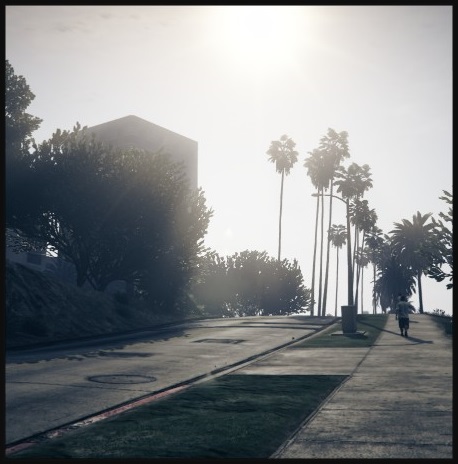
Rockstar Games’ Grand Theft Auto series has received a lot of flak, from all sides of the political and ideological spectrum. They aspire to being The Great American Satire, and sometimes they achieve moments of wit and insight, but while they’re great games, all too often as cultural critique they resort to lazy, crass caricature that says little more than, “America, huh?”
One of the things that video games can do magnificently is create worlds. From the satirical real-world analogues of Rockstar’s Grand Theft Auto series to the historical simulacra of Assassin’s Creed infused with secret meaning, from Super Mario‘s candy-coloured vistas to the stark alien worlds of Metroid: in games we can experience spaces that are uncanny twins of real places or that are thrillingly new. This isn’t exactly a series of posts or a new feature as an occasional exploration of games that I love because of where they take me.
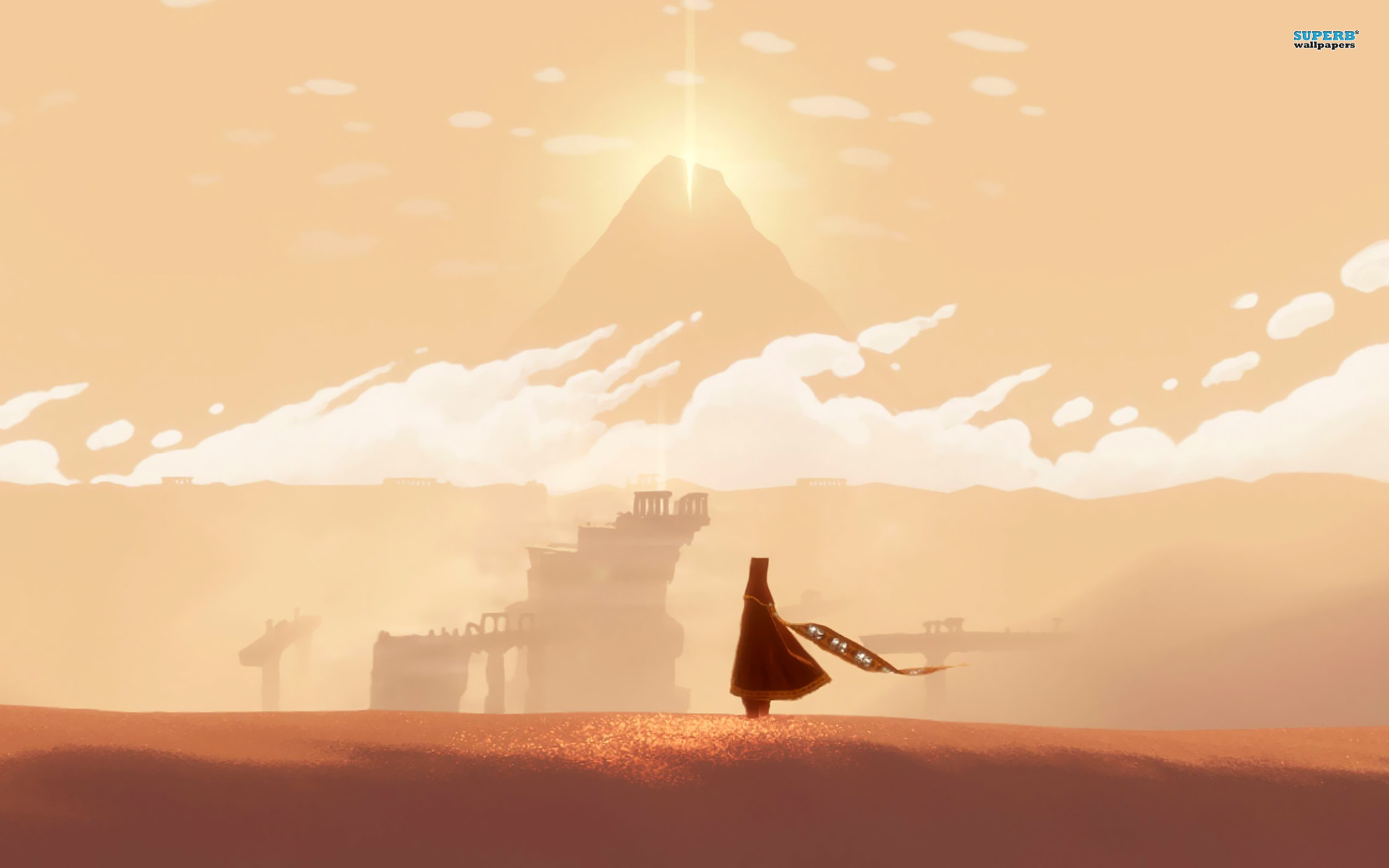
One of these games is Journey, originally developed by Thatgamecompany for the PS3 and now available for the PS4. In terms of its gameplay, it’s a simple game, almost entirely devoid of challenge; it has also been called an ‘art game’ and I’m sure there are some who would even deny it’s a game to begin with, for some reason or another. It wonderfully evokes a sense of place, though: in Journey you’re a lone traveller, perhaps a pilgrim, marching onwards towards the distant mountain through deserts, among abandoned ruins, across the bottom of the ocean and up snowy slopes towards the goal that keeps getting closer even as it remains tantalisingly out of reach.
While the actual virtual locations are fairly small and can be traversed in a few minutes, they come alive through a wonderful blend of the real and the imaginary. Visually, Journey has a minimalist but beautiful style, using strong colour contrast and simple shapes to evoke less real places than our dreams of such places. There’s a sparsely surreal quality to the deserts you travel through early in the game, as if Lawrence of Arabia‘s vistas had been reimagined by Giorgio de Chirico. At the same time, the place is tangible: you leave behind lines in the glittering sand as you move through it, sliding down dunes. There’s a tactility to these environments and your place in them; late in Journey, as you travel up the mountain towards your destination, the cold wind holds you back, slowly freezing you in place. Journey‘s spaces feel both alien and real – these are worlds you could otherwise only explore while asleep, but you feel the sand between your toes, the snow on your face.
Journey offers fairly little in the way of interaction to its players, its chief method of interaction being movement, and the game gets that very right. The player avatar becomes a part of the world, where in a lesser game that avatar feels superimposed on it. Other than walking around, the player can also fly, though this power is very much limited and feels less like the kind of power fantasy common to gaming than like a moment of freedom – again, very much like in dreams. There is one more thing the player can do, though, and that’s where the world gains a dimension: he or she can sing… and if others are around, they will hear that song. Journey is a multiplayer game, but it’s a most unusual one: on your pilgrimage to the mountain, you encounter other pilgrims, looking exactly like you. They walk, fly, and they sing; where one pilgrim may chirp in short, playful sounds, another may hold a note, almost as if inviting you to join voices.
It’s strange how other people can make a virtual space in a game feel more real, but that’s definitely how I experienced Journey. It’s maybe a bit like Marianne Moore’s “Poetry”, which talks about “imaginary gardens with real toads in them”: if you inhabit a world of the imagination with someone who may be incomprehensible to you but who is real, reacting to your movement, your flight and song, then that world becomes more real as well. Some of the pilgrims I encountered in Journey went exploring with me, others were kind guides pointing out an interesting ruin or a forlorn statue for me to find, and yet others seemed to sing at me in an increasingly frustrated voice, unable to make me understand their song. And then there were some that ignored me entirely. Yet most accompanied me, for a short while or for longer stretches, on my pilgrimage towards that mountain. For a few moments, they were friends, the only friends I found in that strange world. And when I dream of the desert and the bottom of the sea and that mountain, I also dream of their song. It’s those disembodied voices that we’ve left behind, floating over the dunes.
My partner-in-blog has written about his year in pictures, so I’ll end 2014 with three videos: two about the main thing that keeps us going here at Château Goofybeast, i.e. film, and one bonus one that barely qualifies as a video, but damn, if the music ain’t pretty. Here’s wishing each and every one of you a great 2015, with lots more films, books, comics, games and whatever your eyes, ears and hearts may desire!
One of the pleasures of having played computer and video games since, oh, the heady days of 1982 is that I’ve been in a position to observe their development almost from the beginning. As with any medium, there’s been more than a fair share of absolute garbage, but as cultural artefacts games have proven to be vibrant, creative and surprising. Certainly, the big money tends to go to mainstream behemoths like Call of Duty, the equivalents of the latest summer blockbuster movie, but you also get surprise successes such as Minecraft, arguably the Lego of gaming in several ways. These days, indie gaming has freed up developers to be visionary as opposed to keeping a constant eye on the bottom line, and while some visions may be pretentious, confused or simply result in bad games, others have done more than just hint at the potential inherent in the form.
Supergiant Games is not exactly the prototypical indie, but there’s definitely a strongly independent streak to their games to date, and this year’s Transistor bear few of the traits of mainstream gaming. The game’s production values are downright gorgeous, but there’s no pandering to what executives might think sells well – for instance, Transistor‘s protagonist is female, yet she isn’t sexualised in the sort of facile way that’s designed to appeal to a young male demographic. This is just one indicator of how, while the game echoes other examples of the medium, as a whole it is quite unique.
All in all, while in terms of gameplay Transistor isn’t necessarily my cup of tea, it’s a fantastic example of how the medium of games has come a long way: it is aesthetically creative and confident, evoking a world that can perhaps begin to be described as The Matrix filtered through a Gustav Klimt-inspired Art Nouveau/Art Deco sensitivity with a touch of anime. Its writing does not suffer from the tendency towards excessive exposition and over-explanation, instead being elegant and elliptic. The music is beautiful and stirring, more than worth a listen outside the game – but like all of Transistor‘s elements, it complements everything else exceedingly well. The game’s aesthetics, tone, soundscape, writing and atmosphere all come together to form what could easily be called a Gesamtkunstwerk, a total work of art, that is more than the sum of its already considerable parts. And it all works so well as a game; the visuals and acoustic design would fare well in any medium, but interactivity and choice add to Transistor, down to small touches that are full of personality. I mean, this is a game where pressing one of the controller buttons results in Red, the main character, humming in harmony to the music that’s playing.
Transistor won’t appeal to all: one person’s artistic triumph is another’s pretentious mess, the gameplay’s mix of action RPG and turn-based strategy won’t be to everyone’s taste, and many reviewers have criticised how much Transistor‘s writing leaves to the imagination. It trades broad appeal for a voice of its own (ironically, as aside from her humming Red has been stripped of her voice). A medium that’s capable of producing such works, I’d say, is definitely healthy and one I’m excited to keep following.
How long has it been since Kickstarter exploded onto the scene? My first pledged project was about 2 1/2 years ago, but there have been so many since. Some were successful, some weren’t; some have produced a film or a game and some are still running. Sometimes the results were mixed, but by and large I’m in the happy position of being able to say: I have contributed, in some small way, to the existence of a number of works that otherwise wouldn’t exist – and that’s a cool thing to be able to say.
I don’t want to overstate the effect my contributions have had; I didn’t tip the scales for any of the projects I pledged to, I was usually one of many thousands. Yes, a handful of the projects I supported were touch and go, but I’m still one of many. Nevertheless, for all the collectivist benefits of Kickstarter, with each of the successfully completed projects I got my hands on – whether the result was a movie or a game – I did get a frisson of “I did this!”, or perhaps rather “I was a patron to this!” In my very small way, I’ve been a mini-Pope Julius II to, say, the Veronica Mars movie or Wasteland 2.
And let me tell you: patronage is addictive. I’ve reduced but not kicked (no pun intended) my Kickstarting habit, but during the first year or so my patronage muscle was twitchy as hell. I don’t regret any of the pledges I’ve made – or, more accurately, I may not have been entirely satisfied with all of the resulting works, but I was still happy having pledged to begin with. Knowing that a group of artists with an idea that probably wouldn’t have survived the cold, hard realities of the free market were able to work on a project close to their hearts? That’s worth a lot – definitely more than putting money into the latest highly polished, much advertised but essentially generic triple-A hit. Put it this way: if you could do your bit to make Kristen Bell happier, what would that be worth to you? (As I said: Kickstarter is addictive – and most addictions aren’t necessarily altogether healthy.)
That closer emotional engagement has its flipside, though: if something I’m invested in turns out not to meet my expectations, it’s difficult not to take that personally. A couple of months ago, Divinity: Original Sin, a role-playing game I’d Kickstarted, came out to roundly enthusiastic reviews, and my endorphin levels went up with every piece of critical acclaim that I saw… until I played the game. Don’t get me wrong: Divinity: Original Sin, regardless of its silly title, is a good game and a typical case of something that simply might not exist in this form without Kickstarter. Whatever would be different if they’d made the game with the support of a traditional publisher wouldn’t address my issues with it. But I supported the project predicated on certain promises that I interpreted one way but that were meant another way. I don’t feel like the developers, Larian, lied to me – but it does feel more deflating to follow a project, read the update posts, religiously watch every behind-the-scenes video, and then check out the end result to find that my expectations were… inaccurate? Misguided? A bit naive?
Patronage doesn’t give me the right to expect a result that pleases me in every way possible. It’d be wrong to think that Larian was at fault for creating a game that meets their expectations but veers away somewhat from mine. I’m still glad I supported the project, out of principle, because more artists and craftspeople should be free to create things that risk-averse publishers wouldn’t touch with a ten-foot pole. But what I’ve learnt is this: Kickstart at your own peril, and manage your own expectations. In some ways I’m probably more disappointed with Divinity than with the handful of projects that reached their pledge goal but then failed in development, because the project lead had miscalculated or because the team consisted of one passionate person who fell ill and could no longer afford working on that particular dream. In the end, what’s more important to me: doing my small part to enable an artist to follow their vision, or wanting them to follow m*, even though the latter is vague even to me? (“I know it when I see it” doesn’t make for very stringent design or criticism.) Based on my Kickstarter experiences to date, I shall have to accept that a feeling of ownership is not the same thing as actually owning something. I support the Kickstarter projects, but they’re not mine. If I’m lucky – and that luck can be helped along by using my brains as much as my gut to decide what to back – I may like or even love the end result, but patronage doesn’t entitle you to liking the end result. Who knows, perhaps Julius the Second looked at the ceiling of the Sistine Chapel and thought: “If Eve ends up with cow-eyed Adam instead of that hunky David guy, the whole thing sucks. Team David all the way!” If he did, I hope he had the good sense to keep quiet about it.
The recent Telltale Games series – The Walking Dead, which is currently in its second season, and The Wolf Among Us, based on Bill Willingham’s Fables – make great use of that phrase. They provide the player with relatively limited choice, but they put you in control of how you behave towards others, how you treat them. You may just have tried to cement a shaky alliance by siding with a frightened father over the rest of the group: Kenny will remember that. Or you have just had your character, Sheriff Bigby Wolf – yes, that’s the Big Bad Wolf of fairytale fame in human shape -, beat up a murder suspect in the hope of scaring a confession out of him: The Woodsman will remember that.
The Telltale games, especially the recent ones, have mostly received good to great reviews, but there’s been criticism of what they do since the beginning. Choice and consequence: these are one of the Holy Grails of many gamers, and a fair number of them see the choices in the two aforementioned series as shallow at best, false at worst: the plot largely remains the same, regardless of what you do and what the other characters remember. If someone is fated – or, more accurately, written – to die, they will die. Sometimes the plot may branch in small ways, but these branches are usually closed quickly in favour of a tightly constructed story arc.
What changes, though, is your relationship to the characters you interact with. Kenny will remember that you sided with him at a time when he felt most alone – and, perhaps more important, you will remember. You’ll feel like a good guy, or conflicted over siding with a decent but choleric man who acts before he thinks. The interaction may be shallow in one sense, but in another it is far more nuanced than the binary, “Choose your own adventure”-style story choices in some games lauded for giving the player agency. I don’t dislike those games, but I find Telltale’s, let’s say, relationship-based interactivity more engaging. Their games give you the sort of choices that at least I can relate to: in real life, I rarely am faced with deciding between remaining loyal to a corrupt lord that nevertheless provides stability or joining a rebel army whose dedication to the cause borders on fanaticism. The choices I have are usually about my attitude towards others and how I express this: do I snap at someone because I’m tired and they pushed the wrong buttons, or do I let it go? These are the decisions that in aggregate shape who I feel I am.
Obviously games are often escapist fare, and many enjoy making decisions that they are unlikely ever to face in real life. I won’t deny that the escapist side of games appeals to me too – yet I like some reality in my escapism. I like to feel with characters in unreal worlds that nevertheless resonate and feel real to me. In that respect, I usually stand with good old Marianne Moore, not just with respect to poetry: I want “imaginary gardens with real toads in them”, and not just toads but Kennys, woodsmen and Big Bad Wolves that, for their red eyes and sharp claws, are relatable, are people. Telltale’s choices aren’t epic, they’re human-scale, and they are a large part of what makes their tales of the zombie apocalypse and of exiled fairytale characters trying to make a life in ’80s New York interesting to me: the premises come to life most in how they juxtapose the fantastic and the real, the supernatural and the essentially human. Being an asshole or a nice guy, taking the easy way or sticking to your beliefs, even if you can’t change where things end up, perhaps especially when these choices end up not making a dent in reality – they nevertheless define who you are. Games, perhaps more than other media or art forms, offer interesting ways of expressing yourself.
Clementine will remember that. As will I, because that decision was mine in a meaningful way. When I choose to side with one faction over another in The Witcher II, I do so because I want to see all the material the developers created, to get my money’s worth. I know I will go back to choose the other faction later on. When I make choices as an ex-con trying to do right by his surrogate daughter in a dangerous world, or as a sheriff with deep-rooted anger issues trying to solve a murder, most likely I won’t go back to listen to the other branches on the dialogue tree. I’ve made my choice, and I, too, will remember that.
P.S.: There’s one instance where The Wolf Among Us uses, and subverts, the “_______ will remember that.” trope to great comedic effect. The game’s almost worth playing just for that.
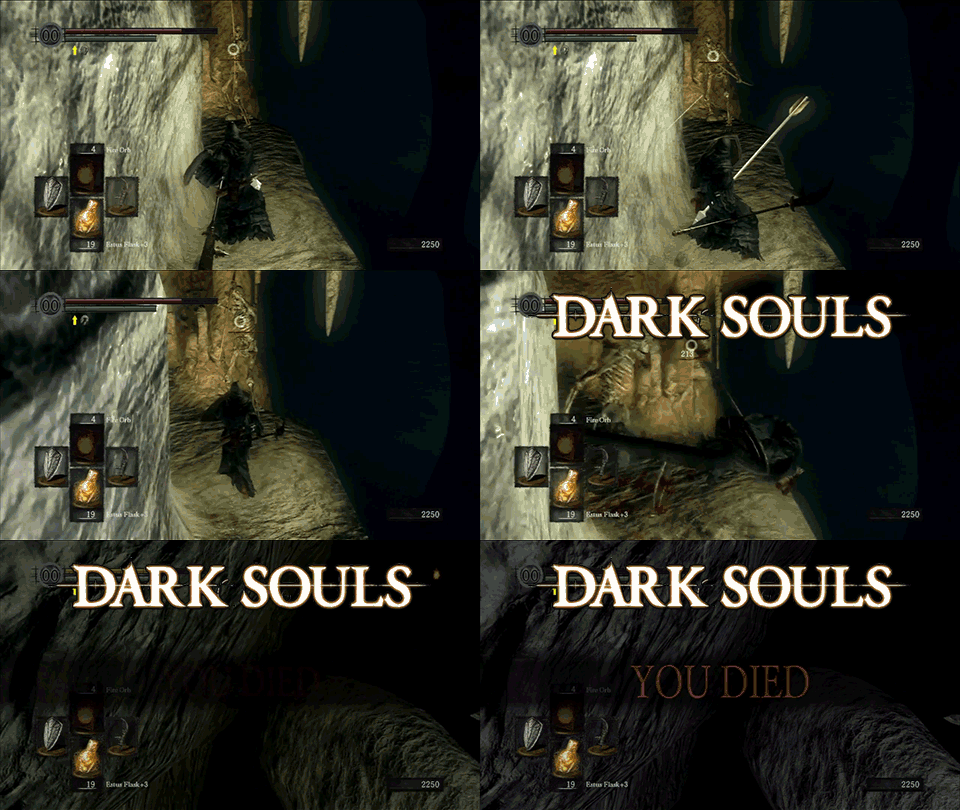
I admit: even though I’m pretty self-assured, not least when it comes to my media consumption, I still feel faintly embarrassed about telling people that I play games. It’s not even my age; I don’t mind being a gamer at the age of 38 (soon to be 39). It’s not entirely the subject matter either; there are many games that are embarrassing, juvenile rubbish in terms of their aesthetics and writing. No, I think what it is most of all is how gaming can reduce me to one of the dumber monkeys in a Skinner Box: it’ll have me doing the same thing over and over and over with little immediate reward. Take my current addiction, Dark Souls 2, a game so proud of its own difficulty that its central hub area has a monument to all the player deaths the game has garnered worldwide.
At present, the monument lists over 100 million deaths. Let’s be clear about what this means: people playing Dark Souls 2, like me, have been doing minor variations of the same thing over and over again, and dying again and again. Ideally they progress a bit in between deaths, but if they’re anything like me they’ll die dozens of times in the same situation, doing pretty much the same thing and trying to figure out how to change it up so they can die a split-second later, hit an enemy for just a bit more damage, and slowly but surely inch their way to getting through that bit alive – only to die again (and again and again, clap clap) two rooms further on.
What is it that makes such an exercise in repetition and masochism engaging and even entertaining? Obviously there are the moments when you actually make it, when a combination of learning, skill, strategy and sheer luck lets you whittle that enemy’s hit points down to zero, when you dive under an enemy mage’s spell and stick him with the pointy end, when you turn a corner and find a momentary sanctuary there – but most of the time you’re busy pulling that lever and wondering why you’re not getting that piece of cheese or the fish biscuit you were hoping for. You’re a rat in a maze. A beautifully rendered, darkly romantic, imaginative maze, but even that beauty is lost as you’re getting skewered, flash-fried and/or magic missiled for the nth time.
There have been articles about the inherent pointlessness of Dark Souls and similar games, and as much as gamers tend to dislike critical looks at their hobby, I do think it’s a valid question: what are we getting out of the endless rinse-and-repeat cycle? At what point have we succumbed to the gamers’ version of Stockholm Syndrome and we keep pulling that lever not because we expect a fish biscuit but because we’ve come to like it?
Now excuse me, I’ve got a lever to pull. And to be stabbed in the back by an Undead Knight while doing it, most likely.
There’s a tendency among some gamers who’ve been pursuing their hobby for decades to measure the worth of a game by its length. I myself remember many a week and month spent playing single games, and there’s definitely something to be said for roleplaying games that deliver a huge world and an epic plot to match – but I’m also coming to appreciate the beauty that can come with brevity. Especially indie developers often benefit from providing a short but focused burst of gameplay, creating encapsulated experiences that, like short stories and short films, can succeed in ways that are essentially different from their longer – and at times too long – brethren.
So, in lieu of a regular Variety Pack, I want to introduce three short titles that I’ve recently played and that both occasional gamers and more old-school, hardcore (read: nerdy) gamers may have ignored. All three games excel at imagining fascinating, evocative worlds without the extensive, often tedious expository worldbuilding that game designers sometimes indulge in… and that some gamers mistake for deft storytelling.
Year Walk
How to describe this one? It’s as if Ingmar Bergman were to reimagine The Blair Witch Project by way of a puzzle box. Taking up the motif of the Nordic year walk, during which travellers encounter mystical creatures as they try to get to their village church in search of visions of the future, the game is one of the visually most unique miniatures I’ve ever played. It is exquisitely atmospheric, creepy and redolent of sorrow and guilt.
The Swapper
In general, puzzle-heavy games tend to lend themselves to a shorter format; even the most ingenious puzzle design gets old if repeated for hours upon hours. The Swapper is a perfect example of this, using its simple premise to great effect: the player guides an astronaut through a derelict space station. Using a swapper device, this astronaut can be cloned up to four times, their consciousness transferred from body to body. This allows the player to stand on buttons, pull boxes and do similarly banal things to progress through the station – but it also tells a subtle yet effective story of identity and the ephemerality of the soul. There are echoes of Moon, but also of Michel Gondry’s more melancholy dreamscapes in the game’s clay-moulded space scapes.
Botanicula
When I was a child, I watched the samey Saturday morning cartoons from America and Japan that were on TV, but there were also Eastern European children’s series that were both much more mundane, set in a world I recognised as being similar to my own (I probably missed all the subtext about living in a Communist system), and more surreal, even subversive. The heroes and sidekicks especially of the US cartoons all pretty much followed the same visual and character templates, while the series from Czechoslovakia were often much more unique, as if the oppressive systems they were created under forced them to find other creative outlets.
The Czech developer Amanita Design may not be working under the shadow of Soviet rule, but they have clearly inherited the creative drive of their forebears. Amanita’s games are gorgeous, unique toyboxes filled to the brim with personality, and Botanicula is a perfect example of this. Some of its puzzles may be annoying, but it is always a joy to inhabit an Amanita world, and this one is no exception.
I’ve written about pixel art before, but as someone who was playing games already when pixels were bigger than my hand there’s something about them that speaks to me, and it says things other than, “Put that away! It’s horrible!” I’m wondering to what extent this is nostalgia talking – big pixels remind me of the time when I was young, full of promise and had hair on my head rather than my ears. What does a non-gamer, or someone whose gaming career started at resolutions beyond 320×200, see when they look at pixel art? Do they see technical limitations, or do they see what I and my fellow gaming Methusaleas see?
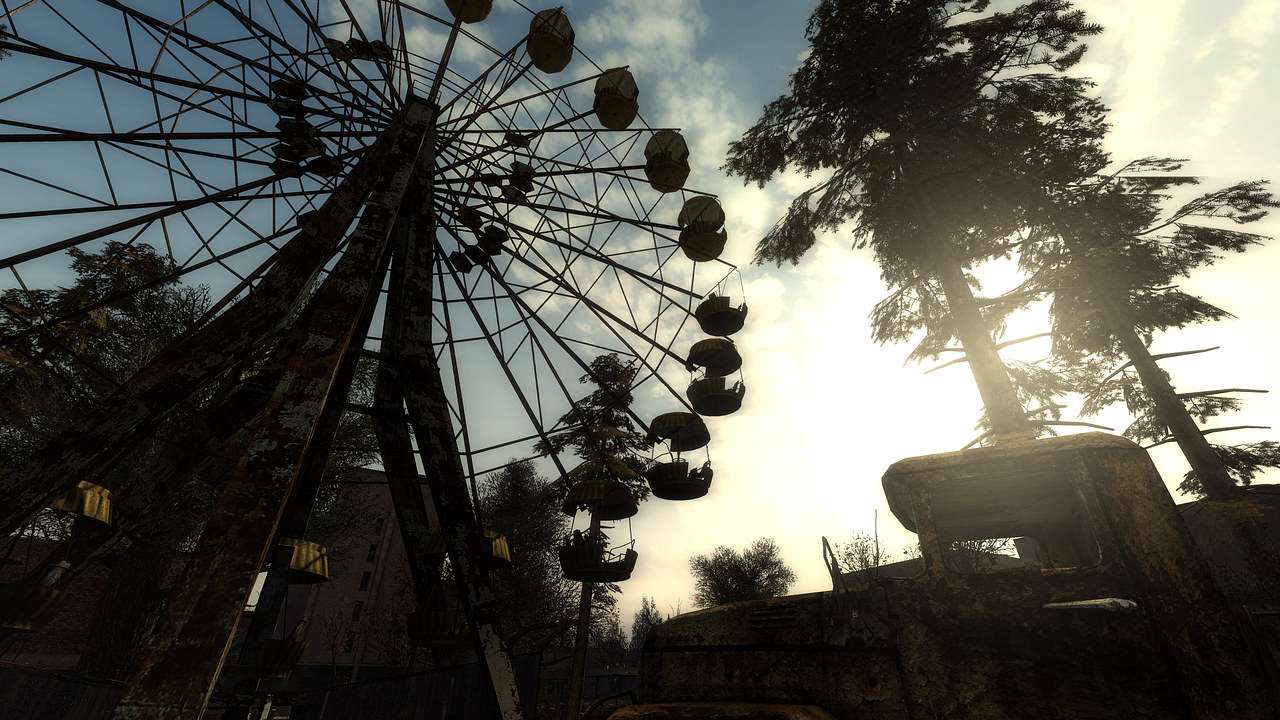
For me, the stylistic choice made for instance by the developers of Superbrothers: Sword & Sworcery EP (yup, that’s its actual title) is a valid one, since its pixel-heavy goodness achieves a unique effect. It’s not just retro-hipsterish affectation – it’s a valid form of abstraction that is particular to video games. When I look at a screenshot from Sword & Sworcery, I find a highly evocative quality in the image that reminds me of Scott McCloud’s writing on comics. In that medium, the reader is engaged to some extent by the elliptic quality of the frame-by-frame format: we fill in the blanks that are between the individual images. Retro pixel art asks us to fill in the blanks between the pixels; it’s a very specific stylistic cousin to blurring an image for artistic effect. A simple high-resolution paint job would make the picture more specific, more precise, but that evocative potential would be lost in the process. If I think of films that work largely through allusion and ellipsis, such as Andrej Tarkovsky’s Stalker, I imagine something akin to the pixelscapes of Sword & Sworcery more than the more realistic (though also evocative) vistas of the Stalker computer game, a distant cousin of Tarkovsky’s film with very different intentions.
Undoubtedly there’s an economic side to pixel art in indie games: the resources needed to create a game featuring old-school graphics are on an entirely different scale than what goes into flashy, hyperdetailed 3D environments. Beyond this, though, I don’t think that titles such as Papers, Please, Echo of the Wilds or Hyper Light Drifter (you’ll find trailers for all of these below) went with pixel-based artwork because it’s cheaper – all of these aim for a specific effect, an abstraction that at its best can be as gorgeous and evocative as high-detail photography. Even the purposeful ugliness of Hotline Miami and its grotesque ultra-low-res ultra-violence aims for a visual quality that I expect does not only speak to the oldtimers clutching their gamepads. The bigger the space between some pixels, the more space for gamers to lose themselves in.
P.S.: It’s quite fitting that today Rock Paper Shotgun posted an interview with Dave Gilbert, whose Wadjet Eye Games develops old-school low-res pixel art adventure games; in the interview Gilbert says the following: “The great thing about pixel art is it can, how do you explain it? It’s more like your mind fills in a lot of the details when it’s done the right way. When it’s done the wrong way it just looks ugly, that’s the case with any art.”



 A Damn Fine Cup of Culture