Fool me once…

… and the award for Best April’s Fools Joke goes to – The Criterion Collection, who advertised that this masterpiece of modern cinema would soon join their ranks of superb DVD and Blu-ray editions:
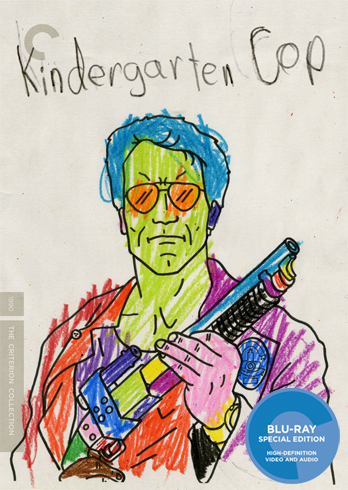
And yes, they went the whole hog. Check out their synopsis of Reitman’s often underrated gem:

Historically, the policier and the family comedy were two distinct categories. Then, in 1990, Kindergarten Cop gave us all a lesson in genre revisionism. With muscular sensitivity, Hollywood’s last action hero Arnold Schwarzenegger embodies detective John Kimble, who is compelled to go undercover as a teacher of five-year-olds in order to catch a ponytailed drug dealer. Though it’s distinguished by pulse-pounding suspense, a Crayola-bright palette by cinematographer Michael Chapman (Taxi Driver), and trenchant observations about education in the Bush I era, the film’s emotional center is Schwarzenegger’s gruff yet good-tempered interaction with a class full of precocious scamps, including a tumor-forewarning death-obsessive and a genitalia expert. By leavening a children’s film with enough violence to please even the most cold-hearted bastard, director Ivan Reitman shows that he refuses to color inside the lines.

Which is only topped by some of the extras:

  • New high-definition digital restoration of the 1990 director’s cut, presented in 5.1 surround DTS-HD Master Audio on the Blu-ray edition
  • New audio commentary featuring Secretary of State Hillary Rodham Clinton, author of It Takes a Village: And Other Lessons Children Can Teach Us
  • Excerpts from the French television program Cinéastes de notre temps: “Ivan Reitman”
  • Kindergarten Cops Today, a new hour-long documentary featuring former New York City police detectives Frank Serpico and Robert Leuci, former San Francisco police inspector Dave Toschi, and New York City mayor Michael Bloomberg
  • From “Fingers” to Finger-Painting, an interview with cinematographer Michael Chapman
  • Archival video of Schwarzenegger’s acceptance speeches for the Favorite Movie Actor award at the 1989 and 1991 Kids’ Choice Awards
  • The Kids Aren’t All Right, an analysis of all the cuts made to ensure a PG-13 rating
  • More than six hundred minutes of rare behind-the-scenes and archival footage
  • Seven theatrical trailers
  • PLUS: A booklet featuring an essay by former police reporter and creator of The Wire David Simon and a reprint of James Agee’s original review of the film

I would so buy that in a heartbeat – even before checking out the Criterion “Three Reasons” video:

 

Oh, how the ghost of you clings…

Is there another medium as nostalgically in love with itself as film? You don’t really see many paintings about the painters of yesteryear, or novels about novelists from the 19th century. Hollywood, on the other hand, loves looking at itself back when it was younger, had fewer wrinkles, and Michael Bay wasn’t even a twinkle in ILM’s eye.

In the run-up to the last Oscars, there were two major examples of cinema yearning for its heydays: Martin Scorsese’s Hugo and The Artist, a French film whose point of reference is nevertheless the American movie scene of the early 20th century. Both received a fair share of accolades and both put a lot of emphasis on charming their audiences. Both movies are accomplished in many ways, but I’m somewhat torn on them: while I loved Hugo more, I have to say I appreciate The Artist more as a film.

Scorsese’s obviously one of the greats of cinema, and deservedly so. Taxi Driver, Raging Bull, Goodfellas, but also The Last Temptation of Christ, Kundun or the concert film Shine a Light – the man has a strong style, but he doesn’t remake the same film over and over again. Hugo is strange for him in some ways, as Scorsese’s never shied away from gritty, violent themes; trying his hand at a family movie is decidedly new for him. Having said that, there are definite stylistic links between some of his more recent period pieces, especially Gangs of New York and The Aviator, and Hugo, in that a lot of emphasis is put on creating a world. And what a world it is – the Paris of the film is not real in any way, but the train station in which most of Hugo takes place is a beautifully imagined, intricate world.

At the same time, Scorsese’s latest feels like it’s at least two different films, one for children who enjoy Little Rascals-style capers and broad characterisation, and one for people who love the cinema. Narratively these two are bridged by the sadness at the heart of the film, embodied by the titular character who has lost his father, but the result is a work that doesn’t always feel coherent. After seeing the film I walked out of the cinema feeling a warm glow for the love letter to the movies that I’d just seen, but I also sat in the dark feeling impatient for the slapstick, the scenes of Hugo running away from a panto-style villain and the “gosh, it’s an adventure, isn’t it?” enthusiasm of Chloë Grace Moretz’s character to end and for the film to get back to Méliès. The scenes that are primarily about the magic of movies are beautiful and poignant – much of the rest of the film first and foremost made me think that it’s been decades since I was twelve years old. Perhaps I’m not the ideal audience – but I honestly wonder whether a twelve-year old would be all that likely to respond to the scenes focused almost entirely on Méliès and on film history. How many twelve-year old film buffs are there?

While I share Hugo‘s love for cinema, I’m by and large indifferent to silent movies, to the extent where I don’t even remember if I’ve ever seen an entire one. (Yes, I do feel a bit guilty about never having seen Metropolis. Happy now?) I’m not sure The Artist‘s makers are nostalgic to the era where films were silent, either, or that they wanted to start a new wave of dialogue-free films. (Our cinema showed a Swiss short beforehand, also silent and fashioned as a pastiche of the original films of the ’20s. It was unbearable, smug and shallow, having nothing going for it other than wanting to emulate the style.) Take away the self-conscious, meta-cinematic elements and The Artist doesn’t work; but it’s this (dare we say postmodern?) playfulness that is as central to the film as the considerable charms of its two leads, Jean Dujardin and Bérénice Bejo. The film’s a meringue, as I would put it: sweet, delicious and so light the slightest puff of air could blow it away. It doesn’t have much substance in any conventional sense – but charm, style and wit can have a substance all of their own.

What The Artist finally does better than Hugo is this: it’s perfectly formed, it comes together into a whole. It is a complete film rather than two half-films patched together, with considerable skill that nevertheless cannot hide the join. And for all of Scorsese’s talent, The Artist works better because it has made a decision what sort of film it wants to be, and then it’s about the best such film it can be. As far as meringues go, it’s just about one of the best I’ve had.

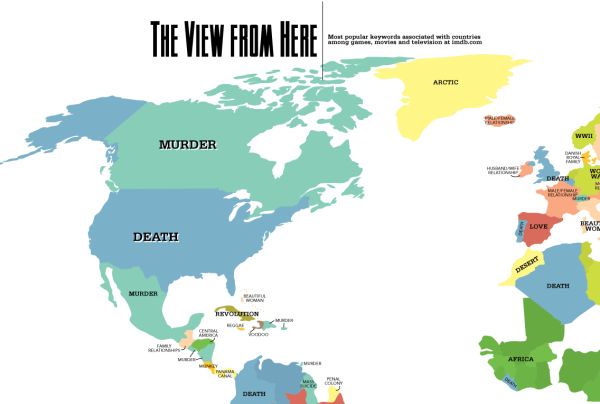
Looking for Murder, Love and Death in all the wrong places…

Yeah, I still owe you a genuine blog update, don’t I? Planning to write one on films in love with cinema (is that incestuous or masturbatory? or both?) this weekend, but in the meantime here’s a fascinating infographic from a site called Very Small Array: Popular IMDb Keywords Associated With Countries. Sounds boring, I know, but do check it out, and make sure to check out the map at the maximum available size.

March Variety Pack

Another month, another variety pack. I’m planning to write longer posts on Hugo and Breaking Bad – and possibly Being Human, depending on my mood – but in the meantime here are some shorter takes on a few of the films I’ve seen recently. Everything from teenage killing machines to Bostonian remakes of Heat and tragicomic Irish policemen – oh, the humanity!

Hanna

Joe Wright’s film about a teenage assassin and her odyssey is an odd ‘un. It’s definitely strikingly different from what you might expect reading the blurb on the back of the DVD, and it’s got a lot going for it – but in the end I don’t think it works all that well. Hanna, starring the unpronounceable Saoirse Ronan, is basically three different films: a gender-swapped Bourne Identity, a modernised L’Enfant Sauvage and a stylised, symbolist-bordering-on-the-surreal fairytale. It pulls off the first two, but it is both most interesting and least successful in the latter: there are elements reminiscent of Little Red Riding Hood, with the weirdest variation of the Big Bad Wolf ever (played by Tom Hollander as an artsy, flamingly camp psychopath, which should give you an idea), but these more stylised elements stand out like sore thumbs compared to the almost-realism of the more Bourne-inspired parts. It’s a shame – there’s a lot to admire about the film, from Ronan’s acting to the cinematography, but there are bits that feel half-baked or even outright ridiculous. And if Cate Blanchett’s accent even comes close to resembling the way any real human being talks, I’ll buy a 40-gallon hat and eat it.

The Guard

I am a big fan of Brendan Gleeson. I like black humour. Don Cheadle is one of the most criminally underused actors in Hollywood. And In Bruges was one of my favourite films the year it came out, making me laugh and cry in equal measure.

The Guard feels like like it’s trying to go for an In Bruges feeling in some ways, and Gleeson’s character has the same sort of laconic, melancholy humour going – but it doesn’t even come close to the earlier film’s… integrity, for want of a better word. The Guard is funny, undoubtedly, but its tentative attempts to be more than a pleasantly diverting, dark comedy don’t lead anywhere. Worse perhaps, The Guard is lazy in how it seems to think that it’s enough to have Gleeson play his usual part (or even a reduced version thereof) and have some jokes, and the rest will take care of itself. It isn’t, and especially if you’ve got Don Cheadle in the film it’s a massive waste to give him the most underwritten part in the film. If The Guard, whose author is the brother of In Bruges’ writer director Martin McDonagh, had come first, it might have been less of a disappointment – as it is, it’s difficult not to think that the time it takes to watch the film would be better spent on the earlier, better movie.

One thing, though: it’s great fun to watch the scenes shared by Liam Cunningham and Mark Strong. If there were ever a prequel spinoff focusing on their two characters, I’d watch it at the drop of a hat.

The Town

Talk about films that would play better if you hadn’t seen earlier film X… I’ve never been a big fan of Ben Affleck as an actor – I don’t dislike him, but I find him fairly bland, perhaps 0.47 McConaugheys – but I very much enjoyed his directorial debut, Gone Baby Gone (starring his kid brother Casey). The Town shows the former wasn’t a fluke – Affleck definitely has a talent for directing, and I was surprised to enjoy his acting in the film more than in most other things I’ve seen him in, even though I’m usually suspicious of actor-directors who put themselves in the main part. The film is also well written, acted and filmed – but it is practically impossible to watch it without thinking Heat… and more specifically, that Heat does everything better than Affleck’s film. There are too many echoes in The Town to Mann’s masterpiece, so that halfway into the movie it was difficult to focus fully on what was happening and not sit there thinking, “Yeah, this is just like that scene with Ashley Judd, and that’s very much like that bit with Tom Sizemore…” I liked The Town quite a bit – and am definitely planning to keep my eyes open for Rebecca Hall – but it brings too little to the table compared to Heat not to suffer from the comparison. In a world without Mann’s movie it might be different, but as it is I have to wonder: was there ever a moment when someone on the crew, the Director of Photography or one of the producers, said, “Listen guys, great work’n’all… but I’ve seen this film before, it was called Heat, and why exactly are we doing a Boston-based reskin of that movie?”

Secrets and lies

I have to confess something – and not even under duress: I am not a big fan of John Le Carré’s Tinker Tailor Soldier Spy. I’ve got a copy of the novel at home, signed by the man himself (or was it David Cornwell? I forget…), since as a student I was part of a committee that invited him to do a reading at our department (and thereby hangs a tale for a different occasion). I’ve read the book twice and I’ve seen the BBC miniseries from the ’70s the same number of times – but while I enjoy the minutiae of Le Carré’s construct, Tinker Tailor Soldier Spy has always struck me as overly internalised, to such an extent that to me it came across as lacking urgency. There are definitely things about it – both novel and miniseries – that I liked, even a lot, first and foremost Alec Guinness’ George Smiley, but at least as much Ian Richardson’s Bill Haydon, but by and large I’ve found the whole thing too low-key an affair – and it takes a lot for me to find something too low-key and internalised.

The recent film version of Tinker Tailor Soldier Spy works a lot better for me – though ironically the film probably wouldn’t have had the same effect on me if I hadn’t recently re-read and re-watched the novel and series. Tomas Alfredson’s adaptation is at least as good as the BBC effort in terms of its cast; there is no one in the film who isn’t cast and acted very well. It is also one of the most accomplished films of the last ten years in terms of production design, visualising the late days of the Cold War to perfection – and making the drab, dreary MI-6 of the time barely more appealing than its Russian counterpart, at least in immediately sensual terms.

Alfredson’s film – and this will show me for the heretic that I am – is much better at bringing out the themes of betrayal and the human costs of living a life of secrecy, subterfuge and lies than the BBC miniseries, without losing the TV version’s subtlety. The film version transports its themes primarily through its acting and mis-en-scene, not through overly literal speeches or dialogues. I would go so far as to say it improves the book, making it more effective without sacrificing its strengths.

Where the film steps wrong, at least in my opinion, is in how damn elliptic it is. It has trimmed any fat off the story, but in doing so it has cut very close to the bone. I like elliptic storytelling when done effectively, in fact I very much prefer it to storytelling that has multiple redundancies built in at every turn, something that tells the audience that it is certain not to overestimate their intelligence. Tinker Tailor Soldier Spy takes it further than is necessary or indeed helpful, I think: the plot comes across as complicated to the point of being obscure for the first hour or so, and only because Alfredson wants his audience to work in order to catch up. That’s fair, but the problem is that it tends to make the audience think that the plot is where it’s at, that you need to have an investigator’s – or a George Smiley’s – mind to understand what this is all about. This, however, is an unfortunate distraction: Le Carré’s story is strongest when it is about its characters, and the film version doubly so. The plot should tell us about the characters, not the other way around – and the more complicated the goings-on seem, the easier it is to miss what is important and interesting about Tinker…: how the world these characters inhabit and the betrayals, both small and large, they’re required to commit in the line of duty corrode their ability to be human. The film’s structure makes it seem like a whodunnit, when the solution is finally banal and rather simple, as well as practically dictated by the casting.

This is one of the very, very few films that may in fact improve with a few minutes of audience guidance. Spell one or two things out for us, George, will you? And in return we can concentrate on you, and on Bill Haydon, and on Ricki Tarr, Peter Guillam, and on poor, poor Irina. The whodunnit can take care of itself.

We need to talk about Lisbeth

In my heart of hearts, I knew it. There may be many girls with dragon tattoos, but there is only one Lisbeth Salander. David Fincher’s take on men who hate women is too slick and too self-assured to get anywhere close to the 2009 Swedish original, directed by Niels Arden Oplev. While I cannot recommend parts two and three of the original, the first part is pretty damn good entertainment sprinkled with bits of character studies. We meet a determined but far from bullet-proof journalist who cannot believe the story he has been dragged into. Michael Nyqvist gets his role just right: He knows what he wants to do next, but is far from sure whether it’s wise to do so. I always had the sense that with him, he kept thriving on the difficulties. His dogged determination seems to melt the snow around him. There are many moments where you can see him think, and then act. Daniel Craig’s Blomkvist is too sure about himself; he is never really scared, never really surprised and never really drunk. He isn’t even too fazed when someone tries to shoot him in the woods. He is the wrong choice for this role.

Of course, the Swedish movie will always have the advantage of having introduced us to Lisbeth Salander, on of the most intriguing characters in popular movie-making in a long time. I don’t know how, but Noomi Rapace has exactly nailed the character (now there’s a painful pun) and I pitied Rooney Mara as soon as her name was up for Fincher’s movie. Rapace plays her damaged and in self-chosen isolation, but highly self-reliant; I’ve never been able to see the character behind the role, which is a very good thing. With Mara, I felt I was looking at a goth runaway with an attitude problem and random bouts of Asperger’s. I could see the clockwork behind her acting, and it made the scenes where she brings Wennerström down less credible. The original Salander was surprised at herself that she could feel something akin to love for Blomkvist; the other Salander’s love for him comes to her like an afterthought and finally only stops short of a soppy Christmassy gesture.

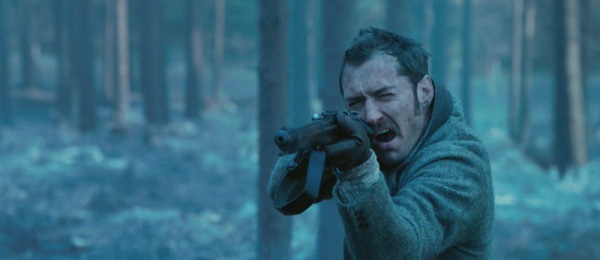
Comparisons aside, I also had a number of problems with Fincher’s movie itself. The first three minutes play like Lord Voldemort’s idea of a Prodigy video. As the story unfolded, I could not shake the feeling that this must have felt like watching Gus van Sant’s Psycho remake: the same camera angles, the same lines, the same plot points – heck, there were moments where I was almost sure that the two Salanders and the two Blomkvists inhabited the very same hut, shooting on alternate days. The only good thing they left out were the scenes where little Mikael has Harriet Vanger babysit him.  There are some other changes, but they are insignificant – except, except… they changed the ending. Remember the scene where the original Blomkvist stands in full sunlight for the very first time in the movie, approaching a woman who has her back to the camera whose hair is ablaze with sunlight? Remember what happens then? They cut it. They cut that and turned the ending around. That, and giving Lisbeth that soppy street urchin ending. And while we’re at it: It is a huge, huge mistake to let the characters talk English with a Swedish accent. Once I know the main characters are Swedish, I can suspend disbelief and think of them as Swedes, even if they use proper English – that’s especially true for a movie that engenders a whole lot of disbelief.

I don’t know why I felt that Fincher’s version is longer than Oplev’s. Maybe it’s slower because the atmosphere is so much more subdued. I know a certain drabness and coolness is Fincher’s trademark, and it is essential to Se7en and Zodiac, but here, it sabotages the feel of the whole movie. Blomkvist and Salander are not cool characters – they may just behave like normal people, but they are churning with stuff. They need to be, because otherwise that cold Swedish winter and the shock-frozen Vanger family will get to them.

He drives, therefore he is

I’m alone, I am not lonely. (Neil McCauley, Heat)

I’m not a psychopath, Anderson, I’m a high-functioning sociopath. Do your research. (Sherlock Holmes, Sherlock)

Admittedly, it may be due as much to what I’d read about Drive as to the actual film, but ten minutes into Refn’s much acclaimed film, these two quotes popped up in my head. The Driver, played by Ryan Gosling in such an internalised way it could almost be mistaken for no acting at all, is very much in line with several Michael Mann characters, most of all McCauley as played by Robert De Niro (in one of his last great roles – whatever happened to that guy’s talent, at least for choosing good parts?); in fact, he’s almost a distilled version of all of those strong, quiet men living according to their very own moral code. And in the process of distillation, he’s lost something: when it comes to interacting with others, there is something almost autistic to the guy. He’s 99% blank, though is it because there’s nothing there on the inside or because he’s so much defined himself through his role?

In spite of distracting, extremely loud and though not incredibly close munching (I barely heard my girlfriend eating popcorn right next to me, but there was a person several rows back who sounded like her chewing was amplified through the cinema’s sound system, which must’ve included a crunchwoofer), I was sucked into the film almost immediately, as its first sequences introduces the Driver as a virtuoso professional, and there’s a giddy joy to watching a film present that sort of perfection in similarly perfect cinematic craft. As soon as we see the protagonist in scenes with human beings, though, there’s something lacking, and we start to suspect that this strong, silent type is silent because speaking would reveal his weakness: he doesn’t do the whole human interaction thing. In fact, as we see later in the film, the Driver may be so lacking in these things, he may be downright sociopathic; at least his skill for detached, unflinching, professional violence (he’s definitely not an amateur in the literal sense, he doesn’t seem to enjoy stomping a would-be killer’s head to mush) suggests this.

Until the woman enters his life. And while I like Drive a lot, I see where the criticism of its female characters comes from: Carey Mulligan’s character Irene works well enough for me, but that’s because I reacted to her vulnerability much in the same way the Driver does, but as a character she’s underwritten – again, similarly to the female characters in, say, Heat. (I love Diane Venora’s performance in Mann’s film to bits – “You prefer the normal routine. We fuck, then you lose the power of speech.” – but she, like Irene, is primarily there as a foil for the male characters.)

Then again, Drive isn’t interested in presenting a full range of deep characters with complex motivations – and while I’d definitely say that it’s a smart critique of the near-mythological Strong, Silent Type, I also think that an overly academic discussion may do the film a disservice. (And I’m saying this as someone who’s always up for a pretentious, get-out-our-rulers-and-measure-the-size-of-our-brains academic discussion.) What I reacted to most strongly was the film’s underlying sadness, the protagonist’s inarticulate loneliness. Over-intellectualising the film, while it’d stand up to such analysis, ignores the feelings it evokes strongly and successfully. Like Neil McCauley, the Driver may say he’s alone, not lonely, but if he did he’d be lying to himself. But perhaps it’s these lies that allow his kind to ride off into the sunset, solitary, unencumbered and definitively alone.

January Variety Pack (3)

And, just in time, here’s the third and last variety pack for this month. We’ve been to the cinema a couple of times already this year, and while I wasn’t completely bowled over by any of the movies, it’s still nice to get the whole ritual: getting popcorn, sitting down, the lights dim, the curtain opens, trailers… It helps that none of the shows had a predominantly teenaged audience. (I’m slowly getting to the age where I get a warm and fuzzy feeling if I can still honestly say I’m one of the younger people in the audience.) So, what did we watch?

Sherlock Holmes: A Game of Shadows

Oh, Sherlock. Sherlock, Sherlock, Sherlock. You’ve got a lot to answer for. My near-constant thought during the first hour of the Guy Ritchie/Robert Downey Jr. sequel was this: “Sherlock does it better.” I sat there missing the smartness and the wit of the BBC series. Was the first Sherlock movie as much of a dumb actioner? I remember thinking at the time that for all of the rollicking action, the first film didn’t make me feel like I should have handed in my brains at the entrance. It wasn’t Proust, obviously, but it had a smart script and great chemistry between the leads. By comparison, Sherlock 2 felt for a long time like its subtitle should be Mr Downey Jr. Pays His Rent. The action sequences were long and overstayed their welcome. The plot took forever to get going.

A Game of Shadows fares better in its second half, and it does feature a few very nice scenes – I especially enjoyed the final confrontation between Holmes and Moriarty, and Stephen Fry’s Mycroft Holmes is fun throughout the film – but it still fails on one crucial point: not only do I think I would have enjoyed most episodes of BBC’s Sherlock better, I don’t think I would have enjoyed rewatching the first film any less. And that’s rather sad, I think. Whatever works in the film (Mycroft, Moriarty, one or two of the setpiece scenes), it’s put to the service of a sequel that doesn’t for one second justify its existence.

The Ides of March

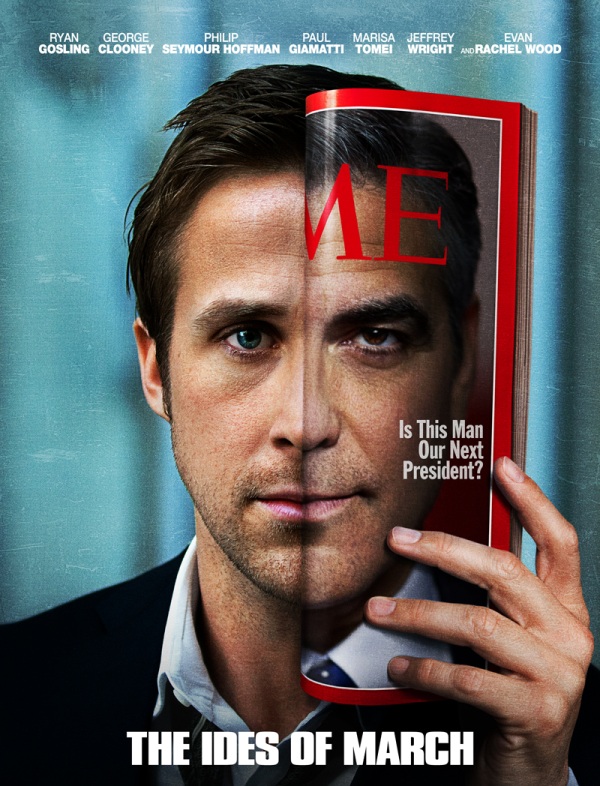
So, how to make myself feel smarter again? Shouldn’t a political thriller/drama directed by George Clooney, starring the current golden boy Ryan Gosling and based on a stage play do the trick? It should, but somehow it doesn’t. The Ides of March isn’t a bad film; in fact, it’s a handsomely made, nicely acted, reasonably smart film – the problem is that with those actors it should be so much better. Instead it is adequate. It is lukewarm. I enjoyed it well enough while watching it, but the film doesn’t add up to much other than yet another statement that politics corrupt. That idealism cannot survive in politics. Well, bugger me with a fish fork, who’d have thunk?

It would be unfair to say that all of the film is merely satisfactory. Phillip Seymour Hoffman’s performance is strong, as always (but it’s such a monumental waste to have him in a film with Paul Giamatti and not give the two of them a good, juicy scene together), and Ryan Gosling’s character is interestingly ambiguous. Is he an idealist or is he smug, self-righteous and the most corrupt of the bunch? Is he changed by what happens, or does what happens reveal the rotten core underneath? Still, the film rarely becomes more than a finger exercise, Clooney showing that he knows his craft – and after I loved his first, Confessions of a Dangerous Mind, I would have expected something more than that.