January Variety Pack (2)

A bit later than promised, but here’s the second January Variety Pack, containing all the snap, crackle and pop you could hope for, as well as Teutonic metaphysics and an ageless gnome who’s finally getting old.

Cave of Forgotten Dreams

Werner Herzog is one of those film makers I’ve been aware of for a long time but whose work I’d never seen. His name triggers childhood memories of zapping into Klaus Kinski films and being weirded out by the guy, and I definitely remember hearing about the epic, ongoing on-set battles between Kinski and Herzog – but I’d never seen more than a couple of seconds of the actual films. I’d heard good things about his earlier documentary, Grizzly Man – but again, if it was ever on I missed it. Cave of Forgotten Dreams hadn’t even been shown at cinemas here when I succumbed to the post-Christmas lure of Amazon.com and went ahead and ordered the film on Blu-ray. Hey, if people praise its amazing visuals, I want all the pixels I can get, right? (No 3D, though – it’s available on the disk, but my TV don’t do three-dimensionality.)

Herzog’s a weird one, at least on the basis of this film. Much of his slow, accented voice-over is heavy on the metaphysics, and while I wouldn’t necessarily say I like it, I cannot deny that I find it compelling – right down to the surreal epilogue featuring albino alligators. It becomes even weirder when Herzog cracks a joke, in the same slow, deliberate, strangely sad voice. (Imagine a voice with a heavy German accent that’s pretty much the aural equivalent of Tommy Lee Jones’ facial expression throughout The Three Burials of Melquiades Estrada.

As much as Herzog puts his stamp on the film, its real star is the cave itself and its amazing paintings dating back tens of thousands of years. Not all of the individual paintings are equally fascinating, but some show striking subtlety and artistry – and they look as if someone left them there just yesterday. Herzog’s film is highly successful at evoking both the age of the cave artworks and their immediacy – freaky amphibian reptiles with blood-red eyes are just an extra. The film is enjoyable even without smoking pot or drinking a bottle of cheap-but-nice red wine beforehand.

Mission Impossible – Ghost Protocol

… or MI:4, to its friends. In spite of my pretentious-yet-middle-of-the-road film geek credentials (with a few dozen Criterion editions on my shelves I cannot really deny it) I like a good action movie. I’ve enjoyed the Bourne series, Die Hard is one of my favourite Christmas flicks (right there with It’s A Wonderful Life and Nightmare Before Christmas) and I have fond memories of the Californian governor relieving Bill Paxton of his boots, clothes and motorbike.

In those terms, is Em-Aye Four a success? There are moments in the film that I’d consider among the most exciting action scenes of the last ten years. (It helps that we’ve arrived at a point where you can’t always tell a green-screen shot from stunt work.) I sat on the edge of the chair, I jumped, my pulse went up, my breath caught, just as the movie intended.

Apart from that, though, the film fails in one fundamental way: I didn’t care about any of the characters. Is the problem that Brad Bird’s first non-animated movie doesn’t know what to do with its human cast (nor, cheap joke alert!, with Tom Cruise)? Perhaps. It pays lip service to characterisation, but the motivations it provides for its protagonists are uninterestingly written and the actors don’t make them come to life. In fact, you care more about the characters when they’re not angsting about the partners they’ve lost to the job – they’re more relatable when they shut the hell up than when they open their mouths and pretend they’re real people.

For what it’s worth, MI:4 is better than John Woo’s MI:2 – but then, watching a burning dove fly past pooing itself in slow-motion fear is (marginally) better than that film. Is it on par with MI:3? I honestly couldn’t say, because for the most part J.J. Abrahams’ stab at the Missionary position self-destructed about five seconds after I exited the cinema… which is quite the achievement, admittedly, for a film featuring Phillip Seymour Hoffman.

Speaking of achievements, though, CGI has finally managed to conceal the fact that Thomas Cruise, Esq. does not age. The wrinkles that have begun to show on the Cruisester’s face look positively life-like. Will the Academy Award go to Make-Up or to Visual Effects? And is there any truth to the rumour that Cruise’s performance was motion-captured off Andy Serkis?

P.S.: For the record, I quite like Tom Cruise as an actor, when he’s got good material and is directed well – or when he shows that he’s got a sense of humour. (A bit of respecting this! and taming that! also seems to work quite well for him…)
January Variety Pack (1)

I know, it’s been a while. My apologies; my excuse is that I was lazy. Not a very good one, is it? In any case, I thought that rather than write one long update on a film I’d recently watched, I’d do some shorter ones. So without much further ado, here’s the first of my variety packs – the second is to follow very soon…

Four Lions

I have to say, when I heard about the film I was both intrigued and worried. It’s not that I think there are topics that can’t be treated by satire – but I also find the equal-opportunity-offender satire of, say, Trey Parker and Matt Stone neither particularly funny nor all that perceptive; in aiming at all targets, it rarely achieves more to my mind than a general, “Well, all positions can be a bit silly, can’t they?” Also, being offensive for its own sake is such a lazy way of satirising a subject. Which, let me hasten to say, Four Lions doesn’t do. In fact, for satire it is far from offensive in one important sense: as it opens its subjects to ridicule, it also evokes sympathy for them. It humanises its protagonists, the Muslim suicide bombers, as it shows them to be deeply flawed and silly in their motivations and reasoning. And it’s exactly this element that makes the film so funny and chilling in its strongest moments – rather than saying, “Those guys are our enemies and need to be destroyed” it asks us to see them as fellow human beings, albeit misguided ones… which may be much more subversive: love thy enemy.

But, apart from that, Four Lions is one of the funniest films I’ve seen in a while, asking the very important question: “Is a wookiee a bear, Control?”

P.S.: In terms of its darky humorous yet sympathetic tone, Four Lions reminded me of the Danish black comedy Adam’s Apples. Also highly recommended!

Never Let Me Go

Since I liked Kazuo Ishiguro’s novel a lot, I was curious about the film version by Mark Romanek of One Hour Photo semi-fame. I was also worried; would the novel’s delicate, moody tone survive the transition to the big screen, and more importantly, would it survive La Knightley? I’m not her biggest fan – I do think she’s talented, but more often than not film makers make the assumption on the part of the audience that we fancy her like mad, and they then become lazy when it comes to letting her act. Instead she ends up doing her portruding-chin shtik that signifies, “My character is feisty, passionate and won’t take crap from anyone!” All too often she doesn’t portray characters on screen so much as do a slight variation of what she’s done in other successful films. Since I don’t find her particularly sexy (I was definitely Team Parminder in Bend It Like Beckham) Keira being Keira just isn’t enough.

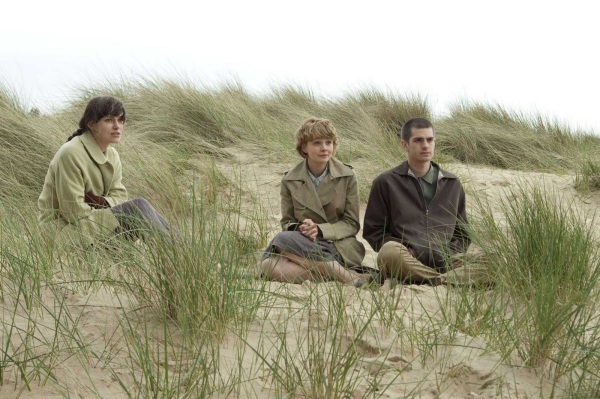
I wasn’t particularly fair in this fear, at least when it comes to Never Let Me Go. The adaptation isn’t perfect: it would need some more time for the implications of what’s going on to sink in and be as quietly devastating as in Ishiguro’s novel, and the writing (the script is by Alex Garland, whose work I tend to find compelling and frustrating in equal measure) is a little too on-the-nose at times, assuming that the audience is too thick to get it. But the casting, including Keira Knightley, works perfectly. Yes, both Andrew Garfield and Carey Mulligan aren’t miles from the parts they usually play, and it’s not as if Knightley is miles away from other parts she’s done, but the actors fit their parts to a T, with Garfield especially delivering a performance as poignant as that he gave in Boy A. I could imagine that my first criticism is less of an issue for those who haven’t read the novel – the film isn’t rushed by any means, it just doesn’t give its audience quite as much breathing space, which is what I missed a bit.

Menaced by the pause

In Swiss cinemas, there’s almost always an intermission roughly halfway during the film. Doesn’t matter if it’s a three-hour epic or a blink-and-it’s-over chit of a comedy. Doesn’t even matter if it’s the remastered 2001: A Space Odyssey and five minutes after the cinema’s intermission (2001 – now there’s a true popcorn flick!) there’s the roadshow version’s actual intermission.

Even though I would consider myself a cinephile, I don’t hate intermissions with a vengeance. Sometimes I like having a moment to pause and think about what I’ve just seen; sometimes my bladder is grateful for them.

And sometimes they break a movie’s back, much like this:

I greatly enjoyed the first 50-60 minutes of Roman Polanski’s Carnage. The film was expertly paced, the casting near perfect (although I would’ve loved to see James Gandolfini in it), the performances strong, with just the right lightness of touch. I’m notoriously tricky when it comes to comedy, but I was laughing along with the escalating situation. And then came the break.

For all I know, without the forced interruption I would have stayed in the film. I would have enjoyed it to the end. As it was, the impetus was gone, and what remained felt clichéd, trite, predictable. Oh ho, neuroses and hypocrisy under a thin veneer of civilisation! Tee hee, the lawyer collapses when his mobile phone ends up in the vase! Giggle, snort, the wife breaks down in a sobbing wreck when her beloved handbag is thrown across the room, spilling its innards all over the floor.

Thing is, all of this – the clichés, the lack of any depth – was there in the first half… but as the film built up momentum, it felt like all of this was exactly to the point. Having had five minutes of ice cream ad projected at the screen and then to pick up where we’d left, as if nothing had happened? Carnage had turned from witty, sharp, light-of-touch comedy to leaden sitcom. The remaining 25 minutes felt longer than the almost-hour we’d already seen. Yes, it was still expertly acted, but to such obvious, hackneyed effect. Perhaps an earlier break would’ve been better, giving the film more of a chance to build up momentum again. I don’t know, but as it was I had seen two thirds of a smart, funny film, only to turn against it in the remaining half hour.

It’s difficult not to think of this piece of Zen wisdom:

P.S.: It’s difficult not to love Christoph Waltz’ performance in this, though, while disagreeing with him 99.9%.

Some snyde remarks, part three

I am the guy who thrashed Eden Lake and The Social Network. I am the guest author of this blog, so I am not really behind most of the interesting and well-informed entries around here. That is someone else, and he is in no way responsible for the whining and whingeing about how bad this or that movie is. In fact, he is much more careful in choosing his drug of choice.

So, hey, part three. You’ve been warned. And since you’re still reading after the warning, here’s a promise: I’ll find a movie that I like, and will write about it. So much disregard for your own mental well-being must be rewarded.

Sucker Punch is all style on the outside, and evil smut at its centre. It’s like that golfball that’s supposed to contain poison. There’s that girl, played by Emily Browning, whose mother is dying of some unknown disease. Shortly after, her uncle or stepfather goes after her younger sister, and she dies, too, but I am not sure how, or whether there was any paedophilia involved, as the scene seems to suggest – I think someone became jittery about a possible NC-17 rating and screwed up the stylish display of kiddie abuse by re-editing. She is carted off to a mental asylum, where, strangely enough, the inmates are all teenage girls. Maybe there are other wings, one for old men, one for…

Hang on, where am I? Oh yeah, the staff. There is one half-way sympathetic character, their therapist Dr. Gorski, played by Carla Gugino. There is also the janitor, a shady guy named Blue, who recommends to the stepfather that the girl get a lobotomy, because then his visits would require only one consenting adult, while she will be no longer consenting to anything, nor ever see adulthood. Stepdad agrees, and so the doctor, who looks deceptively like Jon Hamm, points his tool at her forehead. I am talking about that metal needle they use for the lobotomy, and I take exception to the way you think, but it’s Zack Snyder’s fault, not yours.

And just when he wants to insert the needle into her eye, someone says stop, and we are in the Browning character’s psyche, where the asylum is a brothel ruled by Blue the pimp, and the girl orphans, who are all dressed in skimpy school uniforms that would break any school unform rules anywhere, take dancing lessons under Madame Gorski, the dance instructor. The girl, who is now called Baby Doll, is by far the best dancer, but we never get to see her dance, because when she does, the movie switches to yet another level, where a guy who looks deceptively like Scott Glenn tells Baby Doll about a quest she and the girls must go in order to be free: They have to recover a map, a lighter, a knife, a key and another mysterious object. It was at this point that I remembered that whenever a movie goes into cheap CGI mode, it is a good idea to think fondly of the fact that the whole of the Muppet Show is out on DVD.

Baby Doll has to distract the staff by dancing so the other girls can steal the items they need. The second dance shows the girl gang in some sort of super-Gothic bombed-out Dresden. I guess Baby Doll must have liked 20th century history, but got confused on the details, because the real Nazi soldiers were not zombies powered by steam and clockworks. This scene is so ridiculous that it made up for the rest of the movie. I mean, the Third Reich could have used zombies without the machinery, if only to save on the overhead, but never mind. So the gang kill a lot of the steamheads and shoot down a lot of fighter planes, although their mission is to steal a map from a messenger on foot.

And so on. At some point, the music for Baby Doll’s dance stops, and they are discovered. All of the gang except for Baby Doll and Sweet Pea (Abbie Cornish) are shot by Blue, who finds out about their plot. It is here that the movie definitely is confused and confusing: We are still in Baby Doll’s mind, so why oh why does she allow for Sweet Pea and herself to be saved, but let the others die? Horror vacui is a real, real thing, people. In the very end, Baby Doll allows Dr Hamm to go through with the lobotomy so Sweet Pea can run from the asylum and board a bus driven by someone who looks like… oh, forget it. Dr Hamm, right after his umpteenth lobotomy, realizes that lobotomy is… WRONG! He will have a great career in advertising. Blue is arrested, but poor Baby Doll is lobotomized. Ha! Didn’t see that one coming, but maybe she did. The movie shows her slightly smiling, suggesting that she has won. But won what?

Sucker Punch has a feminist message, and it is this: Girls rule, especially those with the semi-automatics and the samurai swords, and never mind the skimpy dresses. I have a message for Sucker Punch: show me a kind of feminist statement that involves names like Baby Doll and Sweet Pea, where the female protagonists have to do what their fatherly mentor tells them, and I suggest to you an improved kind of feminism involving spirited debate about equal rights and passionate demands for the improvement of the women’s cause, free of charge, and I don’t even have to try too hard. Because you see, even I, a guy, can see that all that fighting and killing while flashing your cleavage and gusset can wear even the angriest girl out. Me, too.

It is beyond me how Abbie Cornish, who stood up for herself in Bright Star and who impressed me in a small gem of a movie called Somersault, could have said yes to such a piece of guano as this. And Emily Browning is not a moron, I’ve gathered from a few interviews. There will be a movie with her called Sleeping Beauty that seems to feature those sexual politics that Sucker Punch relegated to its own screwed subconscious. Seems like Baby Doll wasn’t the only one lobotomized.

The past is a foreign country…

… they do things better there.

Or at least Paul Abbott did. I’ve obliquely alluded to my dissatisfaction with his recent BBC miniseries Exile before – very obliquely, so much so that I was hardly able to find the reference – and out of the recent spate of BBC drama it was the weakest. In spite of a good cast and great first episode, it was predictable, lazily characterised and didn’t do anything we hadn’t seen before. This was especially disappointing because eight years ago Paul Abbott had written another BBC miniseries, also starring John Simm, and that one was smart, exciting and kept me guessing pretty much throughout. It was called State of Play, and yes, if that title rings a bell, it’s because Hollywood turned it into a movie remake.

I’m currently re-watching State of Play and can attest that it stands up well even at a second viewing, where Exile didn’t even survive a first viewing intact. It’s got a great, varied cast both of old hands and fresh faces (and bringing together John Simm and Philip Glenister years before Life on Mars), and it was directed with pace and style by a certain David Yates who would later bring out the gloomiest in the halls of Hogwarts.

The series isn’t perfect – I can’t remember how it ends, but I do remember that the ending fell somewhat flat when we first watched it a few years ago. (I also remember a number of episodes of Cracker that started much better than they ended, while I’m at it.) But in terms of zippy, clever entertainment produced UK talent at the top of their game, it’s well worth watching. And hey, it’s got Polly Walker, Kelly McDonald, James McAvoy, Bill Nighy… Definitely something for most tastes – plus, at least Amazon.co.uk is selling it for £4. At this rate you need a very good excuse not to give it a try, eh?

This advertising was brought to you by a guy who wants the Beeb to do as well as they’ve shown they can, over and over. Because, as much as I like HBO, every now and then I bet those Brit actors are quite happy to head home, visit their families, have a cuppa with their ageing mum and use their original accents.

P.S.: I can’t say anything about the film version’s quality, but at least they decided to stay stylish when they replaced the editor-in-chief played by Bill Nighy with the Queen of British acting herself, Helen Mirren. (Isn’t it time for her and Judi Dench to star in a buddy cop comedy or in anything, really, since their last co-operation seems to have been a Peter Hall Midsummer Night’s Dream?)

When is a still not a still?

Jim Emerson recently posted about cinematoGIFs, animated stills (that’ll do in your brain!) that try to capture the essence of a scene. The results are evocative and almost hypnotic… I challenge anyone to make such a not-quite-still out of a Michael Bay movie, though!

Edit: Not sure whether these actually work embedded in a WordPress post. When you click on them – or follow the original link above – you should be able to see them in their full, animated glory, though!

Make sure to check out the rest of them!

When in Rome…

For all the amazing places I’ve visited vicariously through cinema, last week that was spent in actual, real Rome made me realise that I haven’t seen all that many films set in the Eternal City, in spite of its obvious cinematic qualities. I’ve seen Antonioni’s Roma, Città Aperta, and I’ve watched Matt Damon trying to figure out whether he wanted to be Jude Law or whether he simply wanted him in The Talented Mr Ripley – but other than that, cinematic Rome has passed me by. (Televisionary Rome, on the other hand…) Having recently walked past the house where Frederico Fellini and Giulietta Massina lived for the last years of their lives, I am resolved to check out La Dolce Vita and Roma, at least. Film Four, couldn’t you throw a Fellini retrospective our way?

However, I did spend a couple of weeks earlier this year exploring the place – albeit neither in films nor in the real world, but in Assassin’s Creed: Brotherhood, a game that carries the DNA of both Dan Brown and Umberto Eco according to some critics (I’m afraid that Eco, other than The Name of the Rose and some essays, has passed me by so far – another omission I’m hoping to correct). It’s set in Renaissance Rome, and it’s a near perfect example of how video games, in terms of technology but accordingly also in terms of ambition of what can be depicted in games, have developed in the last couple of years. Obviously seeing the real Pantheon or Colosseum or Campidoglio isn’t the same as seeing them in the game – and indeed, when I fired up Brotherhood this morning to check out the locations with Rome fresh in my memory, I did find them all to look considerably smaller in comparison – but letting you explore places that feel alive and that are inaccessible to you otherwise is something that games are doing better and better.

What games cannot do, though, and won’t for a long, long time, is deliver that perfect Granita di Caffe con Panna. Time for Nintendo to make a deal with Nespresso, methinks!

P.S.: In Brotherhood, the Colosseum and the Pantheon are probably my favourites. In actual Rome, it’s the wonderful Caravaggios (can he lay eggs?), the restaurants and that perfect tagliolini cacio e pepe at Le mani in pasta in the Trastevere part of the city. Molto delicioso!

Catch this!

Okay, this’ll be a very short one – I’m in Delhi for the week (work, I’m afraid, and without my better – and certainly better-looking – half) and don’t have all that much time for non-work blogging, but I just saw this and needed to share my excitement with the world. I’d heard that Steven Soderbergh was going to quit filmmaking, but it seems that one of his last gifts to cinemaphiles is what looks to be like the lovechild of Traffic and Outbreak – with Gwyneth Paltrow as the monkey. So, without much further ado, get infected.

“Remember when?” is the lowest form of conversation…

… nevertheless, though, remember when I did a semi-ironic, semi-appreciative post on Terrence Malick’s Tree of Life? And remember when I plugged Mark Kermode’s BBC Radio film reviews?

Well, those two threads got together, had some glasses of wine and cuddled up under the blankets… and now, months later, voilà!

Because, obviously, Kermode would never have reviewed Tree of Life if it hadn’t been for my blog. Ob-vi-ous-ly. (In any case, it’s not one of the funniest or most cutting reviews, but that’s because Kermode’s reaction to the film, while more negative than mine, is fundamentally respectful if baffled and at times frustrated with Malick’s riff on Genesis, the Book of Job and Walking With Dinosaurs.)