Eagles on Pogo Sticks likes this.

Yesterday evening, before we went to the cinema, we were discussing David Fincher’s other films. Which did we like best? Which least? I came up with my personal Top Three films directed by Fincher (in no particular order): Seven, Fight Club and Zodiac, with Alien 3 receiving special mention. (It’s flawed but the bits that I like I pretty much love.) Seven is probably the moodiest of his films, Fight Club the most enjoyable and Zodiac is perhaps the most perfectly crafted Fincher film.

Since yesterday evening, I’ve added The Social Network to the Top Three (which therefore contains four titles now, risking a possible world-destroying mathematical paradox), albeit on probation. Will I still like it that much in a week’s time? In a year? Once I’ve seen it as often as the other films? (Zodiac I’ve only seen three times so far, but Seven was my film for bad moods for a while when I was often in a bad mood.) We’ll see, but for now I would say this: it’s Fincher at the top of his game (Ebert rightly calls the movie “splendidly well made”), working with a script that complements his considerable skills. This makes for an interesting comparison: The Curious Case of Benjamin Button was decried by some because that film’s script pulled it in the direction of a mawkish sibling to Forrest Gump (scripted by the same writer, Eric Roth, not to be confused with Eli Roth). I thought that Fincher’s cerebral approach made for a fascinating film that was pulled in two different directions, namely sentimentality on the one hand (script) and a weird sort of Verfremdung on the other (direction), resulting in a tension that didn’t always work in the film’s favour.

Aaron Sorkin’s script for The Social Network, though, is sharp and witty, with little trace of mawkishness. It’s not cold or unemotional in any way, but it doesn’t do the Spielbergian brand of emotion that requires heartwarming performances and a John Williams soundtrack so obvious it makes you feel a little queasy because the sentiment is laid on so thick. The film thrives on repartee and verbal barbs that is delivered at breakneck speed – I’ve rarely seen a movie that is so dialogue-driven and feels this fast (though not rushed).

I’ve seen TV series like this, though, especially one little known one about the president of some far away country. I think it’s called… let me see… The West Wing? Which, coincidentally, was also written by one Aaron Sorkin. Having watched the first four seasons of The West Wing (the ones during Sorkin’s time at the helm of the series), I find The Social Network‘s fictionalised Mark Zuckerberg a dark twin of Josh Lyman, deputy chief of staff to President Bartlet. Lyman is more likeable because he’s got a strong sense of ideals and ethics, but he shares so many qualities with Zuckerberg: the sense of intellectual superiority that goes hand in hand with deep-seated insecurity, the way that every conversation is seen as a battle, the intense need to win, to be right, even if it means being a dick to others – the atrophied social skills and emotional immaturity that is fun to watch with Josh because he works in an environment and with people that ground him every now and then.

While the origin story for Fincher and Sorkin’s version of the Facebook founder is perhaps too simple – Zuckerberg basically gets started on the road to Facebook because of the Girl That Got Away, throwing his social dysfunction right back in his face – it makes for an interesting foil with Josh Lyman. Without his Girl Friday, Donna Moss, would he become increasingly insufferable as Zuckerberg does, ending up a sad, pathetic geek with a brilliant mind?

If you wish upon a star spangled banner

We’re slowly sidling up to the fifth season of The West Wing – apparently the one where most people agree things went down the drain. From what you can read on the web, it’s held in about as much esteem as Buffy the Vampire Slayer S6. Well, if that means that we’ve got The West Wing‘s “Once More With Feelings” to look forward to, I guess I can cope.

We’ve just seen the President decide not to stand idly by while a genocide takes place in an African country. The situation’s an obvious take on Rwanda, and on the United States’ mealy-mouthed reaction to that genocide, right down to the semantic games played to justify inaction. President Bartlet asks one of his staffers, “Why is a Kudanese life worth less to me than an American life?”, and the staffer replies, honestly: “I don’t know, but it is.”

Except that’s not good enough any more for the President. He decides that the US lose any justification they have to self-righteousness if they do not intervene. Basically, Bartlet does what Clinton, back in 1994, didn’t do, for various reasons.

Watching The West Wing now, years after it was first broadcast, I was a bit non-plussed by this storyline. As it developed, it felt very much like a “What if?”, but one that had strong elements of left-wing wish fulfilment. What if we could go back to 1994 and act differently? What if we’d lived up to the standards we set for ourselves, and the image we project of the United States? Nothing against a “What if?” scenario, but this one felt a bit like “Well, if we finally do the right thing in fiction, that must be worth something, right?”

Admittedly, this isn’t altogether fair to the series. For one thing, the storyline has only just begun, and I doubt it’ll remain as clear-cut. The series has never suggested that what ought to be done is easy or that it doesn’t have any repercussions. More than that, though, President Bartlet’s decision to intervene is obviously not entirely selfless – after all, the previous season’s final episode had him deciding to have the Foreign Minister of a Middle Eastern state assassinated due to his close ties to Islamist terrorists. While The West Wing has a weird habit of forgetting everything about characters it doesn’t quite know what to do with (Where’s Ainsley at? Where’s the girl, Jed? Where the fuck is Ainsley, huh, Jed? – Ah, to be honest, she can stay lost in the same place as Mandy, for all I care…), it doesn’t forget its characters’ transgressions – and hey, if there’s anything white liberals, especially of the lapsed Catholic persuasion, are really good at, it’s guilt, isn’t it?

On a very different note: when Donald Moffat turned up as C.J. Cregg’s dad a couple of episodes ago, my first thought was: “It’s the President!”  Moffat’s one of the US actors who have played POTUS (in his case in the Tom Clancy movie Clear and Present Danger) – which made me think that it would be fun to have a West Wing episode where all the guest stars are erstwhile presidents of the United States. Of course James Cromwell would beat them all… and a quick Google search has revealed to me that he may just turn up on the series. Guess what he’ll be playing…

You better show Don Bartlett some respect, paesan!

Ah, The West Wing. Part political drama, part Whedonesque comedy (replace the supernatural or sci-fi elements with politics), part character-driven melodrama, part actors’ showcase. Part pinko liberal wish fulfillment.

I enjoyed the series from the beginning, but after lots of HBO fare season 1 often looked pedestrian in comparison. Great dialogues, great acting, but does TV have to look like TV, namely drab, conventional, boringly shot? Even dialogues can be filmed more interestingly – and no, WFTF (Walk Fast Talk Fast) doesn’t make for interesting cinematography after the nth time it is used.

We’ve now arrived at the end of the third season, and while the series hasn’t aspired to the cinematic heights of The Sopranos or Carnivale yet, it has definitely had its cinematic moments – and none more so than the season 3 finale. Not only do we get Shakespearean scenes of plotting in the shadows (okay, that’s dramatic rather than cinematic – but the dark-light contrast still looks as good as it did when the German Expressionists used it), the entire ending takes not just a page but entire chapters out of the Godfather playbook. Jed Bartlett watching a rousing Edwardian song during a performance of The War of the Roses (entire US administrations could rise and fall during the time it takes to perform all of these plays) while US operatives ambush and assassinate a Middle Eastern defense minister… The only thing missing is a few strains of Nino Rota and possibly a horse’s head, although reports have it that there was a shortage of good horses, in parts or otherwise, during Shakespeare’s history plays.

For all the homages in “Posse Comitatus”, the one scene that stands out most in my mind is the one that is quintessentially West Wing:

Give me such a scene and I’ll become a US citizen just to vote for Bartlett!

P.S.: Was “Posse Comitatus” originally broadcast before every single series decided it needed a sad scene set to Jeff Buckley’s version of “Hallelujah”?

Arrivederci Roma!

The second season of HBO’s Rome was… well, let’s say that it was less than it could have been. Its main problem was this, it would seem: the series creators realised that Rome wouldn’t be back for a third season. Seeing how they had planned for a five-season arc, they were faced with a dilemma: should they speed up the plot so they could bring it to some semblance of an end, or should they let things play out at the pace they had planned and risk leaving us with yet another Carnivale or Deadwood, ending way before it was finished?

They decided to go for the first option, telescoping their plot for the hoped-for seasons 2, 3 and 4 into the second season. And that’s pretty much what the season felt like: four or five episodes into the story, someone suddenly pressed the Fast Forward button, and off we go like a rocket sled. Pacing? That’s for wimps and people whose series are allowed to run their course.

I remember how frustrated I was especially with Deadwood, where we got three quarters of a complete story. It was as if someone had ripped the last 100 pages from a novel, from every copy ever printed. And then they’d deleted the last 100 pages on every backup of the manuscript. Okay, I realise how thinly stretched the simile is – but the point remains: an unfinished story is a frustrating story.

What is similarly frustrating, though, is a story that doesn’t have time to pace itself. At times the second season of Rome felt like its own “Previously on”: okay, now Brutus is dead! Now Anthony’s in Egypt! Now Servilia’s offed herself! Most of the main characters are dead and have been replaced by twenty-somethings! The kids get half a dozen years older over night! This rushed feel wasn’t necessarily helped by the series’ replacing the young man who had played Octavian with another, slightly older young man playing the same character – while practically all other characters around the same age were still played by the same people!

The letstelleverythingasquicklyaspossiblesowecansqueezeasmuchplotintothisaswecan approach meant that we found some sort of closure, but it also meant that the characters lacked breathing space – and as was the case with so many HBO series, the characters is where it’s at. Brutus’ death, for instance, was still moving, but it could have been infinitely more so with a more generous build-up.

The last episode, though? We were rudely jarred out of Fast Forward, but that meant that at least we had an hour where Rome was returned to its former glory. I admit, I was never too keen on the character of Marc Anthony (as portrayed by James Purefoy): he had all the arrogance and cockiness but little of the charm, which made it all the more difficult for me to understand why certain characters would fall for him. Cleopatra, too, annoyed me more than anything else, striking me as an antique oversexed bimbo with the personality of a urinal.

Give these characters good, meaty deaths, though, and suddenly they become grandiose, they become tragic. They gain the ability to move us. And boy, did they take that opportunity and play it to the fullest. A couple of series have done this: make me care about a character just to kill him or her off – but here it wasn’t a cheap ploy to make us care, it was earned. Anthony and Cleopatra’s deaths, while not the near-perfect scene that Julius Caesar’s murder was, count among the series’ strongest moments, together with the death of Cicero and Lucius Vorenus saving Titus Pullo’s life in the arena.

In spite of the whiplash-inducing pacing problems of the second season, I miss the series. I miss the characters, I miss the plotting and intrigues, I miss the visceral quality of the language and imagery. My hope lies in the Rome movie that is still much more likely to happen than the fabled Deadwood film that’s supposed to wrap up the story. Hey, if HBO can greenlight Sex and the City 2, can’t they spare a few sesterces for Pullo and Vorenus, the most beautiful love story to grace the small screen in years?

Don’t stop-

As always, I’m pretty late to the party, so please bear with me as I write about the pop culture event of the year… 2007, that is. “Remember when” may be the lowest form of conversation according to some – but remember when The Sopranos ended on the ten seconds of silence heard around the world?

The Sopranos has been with me for a long time. It has a special place in my heart for accompanying the most important relationship in my life. Even beyond its personal significance, it was the first HBO series I got into – arguably it’s the one that got me hooked and that led to Six Feet Under, Deadwood, The Wire, and so on. And while it had its ups and downs, feeling at times like it had continued past its prime, it is clearly one of the strongest pieces of TV fiction ever, featuring one of the best written, best acted core casts.

In seasons 4 and 5, I felt that while the individual episodes were strong, the series wasn’t going anywhere. The episodes were exchangeable. There wasn’t all that much of a compelling story arc (they should’ve had Christopher writing the series – there’s a man who knows about the importance of arcs). Idiosyncratically named season 6 part 1 (if you want to top that, you need to go to video games and check out Star Wars: Dark Forces III: Jedi Knight II: Jedi Outcast) was a mess in some ways, but it tried, and succeeded, in getting the series out of its rut. The whole of season 6, but especially part 2 (the final nine episodes, that is), had a sense of purpose: we were spiralling in on the destruction of everything that Tony holds dear, often at his own hands.

“Made in America”, the final episode, ended… strangely. Was it a massive anti-climax? Was it a subtle way of saying that Tony’d been whacked? Was it a “Fuck you!” to the fans who’d been loyal to the series for almost a decade? Personally I’m leaning towards the “Tony’s dead” interpretation myself, since it’s pretty stringent – the strongest argument being Bobby Baccalieri’s line earlier in the season, referring to the moment when you get shot: “You probably don’t even hear it when it happens, right?” A lot of things point, more or less strongly, towards Tony’s violent death.

At the same time, though, season 6 part 2 (paragraph A, line 23) is a season of red herrings. There are several episodes that ratchet up the tension, suggesting very strongly that by the end of it, character X would be dead: Paulie Walnuts, Hesh, Bobby, Christopher. The latter two do end up dead, but only after a bait and switch pulled by Chase. “Made in America” works pretty much the same way, with everything pointing towards that final gunshot – but then we get nothing. Blackness. Silence. “Don’t stop-” indeed. Does it stand for death? Tony’s death? The series’? Or for Chase denying us the closure we want, whether that is Tony getting away with it all or getting the punishment he undoubtedly deserves?

Shrodinger’s Tony aside, though: the episode is perhaps the strongest of the entire series in terms of filmmaking, and the final five or six minutes are a brilliant example of this. I can’t think of many films or series that ratchet up the tension so deftly while showing what can easily be seen as wholly innocuous. Add to that Chase’s usual good hand at picking the perfect soundtrack for this series:  “Don’t Stop Believing” will forever be stuck in my head together with this scene. And cutting off the music when it does? Perfect. What better moment to end than in mid-sentence, right after “Don’t stop”?

Farewell, Tony. Farewell, Carmela, A.J., Meadow. Good bye, Sil, Chrissie, Uncle Jun, Paulie, Bobby, Janice, Livia. Ciao, Dr. Melfi. Many of you were pricks with an over-inflated sense of entitlement – always with the drama! – but damn, if you didn’t make these ten years of TV watching memorable as hell. (Quite conceivably a hell run by the Irish, where every day is St. Patrick’s Day.) Wherever you are, whatever you’re doing-

P.S.: Another nail in the “Tony’s dead” coffin, and one that I find pretty convincing: there’s no reason to end before the entire family’s together, but we don’t get to see Meadow with her parents and brother. If the end was supposed to be open, it would’ve ended with all four of them; instead, we get the Blam! of the black screen just before Tony sees her. Either Chase’s fucking with us, which I don’t believe – or something interrupted the family union. Something pretty final.

P.P.S.: Think what you want about the woman, but Hilary Clinton’s Sopranos spoof campaign ad had class:

My favourite kinds of imperialism

We’re getting close to the end of The Sopranos. Both Rome and Carnivale only have one more season to offer us. And at the speed at which we’re going through West Wing, President Bartlett will have finished his second term in record time.

How to find good, new series? Used to be, I could pretty much get three out of four HBO series on DVD and be happy for the next year or so. Even if some of them found an untimely end, the journey was absolutely worth it.

Now, though? Can’t say I’m all that interested in Hung, and I’m not sure I would enjoy Big Love (which may be due to my lack of trust in Bill Paxton’s acting abilities – “Game over, man!”, indeed…). What about all these new series starting on other channels, though? The Elmore Leonard series Justified sounds like it might be fun, and I’m definitely hoping to get Caprica, provided that it doesn’t get cancelled after one series.

However, HBO seems to be stepping up its game, with not one but three series premiering this year. The one I’m currently most excited about is the one I only found out about five minutes ago: Boardwalk Empire, by Sopranos alum Terence Winter and Martin Scorsese – yes, you read that right, the Raging Bull of mob cinema himself! Check out the trailer, which looks like the murderous bastard child of Once Upon a Time in America and The Sopranos:

Also looking quite promising, although in a more Norman-Rockwell-meets-Interracial-Slaughter way: The Pacific, which seems to be a sort of companion piece to Band of Brothers. Oh, and it stars the little kid from Jurassic Park, all grown up. Listen, boy, you should know better than to return to island jungles! (Cue bad “Doyouthinkhesaurus?” jokes about jungle warfare…) Again, let me peruse YouTube:

Finally, the creators of my favourite series (it shares the pedestal with Six Feet Under) are doing a new show on the aftermath of Hurricane Katrina. It’s called Treme and it’s got the usual awesome cast of actors, including Wendell Pierce and Clarke Peters. It’ll be good to see Lester Freamon and Bunk Moreland back in action!

USA! USA! USA!

As I’ve written before, I like The West Wing. Admittedly, season 2 lacks some of the urgency of the first season (except in the double episode that starts off year 2 of the series), but it’s still a witty, well written and acted, greatly enjoyable 42 minutes per episode. I appreciate its politics and the idealism of its characters, tempered as it is by an appreciation that there’s a gap between ideals and reality that needs to be negotiated almost constantly.

Every now and then, though, the series does something that strikes me as uniquely American, and it annoys the hell out of me: it goes into Pledge of Allegiance Mode. A typical example of this is at the end of the season 2 episode “Midterms”:

To give you a bit of context: after an assassination attempt by a white-supremacist group Toby, perhaps the character on the series who is furthest left-wing (and one of my favourites, the grumpy old Eeyore that he is), spends most of the episode desperately trying to find ways of legally restricting the constitutional rights of such groups. Obviously the Constitution is sacrosanct, this being the United States, but Toby’s take is that there may be things more important than a piece of paper, however old and revered that piece of paper is. By the end of the episode he comes around to believing that perhaps it isn’t all that bad that the government protects the rights even of those who try to bring it down. His “God bless America” is earned, it comes out of a process. I may or may not agree with the sentiment, but Toby’s not made this easy on himself.

The others, though? They’re basically joining in the choir, cheapening the sentiment. It’s not idealism in the face of ambivalence and reality: it’s facile, slogany patriotism. Now, I have to admit that patriotism is something my brain fails to comprehend in general, but I can accept that the main characters on The West Wing are patriots. At the series best I can almost grasp that when these people talk about the United States of America, they mean an almost mythical construct, a symbol of perfect democracy, and that they’re aware that there is, and always will be, a huge distance between the symbol and the reality. But when they go into cheerleading slogans, with everyone in the round repeating the words, there’s something disturbing about it to me. With every repetition it’s stripped of the self-awareness, meaning and complexity that a character like Toby brings to it and becomes something insultingly, childishly simple and chauvinistic. It’s this belief that the ideal, the symbol and the actual country are close enough to one another that allows for crusader-style action around the globe – hey, if your country is the embodiment of all that is good and just, then your actions must be good and just by definition, right?

To be fair, those moments on The West Wing are just that: moments. By and large, the series remains firmly aware of the clash between ideals and reality, and of the fact that it is practically impossible to negotiate the two without despairing that you’ll never get to where you’re going, that you’ll always be compromising your ideals in the end – but that, in the face of compromise, you can still keep fighting for your ideals and achieving small victories every now and then. I just wish they could do without the “Rah, rah, USA!” moments altogether, because they just feel tacky.

Okay, and after all this heavy stuff, dude, here’s a fun little something for those of you waiting for or already watching the final season of Lost. (Don’t worry, there aren’t any spoilers.)

Blood Wing? True West? Something along those lines…

Since Switzerland is behind the rest of the world in all things pop culture, we’ve only just finished watching the first season of True Blood. Now, for those of you who have been following my HBO fetishism for a while, this will come as a bit of a surprise, but… I thought that True Blood was nothing much to write home about. It was entertaining enough, but I wouldn’t give the best episode of the series for the worst of Deadwood, The Wire or Six Feet Under, that other Alan Ball series. (I might be willing to exchange any episode of True Blood for that episode of The Sopranos where Tony meets his father’s mistress. Shudder…)

One major problem with the series, at least from my point of view, is that the main characters are much less interesting than the side characters that wander in for a couple of episodes. Bill and Sookie (or “Sookaaah!”, as Bill might put it) are okay, as are Sam, Tara, Jason and all the others, but I never really cared all that much about what was going to happen to them. On the other hand, I cared about poor, shlubby, gay vampire Eddie, I cared about psychotic, sexy hippie/murderess Amy, and I definitely wouldn’t mind seeing more of Kurt Kobain lookalike Eric (a charismatic performance by Alexander “Iceman” Skarsgard) or the Magister as played by Zeljko Ivanek.

At the same time, True Blood is almost perfect fare for a tired evening after a day at the office. It’s fun, it’s nice to look at, and that title tune always gets my toes twitching. Now, if only it was on offer as a downloadable track for Rock Band…

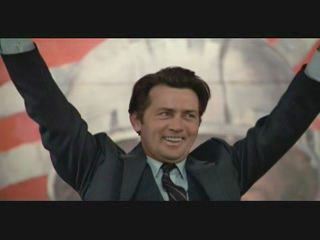
We’re also almost at the end of the first season of The West Wing. It took me an episode or two to forget that the guy playing the President had also been Greg Stillson in David Cronenberg’s film version of The Dead Zone, i.e. not a man you’d want anywhere near the White House, but now I’m okay with Prez Jed Bartlett sitting in the Oval Office.

So far I’m enjoying the series a lot, although it’s pretty much the opposite of True Blood – intelligent writing, heavy on words and ideas, and very little in the way of graphic sex, fangs, shapeshifters and blood. It does, however, have Allison Janney, an actress who I’ve come to like a lot. If I had to single out one of the characters from the series as my favourite one, it’d be her C.J. Gregg. Janney is as pitch-perfect with scenes of political drama as she is with understated humour and outright goofiness.

It’s amazing, though, how bad most of the characters on the series are when it comes to interpersonal relationships that aren’t primarily defined by work. They make great colleagues (when they’re not making vicious fun of you after a root canal) – they seem to make for lousy boy- and girlfriends (though mostly boyfriends). Déformation professionelle, I guess.

A rabbi, a Mormon and an angel walk into a bar

I’m not a big fan of Meryl Streep. Obviously she’s a good actress and has done some very fine work – but I find it difficult to watch many of her performances without thinking that they are too visible, too clearly acted for my tastes. Streep is too much of an institution to vanish behind her roles, something that I also feel with respect to many of Robert de Niro’s performances in the last ten years or so.

Having said that, though, I very much liked Streep’s performance in the HBO miniseries Angels in America – or should I say, her performances? As was the case in the original stage play by Tony Kushner, most of the roles were doubled, with actors playing two or three different parts. It’s something I enjoy in stage plays, but it rarely works in film, which tends to be too caught up in presenting a realistic surface while sneaking the most outrageously unrealistic plot elements by us. Angels in America, Part I: “Millennium Approaches” starts with a funeral sermon delivered by an ancient, doddering rabbi, played by Ms. Streep. Yes, it’s showy – we can make up one of the preeminent American actresses so she looks like nothing like herself! – but it works.

There’s a lot about “Millennium Approaches” that works. The cast is pretty much perfect, my favourites probably being Patrick Wilson’s Joe (I’ve liked him in every role I’ve seen him in so far), Mary Louise Parker’s Harper and Jeffrey Wright’s Belize. Under Mike Nichols’ direction the play translates very well to the small screen; the humour and the pathos are all there and highly effective. After watching the first part, I was all geared up for part II, “Perestroika”.

I’d read both plays years ago; I did an amateur production of “Millennium Approaches” in 2000, and afterwards we did a reading of “Perestroika”. Back then I thought it was the weaker of the two, failing to do a satisfying pay-off to the cliffhanger ending of the first play. However, I didn’t expect “Perestroika” to fall on its face with quite as resounding a thud. Yes, there were elements of camp melodrama in the first three hours of Angels in America, but they were pulled off well. Part II, however, descends into scenes that would have made Ken Russell embarrassed. The actors try their best, but some scenes – especially the ones featuring the angel whose appearance “Millennium Approaches” leads up to – are cringeworthy. There may be some way to make lines such as “The blood-pump of creation! Holy estrus! Holy orifice!” and groin-bumping scenes between Meryl Streep and Emma Thompson work, but if there is, Nichols hasn’t found it.

It’s not just the HBO production, mind you; Kushner’s original play falters badly in the second part. There are still some strong scenes (especially the ones that eschew operatic metaphysics), but the script becomes prone to hamfisted speechifying.

I’ve rarely seen a play, film or series that does so well in the first part and fails so badly in the second part. And based on what I’ve seen, I am very glad that we decided to leave it at the evocative cliffhanger at the end of “Millennium Approaches”. The thought of making people I like deliver those lines… Nothing angelic about that.

P.S.: One thing I liked from beginning to end, though: Thomas Newman’s score.