Welcome to Six Damn Fine Degrees. These instalments will be inspired by the idea of six degrees of separation in the loosest sense. The only rule: it connects – in some way – to the previous instalment. So come join us on our weekly foray into interconnectedness!

I’m a little jealous of all of you who misremember scenes in movies, because I have a hard time remembering detailed scenes of anything. It’s gotten particularly bad the older I turn. There are books I’ve enjoyed where, four months later, I can’t recollect whether I actually read them or was just planning to.
Apart from, you know, becoming decrepit, this is probably a function of how differently I approach reading. These days, I use books to complement and enhance how I feel. I read whodunnits* because I explicitly want to surround myself with mystery and light humour. I read sci-fi to be wowed by the infinite expanses of the universe. I read ‘found family’ stories to satisfy my craving for connection and so on. I regulate my mood with fiction, and I am very picky about what I choose. I’m no longer reading in order to be surprised.
A while ago, my fingers were drifting along the spines of the English language fiction section of the local libraryl and I remembered what library visits used to be like: the way that, every day, I used to pick a random book that caught my attention and then I’d surrender to it. I let it crack open my mind, trusting that I’d get something out of the experience. And I usually did. Not everything I read was good, but it all shaped me and made my thoughts more interesting.

In middle school, for instance, I once wrote an essay on The Stainless Steel Rat by Harry Harrison. My English teacher commented in the margin that he didn’t get why I’d waste my essaying skills on an inferior book like that. I remember thinking that was beside the point. It was new. It had excited my brain. Why did quality have to come into it?
In that ‘fingers drifting across spines’ way, I discovered The Belgariad by David Eddings, which I found infinitely superior to Terry Brooks’ Sword of Shannara. To be honest, Sword of Shannara is legit crappy, but The Belgariad, too, thrives on lazy stereotypes. I can’t, in good faith, recommend it. But back then, it blew a door in my mind wide open. I began creating my own fantasy worlds and my own stories. The Belgariad of all things turned me into a writer.
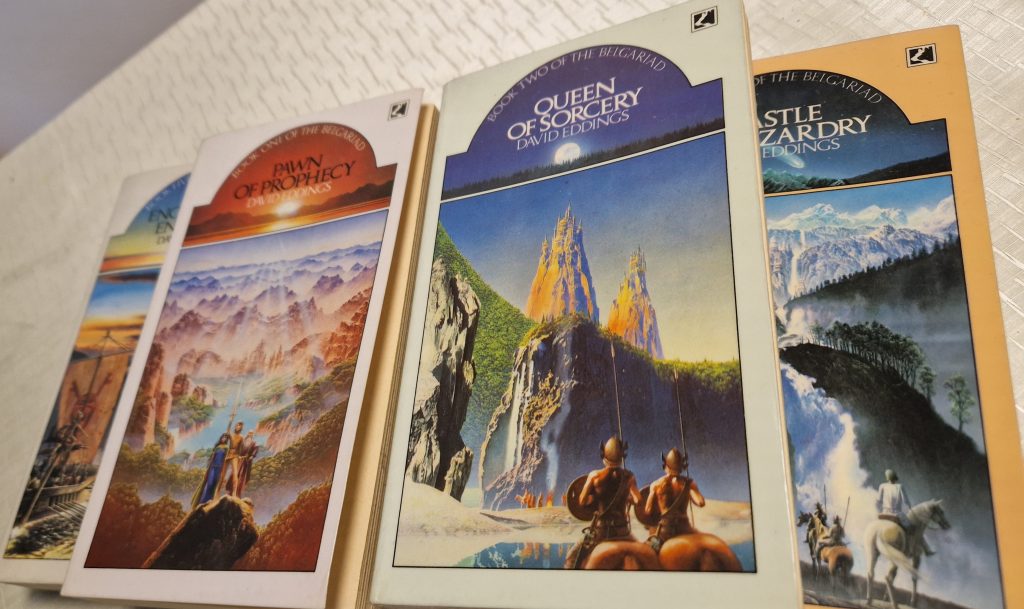
These days, “get a random book and let it do whatever it likes to your brain” seems dangerous. I don’t want to be hijacked into feeling creeped out, or depressed with humanity or, God forbid, too stupid to get the point.
When did it become so important to enforce the balance of my mood? When did the discovery of the new surrender before the support of the present?
For one thing, this approach makes choosing the next book a fraught exercise: getting it exactly right takes time. And, of course, it makes the reading experience ambient to my brain noise, the background music to my thoughts. It makes everything, regardless of how good it is, forgettable.
Paradoxically, my general m.o. in life is “do things first, ask questions later”. I love surprises. In the space of one year, I went skydiving (loved the freefall, but very painful to my eardrums. Do not do if you tend to get blocked ears in airplanes), attended a month-long improv workshop (excellent, very recommended) and signed up for high-intensity interval training (ugh, no. Noooooooo. Why.). There is no reason for me to shy away from unexpected fictional adventures.
And so I tell myself that fiction can be soothing. It can also be unsettling. It is most memorable when it unhinges your brain.
Be more unhinged.
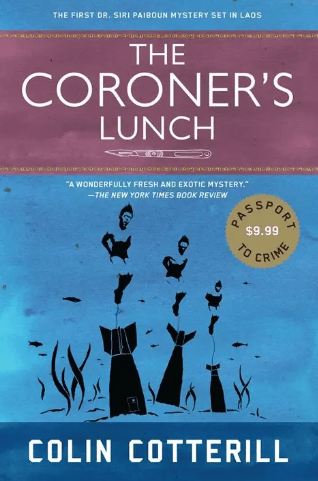
*Also, have a book recommendation from my current bedside table: The Coroner’s Lunch by Colin Cotteril is the first of a series of whodunnits set in 1970s Laos. Dr. Siri Paiboun has just been appointed the only coroner in newly Communist Laos. As a septuagenarian who has never been trained in dissecting dead people he’s not happy about it. But his mischievous nature brightens considerably when the first mysterious corpses begin to turn up. Things become even more chaotic when Siri discovers his own personal connection to the spirit world. It’s a lovely series full of humour, I learnt a lot about Laos and it’s really well written.

