Welcome to Six Damn Fine Degrees. These instalments will be inspired by the idea of six degrees of separation in the loosest sense. The only rule: it connects – in some way – to the previous instalment. So come join us on our weekly foray into interconnectedness!
A world away from the urban landscape and its City Lightslies the genre of Folk Horror. But what is “folk horror”? One of the trickiest aspects of a discussion about any film genre is to pin down a good definition. I do rather like what Wikipedia succinctly offers on this score at the start of their entry on the subject:
“Folk horror is a subgenre of horror film and horror fiction that uses elements of folklore to invoke fear and foreboding.”
Welcome to Six Damn Fine Degrees. These instalments will be inspired by the idea of six degrees of separation in the loosest sense. The only rule: it connects – in some way – to the previous instalment. So come join us on our weekly foray into interconnectedness!
To me, The Lord of the Rings is unreadable. Not because the writing is bad; it’s not. And not because I am not into fantasy; while it’s not my favourite genre, I don’t run for the hills if someone suggests a good fantasy novel to me. I have not yet read a bad China Miéville novel, if that is anything to go on. I am also not afraid of super-long novels, either – behold, I am the guy who read Infinite Jest and loved it. It’s just that investing myself in a heavy brick of a novel, there is a point where the text has to convince me that it’s worth wading through it for the next couple of days or weeks.
Last week we went to see the latest of the new Star Trek films, the one whose title is certain to trigger a Pavlovian response in any fan of the English ska band Madness. I’d greatly enjoyed the first of the reboot movies back in 2009, though Star Trek Into Darkness hadn’t done much for me, but I hadn’t given up on the franchise yet. Star Trek Beyond, though… It’s a competent enough film in some ways, the main cast is still the best reason to watch the reboot – but I simply didn’t feel it. Most of the time it wasn’t the plot that kept me engaged; instead I found myself distracted, not least by remembering the recent death of Anton Yelchin and thinking, wistfully, that he should have had his final appearance as Pavel Chekov in a better film.
We’re slowly sidling up to the fifth season of The West Wing – apparently the one where most people agree things went down the drain. From what you can read on the web, it’s held in about as much esteem as Buffy the Vampire Slayer S6. Well, if that means that we’ve got The West Wing‘s “Once More With Feelings” to look forward to, I guess I can cope.
We’ve just seen the President decide not to stand idly by while a genocide takes place in an African country. The situation’s an obvious take on Rwanda, and on the United States’ mealy-mouthed reaction to that genocide, right down to the semantic games played to justify inaction. President Bartlet asks one of his staffers, “Why is a Kudanese life worth less to me than an American life?”, and the staffer replies, honestly: “I don’t know, but it is.”
Except that’s not good enough any more for the President. He decides that the US lose any justification they have to self-righteousness if they do not intervene. Basically, Bartlet does what Clinton, back in 1994, didn’t do, for various reasons.
Watching The West Wing now, years after it was first broadcast, I was a bit non-plussed by this storyline. As it developed, it felt very much like a “What if?”, but one that had strong elements of left-wing wish fulfilment. What if we could go back to 1994 and act differently? What if we’d lived up to the standards we set for ourselves, and the image we project of the United States? Nothing against a “What if?” scenario, but this one felt a bit like “Well, if we finally do the right thing in fiction, that must be worth something, right?”
Admittedly, this isn’t altogether fair to the series. For one thing, the storyline has only just begun, and I doubt it’ll remain as clear-cut. The series has never suggested that what ought to be done is easy or that it doesn’t have any repercussions. More than that, though, President Bartlet’s decision to intervene is obviously not entirely selfless – after all, the previous season’s final episode had him deciding to have the Foreign Minister of a Middle Eastern state assassinated due to his close ties to Islamist terrorists. While The West Wing has a weird habit of forgetting everything about characters it doesn’t quite know what to do with (Where’s Ainsley at? Where’s the girl, Jed? Where the fuck is Ainsley, huh, Jed? – Ah, to be honest, she can stay lost in the same place as Mandy, for all I care…), it doesn’t forget its characters’ transgressions – and hey, if there’s anything white liberals, especially of the lapsed Catholic persuasion, are really good at, it’s guilt, isn’t it?
On a very different note: when Donald Moffat turned up as C.J. Cregg’s dad a couple of episodes ago, my first thought was: “It’s the President!” Moffat’s one of the US actors who have played POTUS (in his case in the Tom Clancy movie Clear and Present Danger) – which made me think that it would be fun to have a West Wing episode where all the guest stars are erstwhile presidents of the United States. Of course James Cromwell would beat them all… and a quick Google search has revealed to me that he may just turn up on the series. Guess what he’ll be playing…
How many different series can a person watch and still keep them all apart? Right now we’re watching Angel, House M.D., Carnivale and Heroes and Grey’s Anatomy, I’m rewatching Six Feet Under, Battlestar Galactica and Life on Mars, we’ve just finished Fringe and we’re waiting to continue The Sopranos and Buffy. Well, at least no one can accuse me of being a total elitist snob when it comes to telly series…
I enjoyed Fringe because it fulfilled my post-X-Files FBI-investigating-weird-shit cravings. Is it a good series? Not particularly – it’s repetitive, some of the acting is dubious and with half the episodes I think that I’ve seen them before, only Mulder and Scully did them better. It’s great turn-off-your-brain TV fast-food, though, and I’m looking forward to more Leonard Nimoy in season 2. “It’s all lies. But they’re entertaining lies. And in the end, isn’t that the real truth?” (Damn you, YouTube, for not having a clip of that scene!)
Grey’s Anatomy has been something of a guilty pleasure of mine, and throughout much of season 4 it wasn’t all that much of a pleasure, to be honest. The series’ problem – well, main problem – is that they’ve got a number of very good actors and even the middling actors know their parts by now, but the writing (especially with respect to character development) covers the whole range from maudlin to obvious to plain bad, with the occasional strong scene. If the series could decide to be a comedy, it wouldn’t matter that most of the characters are written to be highly unprofessional so much of the time (typical example: some patient is dying and needs urgent care, and doctor X decides that this is the right moment to ask doctor Y why they didn’t have sex the previous night – remind me not to get ill in TV Seattle…). It takes very good writing to make the constant jumps from quirky comedy to serious (melo)drama work if the characters aren’t to come across as nincompoops at the mercy of the script. Season 5 had many of those weaknesses, but it had enough strong moments to keep me watching. Still, there are some developments and storylines that just annoy the hell out of me: a resident at a big Seattle hospital going more or less bankrupt from one day to the next because Daddy cuts her trust fund? Swapping one interesting lesbian character for cute but eternally bland blondie because you want eye candy rather than an actual character? Derek Shepard yet again going all pompously self-righteous, and still no one takes one of those circular saws to his perfectly coiffed head?
In the meantime, I’m rather enjoying where Angel season 3 is taking us. Yes, there were a couple of false steps – Gunn and Wesley going all mooney over Fred wasn’t cute, it was just annoying, and having it go on for several episodes made me want to go Angelus on them all – but it’s fascinating to see how Angel, Cordelia and especially Wesley develop during the season. Just 2-3 more episodes to go until season 4 – and I’m ignoring all those people who say that it’s one of the worst seasons ever in the Whedonverse, because it’s something we have to get through before season 5 and “Smile Time” and the (wait for it) bitter-sweet finale. (Yes, Lucy, I put that there just for you…)
And finally: I’ll be writing a weekly entry at The Best Shows You’re Not Watching, alternating between Six Feet Under and Life on Mars. You can find the first one here. Let me know what you think!
I know I’m once again half a year (or more) behind the rest of the internet – but I finally got around to watching Dr. Horrible’s Sing-Along Blog, done by the Whedon brothers and some of their mates for a song and a half.
A lot has already been written about Dr Horrible, perhaps the world’s first internet-spawned super-villain musical starring Doogie Howser, M.D. So, not to bore people too much, let me fast-forward through the important bits (skip to the end!): I liked it a lot, the songs are infectious, it does have rather major tonal shifts, to the extent where some people thought that the ending sucked because it turned a light-and-frothy lark into something dark and depressing. Several critics accused Joss Whedon of doing what he always does (make the audience care about characters only to do horr- erm, heinous things to them) and of creating a female character that was supposedly a sexist cliché with no life or meaning of her own beyond what she meant to the male protagonists/antagonists.
While clearly some people might not enjoy Dr. Horrible, I do think that those who were surprised by the darkness of the ending weren’t really watching this. While the tone of the first two acts is largely fun and witty, there are some major scenes (and, perhaps more importantly, songs) that hinted at less fun things to come. I mean, honestly, people! Didn’t you watch the beginning of Act II? Or Penny’s song?
That’s also where my problem with the second main complaint comes in, namely that Penny (or “Whats-her-name”, as her close friends of the press know her) isn’t so much a character as a plot device. For one thing, clearly all of the three main characters are primarily stereotypes (with a couple of individual quirks, because otherwise it wouldn’t be Whedon). If Dr. Horrible is bad because Penny isn’t a character of Chekhovian richness, what about Captain Hammer, corporate tool? If any one character remains barely one-dimensional, it’s him. And yes, Penny is definitely also a projection pane for all the “nice guys” out there who secretly carry a torch for the nice, shy, somewhat nerdy girl with the cute smile, just as Billy is a perfect identification figure – which makes the ending more effective, in my opinion.
But what makes her a richer character than some have acknowledged is how, to some extent, she is complicit in what happens. Penny isn’t blind to Captain Hammer’s less charming qualities, but she projects her own needs onto him as much as Billy projects his onto her. Listen to her laundromat song and look at her face while she sings it, and it’s obvious that the character isn’t some Mother Theresa of the Laundromats: her niceness, her need to help others, these are a self-willed resignation that she’ll never get what she really wants, so the best she can hope for is to try and make things better for others while she’s pretty much given up on herself and her own wishes. Once the Hammer-man enters the pic, she can pretend that he’s her means of being happy, until even she can’t ignore his downright idiocy and vulgarity. But all of this is an act of will on her part: to do for others what she cannot do for herself, to resign herself to Captain Hammer because, well, it’s not as if she could do any better, could she?
I could spout some more pseudo-psychological drivel here, but I’m going to spare you. If you haven’t seen Dr. Horrible (and my post so far hasn’t turned you off it), do check it out. Get the DVD and you’ll even get Commentary! the Musical, Wiccan subtitles (?!) and fan-submitted application videos to the Evil League of Evil, such as this one:
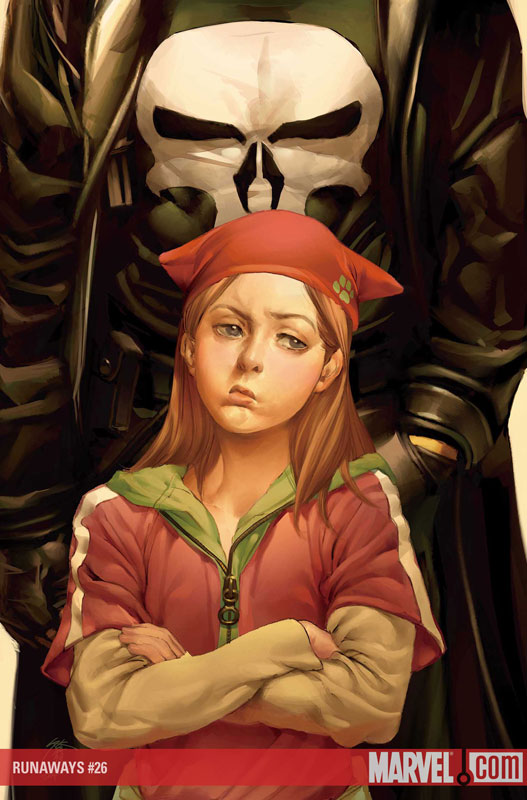
Avid readers of this blog may have noticed that I’m fairly keen on Messrs. Vaughn and Whedon’s work in comics… so when Joss Whedon was set to write the next series of Runaways, I was excited. Both writers have similar strengths; their writing is witty, they create ensemble casts of characters that gel extremely well, and they tell a good story while providing more than enough ambiguity to keep things interesting beyond the plot.
I recently re-read Vaughn’s original three Runaways volumes and apart from a couple of minor issues (such as the slightly inconsistent quality of the artwork – there’s some gorgeous work there, but some panels and some of the inking feel rushed) I greatly enjoyed it. Coming away from Whedon’s run with the kids, however, has left me somewhat disappointed. When he’s at his best, Whedon is a fantastic storyteller, getting you involved way more than I would have expected from stories about teen vampire slayers or space cowboys. He’s not infallible, though; his first Serenity comic, while not abysmal, was in no way as memorable as the TVseries, for instance.
And now, Dead End Kids: my first and main thought throughout was, “I wonder what Brian K. Vaughn would have made out of the material.” Again, Whedon’s writing isn’t bad, but there’s little of the sense of surprise or freshness that Vaughn’s stories had. The kids feel ever so slightly less real and more like comic book teens. (And don’t think you can worm your way into my heart by introducing a new regular character that comes from where I live, insiduous comic!) The art is absolutely fine, but it lacks the quirk of Alphona’s best panels. And the time travel gimmick, while fun, also comes across as a tad overused. In that respect, the story feels a bit as if Joss Whedon had written an episode of Star Trek.
Nevertheless, there are moments when Whedon’s talent shows. Even if the time travel plot is a tad overdone, its denouement is more poignant than I would have expected. There are some interesting hints at the direction in which especially one character might develop, with a daringly cruel punishment for two of the story’s villains. And there’s a couple of pages ending in the death of a minor (or should I say “small”?) character that had me giggle and go “Yewwww!” at the same time.
Was it worth getting the comic? Yes. Was it as good as the other volumes? That’s a definite no. In any case, I’m very much looking forward to Vaughn’s use of Whedon’s characters now. If I’m lucky, the first two volumes of Buffy: Season Eight (the comic-book continuation of a certain barely known TV series that Whedon supposedly had a hand in) should arrive this week, and if memory serves Vaughn has penned a Faith storyline. Should be fun to see how that one’s turned out.
On a very different note: we completed The Wire season 2. ***Warning: some spoilers to follow.*** Apparently there are people that didn’t like the second season too much, mainly because they wanted more Avon Barksdale, Stringer Bell and everyone’s favourite junkie Bubbles and fewer paunchy white guys with bald spots and union shenanigans. Okay, I could have done with more Bubbles too (who couldn’t?), but season 1, while tighter, didn’t have the tragedy of Frank Sobotka. The ending of episode 11, “Bad Dreams”, builds up to one of the saddest fade-outs I can remember. In a way, the reveal at the beginning of the twelfth and final episode of the season isn’t half as sad as seeing Frank walk towards his fate. Even Ziggy, one of the major fuckheads of television history, becomes a tragic character when you see the larger context of what is going on. Yet for all the sadness that permeates the season ending, the series never loses the anger and sense of humour that make it bearable. At least in the first two seasons – I may very well be setting myself up for a broken heart in any of the three remaining seasons.
This film nerd here is a complex beast. On the one hand, I get as much childlike joy out of well-executed genre films that follow the formula to a T. I enjoy the climactic showdown between Hero and Villain. On the other hand, I cackle gleefully when a film (or a book, for that matter) frustrates my expectations. No Country for Old Men is a good case in point, where the supposed hero dies off-stage and isn’t even killed by the bad guy of the piece. Even Raiders of the Lost Ark, a genre movie if there ever was one, doesn’t end with the hero triumphing: it ends with the hero tied to a stake as the ultima deus ex machina comes and melts the faces off a bunch of undeserving unbelievers.
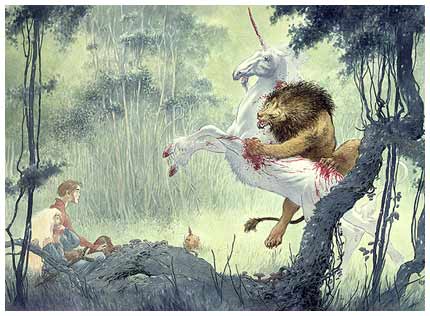
I just finished re-reading Neil Gaiman’s Stardust. I’d last read it in the summer of 2001, just after graduating. I have fond memories of sitting in a French café in Edinburgh during festival time, drinking good coffee, eating croissants and not looking up from my book until I’d finished half of it in one sitting. What I remembered much less was the plot, at least beyond the broad strokes. What I definitely didn’t remember was how differently it told its story from how Hollywood would (and, from what I’ve heard, did) do it. Here too, we don’t get a showdown with the villainess – instead, we get a melancholy coda and a bittersweet ending that made me realise how rarely Hollywood does “bittersweet”. I know that most Gaiman fans prefer American Gods, but I must say that even without Charles Vess’ pictures (I have the non-pic edition), this is a beautiful, wonderfully light, exquisitely crafted fairytale. In comparison, I feel that American Gods collapses under its own ambition, because its dozens of ideas never really come together in a fully satisfactory way.
Oh, and in case you’re wondering about the title of this entry? Well, we’ve just started watching The Wire season 1. Very different fare from Buffy, if you would believe it… But intriguing, with carefully drawn characters and lots of shades of grey. Definitely looking forward to seeing more of it – and telling you all about it, in epic detail. Shudder and despair.
Buffy the Vampire Slayer is an odd beast. It is perhaps the wittiest series with what would seem to be the dumbest premise: HIgh school chick fights vampire. It was cheesy, it had bad fight scenes much of the time, and many of the actors weren’t terribly good.
Yet what Buffy got right, it got right. In every season, there were episodes that are up there with my favourite television fare ever – and yes, that includes Six Feet Under and Deadwood. Over the course of seven seasons, I’ve come to care about all the characters. That never happened with any of the Star Trek series that I watched as a teenager. Nor did I grow tired of Buffy in the way that I lost patience with The X-Files.
Much of that has to do with Joss Whedon’s characters. They quickly come to feel like people you want to spend time with. Yes, even Angel… and yes, even season 6/7 Buffy, although to a lesser extent. (There were moments – flashes – when I even liked Dawn. I’m sorry.) They come to feel real, which is an amazing feat, considering that these people tend to spend their time fighting rubber-mask baddies and being American teenagers.
Yes, the series lost some steam after season 5 ended. There’s a lot going on in seasons 6 and 7 where I thought, “Yes, I see what they’re doing there… I see where they’re going with this”, but it was less enjoyable than what had come earlier. But I do not get the hate those later seasons get from some of the fans. I do not get the vitriol or the sense of betrayal that you find on the internet. (But then, there’s so much on the internet I do not get…)
It’s interesting re-watching season 2 now (our Sunday morning fare), since this is pretty much when the series came into its own. In the sophomore year, the actors had found their feet and really got their characters, to the point where it didn’t matter that much whether they were great actors or not. The writing had got more comfortable, yet at the same time more daring. In season 1, a later episode such as “The Body” or “Once More, With Feeling” wouldn’t have been imaginable; after season 2, pretty much anything was possible. (Well, not quite. I was only prepared for Whedon’s sadistic glee in doing horrible things to his characters because I’d previously seen Serenity. Yes, Joss, I know what you were doing there, I know what you were going for, and if I ever meet you I’ll be sure to applaud you for your audacity while I repeatedly kick you in the privates.)
So, re-watching Buffy while cuddling up to my loved one keeps me from missing Giles and Willow, and Xander and Cordelia, Oz and Joyce… and Buffy. As Willow said so memorably, “Sweet girl. Not that bright.”
Good thing that Joss Whedon and Brian K. Vaughn (of Y: Last Man and Runaways fame) are doing season 8 in comic book form. Shiny.
If you’re watching a hospital soap, and it introduces a patient whose carotid artery is only protected by a thin flap of skin after an operation, what do you think’ll happen?
Yes, it’s Tuesday, which means that yesterday evening was Grey’s Anatomy. While it didn’t figure any pencils-in-eyesockets, it was still not exactly the show I should be watching while eating merguez. However, what usually ruined my appetite while watching the show was the increasing lack of development as far as the characters and their relationships are concerned. At times, the show now feels like E.R. as scripted by Beckett – for all the romantic back-and-froing, there’s a distinct lack of getting anywhere.
However, while too many of the characters now behave like lobotomised idiots who shouldn’t be allowed to practice medicine (they’d probably be taxed by practising the recorder), the patients are where it’s at. The Grey writer are quite amazing, really: it takes them 3+ seasons to make me bored and annoyed with the main cast, yet it takes them 30 minutes to make me care about characters who come into the series to be sick and die.
Can’t say I care yet about Carotid Artery Boy, mainly because I keep looking at him and thinking, “I wonder if it’s full moon already…” Yep, that’s the problem you get when you play a werewolf on Buffy the Vampire Slayer. (I’d be the same if Leonard Nimoy turned up on House… “Do they have green blood on stock? I wonder…” Putting Greg House and Mr Spock in the same room would be sheer geek awesomeness, though.)
P.S.: Don’t worry, an entry on Fun Home is still to follow. Hopefully even before the move. (Sigh.)




 A Damn Fine Cup of Culture