Where’s a will, there’s a pill

Ron Woodroof, the protagonist of „Dallas Buyers Club,“ isn’t easy to like. He is a racist, a homophobe, a drug addict, a drunk and a thief. His one redeeming quality is that he does not give in when he learns that he has caught HIV, but tries to fight it – and he does not just fight the virus, he also fights a harmful anti-HIV drug called AZT, the FDA, the DEA and the DA.

Image

Woodroof is played by the ubiquitous Matthew McConaughey, and he takes on a lot of acronyms with the same down-to-earth earnestness and a stubborn logic. He travels to Mexico, Japan and elsewhere and brings back protein-based and/or natural drugs that will help him and many other AIDS patients to live a little longer and with less pain. He has moral standards: Every drug he distributes, he has tested on himself first. Since selling those drugs is illegal, he accepts paying members to his Dallas Buyers Club and then gives away the drugs they need. To him, it’s a ponzi scheme where no-one loses; to his customers, it’s like swinging yourself form one last straw to the next with a death sentence hanging over you. It’s 1985.

So there you have it: the protagonist is a bastard with some heart. He is gaunt, emaciated and sometimes collapses where he stands. Most of the time, he doesn’t even have enough strength for his escapades anymore. If you can bring yourself to like him, the movie works for you. There is a magnetic scene where Woodroof takes a leak on the Mexican side of the border, but is so weak that he has to clamp the IV drip with his teeth, while humming to himself and racking his brain how to bring a trunk full of medicine to the other side. Thirty years ago, the US had nothing up its sleeve to go to war against a virus.

Image

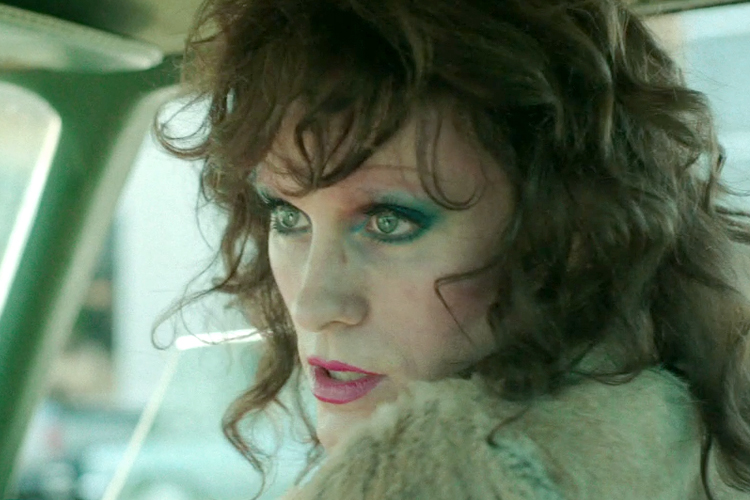
The movie has a lot of scenes and a lot of cuts; there are only a few takes that are over a minute, and yet it never feels in a hurry. It’s not a tear-jerker, but has a lot of humanity for its characters. If Woodroof is the point of entry into the movie, a transsexual called Rayon is its emotional center. Played by Jared Leto with exactly the right amount of courage, confidence and sensitivity, it’s a performance that’s a match for McConaughey’s. Rayon sees something in Woodroof he himself does not. There are no cheap solutions: Woodroof does not become a philanthrope or even Rayon’s lover. Neither does he fall for a doctor, played by Jennifer Garner, who helps him with his cause. Their fates lie elsewhere. It’s not an easy film, but it is surprisingly upbeat, considering.

An Alaskan nightmare

He picks them up in the streets of Anchorage, Alaska, some of them in broad daylight. He starts with local middle-class girls and women, then changes to hopeless drifters and whores because nobody is going to miss them. He rapes and tortures them for weeks in his flat. The less satisfying ones he shoots right there in his living-room where all the animal trophies with their dead eyes look upon the unspeakable acts he commits. The better ones he loads in his Piper plane, flies them to his lonely, wintry hunting grounds, where he sets them free and watches them stumble away through the crosshairs of his rifle. He lets them run until they think that there is the faintest sliver of an escape. Then he shoots them and watches the light die in their eyes.

You shouldn’t have to be told that “The Frozen Ground” is based on a true story. It’s a movie about the twelve-year killing spree of Robert Hansen, a well-liked baker in whose shop cops gather for coffee and doughnuts. He is played by John Cusack, and I’ve just realized that I don’t remember what his voice sounds like. It’s Cusack’s performance that stands out in an otherwise generic exercise. The Hansen in the movie is guarded, watchful, generally friendly. He is boring and can blend in. He is married and has two kids with his second wife. Some say he has a stammer, but how do you know if he says so little?

There is a cop who hunts him, called Halcombe, played by Nicholas Cage, an amalgamation of several real-life cops who were on the case. It’s a decent enough performance, but it’s one that Cage seems to have played at least three times before, and he does nothing with his role to elevate it to Cusack’s level.

There is one girl who gets away while Hansen prepares the Piper for take-off. This is Cindy Paulson. Halcombe must win her trust so she will testify; if she doesn’t, there is no way they can charge Hansen with anything. She is played by Vanessa Hudgens, who could be dismissed as some teenage bimbo from half-assed teenage movies. Not after this movie, she won’t. She plays Cindy as a damaged kid who is almost glad that, after Anchorage, there is nowhere left to run to. Hudgens doesn’t go for manipulative emotions, but for guarded mistrust and self-reliance. There are pieces missing with Cindy Paulson, and Hudgens manages to make us care about her, and so we tend to identify with Cindy, a teenage hooker who lies about her age. She is the entry-point for the movie. Halcombe is the motor for the plot, Hansen is the boogeyman.

The movie is flawed. Halcombe’s family is perfunctory and only there to remind him that they will move to brighter pastures in two weeks, while he cannot let go of the missing girls. Halcombe’s wife is played by Radha Mitchell, an actress who can improve any movie she is in. Not here: the screenplay makes her and Cage play out stuff from the stock cop plot shop. There are supporting roles that don’t lead anywhere, which is a shame when they’re played by actors such as Dean Norris. There is also a confusing scam between two pimps who quarrel about who owns the rights to Cindy. I also minded the prolonged scene where we get to see Vanessa Hudgens pole-dancing. I don’t much care if Hudgens is shapely and pretty; I get that she had to dance for money during in a brief scene; there is no need to film her body from all angles.

The ending is a shame. The Halcombe family, not moving after all, see Cindy off at the airport. That scene is just too fucking cute, Cindy leaving like that over a sickly-sweet soundtrack. I would like to have heard what she had to say to Halcombe.

His last scene with Hansen is weird, too: Halcombe gets a confession out of him by opening the door and letting Cindy take a look at him. That’s too easy and too fast, and a whole scene seems to be missing here. The movie is in a hurry to clean up.

Hansen was caught in 1983, and only after presented with overwhelming evidence did he admit to killing 17 women, but might be responsible for as many as 30. He got convicted for murdering four of them and for the rape and abduction of Cindy Paulson. In Hansen’s home, Halcombe found a map of an uninhabited area full of red crosses. The police went to those spots and dug. Some bodies could not be identified, some were already eaten by animals. Others have not been found, and they might still be lying there, freezing and thawing with the change of seasons, lying there for more years than they had living years on earth.

Check your Easter nests…

… because we’ve got a special Easter present for you: we’re doubling the number of regular writers for Eagles on Pogo Sticks – to two! Mege1 has contributed to the blog in the past, and he’s now joining the site as a permanent, regular fixture, so you’ll be able to read more of his thoughts on films, literature, music and the like.

Here’s what Mege1 writes about himself:

Mege1 has a proper day job, but likes to type away like so many monkeys until there are short stories, novels, plays and screenplays. He also has opinions about movies, books, plays and suchlike and is not afraid to share them. He hails from near Bern, Switzerland.

We’re currently crossing our fingers that there may be more additions to the site’s stable of pop culture addicts in the future. In the meantime, though, happy Easter – and don’t overdose on candy eggs and chocolate bunnies!

frank

Paradise: Faith

I’ve been in love a few times, and I imagine I’ve been loved a few times as well. Sometimes the feeling wasn’t mutual. That’s the way it is sometimes. With belief, it’s a different story: I am not really a religious person. The things I believe don’t believe back in me. This is a suspicion, not a complaint: Belief seems to be such a one-sided affair.

This explains already why I had more difficulty in understanding Ulrich Seidl’s Paradise: Faith, the middle film of his Paradise trilogy. There are other problems with this installment, but we’ll come to that eventually.

05

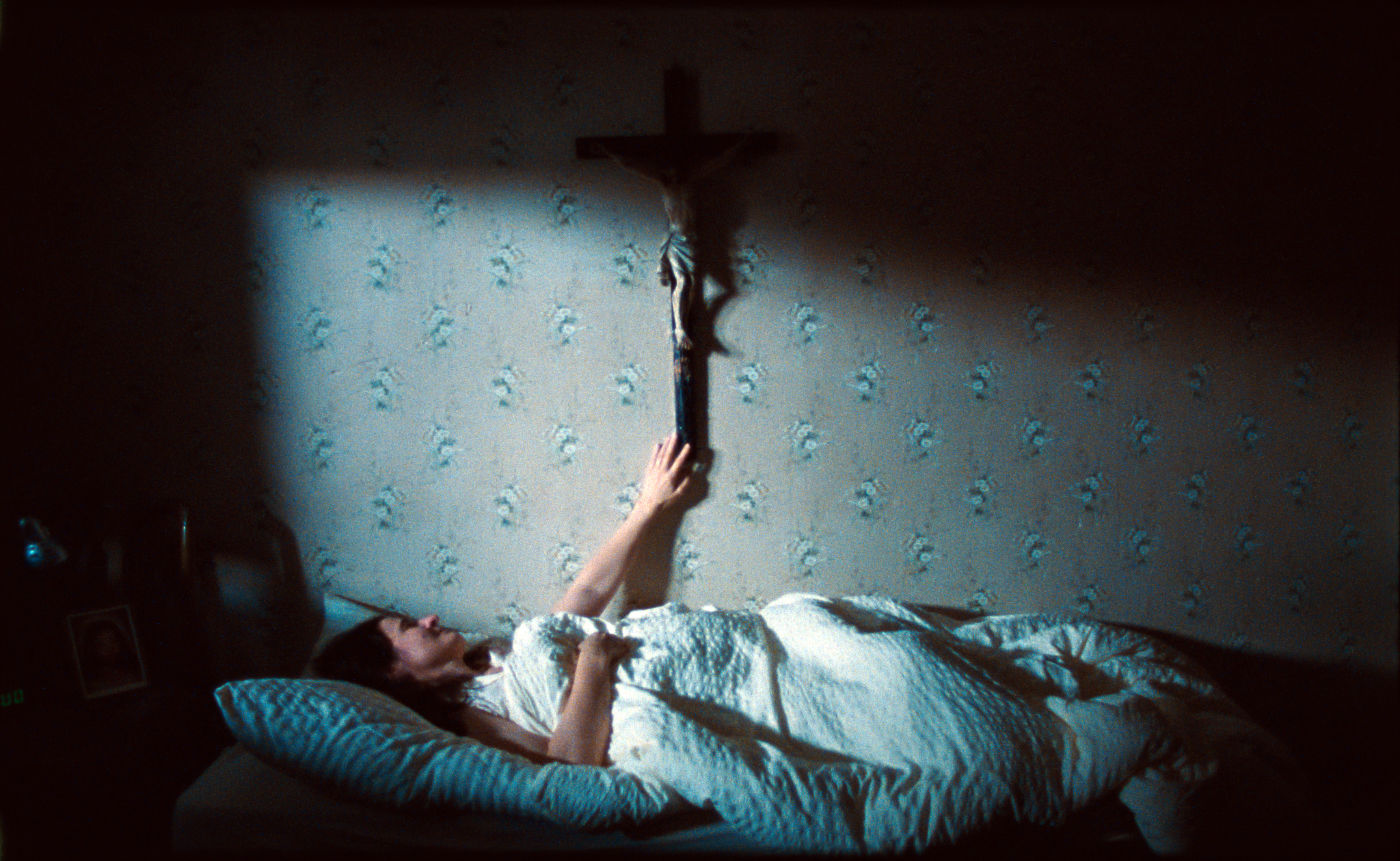
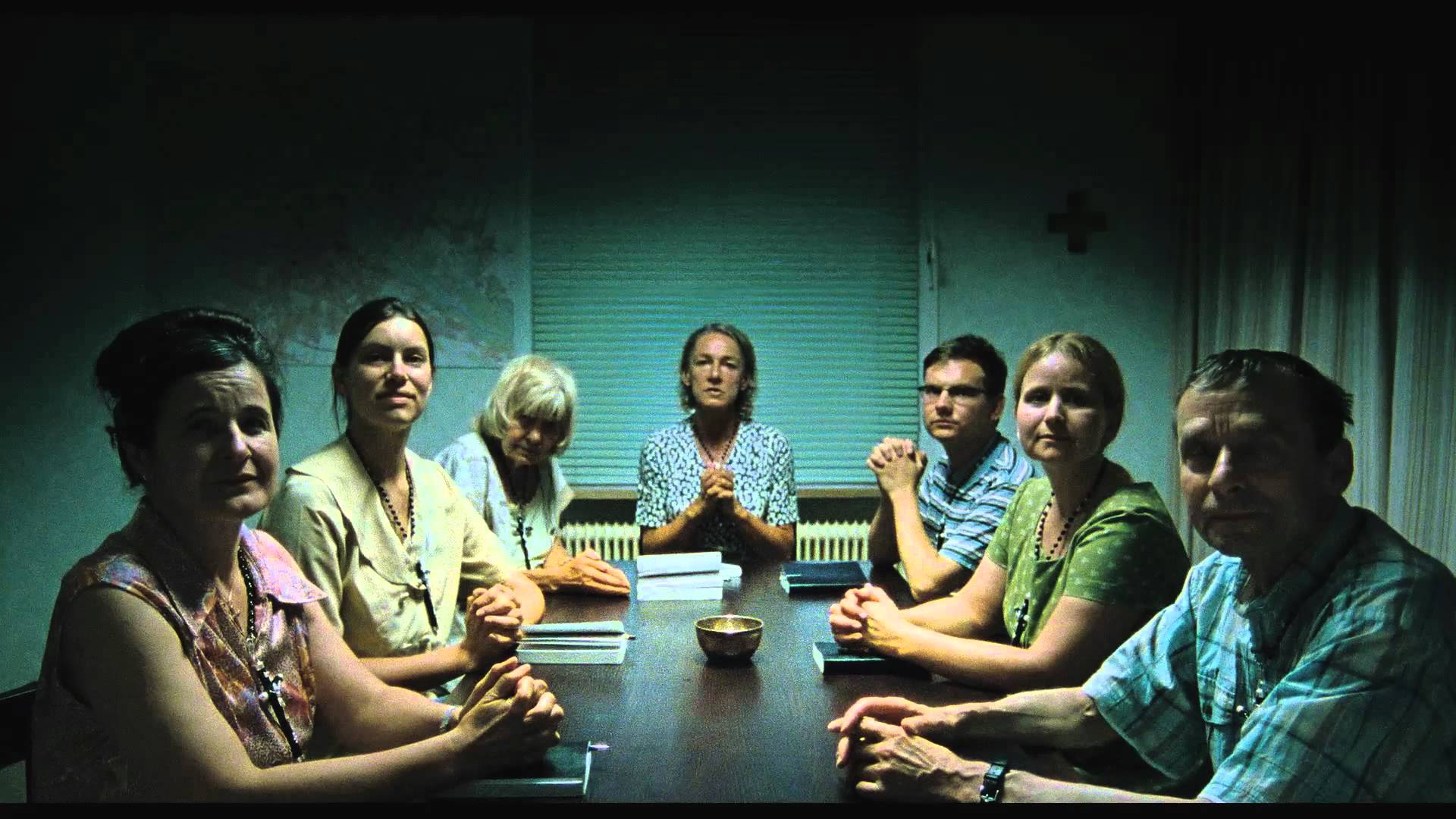
This film’s protagonist is Anna, Teresa’s sister. She is devoutly Catholic, and it is her and her bible group’s sworn objective to make Austria wholly Catholic again. Anna herself is convinced that the world is full of sex-obsessed people, and she asks that they be forgiven by whipping her own naked upper body with a whip while kneeling in front of her crucifix in a cheerless room in her house. Then she thanks her savior for the chastisement. Sometimes she goes as far as to tie a belt with iron thorns around her waist and make rounds through her flat on her knees while praying, and the kitchen timer telling her when to stop. She works as a radiologist’s assistant, but during her holiday, she goes from door to door in run-down apartment complexes and tries to convert people. She doesn’t stop at anything – there is a family of foreigners, non-Christians, of which only the eldest daughter speaks German. The whole family kneels in front of the Mother Mary statue. Anna can be very convincing.

One evening she comes home, and a Muslim is sitting on her living-room sofa. This is Nabil. They seem to know each other. It will later transpire that this is Anna’s husband. To Anna’s mind, this not at all a contradiction to her Catholic zeal – it is simply a test of her faith. She is happy to be married to her pet project, and she thinks it’s an excellent thing that two years ago, her husband had an accident and is now in a wheelchair – if only Nabil could see that true faith has entered her life that way.

Nabil, of course, is less delighted about his situation. He can no longer have sex with her, which is what Anna considers the right path: no sex, but a test of faith instead. Nabil thinks that a wife must serve her husband in all walks of life, and Anna agrees – except that Nabil asks for intimacy and a little more of her time. He is her project and is not supposed to develop human needs, and particularly not such disgusting ones like sex. Nabil’s every attempt is thwarted by Anna; although she can brush him off easily, she must bear his presence because her faith tells her to. Turn the other cheek. She politely refuses him at first, but when he insists, they trade blows. He wants sex he probably cannot have, she has a country to convert. This relationship will end badly.

maxresdefault

One night, again on her way home from trying to convert people, Anna’s greatest conviction seems to become real in her own neighbourhood. She walks past a public park and sees a dozen people involved in a gangbang. She knows she must interfere, but she cannot, and while not really consciously aroused, she must become aware of her own suppressed sexuality. Nabil asking her to sleep in the same bed and those gangbangers entail the same horror to Anna: the world is really only after one thing. It is here that Seidl’s strictly geometrical, static camera lets go and adopts Anna’s point of view. There is a possibility that Anna might only imagine the orgy. There is very subtle irony here: Anna is the one person who cannot tell whether she imagines the whole thing or not because for her, this was bound to happen. She staggers back home, utterly shocked, but proven right.

Anna’s zeal remained impenetrable to me. This movie must play like a horror flick to some Catholic audiences. To me, a former Protestant, Anna is very far from my own walk of life. That’s not to say that I don’t know about being passionate about something, way more passionate than is good for me. I understand obsession. I utterly empathize with trying to fulfill that passion, but I also empathize with the despair of not getting any rest about being passionate all of the time. I seem to be able to stop before I damage myself or others; for Anna, it’s all or nothing. She has subscribed to her faith, and if that involves more than she can take, so be it. It’s God’s will. She is so far out there that I can hardly see her. The actress playing her, Maria Hofstätter, disappears completely in her role. She is Austrian, friendly, with a quick smile. There is nothing in Anna of her.

Back at home, there is undeclared war. Nabil takes down her crucifixes, asks to watch TV, listens to Islamic prayer tapes and even puts a framed photograph of their wedding on her nightstand. He insults her faith and asks her, not to convert to Islam, but simply to find a better religion. He has a point, of course, although if you look past the object of her obsession, religion is not Anna’s problem. She enters a similar situation as her sister Teresa: She might still love Jesus, but there are moments when she despises her faith, but she cannot not believe. She is hard-wired that way, and there is no escape. The movie ends with Anna not whipping herself for a change, but whipping the crucifix on the wall.

Paradise: Love

Ulrich Seidl’s Paradise trilogy takes three basic needs – the need to love, the need to believe in some higher power, and the need for company -, and then shows how we fail most of the time. That doesn’t make Seidl a pessimist – maybe he is just very curious to the point of intrusion. I am not so sure why he chose two women and a girl as his main characters, and I am not sure what the paradise of the title means, but these are three movies that ask the right questions and wisely avoid giving any clear answers.

This trilogy may not be easy to watch. Seidl’s gaze doesn’t flinch, his camera rarely moves or zooms. There is a rigid geometry to his frames: many shots feature some sort of symmetry or at least horizontal or vertical lines of reference – the horizon, train tracks, the roof of a house, a window. His characters are often shown to inhabit the centre of the screen, within clear sight of the audience.

This clarity and order is at odds with some emotional or moral dilemma of one of its protagonists. Sometimes it looks like the edge of the screen is some sort of protection, but more often than not, these three women, and other characters, desperately try to break out of it. The two first main characters are played by renowned Austrian actresses; everybody else seems like they were picked up in the street and put on set. Some of them are.

Paradise: Love

The three main characters are introduced at the beginning of Paradise: Love. Teresa and Anna are sisters, while Melanie is Teresa’s teenage daughter. Teresa takes care of a group of people with special needs; there is, for the whole trilogy, a fitting first scene with bumper cars, not moving at first, then jolting to life and trying to find their route without any clear destination. Everyone has special needs – not because everyone thinks they’re special, but because we are all individuals, looking for something.

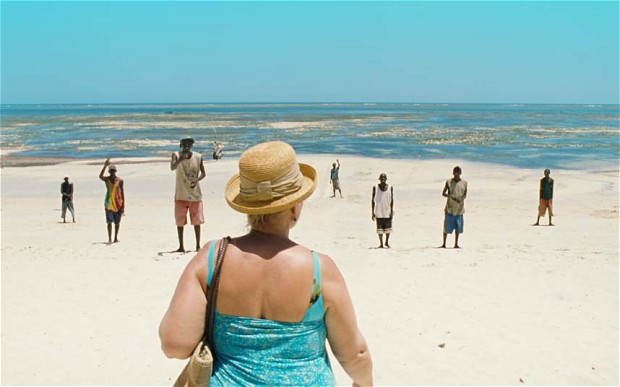
Teresa goes to spend her holiday in Kenia. She is egged on by a group of friends to get herself a toy-boy, who will make love to her for money. Both parties are in on the deal. You pretend to like me, and I will pay you and pretend to like you, too. This offer is subject to mood and need and can be cancelled anytime without prior notice. Seidl uses a chilling shot to establish that situation: there is a line along the beach along which men in uniform are patrolling. On the land side, there are rows of deckchairs, where the female tourists lie. On the other side stand the local vendors. They are not allowed to cross the line, and none of them do. The watchmen must exercise a very strict rule over that line, although we never see them at it.

Teresa is shy at first, almost reluctant, and an initial encounter makes her feel used, and she dumps the guy before he gets into bed with her. There are the salesmen on the beach with their beads and keyrings and souvenirs who are crowding her, and when her refusal to listen to them doesn’t work, there is Munga, unmistakable with his dreadlocks, who sends those overeager guys away. She suspects that this is his spiel. He does not ask her for anything, but is happy to watch over her while she wades in the water, and later show her his village, his flat, his bag of weed and his bed. They have sex. Teresa falls for him because Munga treats her as a human being. He seems inexperienced when it comes to touching a woman, and she teaches him how to. There is a sort of grim comedy to those scenes. A guy that inexperienced, he must be… different.

Let me digress here for a moment. There is a fair amount of nudity in this movie. Teresa is overweight, but she is also attractive. In some scenes, when she is on her way to Munga, she glows with the anticipation of meeting him. Other movies rely on younger and slimmer actresses to get naked. My point is this: most women’s bodies don’t look like models’, and most men are not muscle-bound athletes. Teresa looks… normal. Despite Seidl’s visual compositions, there is a realism to his environment that asks for normal people. If the physical appearance of some of his characters is a problem for you – well, what do you and the people around you look like?

To Teresa’s mind, Munga and her embark on a relationship. He introduces Teresa to his sister, who has a baby in her arms. Munga mentions another child who is in hospital and needs an urgent procedure, but Munga and his family don’t have the money. Teresa is happy to help out, and she gives him some cash. They visit a school, and Munga again asks her for money for school funds. When Teresa hands over only a small amount, the teacher gets cross and sends her away. Munga tells her off later, too, and it’s finally clear that this was his spiel. Well, she should have known that all along, but seemed to forget for a moment. He is just more patient than the vendors on the beach, and slightly cleverer as well.

Well, what did Teresa expect? Sometimes, we convince ourselves that we have found the real thing – fame, money, love – that we walk towards the snakepit with eyes and arms wide open. We need to love, and to be loved – it’s one of the most powerful drives in us humans. We can’t not love. And the promise of that makes us far too trustworthy. Some people are hard-wired that way.

The same goes for Munga. I don’t think he is indifferent to Teresa, but when you can get money out of the woman who comes and makes love to you, why not? She must have loads of it. And he must be grateful to have learnt how to touch a woman. Here’s a cruel thought: Maybe his inexperience is part of his act. Maybe his ‘sister’ is his wife, and the kid is his. And the kid in the hospital doesn’t exist. Who knows? Munga is gone, and Teresa has no clue where to put her love.

Of course Teresa is deeply hurt and disillusioned, but she meets another guy. She can’t not try. There must be some truth in her friend’s smirk when she talks about her black boyfriend. Of course Teresa knew that she wouldn’t find lasting love in Kenia, and that bitter disappointment, in herself as well as in Munga, together with her feelings of revenge, lead to the scene with the male stripper for her birthday and the sad hopeless scene where she tries to seduce the barkeeper. This was never about seduction, but about business. Teresa returns home hurt, disillusioned and with some new, shiny prejudices. She is sadder than before her holiday, and her sadness is deepened by her knowledge that she didn’t have a real choice.

How many roads must a man walk down carrying a cat under his arm?

If you had to guess the screenwriter and/or director of a film featuring the line “Where is his scrotum?” with respect to a ginger cat, how long would it take you to come up with the name ‘Coen’? There are definitely many examples of the brothers’ trademark deadpanned quirks throughout Inside Llewyn Davis – at the same time, though, their latest is a remarkably low-key – and dare I say “mature” without sounding really old? – work, scrotum or no scrotum.

There are many things the film isn’t; for one thing, I wouldn’t call it original, as its characters and story beats are pretty familiar, nor is it as comedic as many of the Coens’ films, although it is frequently amusing. It is, however, a film that is crafted almost to perfection, knowing what it wants to be and how best to be it. This is nowhere as apparent as in Oscar Isaac’s performance as the title character, a singer-songwriter trying to find his place in the folk music scene of the ’60s. This isn’t an award-grabbing performance, remaining mostly internalised throughout, yet there’s not a single beat, line, gesture or lack thereof that could be changed without losing the character’s essential quality. Llewyn Davis is not an easy character to like, often exuding an understated mix of resentment, self-pity and arrogance underlying his lack of direction or drive, but Isaac, working with a strong script, makes him engaging – and that’s when he isn’t singing. When he is, you want to keep listening to Davis’ voice.

Inside Llewyn Davis

Just as essential to the film’s success as the central performance, the script and the music, is its beautiful cinematography, for once not by longtime Coen collaborator Roger Deakins but by Bruno Delbonnel of Amélie fame. I’ve long been annoyed with the nostalgia porn of so many films set in the ’60s or ’70s, but while Inside Llewyn Davis looks beautiful, it’s not the usual commodified attractiveness of the past that cinema tends to peddle. Delbonnel’s images are gorgeous to look at, but that doesn’t keep his New York and Chicago, his big city streets and smoky clubs, from being cold, dingy and unwelcoming. The film has an artist’s view of the ’60s, not a tourist’s.

So, in short, the film is surely one of the Coens’ most accomplished features – though I’m not sure the film will stay with me to the same extent that some of the Coens’ earlier works have; Fargo will always be special to be for being the first of the brothers’ films I’ve seen (and with my later wife, so it’s loaded with personal significance), and movies such as Barton Fink, The Big Lebowski and The Man Who Wasn’t There have probably left more of an imprint due to who I was when I saw them. As much as I liked Inside Llewyn Davis, it didn’t resonate with me the way that these other films did – but I wouldn’t hesitate to say that in the Coens’ oeuvre, Inside Llewyn Davis may just be the most pitch-perfect, beautifully made.

Review: Charlie Brooker’s How Videogames Changed The World

Ah, video games. The love that dare not speak its name, at least in many mainstream media. According to TV especially, gaming is about bleeps and bloops as well as about blood and guts. Games are inherently male, inherently adolescent, inherently about power fantasies – and lest the gamer protest too much, that’s how the medium likes to present itself, at least when it comes to marketing. Boys play video games where they wield massive guns that would have made Freud go “Hmm…”, girls play video games that are pink and feature ponies, right?

How Videogames Met Your Mother. Or something.Charlie Brooker’s latest on Channel Four, the feature-length How Videogames Changed The World, was refreshing, mainly because TV seems to see games in very generic ways: either we get the embarrassing dudebro image of Call of Duty gaming, the stereotypical manchild living in his parents’ basement eating crisps and playing World of Warcraft, or we get handwringing worries about how gamers are desensitised by their chosen medium and turned into ticking timebombs just waiting to shoot up some high school. Brooker’s show looked as games as if *gasp!* they were a cultural good, for better or for worse, and should be seen as exactly that. Regardless of their cultural worth, games have become too big to ignore – and that may be one reason why they’re still presented as the sort of endeavour waiting for us to go 1 Corinthians 13:11 of them: “When I was a child, I gamed as a child. But when I grew up, I put away childish things, like controllers and such.”

Brooker, together with a whole bevvy of talking heads, took the programme’s viewers through games from their bleepy inception to their social-media-infused present day. Far from po-faced (or should that be Pong-faced?), HVCTW was largely about memories: from Peter “I voiced Darth Maul, so don’t you dare misspell my name!” Serafinowicz to Jonathan Ross, with various comedians and games journalists filling the ranks, talking about growing up on Space Invaders and GTA. One thing that was clear from the show: video games may slowly be growing up, dealing with issues more weighty than whether to shoot that terrorist in the face with an assault rifle, shotgun or grenade launcher, and that’s because video gamers and developers are growing up. A 30-something dev changing diapers on a nightly basis may make very different games from the guy in his 20s, and that’s definitely a good thing. The medium has become increasingly diverse over the last years, with a growing indie scene experimenting with what games can say and how they can say it differently from films or books.

Charlie BrookerFor me as a long-time gamer – ah, those heady days of writing BASIC code in between bouts of International Soccer! – HVCTW was nevertheless a qualified success at best. It was great to see Channel Four taking the medium seriously, but Brooker and his team delivered a show that didn’t quite know what it wanted to be: was it meant for general audiences without much of an idea of the medium, or was it by gamers for gamers? It was each of these at different times, but as a result it often fell between two stools. I wonder how the programme was received by non-gamers, because I’d imagine that they lacked the context to make sense of, say, the ultra-gory Mortal Kombat footage, or to understand the importance of the rise of the indie scene as told by Brooker, yet gamers who’d lived through most of the games mentioned are likely to have found much of the show rather “been there, done that”. Perhaps this could have been averted by giving HVCTW more breathing space and turning it into a series, or by ending it with an actual conversation between gamers, developers, experts and (most importantly, perhaps) people who don’t see what all the fuss is about (as long as they’re not called Jon “You know nothing!” Snow). As it was, HVCTW was several things at the same time – documentary, primer, nostalgic look back – without being any of these altogether successfully. The programme may have worked better as a statement – that video games are culturally relevant – than as an argument supporting this statement.

Now, gentle reader, you may be wondering, “Can I watch this programme myself, so I can tell this Goofy Beast guy how he doesn’t know what he’s talking about?” You can – provided you’re in the UK, or your computer is suffering from MPD and believes it’s in the UK. Just follow this magical link. For those of you unblessed with UK residency, though, here’s a short clip:

P.S.: The true test of whether you’re a real O.G. (Original Gamer)? It’s this – does the Robocop theme tune (Gameboy or C-64, I don’t mind) make you wax nostalgic?

Family is murder

Wherever he is, Alfred Hitchcock must be giggling to himself. Chan-wook Park’s Stoker takes his Shadow of a Doubt and adds several layers of creepy glee that the master missed out on in his tale of a murderous Uncle Charlie, his widowed sister-in-law and his young niece – and in doing so, Park has created a poisonous treat of a movie.

I’ve greatly enjoyed many of Park’s earlier films, especially his Vengeance trilogy and most of all what I would call his masterpieces, Oldboy and Sympathy for Lady Vengeance. They’re not light viewing but they show Park to be an inventive, exuberant stylist with a good feel for striking stories and characters. His Joint Security Area, while less visually arresting (it’s difficult to top Sympathy for Vengeance in this respect), is also well worth watching, and even lesser works such as I’m a Cyborg, But That’s Okay have a lot going for them.

Stoker is Park’s latest film and his first done in Hollywood. If I’m not mistaken, it’s also the first of his movies written by someone other than the director, and that’s perhaps where the biggest differences come in.

Stoker

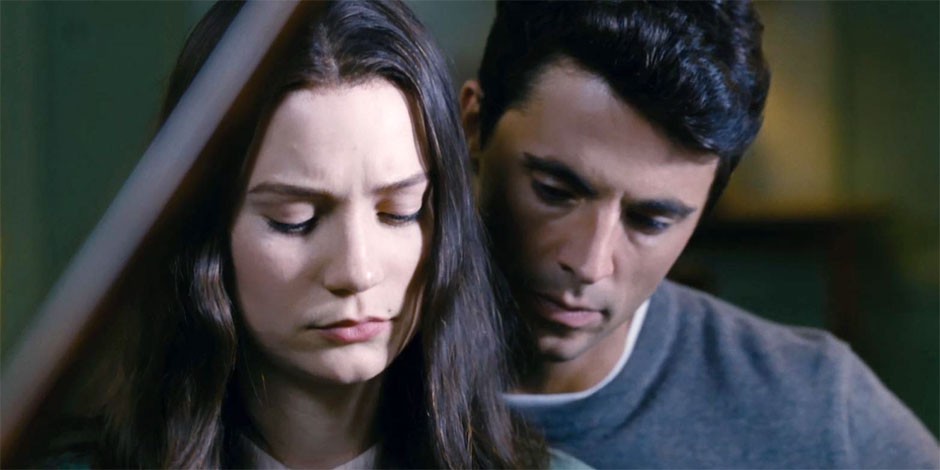
Stylistically, Stoker is perfectly delivered: Park uses his actors and his camera to fantastic effect, multiplying the story’s already considerable creepiness. There is a gothic fairy-tale quality to the images, and the acting is just the right side of the uncanny valley – the protagonists we’re watching aren’t your usual, Hollywood (faux-)naturalistic characters, they’re broken, alien and insectile, with Matthew Goode standing out especially.

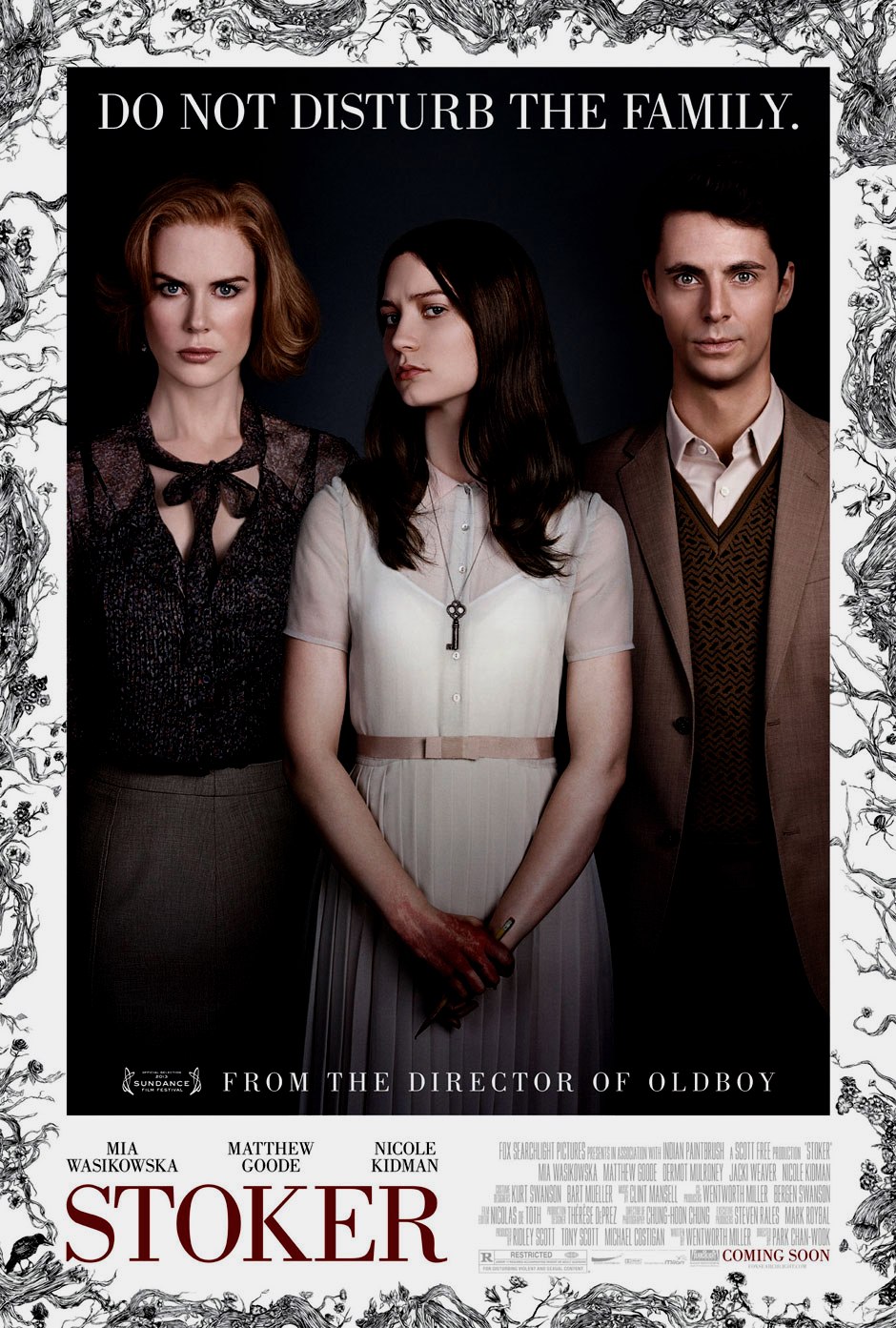
Stoker_Movie-Poster-2013It’s exactly these qualities that make it easy to admire Stoker as a stylistic achievement but difficult to care about, though. Park’s earlier films often featured emotional and physical extremes; they weren’t gratuitous in their violence, but they didn’t shrink from disturbing cruelty and Grand Guignol situations. However, at the same time Park’s directorial eye has been more sympathetic in the past: he wants us to sympathise, quite literally, with his broken characters seeking vengeance, salvation and a measure of peace. In comparison, Stoker features two protagonists especially that fall somewhere between, or even straddle, the sociopath-psychopath divide.

This doesn’t make the film less fascinating to watch, but it makes it less engaging for me than most of the earlier movies. There’s a coldness to Stoker that’s effectively chilling but comes across somewhat like a gorgeously filmed documentary about the predatory habits of praying mantises played out from the perspective of one of these murderous insects. And they’re wearing the skins of Matthew Goode and Mia Wasikowska. And yes, if that image makes you shudder, that’s pretty much what the film does so eminently well.

Location, location, location!

I’ve been underwhelmed by three of the most recent films I’ve seen: Zero Dark Thirty, Django Unchained and Lincoln. Yet these are all films that have received rave reviews from the critics; for instance, Kathryn Bigelow’s latest received a Metacritic score of 95/100, Django Unchained has a Rotten Tomato score of 88 out of 100, and all three were Best Picture nominees at the recent Academy Awards.

Lincoln Obviously an argument can be had about the Oscars and whether they truly reflect what’s best about movies – an argument I’m not particularly interested in getting involved in. What I’m more interested in is this: do all these films depend on the particular culture that gave birth to them? More specifically, to what extent do they depend on an American audience?

As a non-American, it’s not that I’m disinterested in the films’ topics, but I don’t have any connection to them. Slavery, particularly as it was practised in the United States, and the hunt for Osama Bin Laden – neither of these have any particular, personal relevance to me. Going into the films, though, I felt that they required, perhaps even demanded such a personal connection to be at their most effective. For an audience that saw the 9/11 attacks as aimed at them – not at the Western world in general, but at them as Americans – it might be easier to identify with Zero Dark Thirty‘s heroine and her obsessive hunt for Bin Laden. For an audience that culturally still lives in the aftermath of slavery and its legacy, the sight of a black gunslinger exacting brutal revenge on the one side of the cinematic spectrum, on the other a tall, gangly president seeking to end not only a war but a racist, inhumane practice deeply entrenched in the national culture – I expect that these resonate in ways particular to that audience.

Zero Dark ThirtyExcept that resonance wasn’t there for me. Whereas 9/11 felt like a shared event even on this side of the Atlantic (with some caveats – the discussion on the terrorist attacks very quickly became critical of the United States in Europe), the hunt for Bin Laden didn’t. The most personal connection I have to slavery is remembering seeing Roots on TV, which barely counts. Yet there are films that manage to make essentially American topics more universal, where I don’t feel I have to have grown up in a specific culture to connect to them. Did these three films end up less effective, and less successful as movies, because they were aimed at a very specific audience?

It’d be interesting to hear some opinions on this issue. What were readers’ opinions of these three films? To what extent did you feel that they spoke to you – or failed to speak to you?

Note: While Argo could also be said to be about a particularly American topic, it didn’t feel like it to me. This doesn’t mean I agree with the Academy’s opinion on the film – I enjoyed Argo but would call it a good film, not a great one – but in the end I enjoyed it more than either Zero Dark Thirty, Django Unchained or Lincoln. Then again, I haven’t fully enjoyed any of Spielberg’s movies in a very long time… but that may be material for another blog post.

Blood in the kitchen sink

Broken is a great piece of storytelling. The editing, the pacing, the atmosphere – all add to its quality. Even if you don’t know anything about the movie, there are several hints in the first three minutes that there will be blood. After four more minutes, you think you’ve seen the worst, and the rest of the movie is about how people will deal with what has happened. Nope. Brace yourself, you’ve been warned.

And yet, the movie is not a long journey into night. There are hopeful moments, most of them involving Skunk, a smart, kind 11-year old girl. She is played by Eloise Laurence, in a debut performance that has much more to do with instinct than with acting. There is a sequence where she tries to talk her dad into buying her a new cellphone. That moment alone is worth seeing the movie. Eloise Laurence carries the story in the same way Jodhi May did in A World Apart. And oh, it was good to see Tim Roth again, without guns, without shouting. His Archie is a calm, benign father to Skunk and one of the solid centres of the small community, although he himself would disagree.Image

It’s hard to talk about plot. I guess it sort of starts with one of the daughters of the Oswald family, who finds a condom in her older sister’s room. She examines it and then tries to flush it down the toilet, where her dad finds it. Daddy Oswald presses his daughter into wrongly admitting she’s had sex, while she, clearly afraid of her father, blames Rick Buckley of rape, only because he is visible across the street, washing his dad’s car. Rick is thin-skinned and naïve, a good kid, but without any defences. Skunk looks on as Daddy Oswald comes rushing out of his house and beats up Rick. I have only mentioned the first six minutes of the movie. There is no way you can guess what happens next. It is fast-paced, non-linear, and it clocks in at 88 minutes, but feels longer because of all the things that happen underneath the plot. And yet, it never feels rushed. We always know where we are, with whom, why and when.

Daddy Oswald is maybe the most controversial character in this movie. He is played by Rory Kinnear as a wounded widower who does not have the slightest clue how to regain control over his three fast-growing daughters. I might feel for him if he didn’t try to rule by fear and rage.

The movie seems flawless, but I would wish for a less obvious ending. The moments in church are so conventional that they stand out as the weakest scene in the film. Luckily, it’s not a movie you watch for the ending – you watch it for the characters.

Skunk is in some danger because she goes towards people who may better be left alone. There is her brother who is busy becoming a teenager and nicks cigarettes from their nanny who, in turn, falls for Archie, who has no idea what to do with that love, or his own. There is the nanny’s boyfriend, played by Cillian Murphy, who can’t see that Skunk looks up to him, and should act accordingly. In a lesser movie, he would be the teacher who gets accused of abusing a student. Here, he does what any courageous man would do – and it’s very bad luck that he is a teacher. He is untidy with his feelings, but gets more punishment than he deserves. Maybe that’s what the movie is all about. Do we ever get what we deserve? Should we? And what DO we deserve? There is no deus ex machina in this movie – good or bad has to do with yourself and the people who are around you. Sometimes it’s not the stranger with candy that frightens you, it’s the well-meaning neighbour.