Let’s put a smile on this blog!

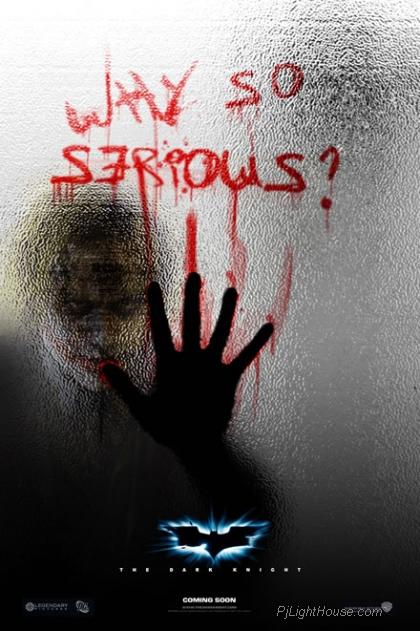
To once again prove that I’m pathetically behind on what’s going on in the world of pop culture: I’ve only now got around to seeing The Dark Knight. At this point, is anyone interested in yet one more glowing yet sad praise of Heath Ledger’s Joker? Yes, Ledger’s performance was hypnotic and is one of the main reasons why this film is rightly hailed as more than your run-of-the-mill comic book adaptation. But that’s all I’ll say on the issue, because you don’t come here to read an elaborate “Me too” blog entry.

The Dark Knight is a good film and better than Batman Begins – the latter was clearly an origins story and therefore somewhat stuck in its template (although doing very well in this respect), but its sequel definitely does much better in terms of providing an interesting, worthwhile antagonist. It does so well, in fact, that Batman/Bruce Wayne suffers by comparison: the film is just so much more interesting when the Joker is on screen. Still, you couldn’t have the one without the other, and the moral dilemmas that Gotham’s favourite anarcho-terrorist poses the Dark Flabberghast are fascinating to watch. The ferries scene, even though it resolves itself without Batman’s input is a vast improvement on the simplistic scenes in the Spiderman films where the general populace pulls together and proves to be heroic in their own right.

It’s not a perfect film, though, not even in it’s genre. There are some mistakes it should have avoided quite easily. For one thing, some of the editing is seriously disorienting and not in a good way – there are scenes that feel like a bad TV edit to get rid of scenes that are too violent, and as a result continuity suffers. Were they trying to keep the film in PG-13 country? (If so, the studio is eminently silly – even without explicit violence this is not a film that you should let your 13-year olds watch.) I don’t mind the disorienting editing of the fight scenes, but there the lack of clarity has a purpose. The continuity wobbles get especially bad in the batpod scene where I felt that they’d buggered up the sequence of scenes.
The film also tries to cram too much into its running time, and where it tries too hard to make us believe something. I’m not complaining about the two villains, because Harvey Dent’s fall from grace follows smoothly from the Joker plot. However, the scene where Bruce Wayne and Alfred get the fingerprint from the bullet? Overly complicated, to a point where it barely makes sense. Same goes for the bat sonar and the ethical quandary that comes with it: not only does it feel overly gimmicky in the film, it’s also much less interesting and complex than the Joker-induced “damned if you do, damned if you don’t”. It feels like a top-heavy retro-active explanation for how Batman manages to find the Joker later in the film, and surely it could have been done in a more elegant way.

These quibbles aside, though, the film is definitely worth watching. It’s worth it for the visuals, it’s worth it for the acting, and it’s worth it to see to which dark corners Nolan will take its hero. If there’s a third film, I’ll be happy to follow him there.
Hamsterdam and the gooey kablooie

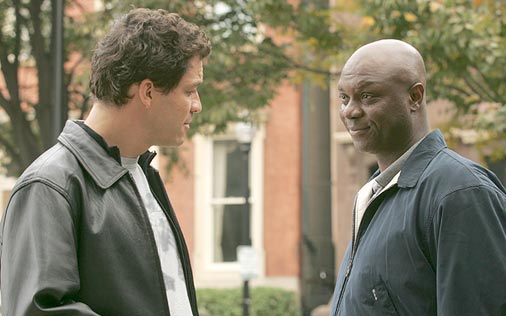
You have to admire Stringer Bell’s attempts to de-thuggify the Baltimore drug trade. His endeavours to get his business away from the drive-by shootings and everyday violence is one thing; his sweet, endearing (not words easily used when it comes to The Wire, except for everyone’s favourite addict Bubbles) meeting rules are something else altogether. It wouldn’t feel more strange to have these dealers and “soldiers” in the drug war speaking in Jane Austenese.

Season 3 of The Wire once more is among the best TV there is. It’s smart, impeccably crafted and unexpectedly funny. (A shout-out has to go to “My dawg…”.) I’m also finding it less affecting than the second season, though. Is it that the stevedores represented by Frank Sobotka had more pathos? Frank’s final episode nearly had me in tears. Or is it that I, in spite of my impeccable bleeding heart credentials, can relate better to pudgy, corrupt white guys with receding hairlines than to black hoppers slinging red tops and getting hot and bothered about semi-automatics.

There’s more than enough here to get to the viewer, though: Cutty’s attempts to get back into the game after 17 years in prison, or Bunny Colvin’s subversive social experiment born out of a frustration with the shambles and hypocrisy of the war on drugs and a wish to do something, however radical, that might actually break the stalemate and help.

And on that happy note I’d like to thank Amazon for its special offers. (No, I don’t get paid for this. I should, though!) Thanks to them, seasons 4 and 5 of The Wire are on the way and I don’t even feel too guilty about spending the money. I’m slowly running out of interesting HBO series, though… so in one, two years’ time I’ll either be reduced to Sex and the City – or it’s back to Six Feet Under. In which case I might as well rename this blog “Fisher & Sons”.

Hey, soldier! Leave that kid alone!

As usually, I was late to the party. Everyone ranted and raved about Children of Men when it came out, so I got the DVD almost immediately when it came out. And then it lay around for ages, was moved from one flat to another… and last Saturday we finally thought, “The value of a DVD lies in watching it, not having it,” as Confucius said. Or Yoda. I forget which.

Now, having seen the film, I’d say that the raves were warranted… if the reviewers left the cinema roughly two thirds into the film. The first hour or so of Children of Men is the most compelling, most chillingly credible cinematic dystopia I’ve ever seen. It is also one of the most breathtakingly well shot films – just how on earth did they shoot some of those long takes?

For a long time, Children of Men succeeds in making a horrific vision of the future all too credible by taking our present-day world and extrapolating. None of the over-the-top gadgetry of other near-future films. (While I’m embarrassingly fond of Strange Days, that millennial melodrama does look extremely dated. That film was right, however, in assuming that whatever entertainment technology will be the next best thing, it’ll largely be used do commodify violence and porn. Now let me go back to play GTA 4.)*

I also like that the film doesn’t provide lots of explanations and exposition. It throws its viewers into a world where the youngest child is 18 years old, where people have become almost indifferent to small-scale terrorist bombings but can’t stop crying over the killing of a Brazilian teen just because he happens to have been the last baby born. Where “Rah, rah, we are the best!” chauvinism has become the norm. And every one of these developments has its roots in our present day. Eighteen years of a slow, ongoing apocalypse will do that to you, I guess. But none of this is dwelled on. While watching the first hour of the film I never felt like the film was trying to tell me something in six-foot high, bolded letters.

But then the film becomes more heavy-handed. We get images that are clearly inspired by Abu Ghraib. We get grimy ethnic refugees in wartorn Bexhill. And to me at least, it all looks less like an extrapolation of our current world and more like editorial comments on current conflicts. Yes, the beginning of the film also commented on our present-day world, but it did so much more subtly, in the background. There’s a richness to the scene-setting that is more convincing and more complex than the in-your-face correspondences of the last 30, 40 minutes.

It doesn’t help that while the first hour of the film focuses on dialogues and characterisation, it ends on what is mostly running and shooting. At least the main character doesn’t become an action film hero (there’s a gorgeously funny escape roughly at the half-way point which plays refreshingly different from what you’d get in a Hollywood action film), but still, there are only so many variations on the theme of running away and being shot at .

Sadly I’d heard so much about the key scene where the guns fall silent at the sound of a baby crying, so when it came it didn’t strike me the way it struck many viewers. The Bexhill transition had taken me out of the film so much that the scenes of awe-struck ‘fugees staring in almost religious rapture at the first baby in 18 years, with the occasional poor sod in the background being shot while gawping, struck me as almost Monty Pythonesque – “Oh look, bab-eurgh!” “Look at its widdle fing-blam!” Or perhaps I just had a phase last Saturday of being a callous bastard… or perhaps it was that I didn’t quite buy the Uncanny Valley CGI Baby. Earlier scenes – the amazing sequence in the car, or Michael Caine’s final moments – got to me much more.

(Yes, I am evil.)

In some ways I think I’d reacted better to the film if I’d known less about it – but even then, I would have felt disappointed by the abrupt shift in tone. The moment that Peter Mullan’s cartoon character Syd turns up is the moment that the film sharply turns into something different, and much less compelling, than before. I came away feeling that I’d seen the beginning of a masterpiece and the end of an okay dystopia. I just wish I’d been able to finish watching that masterpiece before someone spliced a decidedly inferior film, though one strangely starring the same actors playing the same characters, into the reel.

*Actually, I haven’t got the equipment to play GTA 4, so I’m stuck with lower-tech virtual snuff. Poor widdle me.

Always running… from something!

Avid readers of this blog may have noticed that I’m fairly keen on Messrs. Vaughn and Whedon’s work in comics… so when Joss Whedon was set to write the next series of Runaways, I was excited. Both writers have similar strengths; their writing is witty, they create ensemble casts of characters that gel extremely well, and they tell a good story while providing more than enough ambiguity to keep things interesting beyond the plot.

I recently re-read Vaughn’s original three Runaways volumes and apart from a couple of minor issues (such as the slightly inconsistent quality of the artwork – there’s some gorgeous work there, but some panels and some of the inking feel rushed) I greatly enjoyed it. Coming away from Whedon’s run with the kids, however, has left me somewhat disappointed. When he’s at his best, Whedon is a fantastic storyteller, getting you involved way more than I would have expected from stories about teen vampire slayers or space cowboys. He’s not infallible, though; his first Serenity comic, while not abysmal, was in no way as memorable as the TV series, for instance.

And now, Dead End Kids: my first and main thought throughout was, “I wonder what Brian K. Vaughn would have made out of the material.” Again, Whedon’s writing isn’t bad, but there’s little of the sense of surprise or freshness that Vaughn’s stories had. The kids feel ever so slightly less real and more like comic book teens. (And don’t think you can worm your way into my heart by introducing a new regular character that comes from where I live, insiduous comic!) The art is absolutely fine, but it lacks the quirk of Alphona’s best panels. And the time travel gimmick, while fun, also comes across as a tad overused. In that respect, the story feels a bit as if Joss Whedon had written an episode of Star Trek.

Nevertheless, there are moments when Whedon’s talent shows. Even if the time travel plot is a tad overdone, its denouement is more poignant than I would have expected. There are some interesting hints at the direction in which especially one character might develop, with a daringly cruel punishment for two of the story’s villains. And there’s a couple of pages ending in the death of a minor (or should I say “small”?) character that had me giggle and go “Yewwww!” at the same time.

Was it worth getting the comic? Yes. Was it as good as the other volumes? That’s a definite no. In any case, I’m very much looking forward to Vaughn’s use of Whedon’s characters now. If I’m lucky, the first two volumes of Buffy: Season Eight (the comic-book continuation of a certain barely known TV series that Whedon supposedly had a hand in) should arrive this week, and if memory serves Vaughn has penned a Faith storyline. Should be fun to see how that one’s turned out.

On a very different note: we completed The Wire season 2. ***Warning: some spoilers to follow.*** Apparently there are people that didn’t like the second season too much, mainly because they wanted more Avon Barksdale, Stringer Bell and everyone’s favourite junkie Bubbles and fewer paunchy white guys with bald spots and union shenanigans. Okay, I could have done with more Bubbles too (who couldn’t?), but season 1, while tighter, didn’t have the tragedy of Frank Sobotka. The ending of episode 11, “Bad Dreams”, builds up to one of the saddest fade-outs I can remember. In a way, the reveal at the beginning of the twelfth and final episode of the season isn’t half as sad as seeing Frank walk towards his fate. Even Ziggy, one of the major fuckheads of television history, becomes a tragic character when you see the larger context of what is going on. Yet for all the sadness that permeates the season ending, the series never loses the anger and sense of humour that make it bearable. At least in the first two seasons – I may very well be setting myself up for a broken heart in any of the three remaining seasons.

… do as the Belgians do

After I killed him, I dropped the gun in the Thames, washed the residue off me hands in the bathroom of a Burger King, and walked home to await instructions. Shortly thereafter the instructions came through – “Get the fuck out of London, you dumb fucks. Get to Bruges.” I didn’t even know where Bruges fucking was.

Pause.

It’s in Belgium.

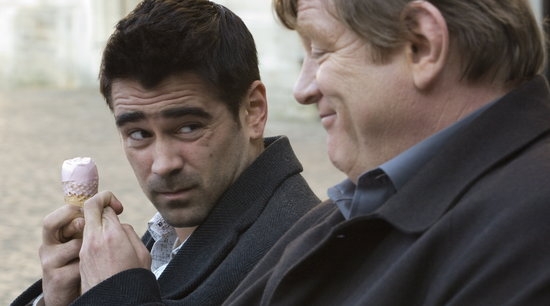
Martin McDonagh’s In Bruges is an effective, strangely affecting black comedy. It’s by no means a great movie, but what it does it does tremendously well. Many of the reviews compare it to Tarantino’s films and to the modern Brit gangster flicks such as Lock, Stock and Two Smoking Barrels, but both of these comparisons miss the persuasive streak of sadness that runs through the film.

Clearly there are elements of Tarantino’s Pulp Fiction, but these similarities only go skin deep. (Two humanised hitmen spouting funny, quotable lines.) A more apt comparison would be Harold Pinter’s The Dumb Waiter, both in its absurdity and in the way its characters are acutely aware of their guilt yet unable to verbalise their feelings. Both Pinter’s early play and McDonagh’s film work as comedy, yet it wouldn’t be fair to either to dismiss them as just that.

A lot of the sadness that permeates (yes, I’m using that pretentious word – deal with it) the film, clearly helped by the medieval morbidity of Bruges and Carter Burwell’s simple yet effective score, comes from Brendan Gleeson. However, while Gleeson’s performance is spot on, it isn’t that different from many of his earlier dubious yet loveable characters (his best to date, as far as I can tell at least, would probably be Martin Cahill in John Boorman’s The General). For me, the true standout performance, surprisingly, was Colin Farrell, both funnier and more touching than I’ve ever seen him. (Disconcertingly, Farrell’s second best performance was in a Joel Schumacher film, Tigerland. How’s that for scary?)

In Bruges falters towards the end, with a finale that ramps up the absurdity at the price of its earlier moodiness, but the film remains a small gem composed of moments of unexpected beauty. And how often do you get the chance to see Ralph Fiennes play the Ben Kingsley part from Sexy Beast?

Coming up next (hopefully sooner than this update): Is it possible that the Goofy Beast was slightly disappointed with a Joss Whedon-penned comic? (No, not Buffy.)

Who watches the Watchmen? – We do, we do!

Okay, 95% of the people reading this will already know, and the other 5% are probably not interested – but for the remaining 0% (yes, that means you!), here’s the Watchmen trailer that came out recently:

Now, part of me looks at this trailer and thinks, “Wow… that is almost picture perfect!” Another part thinks that the last thing Watchmen is about are pretty pictures. This is a trailer, yes, which has one purpose: to get people excited and put asses in seats. But Zack Snyder strikes me as a director enamoured with glossy, stylised images – and that sort of thing tends to detract from the humanity of the characters. And one of the major points of Watchmen is that the superheroes in it (excepting Dr Manhattan, although that would make for a longer discussion) are utterly human. And the book is about ideas, not about wowing the audience with cool visuals.

Having said that, I like much of the casting. I like that Snyder didn’t go for the superstars (although I do think that Adrian Veidt could easily have been played by a good-looking star, since he is pretty much one of the biggest celebrities in the world he inhabits). I like the visual metaphor of the clockwork in the trailer. And I find the CGI representation of Doc Manhattan strangely affecting, especially in that shot where you’ve got three of them.

What worries me, though, is what I’ve heard about the ending. If it’s true… well, there’s one way of pretty much ruining Watchmen, and that’s by screwing with one or two elements of the ending. I just hope that they will be able to resist killing the ‘bad guy’.

Oh, and one last thing…

Heh...
Heh...

Hellboy is the new Miami Vice

Thanks to Hellboy II (or so I would imagine), I’ve been getting lots of hits in spite of a lack of regular updates. Messrs Mignola, Del Toro and Perlman, thank you very much! The film does look quite gorgeous, as do most of Del Toro’s films – obviously they give the Latin American version of Peter Jackson full reign, and his wild imagination thanked them accordingly.

But that’s not what I wanted to blog about. Instead, I’ve come to praise Yorick Brown, not to bury him.

Remember what I wrote a couple of days ago about Joss Whedon’s Astonishing X-Men? Well, Joss is not the only sadistic bastard out there writing comics. Enter Mr Brian K Vaughan, who recently finished his long tale of a man, his helper monkey and a world full of women.

While I enjoyed all ten volumes of Y: The Last Man (the final volume just came out), the series isn’t perfect. There are moments when Vaughan missteps. The plot could do with some tightening. And the hook and setup are so breathtakingly big that it’s almost impossible for the ending to satisfy fully.

Warning: Here be spoilers!

The story strand that perhaps worked least for me was Alter’s trajectory. She’s intriguing to begin with, but Vaughan didn’t seem to know where to take her. She ends up as someone who cannot cope and, as an alternative to suicide, tries to get someone else to pull the trigger by being an all-round homicidal bitch. We’ve had similar motifs with Hero, with 355 (although more subtly, perhaps) and even with Yorick. It doesn’t help that there are entire issues that seem to forget completely about her.

Regardless of that, though, issues 58-60 are heartbreaking. 355’s death (apart from a flashback to Yorick’s intervention in an earlier volume (Safeword) that didn’t work as well as it should have) is done beautifully and practically wordlessly, to devastating effect. Pia Guerra’s simple yet effective art is at its best in the facial expressions: 355’s final look at Yorick, his silent exchange with Alter, and his face as he looks up at Hero, unable even to begin to express what has happened.

Issue 60 is a tricky one: with its “60 years later” conceit, it could easily have fallen flat. And there is something alienating about seeing a world where most of the familiar characters are absent and Yorick appears to be an old, white-haired loon in a straightjacket. My first reaction to the final issue was one of feeling at a distance from the guy we’d just accompanied for several years through a post-gendercidal world, where before he’d always been the ideal screen for all us white, somewhat nerdy male Lit majors to project ourselves onto. But with every flashback filling in glimpses of what happens during the 60 years in between the last two issues, Vaughan hooked me more and more.

At first I would have said that the best, worst moment of the issue is Ampersand’s death, euthanised by an old Yorick wanting to spare his friend the pain. It’s a simple, touching farewell to a character who, with his Eeps and Cheeps has become as much of a person as any of the human characters. This was topped, though, by the silent, moving last three pages, as our escape artist Yorick gets out of his last fix. Vaughan and Guerra handle it perfectly, giving us and the characters just the right note to end on.

So, on that note: Thank you, Brian K Vaughan. Thank you, Pia Guerra. Thank you, Yorick, 355, Dr Mann, Beth, other Beth, Natalya and, of course, Ampersand. It’s been a terrific journey.

And if you break my heart again, Mr Vaughan, I will do real damage to you with the Absolute Sandman vol. 3.

Late to the game, as usual

So, I hear there’s this new Indiana Jones film on. What’s that? It’s been out for a month or so? Aw shucks…

I’m probably exactly the right age for the Indy movies. I saw Indiana Jones and the Last Crusade at the cinema when I was 14, and I got Raiders of the Lost Ark on video later that same year. As a teenager I enjoyed the hell out of these films – except for Temple of Doom, which I already didn’t particularly like at the time. It’s got fantastic set pieces but doesn’t hold together very well as a film. (And it’s the one Indiana Jones movie, in my opinion, where the stereotypical natives do become offensive and racist… but that’s not my beef here.)

My favourite one of the films was always Raiders. It had a magic, a rawness and an energy that the others don’t match. Last Crusade is the funnier film, but it comes dangerously close to self-parody – added to which, well, it’s pretty much a rip-off of Raiders. So many of the scenes made me think, “Yeah, cool, but haven’t I seen this one already?” You get the same type of intro sequence, followed by scenes at Barnett College, followed by the story proper. You’ve got rats instead of snakes. You’ve got the wrath of God visited on those undeserving. And all of it tries just a bit too hard to be funny.

Last Crusade fares worst when it comes to the side characters that were introduced in Raiders. Both Sallah and Marcus Brody are turned into jokes – and they aren’t particularly good jokes. If it wasn’t for the interplay between Indy and his father, Last Crusade wouldn’t be much better than, say, The Mummy or any other Indiana Jones rip-offs.

Now, finally, Spielberg, Lucas and Ford got their act together and made a fourth film. Lots of fans hated it. Correction: lots of fans hated it on the internet. There’s something about Web 2.0 that brings out the extremist in fanboys and nerds. Something can’t be pretty good or sort of bad – it’s all either perfect, worthy of geekgasms, or utter shite of the “George Lucas raped my childhood!” ilk.

Crystal Skull is neither. It’s the third best Indiana Jones film. It’s enjoyable but forgettable. And it makes a couple of very unfortunate mistakes:

  • There’s little to no motivation for Indy. He’s only reacting to what’s happening. For a hero, he’s pretty damn passive. Compare that with Raiders, where something is actually at stake for him. Here the baddies have ten times more of a motivation to do what they do. Indy’s just along for the ride, really.
  • What happened to the guy who got shot, who bled, who looked worse for wear after his big scenes? Indy’s always survived things that no real human being would survive – but he was never indestructible. Here, one of the first things we see the man do is survive an atomic blast. Yes, it’s funny. Yes, it’s one hell of a cool image. But if a hero isn’t touched by a nuclear explosion, well, are we supposed to be thrilled when he’s being chased by bumbling Russian soldiers?
  • David Koepp, the script writer, didn’t really know what to do with his characters. Many of them are utterly unnecessary for the plot and take time away from one another. Was Mac necessary? Not really. The Russians could have done what they did without him. Oxley? He was basically a talking version of Last Crusade‘s Grail diary. Even Marion, although she had some nice scenes, was basically wasted, as was Mutt. There was no urgent reason why any of these characters were in the film – and if you’re making what should be a rollercoaster ride of a film, superfluous characters slow you down.
  • I don’t have any problems with aliens instead of religious artefacts – if they’re intriguing. The Ark of the Covenant had mystery, it felt positively alive. (It was also helped by John Williams’ wonderful score, which I’ll talk about in the next bullet.) The Grail was already much less interesting, but Last Crusade didn’t focus on it: it focused on Indy and his father. The crystal skull? It’s a pretty uninteresting gizmo. It doesn’t have much character. And the ending pretty much lacked awe… which the Ark had in spades.
  • I don’t remember a single one of the new tunes Williams penned for Crystal Skull. All three former Indiana Jones movies had memorable tracks, and the Raiders March is one of the most iconic pieces of film music there is. I can’t remember the last time Williams wrote music that didn’t feel like B-sides. The man wrote some of the most memorable film scores – but from what he’s been producing in the last, say, ten years, he should finally retire.
  • The villains… Raiders had its iconic Nazis, and it had Belloq, to date still by far the best adversary Indy ever had – because he wasn’t actually that different from the man. Belloq had a great introduction, his interactions with Indy were well written and acted, and he actually had charisma. Cate Blanchett tries hard, but the script doesn’t know what to do with her. Is she evil? Driven? Obsessed? Is she actually a tragic figure? I don’t mind ambivalent characters, but I mind scripts that seem to have an attention span of five minutes. Koepp didn’t really seem to have much of a concept of any of the characters… which is probably why the film feels mostly like a string of episodes, none of which are really terribly compelling. And what’s Indy without a good adversary?
  • And what’s with the horrible over-exposed wedding at the end? It looked like Heaven in Always! Walk into the light, Indy…

Anyway, the film’s had enough of a critical pummeling. All in all, it was entertaining enough, but not much more so than a competent Indiana Jones knock-off. And somehow mediocrity is almost worse than an out-right bad Indy movie. I just hope that Lucas and Spielberg won’t try to keep flogging this almost-dead horse. At some point it becomes terribly, terribly undignified.

And talking of undignified: have fun with this! 

Fruit flies like a banana

It’s been… way too long. Ages. What’s my excuse? Work. Too much of it.

Yes, I know – it’s a feeble excuse, but it’s the only one I’ve got. Sorry.

However, you’ve all been on my mind… or rather, the blog has. Every one or two days I’d think, “Hmm… I should write about this.” And then nothing would come of it. Okay, admittedly, it’s not as if I was at work 24/7 – but the combination of lots of things to organise (after all, I had to bring five young climate activists to the inaugural meeting of Kofi Annan’s new organisation – no pressure!) with lack of sleep doesn’t exactly make for diligent blogging. In any case, I am deeply sorry about being so silent for the longest time.

So, what sort of things did I feel like blogging about?

  • The EURO 08 and the woes of having high-definition digital television and the only things on are football and tennis. (You can count the grains of sand!)
  • The latest Hellboy collection, which I enjoyed quite a bit. And the Hellboy 2 trailers – Guilhermy goodness!
  • House of Leaves – postmodern horror or horrifically postmodern?
  • I, Robot – there are some films that aren’t even worthwhile when you can watch them for free…
  • Team Fortress 2 – but then, everyone’s already blogged about TF2, so I’d only out myself as perennially late.

In any case, I’ll leave you with an impression of the latter. Great fun if you need to blow off some steam. (For gamer nerds: no, that pun wasn’t intended.) Never before has carnage been such family-friendly fun!

My HDTV runneth over

Today I finally became the proud owner of a digital TV set-top box. I haven’t really checked it out that much yet, but it finally allowed me to see the Future of TV. More pixels. Full HD. And lots of other terms that basically boil down to “Let’s let the boys play a bit, shall we?”

So far I’ve checked out three of the HD offerings: HD Suisse, BBC HD and lastminute.tv. The latter was basically a glorified travel ad for last-minute trips, BBC was showing some nature documentary and HD Suisse was broadcasting a classical concert. Not exactly the most exciting programming imaginable. But I was sitting there going, “Wow, look at that image, you can read every semiquaver on that violinist’s sheet music, and even his notes, and check out that Capuchin monkey. see how every single hair on its head is visible? And that cheap, computer-generated price tag for the hotel, you can hardly make out any aliasing on it! This is what TV is all about!” (Okay, that last one is even more wildly exaggerated than the other examples.)


If they actually showed Lost or Battlestar Galactica in Full HD, chances are my brain would implode and I’d end up a drooling imbecile. Right now I don’t drool yet.

And my girlfriend’s reaction? “Cool, they’re showing Doctors on BBC!”

Talking about the future of this and pixelly goodness that, the latest entry in the AV Club‘s “My Year of Flops Case File” is a highly enjoyable panning of Speed Racer, latest proof that the Wachowski siblings’ worst movie may not have been a Matrix sequel. Share and enjoy!