Birds, rats and iron giants

I like Pixar movies, by and large, but I’m not as over the moon with them as many others. For one thing, I got extremely annoyed with John Lasseter when I got the Studio Ghibli films on DVD and had to sit through his patronising “My dear friend, Miyazaki-san…” and “You are very lucky…” intros; but also, I felt around Monsters Inc. and especially Finding Nemo that they were getting way too sentimental for their own good.

However, I loved The Incredibles. Yes, it also had that “family is the best” vibe that Nemo had, but it was done a lot less sappily. It was sweet but stayed quirky at the same time – and it was a lot darker in parts than Nemo – which basically did the Bambi thing by killing off Nemo’s mother, but apart from that there was little to no edge to the film. The Incredibles, on the other hand? Remember the scene when Mr. Incredible finds out what’s been happening to all the supers? Or the one where he almost kills Mirage? Also, there’s something very real about Mrs. Incredible’s fears that her husband is cheating on her – which is a fear you won’t find in many movies produced by Disney, I’d wager.

I also liked Ratatouille a lot – and there’s a subtle, quiet scene late in the film that brought a lump to my throat. I remembered that lump from another film by the same director: The Iron Giant. More than most directors of animated movies, Brad Bird is a deft hand at mixing the sentimental and the funny, real pathos and sheer goofiness. While Ratatouille is a very different film from The Iron Giant and indeed The Incredibles (the latter two go much more for the iconic, namely ’50s cold war paranoia and superheroes), all three of these films show a subtlety that is rare in American animation, so that a short, simple scene can break your heart.

The Iron Giant

I also liked Lifted, the Pixar short that was shown before Ratatouille. I hadn’t been that mad about For the Birds (shown before Monsters Inc., I think) or the jackalope one (Boundin’), since both of these got on my nerves after roughly one minute (they weren’t quite as clever or loveable as they thought they were, as far as I’m concerned), Lifted had a simplicity of story and design that worked very well for me. So, courtesy of YouTube, here’s Lifted:

In which I revise my opinion on Hollywood’s favourite stick insect (slightly)

About a week ago I was informed by my love that we’d be watching Pride and Prejudice on Friday. Not the BBC six-hour extravaganza – that’s still on the menu for later – but the recent film version with Keira Knightley and Matthew “I’m an MI5 agent – get me out of here!” MacFadyen. Since I’d heard good things about the film, I resigned myself to my fate with rather less grumbling than might be expected. After all, I’m secure enough in my sexuality to watch a Jane Austen film without fearing to catch “the gay”.

No, no, no… It’s not what you may be thinking now. I wasn’t secretly thrilled at the thought of 2+ hours of Keira Knightley being all witty and sarcastic and sexy. Thing is, I don’t find her very sexy at all. She’s not ugly, but a) she’s too girlish and b) she’s too thin. Back when I saw Bend It Like Beckham, I thought that there’s a very attractive woman in this film, and her name is Parminder Nagra. Keira? I wouldn’t mind cooking a proper dinner for her, but that’s about as far as my feelings towards her go.

C’mon… which one would you go for?

Also, I never thought that she was a great actress. All the films I’d seen her in, she was basically the same character: feisty heroine/modern grrrl who can hold her own with the boys. I mean, like, hello! Boring! (Or something to that effect.) However, I must say after watching Pride and Prejudice that there’s more to her, provided that the director and cinematographer and make-up artists and producers don’t keep telling me, “You must desire this woman! If you don’t, there’s something wrong with you!” Her Elizabeth Bennet was far more interesting than any of the other characters I’d seen her as.

In general, the film was surprisingly good. Now that I’m no longer teaching at an English Department, I can perhaps confess that I’m not too keen on Jane Austen. Sure, she’s witty, but I wish she’d written only one novel or perhaps short stories. Admittedly, I’ve only read Emma, but with the Austen film adaptations I’ve seen I always felt déjà vu. The 2005 P&P film has its faults: the pacing is off, with the beginning feeling rather rushed and the middle too leisurely; some of the more modern camera moves and edits fail because the film tries too hard to be “contemporary”; and there’s entirely too much giggling! But at least in the European version, there was something nicely understated about the romance: as a matter of fact, many of the romantic couplings are less about brainless passion than about a mutual liking combined with a sense of pragmatism. Or, in one case, about stupidity. And the film doesn’t try to gloss this over.

Finally, talking of gloss, or lack thereof: while the film looks lovely much of the time, it doesn’t go for the Heritage look where even dirt is disconcertingly clean. There’s mud, there’s geese and pigs (with big dangly man-bits – what a strange scene!), and things aren’t antiseptic. The film didn’t have the picture postcard look, the “Wish you were here in the 19th century with us!” feel that so many costume dramas insist on, and it was all the better for this.

Notes from the Zone

Nope, I haven’t handed in my nerd credentials and stopped playing computer games. As a matter of fact, I recently got a new graphics card, so I’ve been diligently playing those games that didn’t run that smoothly before the upgrade. One of the titles I’d most been looking forward to is Stalker – Shadows of Chernobyl. (Well, technically it’s called S.T.A.L.K.E.R. – Something of Doodah, but unless someone can tell me what the abbreviation is supposed to stand for, I refuse to use that wannabe leet name.)

There’s been a discussion about games as art for a while now. If we look at them as narrative art, then I’d agree that there are few games that tell a story that’s better, or even as good, as your average mainstreamy Hollywood genre piece. (There are exceptions, but that’s material for another entry.) What games can excel at, though, is atmosphere – and that’s what Stalker has in spades. It’s based, though loosely, on Andrei Tarkovsky’s enigmatic film of the same name (which I haven’t seen yet – shame on me!).

The game is set in the area around the radioactive wasteland surrounding the defunct nuclear reactor in Chernobyl. Stalker‘s version of the Zone is populated by lone adventurers, bandits, militia and mutated animals. It is dotted with anomalies that tend to mean your death if you wander into any one of them unawares. (There is grim fun to be had of watching packs of mutated dogs happen into an anomaly that pretty much spins them around like the cow in Twister – and then tears them apart.)

Stalker manages to be one of those games that’s greatly enjoyable but not a lot of fun, and that’s mainly down to its atmospheric setting. On my first day in the Zone, I happened across a camp that other Stalkers had made amidst rusty cars and a broken down Hind helicopter. Just as the sun set, a group of bandits attacked, and most of what I could make out were bursts of fire in the darkness and the flashlight’s circle of brightness illuminating burnt out Ladas and the occasional bandit aiming his semi-automatic at me.

In general, the nights in the Zone are tense and scary – mostly because they are actually dark. Walking towards distant lights, your flashlight barely illuminating the bushes in front of you, while you hear strange animal sounds, and suddenly a pack of dogs attacks, their eyes glinting in the dark… Definitely beats the hell (pun only semi-intended) out of Doom 3‘s predictable haunted house ride and its rubber zombies.

I’m not very far yet, but I’m looking forward to getting closer to the shut-down reactor and entering the parts of the Zone that used to be residential areas. Until then, I will continue being the bane of mutated dogs and hogs everywhere… until I run out of ammo. I run pretty fast (’till I stumble into one of those amusing anomalies and it proceeds to turn me inside out).

Green appeal

I’ve never been much of a James Bond fan. As a kid, I watched some of the Sean Connery ones and enjoyed them, but never enough to think “Hey, there’s a Bond movie on tonight! Let’s watch it.” Roger Moore always struck me as eminently kickable, and in my books Pierce Brosnan is the better, more interesting Bond in John Boorman’s The Tailor of Panama than in any of his actual Bond movies. Especially in the last couple of Bond flicks, the writing devolved to the level of a bad Christmas panto, with puns so atrocious you have to be pissed on eggnog to appreciate.

Yesterday, I watched Casino Royale for the second time. More so than at the cinema, I was struck less by how different it was from the earlier Bond movies than by how similar it is in many respects. When it came out, critics kept saying how the franchise had taken some pointers from the Bourne movies, and that’s definitely true – but it’s still as glossy and slick as its predecessors. Bond’s world is still that of the rich and famous, not the more faceless, banal world that Bourne tries to survive in.

Nevertheless, I found the film just as intriguing on the second viewing as when I saw it at the cinema, and that’s mainly down to the much tighter writing and to the two leads. David Craig has an effortless arrogance that complements his rough-hewn exterior perfectly. Craig makes Bond an interesting character much of whose charisma comes from his brutal ruthlessness. You actually believe that he is capable of what he does, whereas I could never buy Brosnan’s derring-do adventures.

More so, however, Eva Green is a brilliant asset to the film. Not only is she breathtakingly beautiful, she too is a much more rounded character than any other Bond girl I can remember. Neither Green nor Craig seem to have thought, “I don’t really have to act, it’s only Bond.” They approached their roles as if they were actual rounded characters, and that makes watching them so much more interesting than watching the action figures you got in most of the franchise’s movies in the last ten, twenty years.

Seeing how two franchises – Bond and Batman – were rescued from their worst moments (Die Another Day, Batman & Robin), I’m definitely looking forward to where they’ll go next. It would be a shame for them to flicker and burn briefly only to fizzle out yet again.

The first rule of Fight Club

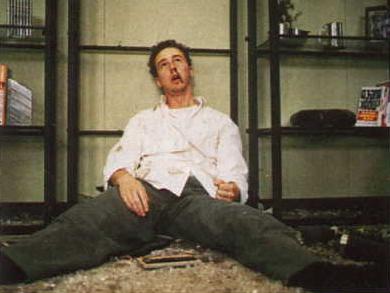
So, I’ve been rewatching Fight Club. (Best way to listen to commentary tracks? Work out while you’re listening to them. You’ll feel like a fit couch potato.) I still think it’s a very funny, very clever and extremely well made movie. But one thing about it tends to annoy me… and that’s many of its male fans.

So many guys I know who like the film buy into Tyler Durden’s fashionable nihilism and reactionary chic. They see the film as a critique of a society that brings forth the silly, ridiculous “Let’s all grouphug and cry into each other’s t-shirts!” self-help groups and subscribe to the “You are not beautiful, unique snowflakes” existentialism that Tyler preaches.

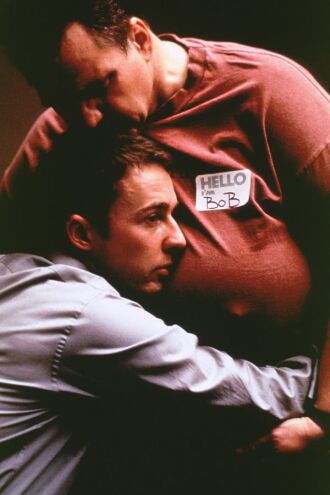
Bob. Bob had bitch tits.

But, essentially, is there much of a difference between the fight clubs and the self-help groups? Aren’t both basically places where people come together, feel sorry for themselves and their lot in life (perhaps even with justification) and then make each other feel better by either hugging each other or beating each other? Aren’t both simply schemes to make you think “Yeah, there’s others out there who feel like me?” The guys who join Tyler’s clubs are losers, and they think that beating each other up and being about as nihilist as a Nine Inch Nails t-shirt turns them into men.

“We’re still men.”

“Yes. Men is what we are.”

The only real difference (apart from the blood and snot vs. tears and snot, depending which brand of self-help group you prefer), it would seem to me, lies in the ideological veneer that covers either. But those guys who think, “Yeah, that Tyler is cool, we’re not beautiful and unique snowflakes, consumerism sucks, and I’d quite like to beat someone’s face into a pulp, because that’ll make me a man” – I’d say that a lot of Tyler Durden’s joke is on them. If you have to beat someone up, or be beaten up, to feel like a man, if you have to demolish coffee shops in order to feel you’ve got a sizeable penis, then good luck finding new teeth.

Rock bottom, and lovin’ it!

On the internet, the imaginative nerd is king

Okay. If I am predictable, then today’s blog entry will be about Fight Club. And it is, after a fashion.

The internet is a weird, wonderful and sometimes rather frightening place. YouTube is a perfect example of this.

There’s this guy who re-enacts scenes from films. With himself in every role. And the strange thing is, he does it quite well. So, here’s his take on a famous scene from Fight Club (where the multiple-roles-played-by-the-same-actor thing works fairly well, if you think about it):

And if you’re not weirded out enough… Here’s perhaps the strangest thing he’s done. Check out this scene from Pan’s Labyrinth, through the looking glass:

P.S.: His name is Brandon Hardesty. His name is Brandon Hardesty. His name is Brandon Hardesty.

It’s all backwards

Chinese boxes? Fuggedaboutit!

Last evening’s session on film analysis went well, and the students enjoyed it too. It made me want to do an entire course on the subject. It also made me want to watch all three movies again.

Of the three, Memento is the one that startled me most when I first saw it. It’s intricately structured and plotted, but beyond this it’s beautifully presented, with a sparse melancholy and occasional absurd humour that strengthen it into something more than a well made puzzle.

It’s also got a fantastic, disorienting first scene that acted as the perfect hook for me. I got the impression that it also did so for the students yesterday; they seemed quite frustrated at me stopping the film after roughly seven and a half minutes. Well, guys, it’s in the department DVD library, I think – and if it isn’t, just pester one of the staff members ’till they get it. After all, someone also got the original Texas Chainsaw Massacre for the department, which justifies many an additional purchase, I think (Perhaps they could get Crossroads, that Britney Spears movie, scripted by Shonda Rhimes of Grey’s Anatomy fame.)

I liked the effects of reverse chronology in storytelling, if done well. Memento definitely makes good use of having two narrative strands, one in normal chronological sequence, the other one reversed, putting us in Leonard’s shoes: we never know what went before, just like he can’t remember. It’s a structural strategy that’s also highly effective, and moving, in Eternal Sunshine of the Spotless Mind and in Harold Pinter’s play Betrayal. (I’ve just read that there’s a Seinfeld episode, “The Betrayal”, that has the same structure and makes multiple references to Pinter – gotta see that one!) The focus is shifted from “What happens next?” to “Why did this happen?” I wouldn’t necessarily want my Die Hard or Aliens told in reverse chronology, of course, but every so often I get tired of “What happens next?” – mainly because what happens next isn’t all that exciting.

P.S.: It’ll be interesting to see what sort of visitors the tag list will bring in. Welcome, one and all! Even Britney Spears fans! And aliens, I guess.

Those who can’t, teach…

I’m about to be off and teach a two-hour colloquium on film studies. I’ve never studied the subject, but somehow the person who asked me to teach the session thought that a) having  a PhD in English and American Literature, b) being a film nut (and having 400+ DVDs to prove it) and c) having an opinion on everything qualifies me for this.

Hurm, as a certain psycho superhero might say.

Anyway, since I have to make a few last notes, I’m going to have to make this short. I’ll be analysing extracts from three films with them: The Talented Mr Ripley, Fight Club and Memento. Having re-watched the beginning of those three films, I was reminded again why I liked them so much in the first place. Ripley got a bad rap with some critics, but I still find it one of Anthony Minghella’s, Matt Damon’s and Jude Law’s finest movies. And for those who think the film lacks tension, I thought I could put a highly spoilerish excerpt in the blog. Those who haven’t seen the film yet, don’t click on the clip lest you do so at your own peril!

However, I don’t want to leave you with murder and mayhem (or soap – sorry, wrong movie…!), so here’s another, more peaceful clip from the same film. Dunno what it is about the song, but I always get an urge to snap my fingers and tap my feet when I hear it. Enjoy!

Western promises

The title should already give it away: The Assassination of Jesse James by the Coward Robert Ford is not the kind of movie you watch in order to find out what happens at the end. If that’s why you go to the movies, don’t see this film. If you tend to use the words “pretentious” and “artsy” fairly often when talking about films you didn’t like, don’t see this film. If slow equals boring when it comes to movies as far as you’re concerned, don’t see this film. If you’re hoping for gunslinging action, don’t see this film.

The Assassination of Jesse James by the Coward Robert Ford

However, do see this film if you want to see a beautifully written and shot, psychologically fascinating, immensely atmospheric and deeply sad movie, and especially if you’re interested in good acting. Down to the last part, The Assassination has an impressively talented cast; for instance, even the few scenes that focus on Garrett Dillahunt’s Ed Miller (I’ve been a fan of his ever since watching Deadwood) tell volumes in themselves. But the film stands and falls with the two title characters, and they both carry their share of the load with distinction. I’d only seen Casey Affleck in the Ocean’s Double-Digit films, where it’s difficult to judge his acting, but his Robert Ford is a complex, riveting creation: in turn wheedling, puffed up, disturbing, pathetic, deluded, but finally truly tragic, he’s a relative of Matt Damon’s Tom Ripley. At one point James asks him: “Do you want to be like me? Or do you want to be me?” Their relationship recalls that of Tom Ripley and Dickie Greenleaf (Jude Law) in Anthony Minghella’s movie, but it goes further than that. And Ford’s longing, loathing looks at Jesse James carry so much.

I must admit that I am also becoming quite the Brad Pitt fan. I used to think that he was a star, but not much of an actor – and there are films where you need stars. It was only in Babel that I recognised he could play a part that was in no way that of a movie star. In that film I forgot for the first time that he’s a pretty boy, and I saw him as the character. The star quality is back in The Assassination, but it needs to be – Jesse James is a myth, so Pitt has to portray that facet of the character – and it’s made deeper and richer by Pitt’s performance. This quasi-mythic outlaw is also a paranoid, superstitious and at times cruel and petty bastard, and he’s got a deep streak of self-loathing. When he turns his back on Ford for the last time to wipe the dust of a picture, we’re basically seeing a suicide at least as much as a murder. While James is no Christ figure, Ford is as necessary as Judas to complete the narrative – and to some extent this is because James lacks the courage himself to end it all, nor to live on. It’s by no means clear whether Robert Ford is really the coward that the title suggests.

I don’t want to go on too much, because otherwise this blog entry will rival the film in length. If you don’t mind slow, long films, if you don’t mind portentousness, if you think that the western genre can do tragedy successfully; if you don’t mind hearing the same three pieces of music repeated frequently (and they fit very well), if you don’t mind artsy choices in the photography, editing and writing. Or simply if you want to see Nick Cave hamming it up with a guitar in a Brad Pitt movie. If any of these apply, go and see the film.

Second chances

Yesterday I started watching Miami Vice, Michael Mann’s recent film update of the quintessential ’80s neon series. I’d seen it at the cinema, and while I’d enjoyed the gorgeous visuals, I’d been rather underwhelmed on the whole. Now that I’m seeing it on DVD (in a slightly longer version), I like it a lot more. Some of that is probably down to the lack of expectations on my part. (I’ve talked about my Mann-love here before), some of it may be due to the Michael Mann atmosphere: his films tend to have a strong streak of loneliness going through them, which may not work as well in a packed cinema.

It’s rare that my appreciation of a film changes from “meh…” to something better on repeat viewings. The opposite happens a bit more frequently, but it’s still fairly unlikely. But sometimes I see a movie at the cinema and something about it stays with me. SOmehow my brain knows it needs to give this film a second chance. And sometimes it’s those films that I end up liking most.

Just for the record: 12 Monkeys was a film that I needed to see two or three times to like.

And now, for your appreciation, some more Mann love:

Brokeback Speedboat